That uneasy feeling after an abnormal blood result often leaves patients wondering when to repeat a CBC.
It’s hard to know whether to wait, retest, or seek urgent care when results affect hemoglobin, platelets, or white cells.
This guide explains how clinicians decide whether and when to repeat a CBC and what those rechecks are checking for.
You’ll learn timeframes from immediate 24–72 hour repeats to routine 2–4 week checks, plus guidance for post-illness and long-term monitoring.
You’ll also get specific advice for anemia follow-up, neutropenia and thrombocytopenia rechecks, and monitoring during chemotherapy or after medications.
By the end, it’ll be easier to know when a repeat blood test is urgent and when a scheduled recheck will do.
What does a repeat CBC check for?
A repeat CBC helps check blood cell counts again after an abnormal result. Doctors order a repeat to track change over time and to confirm findings.
Have you ever wondered why your doctor wants another blood draw? Well, here’s what they’re looking for:
- Monitoring CBC: Serial CBCs show trends in hemoglobin, white blood cells, and platelets. A hemoglobin drop of about 1 g/dL over 1–2 weeks may prompt closer review.
- Repeat CBC to confirm abnormalities: A second sample can verify low neutrophils or high WBC. For context on what these values mean, see CBC with differential values and meanings.
- Follow-up CBC to rule out lab error: Clotted samples, mislabeled tubes, or platelet clumping can produce spurious results. A recheck reduces false positives.
- Track response to treatment or recovery: Hemoglobin may rise by roughly 1 g/dL in 2–4 weeks after effective iron therapy. Platelet counts can normalize over days to weeks after infection.
Repeat testing intervals vary with the abnormality, symptoms, and suspected cause. Urgent abnormalities may need a recheck within 24–72 hours.
Mild changes in an asymptomatic person often get a 2–4 week recheck. The timing isn’t one-size-fits-all—it’s driven by the degree of abnormality and your clinical picture.
Not a medical advice, content for educational purposes, consult a professional. Always consult a qualified healthcare professional for medical advice specific to your situation.
When should a CBC be repeated?
Immediate repeat within 24-72 hours
Clinicians repeat a CBC urgently when results suggest a sudden or likely spurious change. Rapid recheck helps confirm true abnormalities and rules out lab issues.
Here’s when you might need a quick turnaround:
- Suspected lab error or mislabeled tube
- Visible sample contamination or hemolysis on inspection
- Platelet count recheck when clumping may falsely lower reported platelets
- Severe cytopenias, for example hemoglobin drop >2 g/dL or platelets
- Marked white blood cell abnormalities that may indicate acute leukemia or thrombotic thrombocytopenic purpura (TTP)
Clinicians use a rapid WBC count recheck or serial CBCs to confirm trends. Repeat testing within 24–72 hours can change immediate management or avoid unnecessary treatment based on an erroneous value.
Not a medical advice, content for educational purposes, consult a professional. Always consult a qualified healthcare professional for medical advice specific to your situation.
Standard repeat in 2-4 weeks
A standard repeat in 2-4 weeks fits most mild to moderate CBC abnormalities. This interval gives clinicians a chance to see if values persist, improve, or worsen without urgent action.
Providers may order a repeat CBC to confirm a low-level finding, rule out lab error, or track recovery after a short illness. Common checks include hemoglobin near 10–12 g/dL, platelets around 100–150 ×10⁹/L, or mild neutropenia near 1.0–1.5 ×10⁹/L.
A scheduled follow-up CBC helps spot trends. Improvement over weeks suggests a transient cause—think viral infection or temporary stress on the body. Stable or falling counts prompt more testing or referral.
Actually, this 2–4 week window is commonly cited across clinical practice for mildly abnormal findings. For more detailed timing guidance see when to repeat a complete blood count.
Always consult a qualified healthcare professional for medical advice specific to your situation.
Repeat after illness resolution
A complete blood count may change during a viral illness, dehydration, or acute inflammation. Such shifts often reflect temporary immune or fluid changes rather than chronic disease.
Mild white blood cell or platelet deviations often normalize within 2 to 4 weeks after symptoms resolve. A hemoglobin drop from acute illness may recover over 4 to 8 weeks.
Dehydration-related concentration effects can reverse within 24 to 72 hours. Infection-related WBC changes or low lymphocytes may take 1 to 6 weeks to settle.
For suspected temporary changes, repeat CBC timing around 2 to 4 weeks clarifies resolution. If abnormalities persist or worsen, clinicians can order serial CBCs for closer monitoring.
CBC recheck timing for persistent cases depends on cause and clinical risk. Not a medical advice, content for educational purposes, consult a professional. Always consult a qualified healthcare professional for medical advice specific to your situation.
Long-term monitoring intervals
Long-term monitoring tracks blood counts over time for chronic conditions or stable abnormalities. Clinicians set a repeat CBC schedule based on risk, medication, and stability.
High-risk medications or unstable counts often need monthly CBCs. This allows WBC count recheck and platelet count recheck every 4 weeks. Moderate risk cases may use 6-8 week checks.
Stable patients often move to quarterly CBCs, or every 12 weeks, for routine surveillance. Serial CBC testing helps detect slow trends in hemoglobin, white cells, and platelets.
Use a monitoring CBC intervals plan that lists test dates and target ranges. Document results in a simple log—you know, the kind you can share with your clinician at visits.
A clear plan lowers missed abnormality risk and guides anemia follow-up CBC or neutropenia repeat CBC decisions. Hemoglobin recheck timing varies by cause and treatment response.
Not medical advice; content for educational purposes only. Always consult a qualified healthcare professional for medical advice specific to your situation.
How often should a CBC be done for anemia?
Anemia means low hemoglobin or low red blood cell mass. A complete blood count (CBC) measures hemoglobin, hematocrit, red cell indices and other values.
For new or unexplained anemia, clinicians commonly repeat a CBC within 1 to 2 weeks. This confirms the finding and helps rule out lab error or sample problems.
When starting iron therapy, expect a rise in reticulocytes at about 7 to 10 days. Expect a hemoglobin rise by 2 to 4 weeks—that’s when you’ll typically get a hemoglobin level recheck.
Track both reticulocyte counts and hemoglobin to monitor the iron supplementation response. Severe anemia or troubling symptoms like chest pain or fainting need urgent rechecks.
Repeat testing may occur within 24 to 72 hours. Many guidelines flag hemoglobin below about 7–8 g/dL as higher risk and call for closer surveillance.
| Anemia Severity | Hemoglobin Range | Typical Recheck Timing |
|---|---|---|
| Mild | 10–12 g/dL | 2–4 weeks |
| Moderate | 8–10 g/dL | 1–2 weeks |
| Severe | 24–72 hours | |
| Stable chronic | Varies | Monthly to quarterly |
Stable chronic anemia often needs periodic checks. Typical schedules range from monthly to every three months depending on cause, treatment, and trends.
Use serial CBCs, repeat hemogram or scheduled follow-up CBC to document steady state or slow change. Keep a clear record of values and treatments to guide timing of future tests.
Not a medical advice, content for educational purposes, consult a professional. Always consult a qualified healthcare professional for medical advice specific to your situation.
When to repeat a CBC for specific abnormalities
When to repeat a CBC for neutropenia
Neutropenia means a low neutrophil count. Neutrophils are white blood cells that fight bacteria. Learn more about neutrophils in blood test definitions and ranges.
Use the absolute neutrophil count (ANC) to guide timing. ANC 1,000–1,500 cells/µL often counts as mild neutropenia. ANC 500–999 cells/µL fits moderate levels.
ANC below 500 cells/µL defines severe neutropenia and raises infection risk. Asymptomatic mild cases may merit a repeat CBC in 2–4 weeks to monitor trends.
Moderate cases may need a repeat CBC in 1–2 weeks. Severe counts or any fever prompt an urgent repeat CBC within 24–72 hours and clinical evaluation.
Suspected medication-related drops deserve discussion with the prescribing clinician and a CBC after therapy change. Chronic or idiopathic neutropenia may need serial CBC monitoring every 3–6 months. Chemotherapy patients often need weekly or cycle-based checks.
Not a medical advice, content for educational purposes, consult a professional. Always consult a qualified healthcare professional for medical advice specific to your situation.
When to recheck platelet count after low platelets
Thrombocytopenia means a low platelet count. Normal range sits around 150–450 ×10⁹/L.
Mild drop (100–150 ×10⁹/L) often prompts a repeat CBC within 2–4 weeks. Moderate thrombocytopenia (50–100 ×10⁹/L) usually needs a platelet count recheck in 1–2 weeks.
Severe counts under 50 ×10⁹/L require urgent reassessment. Clinicians may order a repeat CBC within 24–72 hours and assess bleeding risk.
Suspected immune thrombocytopenia (ITP) or drug-related drops influence timing. For suspected medication effects, clinicians often stop the drug—a repeat blood test CBC in 3–7 days may follow.
Example: a fall from 160k to 110k typically gets a 2–4 week follow-up. Serial thrombocytopenia repeat CBC results guide decisions about further testing or referral.
We base timing on guideline summaries and common practice. Not a medical advice, content for educational purposes, consult a professional. Always consult a qualified healthcare professional for medical advice specific to your situation.
Do I need a repeat CBC after an infection?
A CBC (complete blood count) tracks blood cell changes that follow infections. Doctors order a repeat to confirm recovery or catch lingering problems.
After mild viral infections, expect counts to normalize in about 2–4 weeks. Some viral illnesses can cause a temporary low white cell count that clears within this time.
With bacterial infections, white blood cells often fall back to normal within 1–2 weeks after effective treatment. Severe infections may need an earlier repeat CBC or serial checks.
COVID-19 can affect counts for several weeks. Consider a follow-up CBC at 4–12 weeks if symptoms persist—lingering fatigue or shortness of breath might warrant a closer look.
Use a WBC count recheck when symptoms or prior results worry your clinician. Mild abnormalities usually resolve in 2–6 weeks.
Persistent low counts may require evaluation for a low white blood cell count and more frequent testing. Not a medical advice, content for educational purposes, consult a professional. Always consult a qualified healthcare professional for medical advice specific to your situation.
You’ll also like: What is Hematocrit in Blood Test
How often is CBC monitoring needed during chemotherapy?
Chemotherapy commonly lowers white cells, red cells, and platelets. Clinicians monitor counts with repeated blood tests to guide safe dosing.
Here’s what typical monitoring looks like:
- Oncology teams check a CBC before each treatment cycle to confirm recovery
- Nadir monitoring period: many regimens reach lowest counts 7–14 days after infusion and need a check then
- High-risk regimens may require weekly or twice-weekly serial CBC frequency until counts recover
- Certain agents prompt mid-cycle testing or same-day checks before planned treatment
Dose delays or reductions may follow persistently low counts. An absolute neutrophil count under 1.0 ×10⁹/L (1000/µL) raises concern.
Severe neutropenia under 0.5 ×10⁹/L (500/µL) often leads to treatment hold. Platelets below 100 ×10⁹/L (100,000/µL) may trigger rechecks and dosing changes.
These thresholds can vary by protocol and patient factors. Plus, individual response to therapy plays a big role in scheduling.
Not a medical advice, content for educational purposes, consult a professional. Always consult a qualified healthcare professional for medical advice specific to your situation.
You might also like: High Red Blood Cell Count: Causes, Symptoms And Treatment
Can medications cause CBC changes that need rechecking?
Some medications can change blood counts. These changes may prompt a repeat CBC to check trends or recovery.
Here are common culprits and monitoring schedules:
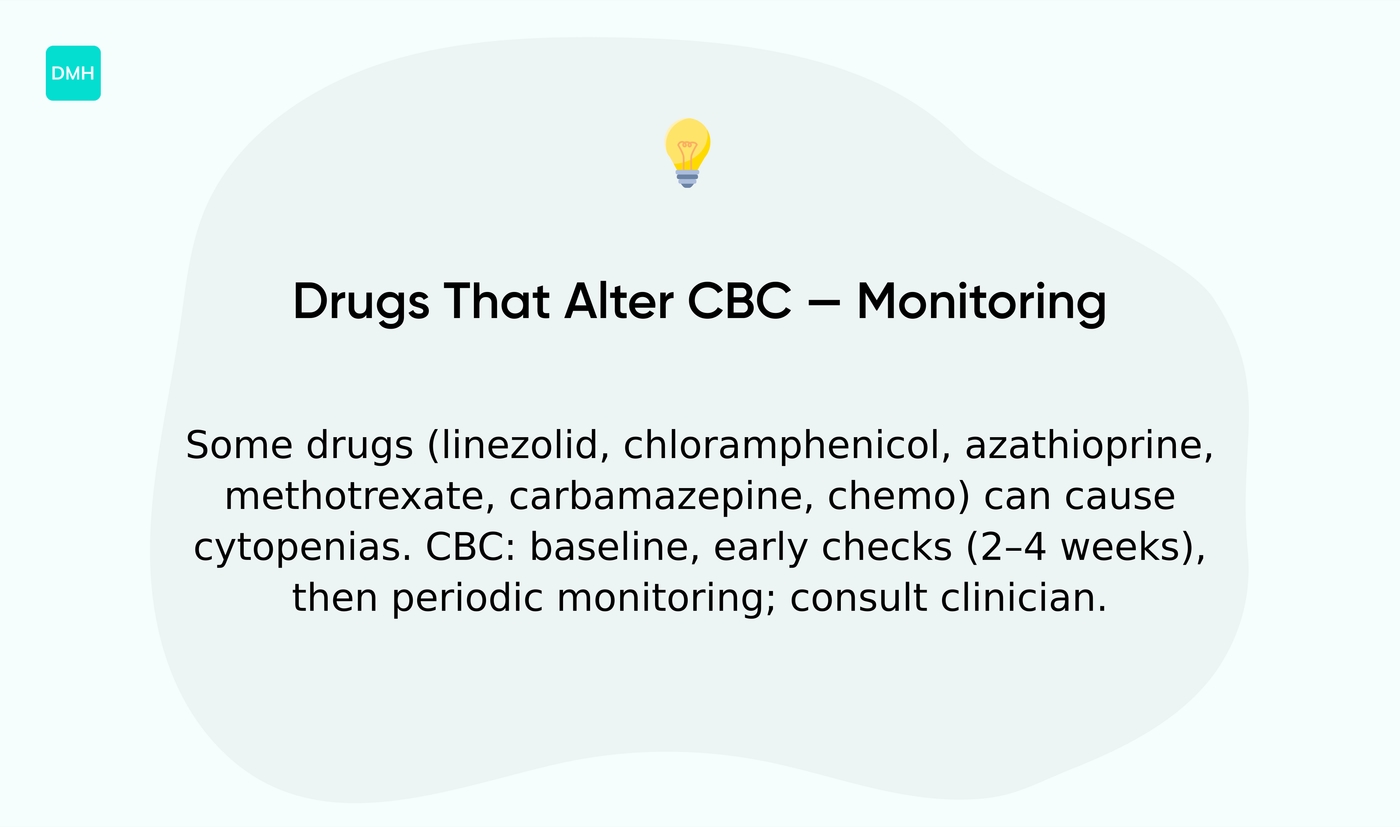
- Antibiotics — Linezolid and chloramphenicol can cause low platelets or bone marrow suppression. Clinicians often check CBC at baseline and weekly for prolonged courses beyond 2 weeks. Use a repeat blood test if counts drop.
- Immunosuppressants — Azathioprine, methotrexate and mycophenolate may lower white cells or platelets. Common monitoring schedules include baseline, every 2–4 weeks for the first 3 months, then every 1–3 months for stable doses.
- Anticonvulsants — Carbamazepine and valproate can cause neutropenia or thrombocytopenia. Typical follow-up includes a baseline CBC, checks at 2–4 weeks after start, then periodic monitoring every 3–6 months as clinically indicated.
- Chemotherapy agents — Many cytotoxic drugs cause predictable nadirs in 7–14 days. Standard practice uses a CBC before each cycle and weekly or twice-weekly counts during expected nadir. Serial CBCs guide dose timing and supportive care.
Medication-related changes vary by drug, dose and individual factors. WBC count recheck, platelet count recheck or hemoglobin recheck schedules may differ for neutropenia repeat CBC or thrombocytopenia repeat CBC.
Discuss monitoring CBC options with your clinician if you need post-treatment CBC or repeated full blood count checks. Not a medical advice, content for educational purposes, consult a professional. Always consult a qualified healthcare professional for medical advice specific to your situation.
Read also: Low Red Blood Cell Count: Causes, Symptoms And Treatment
What if my repeat CBC is still abnormal?
A persistent abnormal repeat CBC means more evaluation may be needed. We explain common next steps and when specialist input may be appropriate.
Look for trends across tests. Stable mild changes often remain stable on serial CBCs—no need to panic over every small fluctuation. Worsening values or new symptoms may indicate progression.
Here’s what typically happens next:
- Repeat CBC timing: Repeat testing over weeks can confirm persistence. Serial CBCs every 1–4 weeks may be used depending on the abnormality.
- Additional diagnostic tests: Providers may order a peripheral smear, reticulocyte count, iron studies, vitamin B12, folate, LDH, bilirubin, haptoglobin, direct antiglobulin test, or viral serologies.
- Hematology referral criteria: Consider referral when counts fall to concerning ranges or remain unexplained after basic testing. Examples include ANC below 500/µL, platelets below 50,000/µL, or hemoglobin drop of 2 g/dL or more.
Bone marrow biopsy may be discussed when blood counts stay abnormal despite testing, or when blood film suggests marrow disease. Decisions depend on symptoms, trend size, and likely causes.
Keep a record of CBC values and symptoms—a simple spreadsheet works wonders. Share trends with your clinician during follow-up visits.
Use resources for help interpreting results, for example how to read blood test results. Not a medical advice, content for educational purposes, consult a professional. Always consult a qualified healthcare professional for medical advice specific to your situation.
You’ll also like: High White Blood Cell Count: Causes, Symptoms and more
Educational notice: This content is provided for informational and educational purposes only and is not intended as medical advice. Always consult a qualified healthcare professional for medical concerns.