That uneasy feeling after a routine blood draw often comes from not understanding the results.
A CBC with differential goes beyond a basic CBC by measuring total blood components and the specific types of white blood cells.
Patients and clinicians can miss signs of infection, anemia, or clotting problems if they only look at totals instead of the differential.
This guide explains how the complete blood count with differential breaks down red cells, platelets, and the five white cell types to give clearer clinical clues.
You’ll learn what each value—like absolute neutrophil count, hemoglobin, and platelet count—means, when abnormalities matter, and when to seek follow-up.
By the end, you’ll be able to read a CBC with differential report with more confidence and ask informed questions to your provider.
What is a CBC with differential
A complete blood count with differential measures blood cell numbers. The abbreviation CBC with differential appears on lab reports.
The test reports total white blood cell count. It gives a breakdown of neutrophils, lymphocytes, monocytes, eosinophils, and basophils. It also reports red cell count, hemoglobin, hematocrit, platelet count, and RBC indices.
The differential lists percentages and absolute counts for each white cell type. Clinicians may use the absolute neutrophil count (ANC) to estimate infection risk.
An automated machine can produce a CBC with auto differential in minutes. A manual differential blood test may follow if the automated result looks abnormal. Absolute counts add clarity beyond percentage values on a WBC differential.
The test helps evaluate anemia, infection, inflammation, bleeding risk, and blood disorders. A clinician may order a CBC differential for unexplained fatigue, fever, bruising, or persistent symptoms.
Results can vary by age, sex, and lab method. Typical WBC ranges fall near 4,000–11,000 cells per microliter. Hemoglobin and hematocrit ranges depend on sex and age.
Reports may show neutrophil count, lymphocyte count, monocyte count, eosinophil count, and basophil count. Not medical advice, content for educational purposes, consult a professional.
What does a CBC with differential test for
White blood cell differential breakdown
A CBC with differential measures five types of white blood cells. Labs report percentages and absolute counts to assess immune function.
| Cell Type | Normal Percentage | Normal Absolute Count | Primary Function |
|---|---|---|---|
| Neutrophils | 40–60% | 1.5–8.0 ×10⁹/L | Fight bacteria |
| Lymphocytes | 20–40% | 1.0–4.8 ×10⁹/L | Support adaptive immunity |
| Monocytes | 2–8% | 0.2–0.8 ×10⁹/L | Clear debris, aid tissue repair |
| Eosinophils | 1–4% | 0.0–0.5 ×10⁹/L | Respond to allergies, parasites |
| Basophils | 0.5–1% | 0.0–0.2 ×10⁹/L | Release histamine in allergic responses |
Neutrophils make up 40–60% of WBCs and fight bacteria. The absolute neutrophil count often reads 1.5–8.0 ×10⁹/L.
Lymphocytes account for 20–40% of WBCs. They support adaptive immunity and rise with many viral infections and some blood cancers.
Monocytes represent 2–8% of WBCs. They clear debris and aid tissue repair. Higher counts may link to chronic inflammation.
Eosinophils typically range from 1–4% of WBCs. They increase with allergic reactions and parasitic infections.
Basophils sit at 0.5–1% of WBCs. They release histamine during allergic responses and signal certain inflammatory states. Elevated totals may prompt follow-up for a high white blood cell count.
Not medical advice, content for educational purposes. Always consult a qualified healthcare professional for medical advice specific to your situation.
Red blood cell measurements
Hemoglobin and hematocrit assess blood’s oxygen-carrying capacity. A hemoglobin level shows grams per deciliter.
Normal male range is about 13.8–17.2 g/dL. Normal female range is about 12.1–15.1 g/dL. A hematocrit percentage result shows packed red cell volume.
Typical male range is 40.7–50.3%. Typical female range is 36.1–44.3%. RBC count measures red cells per microliter. Normal ranges run near 4.7–6.1 million/µL for males and 4.2–5.4 million/µL for females.
RBC indices help classify anemia. Mean corpuscular volume (MCV) normal is 80–100 fL. Mean corpuscular hemoglobin (MCH) normal is 27–33 pg. Mean corpuscular hemoglobin concentration (MCHC) normal is 33–36 g/dL.
An RBC indices pattern can indicate microcytic, macrocytic, or normocytic anemia. A CBC with differential lists these values alongside white cell data. If results fall outside ranges, consult a clinician for interpretation.
Not medical advice. Content for educational purposes. Always consult a qualified healthcare professional for medical advice specific to your situation.
Platelet count assessment
Platelets are tiny blood cells that stop bleeding. A platelet count appears on a complete blood count with differential.
Normal platelet counts range from 150,000 to 450,000 per microliter. Labs may report mean platelet volume (MPV) to estimate platelet size and production.
Counts above 450,000 per microliter suggest thrombocytosis. This may be associated with inflammation, infection, iron deficiency, or myeloproliferative disorders.
Counts below 150,000 per microliter suggest thrombocytopenia. Low counts can increase bleeding risk. Causes may include autoimmune conditions, bone marrow problems, certain medications, and severe infections.
Abnormal results often prompt repeat testing or further evaluation. Discuss findings with a qualified clinician for interpretation and next steps. Not medical advice. Content for educational purposes only. Always consult a qualified healthcare professional for medical advice specific to your situation.
Why would a doctor order a CBC with differential
A doctor orders a CBC with differential to get a broad view of blood health. The test measures red cells, white cells, and platelets. It breaks down white cells into types for a detailed immune snapshot.
Common reasons include checking for infection. A white blood cell count above 11,000/µL often signals an acute infection. Low white counts may signal immune suppression.
Doctors investigate fatigue and shortness of breath with hemoglobin levels and hematocrit levels. Typical hemoglobin ranges run about 13.8–17.2 g/dL for men and 12.1–15.1 g/dL for women. Abnormal values can indicate anemia.
Bleeding or bruising prompts a look at platelet count. Normal platelets range from 150,000 to 450,000 per µL. Low counts raise bleeding concerns. High counts can be linked to clotting risk.
Chronic condition monitoring drives repeat tests. People on chemotherapy or certain medications may need frequent checks. Autoimmune disorders and chronic infections often show shifts in neutrophil count and lymphocyte count.
Preoperative exams and routine physicals may include a CBC differential. Screening for blood disorders like leukemia uses patterns in neutrophil, monocyte, eosinophil, and basophil counts.
Understanding absolute values helps. An ANC blood test under 1,500/µL may increase infection risk. RBC indices such as MCV and MCH help classify anemia types.
If results appear abnormal, follow-up testing or specialist consultation may be advised. Not medical advice, content for educational purposes, consult a professional.
Understanding white blood cell types and counts
Neutrophils and absolute neutrophil count
Neutrophils are white blood cells that fight infection. They commonly make up 50–70% of circulating white cells.
Absolute neutrophil count (ANC) calculates the number of neutrophils in a blood sample. Formula: ANC = WBC × (percent neutrophils + percent bands) / 100.
Normal ANC commonly ranges 1.5–8.0 ×10⁹/L (1500–8000 cells/µL). Labs report percent and absolute values on a CBC with differential.
A high neutrophil count may be associated with bacterial infection, inflammation, physical stress, or certain medications. A low neutrophil count may be associated with bone marrow issues or chemotherapy.
Some viral infections may lower counts and increase infection risk. Severe neutropenia (
Clinicians track ANC trends and symptoms to assess immune status. Not medical advice, content for educational purposes, consult a professional.
Lymphocytes and immune function
Lymphocytes drive the adaptive immune response. They recognize specific pathogens and build memory.
Normal lymphocyte values range from 20% to 40% of white blood cells. The absolute lymphocyte count commonly sits between 1.0 and 4.8 ×10⁹/L (1000–4800 cells/µL).
High lymphocyte counts may be associated with viral infections, immune disorders, or certain blood cancers. Examples include infectious mononucleosis and chronic lymphocytic leukemia.
A CBC with differential helps clarify patterns. A repeat test or targeted tests can help determine cause. Learn more about lymphocytes for additional details.
If you notice persistent lymphocytosis, consult a healthcare professional. Not medical advice. Content for educational purposes.
Monocytes and tissue repair
Monocytes patrol the blood. They enter tissues and become macrophages or dendritic cells.
They clear microbes and debris. They secrete signals that drive healing. On a CBC with differential, monocyte levels help show immune activity and recovery.
Normal range: 2–8% of white blood cells. Absolute range: 0.2–0.8 ×10⁹/L (200–800 cells/µL).
Elevated counts (high monocyte count) may be associated with chronic infections like tuberculosis, long-standing inflammation such as autoimmune disease, recovery from acute infection, or certain blood disorders.
Reduced counts (low monocyte count) can occur with bone marrow suppression, high-dose steroids, chemotherapy, or severe infections that temporarily deplete white cells.
Monocytes play a clear tissue repair role by remodeling damaged tissue and coordinating other immune cells. Measurements may vary from person to person and with lab methods. More details on ranges and causes are available at monocytes.
Not medical advice, content for educational purposes. Consult a qualified healthcare professional for medical advice specific to your situation.
Eosinophils and allergic responses
Eosinophils are a type of white blood cell measured on a CBC with differential. They fight parasites and take part in allergic inflammation.
Normal absolute eosinophil counts range from about 0.0 to 0.5 ×10⁹/L. Lab reports may show percent values near 1–4% of total WBCs.
Elevated counts may be associated with allergic conditions such as asthma, allergic rhinitis, and atopic dermatitis. High values may reflect parasitic infections, drug reactions, autoimmune disease, or certain blood disorders.
Common clinical thresholds use 0.5–1.5 ×10⁹/L for mild eosinophilia, 1.5–5.0 for moderate, and above 5.0 for severe. For instance, 0.7 ×10⁹/L equals 700 cells/µL and may indicate allergic inflammation.
Marked eosinophilia in suspected helminth exposure often points to parasitic infections. Modest rises often point to allergic reactions.
Elevated counts usually prompt further evaluation by a clinician. Learn more about eosinophil counts. Not medical advice, content for educational purposes, consult a professional.
Basophils and inflammatory markers
Basophils are rare white blood cells that release histamine and cytokines during allergic reactions and inflammation. A CBC with differential reports basophil percentage and absolute basophil count.
Normal basophil percentage is about 0–1% of total WBCs. Absolute basophil count typically measures under 200 cells/µL (under 0.2 ×10⁹/L).
High basophil values, called basophilia, may be associated with allergic responses, myeloproliferative disorders such as chronic myelogenous leukemia, and certain inflammatory states. Learn more about basophil function and ranges.
Low basophil counts, or basopenia, may appear during acute infections, stress responses, or after corticosteroid use. Interpretation depends on other CBC values such as neutrophil count and eosinophil count and on clinical context.
Patterns in basophil count changes may guide further testing while a complete blood count gives the full picture. If you have abnormal results, consult a healthcare professional.
Not medical advice. Content for educational purposes. Consult a qualified healthcare professional for personal medical advice.
How to read CBC with differential results
This section explains how to interpret a CBC with differential. Labs report totals and specific white blood cell types.
Labs list percentages and absolute counts. Converting a percentage into an absolute count clarifies clinical meaning. Remember the absolute versus percentage view when reading results.
Common reference ranges help orient readings:
- WBC: 4.0–11.0 ×10⁹/L
- ANC: 1.5–8.0 ×10⁹/L
- Hemoglobin: ~13.8–17.2 g/dL for males and ~12.1–15.1 g/dL for females
- Platelets: 150–450 ×10⁹/L
What patterns should you watch for? High WBC with high neutrophils may be associated with bacterial infection. Low ANC below 1.0 ×10⁹/L raises infection risk concerns.
Low hemoglobin with low MCV often indicates iron-deficiency type anemia. Low platelets under 50 ×10⁹/L may be linked to bleeding risk.
Flag results that show large deviations from normal ranges. Mark values that meet clinically significant abnormalities for follow-up. Labs may auto-flag abnormal differentials or prompt a manual review.
Consider repeat testing or specialist review when trends persist or symptoms appear. Read about typical values at CBC with differential values and meanings.
A lab report on ordering practices may help explain why some tests change over time. Follow-up testing timelines vary by result and clinical context. Not medical advice, content for educational purposes, consult a professional.
CBC with differential normal ranges
This section lists common reference ranges for adults and notes age and gender variation. Ranges may be associated with lab method and population differences.
WBC count: 4.0–11.0 ×10⁹/L. Newborns often show 9–30 ×10⁹/L. RBC count: males 4.5–5.9 million/µL, females 4.1–5.1 million/µL.
Hemoglobin levels: males 13.8–17.2 g/dL, females 12.1–15.1 g/dL. Hematocrit levels: males 40.7–50.3%, females 36.1–44.3%.
Platelet count: 150–450 ×10⁹/L. Counts below 150 may suggest bleeding risk. Counts above 450 may be associated with clotting risk.
RBC indices: MCV 80–100 fL, MCH 27–33 pg, MCHC 32–36 g/dL. White blood cell differential percentages and common absolute ranges:
- Neutrophils: 40–60% (ANC 1.8–7.7 ×10⁹/L)
- Lymphocytes: 20–40% (1.0–3.4 ×10⁹/L)
- Monocytes: 2–8% (0.2–0.8 ×10⁹/L)
- Eosinophils: 1–4% (0.0–0.5 ×10⁹/L)
- Basophils: 0.5–1% (0.0–0.2 ×10⁹/L)
ANC calculation example: ANC = WBC × neutrophil fraction. A 6.0 ×10⁹/L WBC with 60% neutrophils gives ANC 3.6 ×10⁹/L.
Children and newborns show higher WBC and different hemoglobin norms. Labs often flag age-specific panels for clarity. Not medical advice. Content for educational purposes. Always consult a qualified healthcare professional for medical advice specific to your situation.
Difference between CBC with diff and without
A complete blood count reports totals for white blood cells, red blood cells, hemoglobin, hematocrit, and platelets. A standard CBC gives a single WBC number. It doesn’t identify cell types.
A CBC with differential separates that WBC total into neutrophils, lymphocytes, monocytes, eosinophils, and basophils. Labs report percentages and absolute counts, such as the absolute neutrophil count (ANC).
Those values help distinguish bacterial patterns from viral or allergic responses. Order a differential for suspected infection, abnormal WBC on screening, monitoring chemotherapy, or evaluating blood disorders.
Order a basic CBC for routine screening or focused checks of hemoglobin and platelet count. Costs vary by lab and insurance.
Typical out-of-pocket fees for a CBC range from $10–80. Adding a differential may add about $10–40. Automated differentials return quickly. Manual differentials require a technologist review and add time and cost.
Use the differential when cell-type detail changes clinical interpretation or management. Reserve the basic CBC for straightforward questions. Not medical advice, content for educational purposes, consult a professional.
You’ll also like: What Is A Dangerous White Blood Cell Count
Auto differential vs manual differential
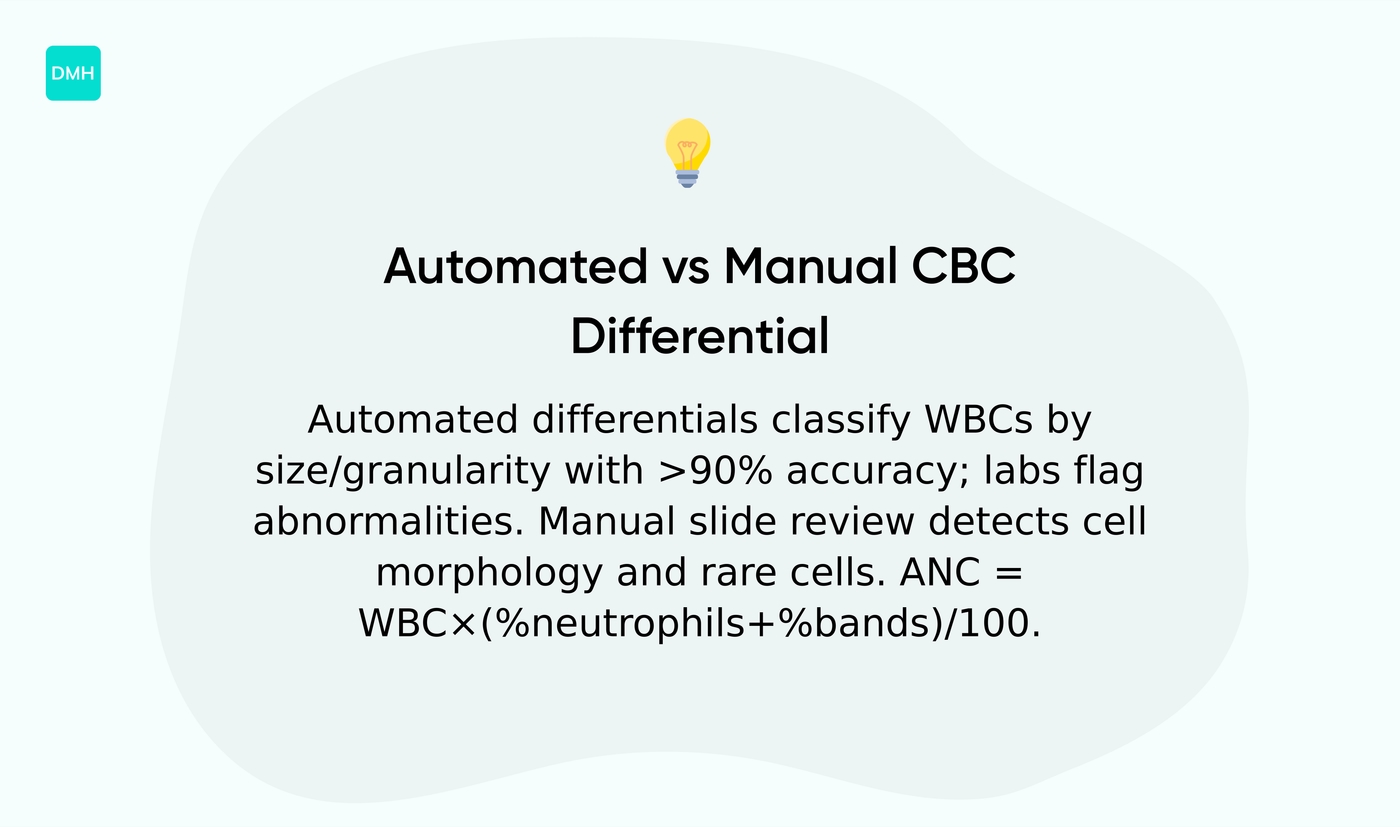
A CBC with differential may use an automated analyzer or a manual slide review. Automated analyzers classify cells by size, granularity, and staining patterns for the WBC differential.
Auto differential accuracy often exceeds 90% for routine samples. Many labs report over 95% agreement for neutrophils, lymphocytes, and monocytes.
Laboratories flag samples with abnormal results, unexpected blasts, or platelet clumps. Manual slide review identifies cell morphology and rare abnormal cells that analyzers can miss.
Labs report both percentages and absolute counts on results. Absolute neutrophil count uses this formula: ANC = WBC × (%neutrophils + %bands)/100.
Here’s an example: WBC 8 ×10³/µL with 60% neutrophils yields ANC 4.8 ×10³/µL. Absolute counts reduce misinterpretation when total WBC changes dramatically.
Clinicians request manual review when cell morphology affects management decisions. Use automated differentials for high throughput and consistent routine reporting.
Order manual review for abnormal flags, unexpected differentials, or suspected blood dyscrasias. Not medical advice. Content for educational purposes. Always consult a qualified healthcare professional for medical advice specific to your situation.
Read also: How Soon Should You Repeat a CBC After Abnormal Results?
Test preparation and what to expect
A CBC with differential rarely requires fasting. Most labs accept samples without dietary restrictions. Some clinicians may request an 8-hour fast if other tests run together.
The blood draw process uses a standard venipuncture. A phlebotomist applies a tourniquet, cleans skin, and inserts a small needle. Typical needle size is 21–23 gauge. One tube of 2–6 mL usually suffices for a full CBC and differential.
Automated analyzers measure cell counts and indices quickly. A manual differential blood test may be added for unusual results. Manual review can add 24–48 hours to reporting time.
Common risks include mild bruising, brief soreness, and fainting in some people. Rare risks include infection at the site and larger hematoma formation.
Turnaround time varies by setting. Routine outpatient labs often return results within 24 hours. Hospital STAT requests may return in 1–2 hours.
Typical costs vary by location and insurance. Out-of-pocket ranges often run $20–$100 in the United States. Insurance coverage, lab network, and whether an auto differential is included affect final price.
Results include WBC differential, absolute neutrophil count, neutrophil count, lymphocyte count, monocyte count, eosinophil count, basophil count, platelet count, hemoglobin levels, hematocrit levels, and RBC indices. Discuss abnormal values with a healthcare professional for interpretation.
Not medical advice, content for educational purposes, consult a professional.
You’ll also like: How to Read Blood Test Results: A Simple Guide
What abnormal CBC results may indicate
A CBC with differential measures cell counts and types to flag common health issues. The test shows changes that may be associated with infection, anemia, clotting problems, or immune disorders.
- High white blood cell count: A WBC above about 11 ×10⁹/L may indicate bacterial infection or inflammation. A high neutrophil count or high absolute neutrophil count (ANC) often points to bacterial causes.
- Low white blood cell count: A WBC below about 4 ×10⁹/L may be linked to certain medications, viral infections, or bone marrow problems. Learn more about low white blood cell count.
- Anemia patterns: Low hemoglobin and hematocrit suggest anemia. Hemoglobin under ~13 g/dL for men or under ~12 g/dL for women can signal iron deficiency, chronic disease, or blood loss. Mean corpuscular volume (MCV) helps classify microcytic versus macrocytic anemia.
- Platelet changes: Platelet count under ~150 ×10⁹/L may raise bleeding concerns. Counts above ~450 ×10⁹/L may be associated with inflammation or reactive states.
- White cell type shifts: High lymphocyte, monocyte, eosinophil, or basophil counts can reflect viral infection, chronic inflammation, allergies, or parasitic exposure. Single abnormal values may be temporary after illness.
Persistent or severe deviations often require repeat testing and targeted studies. A clinician may order iron studies, reticulocyte count, or bone marrow tests to clarify causes.
Not medical advice, content for educational purposes, consult a professional. Always consult a qualified healthcare professional for medical advice specific to your situation.
Read also: Leukocytosis: definition, causes, symptoms and treatments
Educational notice: This content is provided for informational and educational purposes only and is not intended as medical advice. Always consult a qualified healthcare professional for medical concerns.