Choosing between ESR and CRP tests can feel confusing when a doctor orders “inflammatory markers.”
Patients and clinicians often struggle to interpret why one test is high while the other looks normal.
This guide explains what ESR and CRP measure, when each is preferred, and how to read discordant results so findings actually help clinical decisions.
You’ll learn the difference between response time, sensitivity and specificity, typical normal ranges, and common causes for high ESR with normal CRP (and vice versa).
By the end you’ll be able to discuss with your provider which test suits suspected infection, autoimmune disease, pregnancy, or chronic inflammation.
Daily Medical Health breaks down the evidence so decisions are clearer, not more stressful.
What is the difference between ESR and CRP?
ESR and CRP are blood tests that detect inflammation but measure different biological processes.
Erythrocyte sedimentation rate (ESR) records how far red blood cells fall in a vertical tube over one hour. A faster fall often reflects higher plasma proteins that make cells stick together.
Labs report ESR in mm/hour. Values can change with age, sex, anemia, and pregnancy.
C-reactive protein (CRP) measures a specific protein made by the liver during inflammation. Tests use immunoassays and report CRP in mg/L.
CRP levels may rise within about six hours and peak near 48 hours. CRP often returns to baseline faster after an inflammatory trigger ends.
Acute phase protein differences explain clinical use. ESR gives an indirect, slower signal that may reflect chronic or systemic changes.
CRP gives a direct, faster signal that often tracks acute inflammation and infection more closely. High-sensitivity CRP (hs-CRP) detects low-level inflammation for cardiovascular risk assessment.
For a clear listing of related lab tests and how to read them, see blood test markers.
Not medical advice; content for educational purposes only — consult a qualified professional.
ESR vs CRP: which is better for detecting inflammation?
Well, here’s the thing: CRP generally matters more for most current clinical questions. It rises faster, falls faster, and is a more sensitive marker of acute inflammation.
ESR is still useful in selected situations, especially when clinicians want a slower-moving marker that can reflect more sustained inflammatory activity.
| Feature | CRP | ESR |
|---|---|---|
| Response time | Rises within 6–8 hours | Rises within 24–48 hours |
| Peak time | ~48 hours | Days to weeks |
| Return to normal | 3–7 days after trigger resolves | 2–3 weeks or more |
| Specificity | Higher for acute inflammation | Lower; affected by age, sex, anemia |
| Best use | Acute infection, rapid monitoring | Chronic inflammation, autoimmune trends |
CRP is usually the preferred first test for suspected inflammatory or infectious disease, according to British Columbia guidelines. It’s also described in the medical literature as a better indicator of acute-phase inflammation than ESR because it responds more quickly to changes in the clinical situation.
ESR is an indirect marker and is more influenced by non-inflammatory factors such as age, sex, anemia, pregnancy, and some medications. That makes ESR less specific and more likely to be falsely elevated than CRP.
But does either test tell you where the inflammation is or what’s causing it? Nope. A high value means inflammation may be present, but diagnosis depends on symptoms, exam, and other tests.
Which rises and falls faster: ESR or CRP?
CRP rises and falls faster than ESR, so CRP often tracks acute changes more closely.
CRP rises quickly. Levels can climb within 6–8 hours after inflammation starts and often peak near 48 hours.
CRP has a short half-life and can fall toward normal within 3–7 days after the trigger resolves. Some studies report rapid drops once inflammation stops.
ESR lags longer. ESR may take 24–48 hours to rise and can remain elevated for weeks.
Values can stay high for 2–3 weeks or more after inflammation ends, depending on age, anemia, or pregnancy.
CRP measures an acute-phase protein produced by the liver. ESR reflects red blood cell settling influenced by fibrinogen and other proteins.
That difference explains the varied response times and why a high CRP with normal ESR can indicate very recent inflammation.
Not medical advice; content for educational purposes only — consult a qualified professional.
ESR vs CRP sensitivity and specificity
CRP tends to be more specific for acute inflammation while ESR can rise for non-inflammatory reasons.
C-reactive protein is an acute phase protein measured in mg/L. It rises within hours of injury or infection and often falls quickly after resolution.
CRP values above 100 mg/L may be associated with serious bacterial infection.
According to available research, CRP often shows higher sensitivity and specificity for acute bacterial infection than ESR. Sensitivity may range from about 75% to 95% depending on the cutoff used and the condition tested.
CRP specificity for acute inflammation generally exceeds ESR in emergency settings.
Erythrocyte sedimentation rate reflects red blood cell aggregation. ESR depends on plasma proteins and red cell properties.
The usual upper limit is estimated as age/2 for men and (age+10)/2 for women. ESR rises with anemia, pregnancy, female sex, and older age, which can lower its specificity.
Acute phase reactant measures differ in timing and causes, so clinicians may order both tests for a fuller picture of inflammation.
Not medical advice; content for educational purposes only — consult a qualified professional.
Is ESR or CRP more accurate for infection?
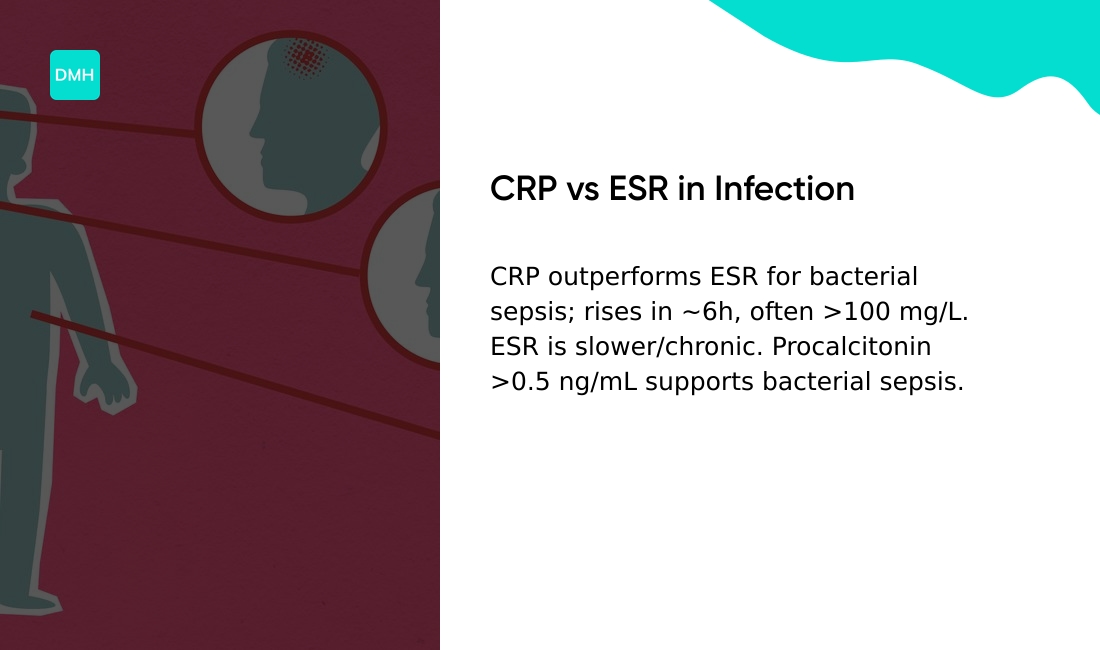
CRP often outperforms ESR for detecting bacterial infection and sepsis.
ESR may better reflect chronic or noninfectious inflammation.
CRP is an acute-phase protein measured directly in blood. A C-reactive protein test can rise within 6 hours and may exceed 100 mg/L in severe bacterial infections.
ESR measures how fast red blood cells settle, a process affected by fibrinogen, anemia, age, and pregnancy. The erythrocyte sedimentation rate rises slowly and can remain high for days to weeks after inflammation resolves.
CRP shows higher specificity and faster response for acute bacterial infections, so it may better track treatment response. Procalcitonin may add value in suspected sepsis; levels above 0.5 ng/mL may be associated with bacterial sepsis and can help guide in-hospital antibiotic decisions.
For related signs and lab findings, review infections that cause high white blood cell count.
Not medical advice; content for educational purposes only — consult a qualified professional.
ESR vs CRP in autoimmune disease and rheumatoid arthritis
ESR and CRP both mark inflammation but they behave differently in chronic autoimmune disease and rheumatoid arthritis.
ESR vs CRP shows CRP is an acute-phase protein made by the liver and can rise within about 6 hours after inflammation begins and fall within 48 to 72 hours.
ESR measures how fast red blood cells settle, reflects plasma proteins like fibrinogen, and changes more slowly.
Rheumatoid arthritis monitoring often uses CRP to track flares and short-term treatment response. ESR can reflect longer-term inflammation and may stay high despite improving symptoms.
Lupus disease activity may show low CRP despite active disease, while ESR may rise with systemic activity or chronic inflammation. The literature notes that ESR may be superior in monitoring disease activity in systemic lupus erythematosus.
If you have persistent joint pain, review common joint pain causes and seek evaluation.
Some studies suggest CRP better detects acute infection and rapid change, while ESR can be superior for tracking chronic or smoldering autoimmune activity and low-grade bone and joint infections.
Not medical advice; content for educational purposes only — consult a qualified professional.
When should you order ESR vs CRP?
Use CRP for rapid changes and ESR for long-standing inflammation.
CRP (C-reactive protein) is a liver protein that rises within 4–6 hours and often peaks by 48 hours. It may normalize within days once inflammation resolves.
ESR (erythrocyte sedimentation rate) measures how quickly red cells settle. ESR rises more slowly and can remain high for weeks.
- Acute inflammation marker: Order CRP for suspected bacterial infection, sepsis, or new febrile illness. CRP gives faster feedback on severity and short-term response to therapy.
- Sustained inflammation marker: Order ESR when you suspect chronic autoimmune disease, systemic inflammation, or when trends over weeks matter. ESR may reflect cumulative changes.
- Monitoring treatment response: Use CRP to track quick rises or falls after treatment starts. Use ESR to follow long-term disease activity in arthritis or lupus.
- Cardiovascular risk: hs-CRP is the more informative marker and is established as a cardiovascular risk predictor in longitudinal research. ESR is not the preferred routine wellness marker for most healthy adults.
Combine tests when results conflict or when both acute and chronic signals matter. Expect CRP values often reported in mg/L (normal
Expect ESR in mm/hr with ranges that vary by age and sex.
Interpret results with clinical context. Pregnancy, anemia, and age can raise ESR without active inflammation.
Procalcitonin may add value when assessing severe bacterial infection.
Not medical advice; content for educational purposes only — consult a qualified professional.
ESR and CRP normal range
This section provides standard reference ranges for ESR and CRP.
ESR normal range: Typical adult ESR values vary by age and sex.
- Men under 50 years: 0–15 mm/hr
- Men over 50 years: 0–20 mm/hr
- Women under 50 years: 0–20 mm/hr
- Women over 50 years: 0–30 mm/hr
ESR can rise with age, anemia, and pregnancy.
CRP normal range: Most labs report CRP in mg/L. Standard CRP often reads as
High-sensitivity CRP (hs-CRP) uses finer cutoffs:
- hs-CRP low risk:
- hs-CRP average risk: 1–3 mg/L
- hs-CRP higher risk: >3 mg/L
See the CRP test normal range for more detail.
Mild versus significant elevations help guide interpretation. Mild ESR elevation often falls between 20–40 mm/hr. Mild CRP elevation can be 10–40 mg/L.
Moderate elevations often reach ESR 40–100 mm/hr or CRP 40–100 mg/L. Marked elevations above ESR 100 mm/hr or CRP >100 mg/L may be associated with severe bacterial infection, sepsis, or malignancy.
Mild isolated ESR rises may reflect noninflammatory factors such as anemia or older age.
ESR and CRP values vary from person to person and by assay method. These numbers may aid interpretation alongside clinical findings and other tests such as procalcitonin or imaging.
Not medical advice; content for educational purposes only — consult a qualified professional.
What does high ESR with normal CRP mean?
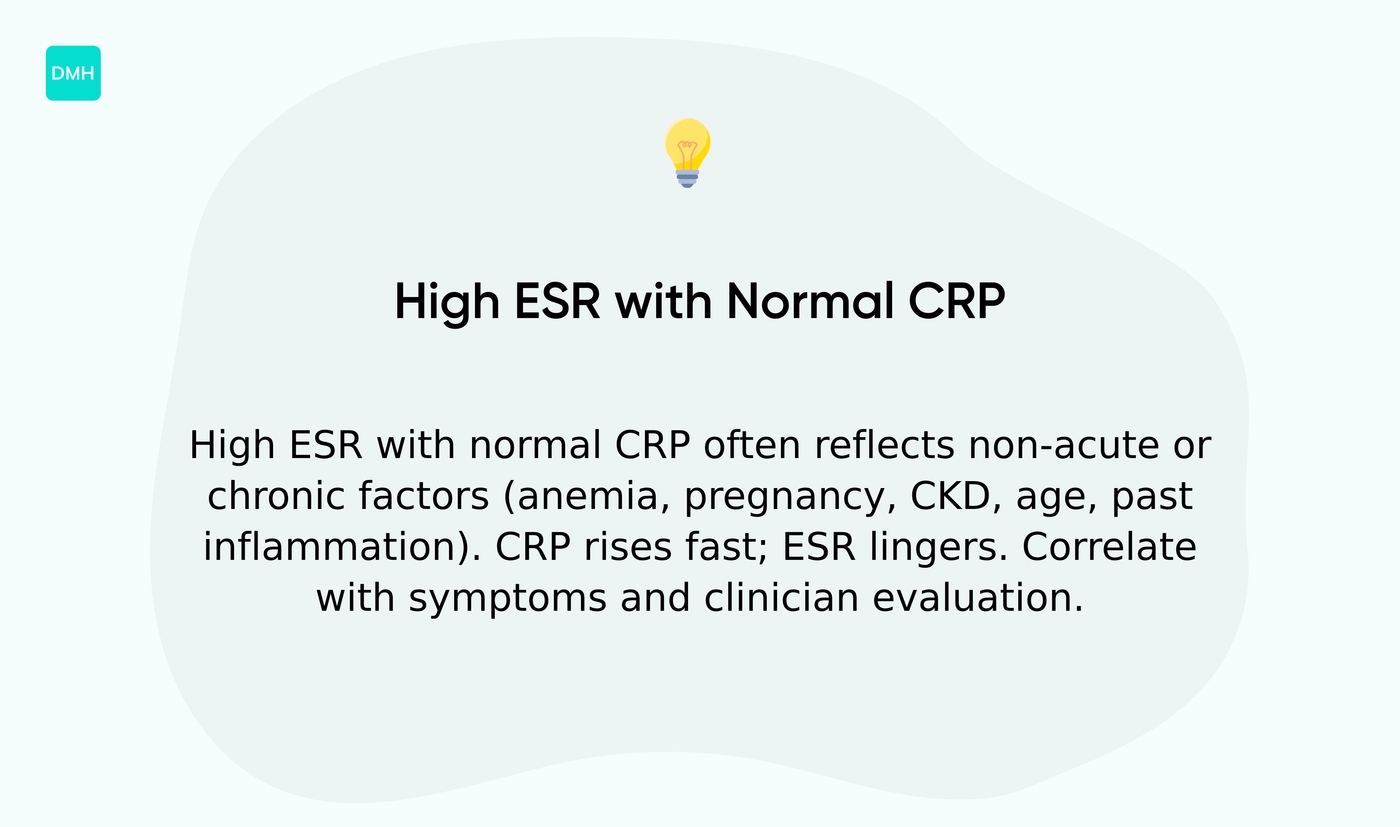
An elevated ESR with a normal CRP often points to non-acute causes.
ESR (erythrocyte sedimentation rate) measures how fast red blood cells settle in a tube. CRP (C-reactive protein) measures a liver protein that rises quickly with active inflammation.
These tests reflect different biology, which explains discordant results.
CRP rises within hours and drops rapidly after an acute insult. ESR changes slowly and can stay high for weeks.
Typical CRP normal range runs under 10 mg/L in many labs. Normal ESR values vary by age and sex, often under 20 mm/hr for younger adults.
A high ESR with a normal CRP may be associated with anemia, pregnancy, chronic kidney disease, or older age. Protein changes that increase red cell aggregation can raise ESR without a matching CRP rise.
Some chronic conditions or past inflammation may leave ESR elevated while CRP normalizes.
Clinicians interpret these results alongside symptoms, exam findings, and other tests. For example, mild isolated high ESR in an older person with no symptoms might prompt observation rather than urgent treatment.
If you have unexplained symptoms, discuss test meaning with a clinician.
Read more about specific ESR thresholds at ESR blood test levels meaning for context on ranges and causes.
Not medical advice; content for educational purposes only — consult a qualified professional.
You might also like: Leukocytosis: definition, causes, symptoms and treatments
What does high CRP with normal ESR indicate?
Acute early inflammation often explains a high CRP with a normal ESR. CRP (C-reactive protein) reacts quickly to inflammation while ESR (erythrocyte sedimentation rate) changes more slowly.
CRP can rise within 6–8 hours of tissue injury or infection and may peak by 48 hours. ESR may take 24–72 hours to increase and can stay high for days or weeks.
A high CRP with normal ESR pattern may be associated with recent bacterial infection, early viral infection, trauma, or early post-operative inflammation.
CRP responds to acute stimuli such as bacterial sepsis more reliably than ESR in many studies.
Noninflammatory factors can keep ESR low. Age, anemia, and plasma protein differences can affect ESR without changing CRP.
One example clarifies timing. A person develops fever and sore throat. CRP may rise within hours while ESR remains normal for two days.
This timing difference matters for acute diagnosis and monitoring.
Laboratory context and clinical findings matter. Use CRP and ESR together for more nuance when evaluating inflammation, infection, or autoimmune disease.
Evidence on test performance appears in clinical guidelines and peer-reviewed studies about ESR vs CRP sensitivity and response time.
Not medical advice; content for educational purposes only — consult a qualified professional.
You might also like: What Happens at Your First Hematology Appointment
Are ESR and CRP interchangeable tests?
ESR vs CRP answers often start with one clear point: they’re not interchangeable.
ESR (erythrocyte sedimentation rate) measures how fast red blood cells settle. CRP (C-reactive protein) measures a liver protein that rises with inflammation.
ESR reflects plasma changes and blood cell properties. CRP reflects acute inflammatory signaling.
CRP rises within hours after tissue injury or infection. It can halve quickly once inflammation eases.
ESR moves slowly and can stay high for weeks.
CRP often shows higher sensitivity for acute bacterial infection and sepsis. ESR may be affected by age, sex, anemia, and pregnancy.
These factors can raise ESR without active inflammation.
Ordering both tests can add value. Discordant results help narrow causes.
High ESR with normal CRP may point to chronic conditions, anemia, or older age. High CRP with normal ESR often suggests early or rapidly evolving inflammation.
Clinicians may prefer CRP to monitor rapid change or suspected infection. They may use ESR to track some autoimmune diseases over time.
Some studies suggest different roles in rheumatoid arthritis and temporal arteritis, but results vary.
Check test context and other labs when interpreting results. See the guide on how to read blood test results for practical tips.
Not medical advice; content for educational purposes only — consult a qualified professional.
You might also like: When Should You Worry About Abnormal Blood Test Results
Educational notice: This content is provided for informational and educational purposes only and is not intended as medical advice. Always consult a qualified healthcare professional for medical concerns.