An out-of-range inflammation marker on your lab report can raise more questions than it answers.
A CRP test (C-reactive protein test) often appears on results, and honestly, people wonder what it’s signaling.
This article explains how the CRP blood test measures inflammation, when levels are concerning, and why doctors order it.
You’ll learn the difference between standard CRP and hs-CRP, what normal and high CRP levels mean, and common causes of elevation.
You’ll also find practical information on how the test is performed, whether fasting is needed, typical costs, and where to get tested.
By the end, you’ll be able to discuss CRP results more confidently with your clinician and know what steps might follow.
What is a CRP test
The CRP test measures a protein that the liver makes. The protein is C-reactive protein.
Levels rise when your body has inflammation or infection. A CRP blood test detects that rise in the bloodstream.
The test works by measuring CRP concentration in serum or plasma. Values often appear as mg/L or mg/dL.
Healthy adults typically have levels below 0.9 mg/dL or 3 mg/L, with most under 0.3 mg/dL. Moderate elevation often falls between 1.0 and 10.0 mg/dL. Severe infection or sepsis may push levels above 10 mg/dL (or 100 mg/L).
Doctors use CRP to help detect acute infection, monitor inflammatory conditions, and track response to treatment. We place CRP among other blood test markers clinicians review when assessing inflammation.
High-sensitivity versions, called hs-CRP tests, can detect low-level inflammation linked to cardiovascular risk. Have you ever wondered why your doctor might order two different CRP tests?
CRP changes fast. Levels can rise within 4 to 6 hours after inflammation begins and fall as inflammation resolves. Test results require clinical context—results alone don’t identify the exact cause of inflammation.
Not medical advice, content for educational purposes, consult a professional. Always consult a qualified healthcare professional for medical advice specific to your situation.
What does a C-reactive protein test measure
The CRP blood test measures C-reactive protein, a substance the liver makes during inflammation.
Levels rise when the body mounts an immune response to injury, infection, or chronic inflammation. The test detects acute inflammation and helps track treatment response.
High readings often occur with bacterial infections and major tissue injury. For example, pneumonia or cellulitis can push CRP above 10 mg/L within hours. Moderate elevations may reflect autoimmune disease or chronic inflammatory conditions like rheumatoid arthritis.
The hs-CRP test detects low-grade inflammation linked to cardiovascular risk. Risk categories often use mg/L: below 1.0 low risk, 1.0–3.0 average risk, above 3.0 higher risk for heart disease. Standard CRP values under about 0.3 mg/dL usually indicate low baseline inflammation.
Clinicians use the test to monitor trends rather than a single value. Sharp rises support active inflammation; falling values may indicate treatment response.
Very high readings, often above 50 mg/L, commonly suggest severe bacterial infection or sepsis. The test is nonspecific and can vary with age, obesity, smoking, and other factors.
Combine CRP results with symptoms, imaging, and other labs for accurate interpretation. Not medical advice, content for educational purposes, consult a professional. Always consult a qualified healthcare professional for medical advice specific to your situation.
CRP normal range and level classifications
Normal CRP levels
The C-reactive protein test measures a liver-produced protein that rises with inflammation.
The CRP blood test often reports values in mg/dL or mg/L. Healthy adults commonly have results below 0.3 mg/dL, which equals 3 mg/L.
Labs use different assays and may set slightly different cutoffs. High-sensitivity assays detect lower values and inform cardiovascular risk assessment.
Elevated results may be associated with infection, inflammatory disease, or tissue injury. We advise discussing out-of-range values with a clinician for interpretation alongside symptoms and other tests.
Not medical advice, content for educational purposes, consult a professional. Always consult a qualified healthcare professional for medical advice specific to your situation.
High CRP levels and what they indicate
Systemic inflammation often causes moderate CRP elevations. Moderate range is 1.0–10.0 mg/dL on a CRP test.
Common causes include rheumatoid arthritis, lupus, and heart attack. Marked elevations above 10 mg/dL may indicate acute bacterial infection, major trauma, or sepsis.
Persistent moderate elevations may be associated with higher cardiovascular risk according to some studies. Note units—standard CRP is often reported in mg/dL, while hs-CRP uses mg/L for heart risk assessment.
A single high CRP blood test result can’t confirm a diagnosis. We interpret CRP alongside symptoms, imaging, and other laboratory tests to guide clinical evaluation.
If you have a high CRP test result, discuss it with a clinician for further testing and context. Not medical advice, content for educational purposes, consult a professional. Always consult a qualified healthcare professional for medical advice specific to your situation.
Low CRP levels meaning
CRP doesn’t drop below an individual baseline set by the body and lab methods.
A low reading usually means CRP sits within the CRP normal range, often below 3 mg/L on common scales. Well, it’s not possible for CRP to fall below baseline, but falling values after a high result often signal less inflammation.
A drop from 20 mg/L to 4 mg/L over days or weeks may indicate a strong treatment response or resolving infection. Trends matter more than single values.
The CRP blood test helps track inflammation over time. Labs vary, and values can differ by assay. Patient factors such as obesity, age, and chronic conditions can affect baseline levels.
We recommend clinicians interpret results with symptoms and other tests. If you monitor CRP, ask about repeat testing and expected timelines for change. Not medical advice, content for educational purposes, consult a professional. Always consult a qualified healthcare professional for medical advice specific to your situation.
hs-CRP test and how it differs from standard CRP
hs-CRP normal range for heart disease risk
The hs-CRP test measures low-level inflammation that may be associated with cardiovascular risk.
The CRP test has a more sensitive form called hs-CRP for heart disease assessment. Here’s the thing—risk categories help stratify your chances:
- Low risk below 1.0 mg/L—low statistical risk for future events
- 1.0–3.0 mg/L—average risk range reported by many guidelines
- High cardiovascular risk above 3.0 mg/L—higher probability of events in population studies (some sources use 2.0 mg/L threshold)
The hs-CRP normal range helps stratify risk alongside lipids and blood pressure. Some studies suggest higher hs-CRP levels can signal ongoing vascular inflammation, but results vary by population.
Use hs-CRP as one part of a broader assessment. Not medical advice, content for educational purposes, consult a professional. Always consult a qualified healthcare professional for medical advice specific to your situation.
When to use hs-CRP vs standard CRP test
The hs-CRP test detects low-level inflammation that may link to atherosclerosis.
The standard CRP test finds larger rises from infection or active autoimmune flares. So which one should your doctor order?
| Clinical Scenario | Test Type | Typical Range |
|---|---|---|
| Cardiovascular risk assessment | hs-CRP | <1.0 low, 1.0–3.0 average, >3.0 high (mg/L) |
| Acute bacterial infection | Standard CRP | >10 mg/L often indicates acute inflammation |
| Autoimmune flare monitoring | Standard CRP | Values vary widely by condition |
| Postoperative care | Standard CRP | Sharp changes help monitor recovery |
Order cardiovascular risk testing with hs-CRP when traditional risk factors are borderline. Use standard CRP to detect bacterial infections—levels above 10 mg/L often indicate acute bacterial inflammation.
Results can vary by lab method and clinical context. Not medical advice, content for educational purposes; always consult a qualified healthcare professional for medical advice specific to your situation.
Is a CRP test used to assess heart disease risk
The high-sensitivity C-reactive protein test measures low levels of C-reactive protein in blood. It detects inflammation that can relate to atherosclerosis.
Elevated hs CRP test values may be associated with higher chances of heart attack or stroke. Risk categories often cited are below 1.0 mg/L for low risk, 1.0–3.0 mg/L for average risk, and above 3.0 mg/L for higher risk.
The cardiovascular event risk estimate from hs-CRP adds information to cholesterol, blood pressure, and smoking status. Some studies suggest hs-CRP improves risk prediction for people with intermediate risk profiles.
CRP is a nonspecific marker. Infection, injury, or autoimmune disease can raise CRP levels.
A single high reading doesn’t confirm heart disease, and clinicians usually combine hs-CRP with other tests and imaging to guide preventive treatment decisions. Chronic arterial inflammation may show as persistently raised CRP levels and may prompt closer monitoring or lifestyle measures.
Not medical advice, content for educational purposes, consult a professional. Always consult a qualified healthcare professional for medical advice specific to your situation.
How is the CRP blood test performed
The C-reactive protein test measures a liver protein that rises with inflammation.
A simple blood draw provides the sample for lab measurement. Here’s what happens:
- A phlebotomist asks you to sit or lie down
- The technician applies a tourniquet and cleans the skin with antiseptic
- A sterile needle enters a vein, usually in the arm, to take blood
- Labs often require one tube—the volume is commonly 2 to 5 mL of blood
- The technician removes the needle and covers the site with a bandage
- The sample goes to the lab for analysis by immunoassay or high-sensitivity methods
Blood sample collection follows the same steps for standard CRP and hs-CRP test methods.
Fasting isn’t usually required for a CRP blood test, according to the Cleveland Clinic. The test may be ordered to detect inflammation or to assess cardiovascular risk when combined with other markers.
Results may return within 24 to 48 hours. Turnaround can vary by lab and test type.
Not medical advice, content for educational purposes, consult a professional. Always consult a qualified healthcare professional for medical advice specific to your situation.
CRP test cost and where to get tested
The CRP test measures C‑reactive protein in blood. It helps detect inflammation and monitor response to treatment.
Out‑of‑pocket CRP test price often ranges from $20 to $75. High‑sensitivity tests (hs‑CRP) may cost slightly more—labs set prices by region and test type.
Insurance commonly covers the CRP test when a clinician orders it for a medical reason. Coverage can vary by plan, network lab, and whether the test is part of a larger panel. You may owe a copay or deductible if your plan applies.
Testing sites include hospital laboratories, primary care offices, urgent care centers, and commercial labs such as LabCorp and Quest Diagnostics. Some community clinics use point‑of‑care devices that can deliver results on site in 10 to 30 minutes.
Most standard lab tests return results within 24 to 72 hours. Preparing for the CRP blood test usually requires no fasting. A clinician may advise specific steps for hs‑CRP if used for cardiovascular risk assessment.
Example cost scenario: cash patient pays about $30 at a national walk‑in lab; insured patient may pay only a small copay. (Prices and timing can vary by location and lab workflow, you know.)
CRP test cost can vary. CRP blood test results often arrive within a few days. CRP test results help guide follow-up.
Not medical advice, content for educational purposes, consult a professional. Always consult a qualified healthcare professional for medical advice specific to your situation.
What conditions can a CRP test detect
The C-reactive protein test measures a liver protein that rises when inflammation is present.
A high CRP level can signal acute infections. Bacterial infections such as pneumonia, cellulitis, and sepsis often push CRP above 10 mg/L. Severe infections can exceed 100 mg/L.
See more on infections that raise white blood cell count.
The CRP blood test helps monitor chronic inflammatory diseases. Rheumatoid arthritis and inflammatory bowel disease commonly show moderate CRP elevations between 10 and 50 mg/L.
Autoimmune conditions may change CRP readings in variable ways. Lupus can produce low or modest CRP rises despite active disease, so clinicians use CRP with other tests.
The hs-CRP test targets low-grade inflammation linked to cardiovascular risk. Risk categories use mg/L thresholds: below 1 low, 1–3 average, above 3 higher risk for heart disease.
CRP can help detect acute tissue injury, recent surgery inflammation, and some cancers where inflammation is present. Plus, obesity, smoking, pregnancy, and age can raise CRP without infection.
CRP provides a sensitive but non-specific signal. Doctors pair CRP test results with symptoms, imaging, and other lab markers to narrow causes. Key takeaway: elevated CRP points to inflammation and guides further testing and monitoring.
Not medical advice, content for educational purposes, consult a professional. Always consult a qualified healthcare professional for medical advice specific to your situation.
CRP vs ESR for inflammation testing
CRP measures C-reactive protein, a liver-produced protein that rises with inflammation.
ESR measures how quickly red blood cells fall in a tube and reflects plasma changes. Which test gives faster results?
CRP rises within 6 to 8 hours and often peaks by 48 hours. ESR rises more slowly and can stay elevated for days to weeks. CRP has a half-life near 18 to 19 hours.
CRP serves as an acute inflammation marker. It often shows larger, faster changes with bacterial infection and after injury.
ESR can be a chronic inflammation indicator because it reflects longer-term plasma protein shifts. Sensitivity and specificity remain limited for both tests—CRP may be more sensitive for acute infection.
ESR can rise for non-inflammatory reasons such as anemia, pregnancy, and age. According to available research, neither test pinpoints a diagnosis alone.
Clinicians may prefer CRP for rapid assessment and for treatment response monitoring. Doctors may order ESR when they suspect chronic inflammatory diseases like temporal arteritis.
For more on ESR values and interpretation, see ESR blood test levels meaning.
Typical units differ: CRP in mg/L and ESR in mm/hour. A common CRP cutoff for low inflammation is under 3 mg/L. Normal ESR varies by sex and age, roughly 0–15 mm/hr for men and 0–20 mm/hr for women.
Not medical advice, content for educational purposes, consult a professional. Always consult a qualified healthcare professional for medical advice specific to your situation.
What factors can raise CRP levels
The CRP blood test measures C-reactive protein produced by the liver.
CRP rises with inflammation and with several non-disease factors that affect baseline levels. Here’s what can bump up your numbers:
- Obesity. Body mass index above 30 often associates with higher CRP. Some studies report values commonly above 3 mg/L in obese groups compared with under 1 mg/L in lean groups.
- Pregnancy. CRP can rise modestly during pregnancy—levels vary by trimester and by individual immune response.
- Type 2 diabetes. Chronic metabolic inflammation in diabetes may raise CRP. Elevated readings can reflect metabolic stress rather than infection.
- Smoking. Current smokers tend to show higher CRP in population studies. Cessation often coincides with falling CRP over months.
- Sedentary lifestyle. Low physical activity links to raised CRP. Regular moderate exercise commonly lowers inflammatory markers.
- Age, sex, race. Baseline CRP can vary by age and sex. Some racial and ethnic groups show higher average CRP in surveys, so reference ranges may differ.
Clinicians interpret a CRP test result alongside symptoms, medical history, and other labs.
The CRP normal range and risk categories for high CRP levels can vary by lab and test type, including hs-CRP used for cardiovascular risk.
Not medical advice, content for educational purposes, consult a professional. Always consult a qualified healthcare professional for medical advice specific to your situation.
How doctors interpret CRP test results
The CRP test measures C-reactive protein made by the liver. It rises with inflammation or infection.
Doctors use the value with symptoms, exam findings, and other labs. Clinicians note the actual number and the trend over time.
A single value under 3 mg/L often sits in the normal range. Readings above 10 mg/L commonly suggest significant inflammation. Very high values, such as 100+ mg/L, may point to severe bacterial infection or major inflammation.
Interpretation depends on context. Doctors compare CRP to white blood cell count, imaging, and clinical history.
A falling value across days usually signals a treatment response. A rising value can indicate worsening inflammation or a new process.
Laboratory methods and reference ranges vary. Units may appear as mg/L or mg/dL. Different assays report different cutoffs—that variation explains why no single universal standard exists across labs.
We recommend viewing CRP levels alongside other data rather than in isolation. For guidance on decoding lab reports, see our guide on how to read blood test results for practical tips.
Not medical advice, content for educational purposes, consult a professional. Always consult a qualified healthcare professional for medical advice specific to your situation.
When should you get a CRP test
We explain common clinical reasons to order a CRP test.
The test measures C-reactive protein, a liver protein that rises with inflammation. Here are the main scenarios:
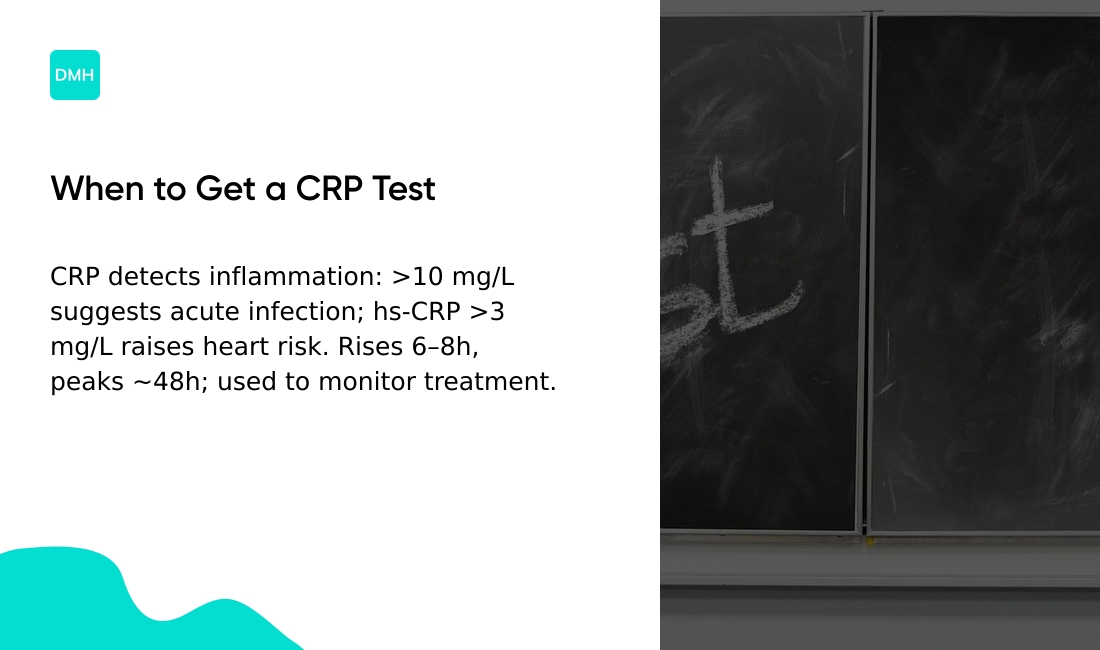
- Suspected bacterial infection: Fever with high white blood cell count or severe symptoms. A CRP above 10 mg/L often indicates significant acute inflammation or infection.
- Chronic inflammatory conditions: Rheumatoid arthritis, inflammatory bowel disease, and lupus may be monitored with serial CRP blood tests to track disease activity.
- Assessing cardiovascular risk: Use a high-sensitivity CRP (hs-CRP) when evaluating cardiovascular risk. An hs-CRP above 3 mg/L often corresponds with higher risk.
- Evaluating treatment effectiveness: Falling CRP levels often reflect a response to antibiotics or anti-inflammatory therapy. Clinicians may repeat testing after 48–72 hours for acute issues.
- Preoperative assessment or unexplained symptoms: Elevated CRP can guide further testing or imaging when symptoms lack clear cause.
CRP rises within 6–8 hours after inflammation starts and often peaks near 48 hours.
Levels can vary from person to person and by lab methods. Some studies suggest CRP trends give more information than a single value.
Not medical advice, content for educational purposes, consult a professional. Always consult a qualified healthcare professional for medical advice specific to your situation.
You’ll also like: Is It Serious To Be Referred To A Hematologist
How to lower elevated CRP levels
Elevated CRP means higher C-reactive protein in the blood.
A CRP test measures a liver-produced protein that rises with inflammation and infection. We outline practical steps that may lower CRP levels:
- Diet. Follow an anti-inflammatory pattern such as the Mediterranean diet. Some studies suggest a 15–25% CRP reduction with this approach.
- Foods to favor. Eat fatty fish, nuts, olive oil, whole grains, and vegetables. Limit processed foods and added sugars.
- Exercise. Aim for about 150 minutes of moderate aerobic activity per week. Trials report CRP drops near 10–20% with regular activity.
- Weight management. Losing 5–10% of body weight can lower CRP by roughly 20–30% in many people.
- Smoking cessation. Quitting tobacco often reduces CRP toward levels seen in non-smokers within months.
- Sleep and stress. Improve sleep duration and use stress reduction techniques to help lower systemic inflammation.
- Medical options. Prescription treatments such as statins and certain anti-inflammatory agents may lower CRP. Some studies suggest statin therapy effects include a 20–40% CRP reduction. Clinicians weigh risks and benefits when considering medication.
We note responses vary from person to person. Clinicians may repeat a CRP blood test or hs-CRP test after 6–12 weeks to assess change.
Lower CRP levels may be associated with reduced cardiovascular risk in some studies, but findings can vary. Takeaway: combine dietary change, regular activity, weight loss, and smoking cessation for measurable CRP declines.
Not medical advice, content for educational purposes, consult a professional. Always consult a qualified healthcare professional for medical advice specific to your situation.
You’ll also like: High White Blood Cell Count: Causes, Symptoms and more
Is a CRP test accurate and reliable
The CRP test measures C-reactive protein made by the liver during inflammation.
We view the test as sensitive but not specific. A raised CRP often signals inflammation from infection, injury, or chronic disease.
CRP test accuracy depends on timing, lab method, and patient factors. CRP can rise within 6 to 8 hours and peak near 48 hours after an inflammatory trigger.
Severe bacterial infections commonly produce values above 100 mg/L. Low-grade inflammation may show smaller rises measured by an hs-CRP test.
Some conditions cause false positive results. Obesity, smoking, pregnancy, and chronic metabolic disease may raise CRP without acute infection. Early infection or immune suppression may keep CRP low despite illness.
Autoimmune lupus often fails to raise CRP in active flares. Rheumatoid arthritis and bacterial infections more reliably elevate CRP.
Clinicians pair CRP with symptoms, cultures, imaging, or confirmatory diagnostic testing for a firm diagnosis. See guidance on abnormal blood tests if results seem unclear or unexpected.
Not medical advice, content for educational purposes, consult a professional. Always consult a qualified healthcare professional for medical advice specific to your situation.
Read also: Low White Blood Cell Count: Causes, Symptoms, Leukopenia
Educational notice: This content is provided for informational and educational purposes only and is not intended as medical advice. Always consult a qualified healthcare professional for medical concerns.