Facing a decision about hysterectomy can feel overwhelming and full of unknowns.
It’s hard to separate myths from facts when you’re worried about side effects, hormone changes, or long-term risks.
This guide explains hysterectomy types, surgical approaches (from vaginal to robotic), and realistic recovery expectations so decisions are clearer.
You’ll learn when different procedures are recommended, what each removes (uterus, cervix, sometimes ovaries or lymph nodes), and how recovery and follow-up typically look.
Practical tips on post-hysterectomy care, sexual health, and cost considerations are included to help you plan with your clinician.
By the end you’ll be able to discuss options confidently and ask the right questions at your appointment.
What is a hysterectomy
A hysterectomy is a surgical procedure that removes the uterus. Surgeons perform this uterus removal surgery for several medical reasons.
Common indications include heavy or abnormal uterine bleeding, large fibroids, endometriosis, pelvic organ prolapse, and gynecologic cancers such as uterine or cervical cancer. The operation ends the ability to carry a pregnancy and often changes menstrual patterns.
Different types remove different structures. A total hysterectomy removes the uterus and cervix. A partial (supracervical) hysterectomy removes the upper uterus while leaving the cervix. A radical hysterectomy may remove nearby tissue and lymph nodes for cancer care.
Surgery may involve an abdominal incision, vaginal approach, laparoscopic instruments, or robotic assistance. Recovery time and complications can vary by approach and by patient health.
Serious complications include bleeding, infection, blood clots, and injury to nearby organs. Long-term effects can include hormonal changes if ovaries are removed and altered sexual function in some people.
According to CDC data, about 600,000 hysterectomies occur each year in the United States, with rates and indications varying by age and region. For instance, a person with a large, symptomatic fibroid that causes persistent bleeding may discuss hysterectomy after other treatments fail.
Not medical advice. Content for educational purposes only. Consult a qualified healthcare professional for guidance specific to your situation.
Types of hysterectomy explained
Total hysterectomy
A total hysterectomy is a complete uterus removal surgery. It removes the entire uterus and cervix.
Surgeons often use this procedure for heavy menstrual bleeding or large fibroids. They may use it for painful endometriosis, uterine prolapse, or gynecologic cancers. This is the most common type of hysterectomy performed today.
Clinicians may recommend this approach when other treatments fail or cancer risk exists. Have you explored all your options with your doctor? If surgeons remove the cervix and no high-grade cervical disease exists, routine cervical cancer screening often stops.
If the surgery addressed cervical cancer or high-grade precancer, follow-up exams may continue. Recovery varies by surgical approach.
Hospital stay can range from same-day discharge to a few days. Long-term effects on hormones depend on whether surgeons remove the ovaries. Not medical advice, content for educational purposes, consult a professional.
Partial or supracervical hysterectomy
Partial hysterectomy removes the upper part of the uterus and leaves the cervix in place. This type of hysterectomy may be chosen for fibroids, heavy bleeding, or benign conditions that spare the cervix.
Surgeons often perform this procedure laparoscopically or with a vaginal approach. Operative time commonly ranges from 1 to 4 hours. Blood loss and recovery time can be lower than with an open abdominal procedure, but outcomes can vary from person to person.
Supracervical hysterectomy can preserve pelvic floor support and may affect sexual sensation in different ways. Some studies suggest mixed results for these benefits, and long-term data remain limited. (The evidence is still evolving, actually.)
Cervical cancer screening usually remains necessary after this surgery. Screening follows local guidelines for Pap or HPV testing. Not medical advice, content for educational purposes, consult a professional.
Radical hysterectomy
Radical hysterectomy surgery is an extensive procedure that removes the uterus, cervix, and upper vagina. Surgeons may remove surrounding tissue and nearby pelvic lymph nodes.
This operation is commonly used for cervical cancer and other advanced gynecologic cancers. Some cases include removal of ovaries and fallopian tubes. Surgery time often ranges from 2 to 4 hours.
Hospital stays can range from 1 to 3 days. Recovery can take 6 to 8 weeks and can vary from person to person.
Risks may include bleeding, infection, injury to nearby organs, and lymphedema when pelvic lymph nodes are removed. Hormone changes may follow if ovaries are taken out.
Less invasive hysterectomy types exist for benign conditions, including vaginal, laparoscopic, and robotic approaches. Choice of approach depends on diagnosis, anatomy, and treatment goals. Not medical advice. Content for educational purposes only. Consult a qualified healthcare professional for advice specific to your situation.
Surgical approaches for hysterectomy
Vaginal hysterectomy
Vaginal hysterectomy procedure removes the uterus through the vagina without an abdominal incision. It may be associated with less postoperative pain and a shorter hospital stay.
Surgeons commonly select this approach for uterine prolapse and some benign uterine conditions. Operative time can be 1 to 2 hours. Hospital stay may be same-day or 24 hours.
Hysterectomy recovery often compares favorably to open surgery. Many patients see a faster recovery time of about 3 to 4 weeks. Some studies suggest lower blood loss and quicker return to daily activities versus abdominal hysterectomy.
Risks include bleeding, infection, organ injury, and vaginal cuff issues. Outcomes can vary by anatomy and surgeon experience. Suitability can vary by health factors and prior surgeries. Not medical advice, content for educational purposes, consult a professional.
Laparoscopic hysterectomy
Laparoscopic hysterectomy uses small abdominal incisions and a tiny camera. Surgeons place instruments through three to four cuts about 0.5–1 cm each.
The surgeon views the pelvis on a monitor and removes the uterus with precise movements. The procedure may take 1 to 3 hours under general anesthesia.
Shorter recovery time is a common benefit. You may go home the same day or after one overnight stay. Your recovery may be 3 to 4 weeks compared with 4 to 6 weeks for open abdominal hysterectomy.
Reduced surgical scars often result from smaller incisions. Studies suggest lower pain and lower wound infection rates versus open surgery. Risks may include bleeding, infection, organ injury, or conversion to an open procedure. Not medical advice, content for educational purposes, consult a professional.
Robotic hysterectomy
Robotic hysterectomy uses a surgeon-controlled robotic system to remove the uterus. The system offers wristed instruments, a three-dimensional view, and tremor filtration.
Recent innovations include fluorescence imaging and single-site platforms. Well, a 2025 report from AHN West Penn Hospital says it was the first site in the country to perform a hysterectomy using a new robotic-assisted surgery system as part of an investigative clinical trial.
Some studies suggest these changes may improve precision. They may reduce blood loss by about 30% compared with open surgery. Operative time often runs longer than with laparoscopic hysterectomy.
Hospital stay and pain may be lower after minimally invasive approaches. Comparative data on robotic hysterectomy outcomes show similar major complication rates to laparoscopy. Conversion to open surgery may occur in under 5% of cases.
Choice of approach can vary with surgeon experience, uterus size, and other health factors. Not medical advice; content for educational purposes. Consult a qualified healthcare professional for individualized medical guidance.
Abdominal hysterectomy
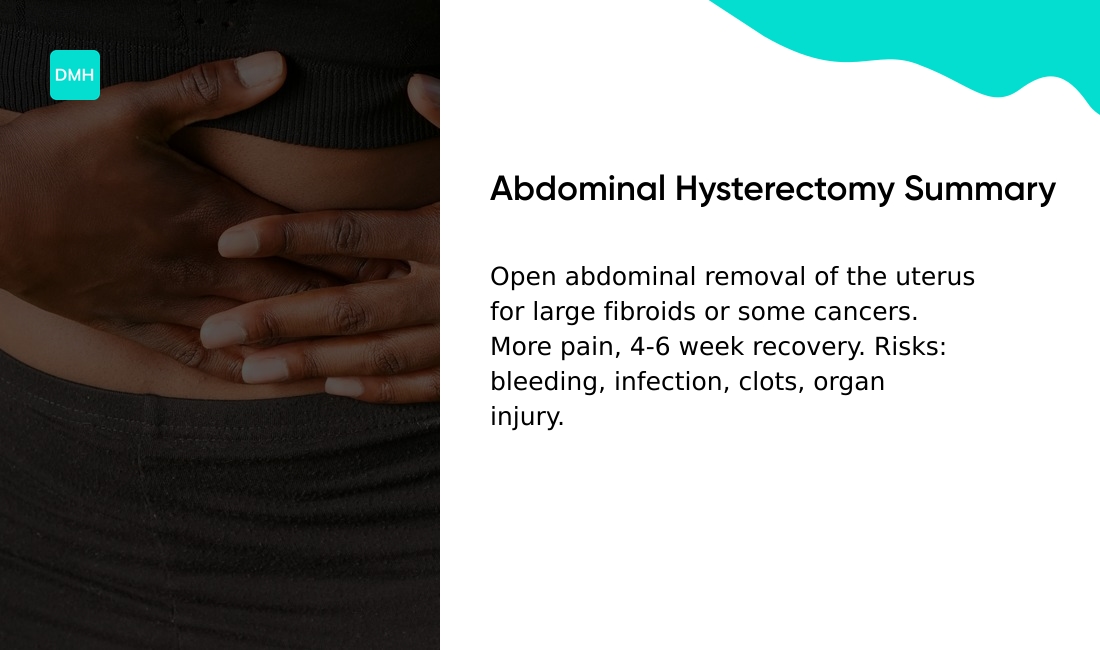
An abdominal hysterectomy uses an open abdominal incision to remove the uterus. Surgeons often choose this approach for large fibroid removal or for some gynecologic cancers.
The operation can give surgeons complex surgical access to surrounding structures. This access may be needed when anatomy is unusual or when additional tissue removal is likely. Plus, it allows direct visualization of the entire pelvic area.
Recovery from an abdominal hysterectomy can vary from person to person. Typical recovery spans about 4 to 6 weeks with restricted lifting and gradual return to activity.
Risks may include bleeding, infection, blood clots, and injury to nearby organs. Short‑term pain tends to be greater than with minimally invasive methods.
Patients often ask about abdominal shape after fibroid removal. See will my stomach be flat after fibroid removal for more on scarring and abdominal contour. Not medical advice, content for educational purposes, consult a professional for care specific to your situation.
When hysterectomy is recommended
Hysterectomy refers to removal of the uterus. Surgeons may consider it when symptoms cause persistent pain or bleeding that reduce quality of life.
Fibroids may affect up to 70% of people assigned female at birth by age 50. Large or multiple fibroids that cause heavy bleeding, anemia, pelvic pressure, or urinary symptoms can prompt consideration of a hysterectomy for fibroids. Less invasive options often include medication, hormonal therapy, myomectomy, or uterine artery embolization.
Endometriosis may affect about 10% of reproductive‑age individuals. Deep or widespread endometriosis that causes severe pain or infertility despite medical care may lead clinicians to discuss a hysterectomy for endometriosis. Surgeons sometimes remove nearby disease during the same operation.
Prolapse and certain gynecologic cancers can also justify uterus removal surgery. Radical procedures remove more tissue and lymph nodes when cancer is suspected. Choice of approach can be vaginal, laparoscopic, robotic hysterectomy, or abdominal hysterectomy based on anatomy and disease extent.
Should hysterectomy be used for sterilization? Actually, it shouldn’t. Safer, less invasive contraceptive options exist and may suit people who want permanent contraception without uterus removal.
Surgery risk and recovery vary by approach. Vaginal and laparoscopic hysterectomy often allow quicker hysterectomy recovery than open abdominal surgery. Individual outcomes can vary from person to person. Not medical advice; content for educational purposes only. Always consult a qualified healthcare professional for medical advice specific to your situation.
| Condition | Common Surgical Approach | Typical Recovery |
|---|---|---|
| Fibroids | Laparoscopic or Abdominal | 3–6 weeks |
| Endometriosis | Laparoscopic | 3–4 weeks |
| Prolapse | Vaginal | 3–4 weeks |
| Gynecologic Cancer | Radical (Abdominal or Robotic) | 6–8 weeks |
What to expect during hysterectomy surgery
A hysterectomy removes the uterus. The operation may treat heavy bleeding, fibroids, endometriosis, prolapse, or cancer.
Surgery usually takes 1–4 hours. Minimally invasive approaches often last nearer the lower end. Open abdominal cases can take longer. Most patients receive general anesthesia. You’ll be asleep during the procedure.
Anesthesia staff monitor breathing, heart rate, and blood pressure. Surgeons access the uterus by the vagina, small abdominal incisions, robotic ports, or a larger abdominal cut. Approach choice may affect pain, blood loss, and recovery.
After surgery you move to a recovery area. Staff manage pain, fluids, and any catheters. Urine output and mobility are checked before discharge.
Some patients qualify for same-day discharge. This is more common after vaginal, laparoscopic, or robotic hysterectomy when recovery is uncomplicated. Overnight stay or longer may occur after abdominal hysterectomy or when complications arise.
Risks include bleeding, infection, blood clots, and nearby organ injury. Postoperative needs vary with the type of hysterectomy and whether ovaries remain.
Hormone changes and menopause after hysterectomy can occur if ovaries are removed, and sex after hysterectomy may change for some people. Expect variability. Recovery times, pain levels, and hospital stay can vary from person to person. Not medical advice, content for educational purposes, consult a professional.
Hysterectomy recovery time and post-operative care
Hysterectomy recovery depends on the surgical approach. Vaginal, laparoscopic, and robotic procedures commonly allow light activity return in 3 to 4 weeks. Open abdominal surgery often requires 4 to 6 weeks for similar recovery.
Pain and energy levels vary from person to person. Wound healing, bleeding duration, and overall stamina can differ by age and health. Many clinicians note that shorter hospital stays and less pain occur with minimally invasive approaches.
Common activity limits focus on lifting and vaginal activity. Here’s the thing: many providers advise avoiding lifting above 10 to 15 pounds for about 4 to 6 weeks after abdominal surgery.
For minimally invasive procedures, reduced lifting for about 3 to 4 weeks is often recommended. Vaginal intercourse is usually delayed until bleeding stops and internal healing progresses, a timeline that can range from 3 to 6 weeks.
Driving and return to work depend on pain control and mobility. Some individuals resume desk work within 1 to 2 weeks after minimally invasive surgery. Physically demanding jobs may require longer leave.
Follow-up visits allow assessment of healing and discussion of symptoms such as fever, increasing pain, heavy bleeding, or wound problems. For practical wound care tips, see healing faster after dental implants, which outlines basic measures that may apply to surgical recovery.
Post hysterectomy care can vary widely. Not medical advice. Content for educational purposes only. Always consult a qualified healthcare professional for medical advice specific to your situation.
Common hysterectomy side effects and risks
Surgical removal of the uterus can carry several short-term and long-term risks. This overview describes common issues that may be associated with a hysterectomy.
- Risk of bleeding: estimated rates of major bleeding needing transfusion range from about 1% to 2% in many series.
- Infection: wound or pelvic infection may occur in roughly 1% to 3% of cases, varying by surgical approach.
- Blood clots: deep vein thrombosis or pulmonary embolism risk often falls between 0.5% and 3% depending on risk factors.
- Organ injury: bladder, bowel or ureter injury occurs in a small portion of procedures, often cited near 0.5% to 2%.
Rates vary by surgical method. Vaginal, laparoscopic hysterectomy, robotic hysterectomy and abdominal hysterectomy each carry different complication patterns and recovery timelines.
Studies and registries report lower infection and shorter recovery with minimally invasive approaches for suitable candidates. Long-term consequences can affect sexual health and hormones.
Some people report improved pelvic pain after uterus removal. Others note sexual function changes such as altered desire or lubrication, especially when ovaries are removed.
Removing both ovaries causes immediate hormone changes and may induce menopause. That may be associated with bone density loss or shifts in cardiovascular risk profiles, although individual outcomes can vary. Evidence shows risks depend on age at surgery and baseline health. Not medical advice. Content for educational purposes only. Consult a qualified healthcare professional for medical advice specific to your situation.
Hormone changes and menopause after hysterectomy
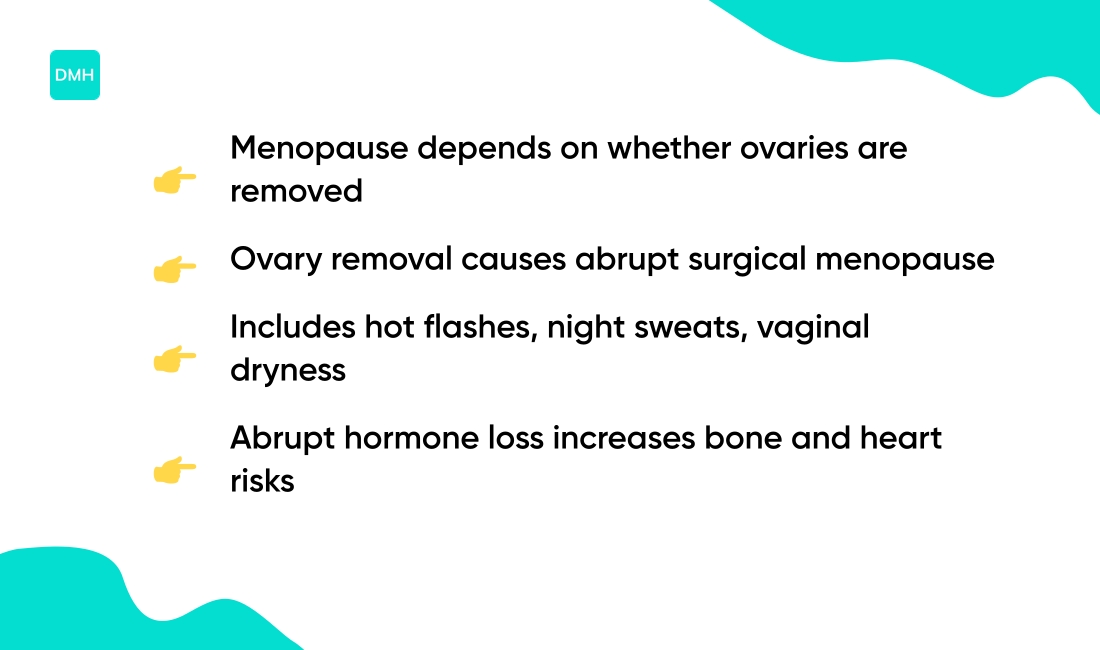
A hysterectomy removes the uterus. Menopause depends largely on whether the ovaries are removed.
If your ovaries are removed during the surgery, you enter abrupt surgical menopause. Ovaries stop making estrogen and progesterone at once. Many people report hot flashes, night sweats, mood shifts, and vaginal dryness. Some studies suggest more than 70% experience vasomotor symptoms after ovary removal.
If the ovaries remain, hormone levels often decline more slowly. Ovarian blood flow can change after uterus removal and may produce an ovarian function decline over years.
Some research indicates menopause may occur about one to two years earlier than expected. Symptom monitoring helps clarify changes.
Recognizing low estrogen symptoms such as hot flashes, sleep disruption, and vaginal dryness can guide discussions with clinicians. Laboratory tests can measure hormone levels when questions remain.
Risk of bone loss and cardiovascular changes may rise after abrupt hormone loss, but individual risk varies widely. Evidence stems from observational studies and randomized trials, and results can vary by age, surgery type, and health history. This content explains common patterns and uncertainties. Not medical advice, content for educational purposes, consult a professional.
You might also like: What Doctor To See For Pmdd
Life after hysterectomy
Recovery varies by surgical approach and personal health. You may return to desk work within two to four weeks after a laparoscopic, vaginal, or robotic hysterectomy. Abdominal recovery can take four to six weeks.
Pain and energy level often improve over weeks. Wound care and avoiding heavy lifting for about six weeks help healing. Follow-up visits may include checks for bleeding, infection, or healing problems.
Sexual activity timing can vary. Many clinicians advise waiting roughly six weeks before vaginal sex to allow internal healing. You may feel ready earlier or later.
Some studies suggest 50–70% of people report less pain or bleeding after hysterectomy for benign conditions. Sexual function may improve for some and change for others.
Hormone changes depend on whether ovaries are removed. Ovary removal before natural menopause often leads to immediate menopause and faster bone loss. Bone density testing may be considered for risk assessment.
Long-term health steps may include:
- Weight-bearing exercise to maintain bone strength
- Adequate calcium and vitamin D intake
- Smoking avoidance
- Alcohol moderation to reduce fracture risk
Read practical tips to prevent osteoporosis and protect bone health. Post hysterectomy care supports recovery. Sex after hysterectomy may evolve over time. Menopause after hysterectomy can change long-term needs. This content offers educational information and general timelines. Not medical advice, content for educational purposes, consult a professional.
You’ll also like: What Doctor Do You See For Breast Problems
How much does a hysterectomy cost
Costs for a hysterectomy can vary widely. Many factors affect final bills.
The surgical approach influences price. Laparoscopic hysterectomy cost often falls between $10,000 and $25,000. Vaginal hysterectomy commonly runs lower. Open abdominal surgery may reach $20,000 to $50,000. Robotic-assisted procedures can add several thousand dollars.
Hospital stay length changes charges. Short stays lower total bills. Longer stays add room, nursing, and therapy fees. Hospital stay fees may add $1,000 to $5,000 per day in some regions.
Geographic location matters. Urban hospitals in high-cost states often charge 20% to 50% more. Rural or low-cost centers often charge less. Insurance status drives out-of-pocket responsibility.
Insurance coverage varies by plan. Deductibles, coinsurance, and network limits change patient costs. For instance, an insured person with a $2,000 deductible and 20% coinsurance facing a $20,000 bill might pay about $4,000 out of pocket, not counting other fees.
Other out-of-pocket items include anesthesia, pathology, prescriptions, follow-up visits, and time off work. Simple estimates don’t capture individual billing nuances.
You may request an itemized estimate from your insurer and hospital billing office to clarify likely expenses. Hysterectomy cost overview can guide planning, but figures vary. Not medical advice, content for educational purposes, consult a qualified healthcare professional for medical advice specific to your situation.
You’ll also like: When Can I Pee After Progesterone Suppository
Educational notice: This content is provided for informational and educational purposes only and is not intended as medical advice. Always consult a qualified healthcare professional for medical concerns.