Laser hair removal can feel like a maze of options, promises, and confusing jargon.
Choosing the right treatment and knowing what to expect (pain, sessions, cost) often leaves people unsure and worried about results.
This guide explains how laser hair removal works, who’s a good candidate, typical costs and side effects, and what happens before, during, and after treatment.
You’ll learn how different lasers target hair, why multiple sessions are needed, and how to minimize risks and downtime.
Whether considering a small area like underarms or a full-body plan, the article will help set realistic expectations and next steps.
It’ll give clear, practical advice to make informed choices and avoid common pitfalls.
What is laser hair removal
Laser hair removal uses concentrated beams of light to reduce unwanted hair. Devices aim energy at pigment in the hair shaft.
The absorbed light converts to heat. That heat damages the follicle’s growth center, called the bulb or papilla.
This selective effect follows the principle of selective photothermolysis. The goal targets pigment while minimizing nearby tissue damage.
Lasers work at specific wavelengths. Common options include 755 nm, 810 nm and 1064 nm.
Choice depends on skin tone, hair color and device type. Diode laser hair removal devices often serve larger areas, while Nd:YAG lasers penetrate deeper and may suit darker skin tones.
Hair grows in phases called anagen, catagen and telogen. Lasers work best in anagen, so treatments repeat over time.
Typical treatment schedules range from 3 to 8 sessions. Session spacing often falls between four and twelve weeks, depending on the area.
Some studies suggest hair counts can fall by roughly 50 to 90 percent after several sessions. Results can vary from person to person.
Devices often include cooling mechanisms to protect skin and reduce discomfort. Mild redness and swelling are common short-term reactions.
According to available research, burns and pigment changes are less likely with experienced operators and correct settings. We provide this explanation for informational purposes only.
Always consult a qualified healthcare professional for medical advice specific to your situation.
How does laser hair removal work
The science behind laser technology
Lasers deliver concentrated light at set wavelengths. Melanin in the hair shaft absorbs that light, and lasers aim to target hair pigment.
Absorbed light converts to heat. That heat can selectively damage follicles and reduce future hair growth. (Pretty straightforward when you think about it!)
Common wavelengths include 755 nm (alexandrite), 810 nm (diode), and 1064 nm (Nd:YAG). Different wavelengths affect depth, and laser wavelengths penetrate to varied layers, reaching follicles about 2–4 mm below the skin depending on the body area.
Devices match pulse duration to follicle thermal relaxation time. Short pulses heat the follicle more than surrounding skin.
Integrated cooling limits epidermal injury and may lower side effects. According to available research, wavelength choice and settings can affect effectiveness and side effects.
We present this for informational purposes only. Always consult a qualified healthcare professional for medical advice specific to your situation.
Hair growth cycles and treatment timing
Hair growth cycles follow three phases. Anagen is the growth phase, catagen is the brief regression phase, and telogen is the resting and shedding phase.
Anagen may include 80–90% of scalp hairs and about 10–30% of body hairs. Anagen can last years on the scalp and weeks to months on the body.
Catagen often lasts two to three weeks. Telogen commonly lasts about three months.
Lasers target pigment in actively growing follicles. Only anagen follicles respond reliably—that’s why multiple sessions are needed.
Active anagen phase timing varies by body site. Many clinics schedule sessions at intervals that match local growth rates.
| Body Area | Typical Session Spacing |
|---|---|
| Face | 4–6 weeks |
| Underarms & Bikini | 4–8 weeks |
| Legs & Back | 6–10 weeks |
Optimal session spacing may reduce missed follicles and improve reduction rates. Some patients need 4–8 sessions for visible long-term reduction.
Results can vary from person to person. Always consult a qualified healthcare professional for medical advice specific to your situation.
Best candidates for laser hair removal
Laser hair removal tends to work best when hair pigment contrasts with skin tone. Dark, coarse hair often absorbs laser energy more effectively than fine or light-colored hair.
Light skin with dark hair usually shows the largest reduction in growth. Hair texture matters too—coarse hairs often respond faster than vellus or pale hairs.
Some studies suggest 60–80% hair reduction after about 3–6 sessions, though results can vary from person to person. What’s your hair and skin combination?
Skin tone affects device choice. Nd:YAG and some diode systems use longer wavelengths and are often used for Fitzpatrick skin types IV–VI.
These systems may be associated with lower pigment-change risks when providers adjust settings correctly. Multiple sessions and proper timing across hair growth cycles remain important.
Search for experienced clinics when exploring options with terms like “laser hair removal near me.” Always consult a qualified healthcare professional for medical advice specific to your situation.
What to expect during laser hair removal
Before your laser hair removal session
At the clinic, providers review skin type, hair color, and medical history before laser hair removal.
Clinics often ask patients to shave the area about 24 hours before treatment. Most providers request no waxing or plucking for four to six weeks prior—this preserves the follicle.
Limit sun exposure for at least two weeks before treatment to reduce pigment risks. Sunburns can delay care.
Mention topical retinoids and oral medications during your consultation. Oral isotretinoin may lead to a six-month wait.
Discuss skin tone, recent tanning, prior hair removal methods, and expected session numbers. Typical plans range from 4 to 8 sessions.
Avoid sun exposure and ask about laser type used for darker skin tones. Ask about expected laser hair removal cost and aftercare protocols.
Always consult a qualified healthcare professional for medical advice specific to your situation.
During the treatment procedure
Laser hair removal sessions start with a quick skin check. The clinician fits protective eyewear for everyone in the room. (Safety first, always!)
Technicians shave or trim the area if needed. They mark targets and test a low-energy pulse on a small patch.
The device uses light pulses. Many systems include cooling mechanisms such as chilled air, contact cooling tips, or cooling gel.
You may feel a snap, a light sting, or warm sensation when the laser fires. Sensation can vary from person to person and by device.
Treatment time depends on area size:
- Underarm sessions: 5–15 minutes
- Bikini or Brazilian: 10–30 minutes
- Full legs: 30–60 minutes
- Full body sessions: 90–180 minutes
Comfort measures may include topical numbing creams, short pauses, and lower settings. Diode lasers may treat larger areas faster, but settings vary by skin and hair type.
Always consult a qualified healthcare professional for medical advice specific to your situation.
Immediate aftercare and recovery
Laser hair removal may cause short-term redness and swelling at treated sites. These reactions commonly resolve within 24–72 hours.
Laser hair removal aftercare focuses on cooling and gentle care. Apply cool compresses for 10–15 minutes every few hours during the first 48 hours.
Use plain aloe vera gel or fragrance-free moisturizers if skin feels tight. Manage redness swelling by avoiding hot showers, saunas, and vigorous exercise for 24–48 hours.
Skip exfoliants and aggressive topical ingredients for several days to lower irritation risk. Sun protection requirements include broad-spectrum sunscreen SPF 30 or higher for at least 14 days.
Sun exposure may be associated with pigment changes after treatment. If blisters, spreading redness, severe pain, or fever occur, contact the treating clinic immediately.
If considering facial oils after treatment, see guidance on how to use oil on face. Always consult a qualified healthcare professional for medical advice specific to your situation.
How many laser hair removal sessions do I need
Many clinics plan 4–8 sessions for laser hair removal. Sessions target hairs in the active growth phase and reduce visible hair over months.
Results vary by body area and hair type. Common schedules use 4–8 week gaps for facial zones and 6–8 week gaps for larger areas.
Typical examples include:
- Facial laser hair removal: often 6–8 sessions, spaced 4–6 weeks
- Underarm laser hair removal: often 4–6 sessions, spaced 4–6 weeks
- Legs or back: often 4–6 sessions, spaced 6–8 weeks
- Bikini and Brazilian laser hair removal: often 6 sessions, spacing varies by clinic
Hair that’s darker and coarser may respond faster. Fine or light hair may need more sessions.
Hormonal areas such as the chin may need extra treatments. Skin tone and the laser type also affect session counts—Nd:YAG lasers may be preferred for darker skin tones.
Many patients book maintenance visits. A single maintenance visit every 6–12 months may keep results optimal.
Some clinics offer packages that lower laser hair removal cost per session. We base these ranges on clinical practice patterns and guidance from reputable clinics.
This information is for informational purposes only. Always consult a qualified healthcare professional for medical advice specific to your situation.
Is laser hair removal permanent
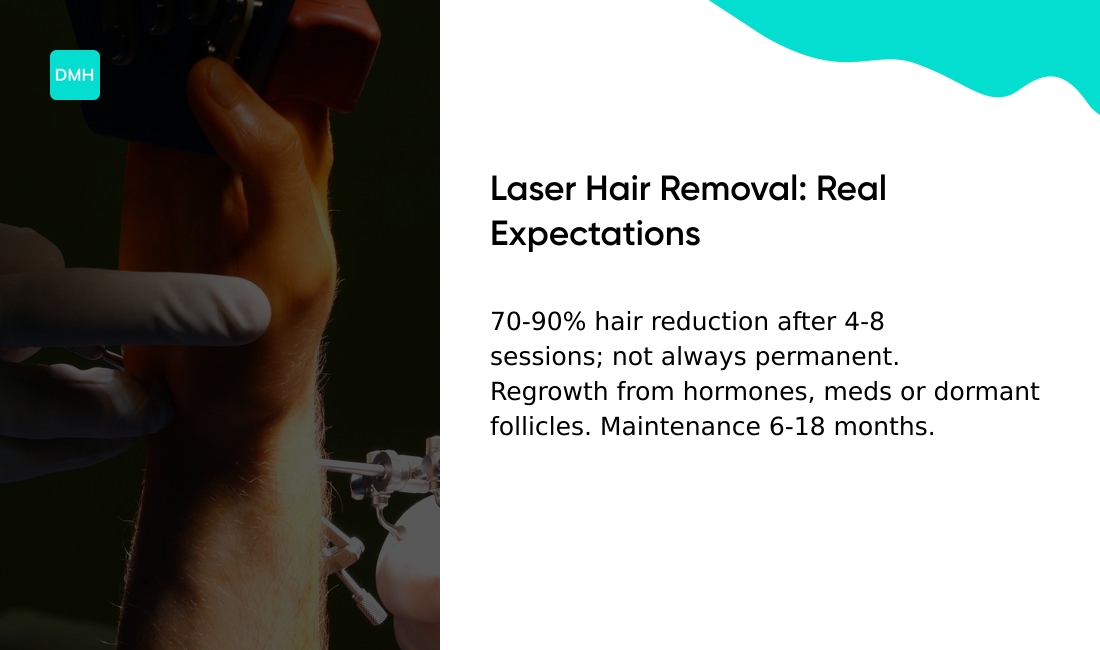
Laser hair removal often yields long-lasting hair reduction. Many people report 70–90% hair reduction after a full course of sessions, according to available research.
The treatment damages hair follicles during the active growth phase. Damaged follicles may stop producing hair for months or years.
But here’s the thing—some follicles can recover over time. Dormant follicles may activate later, and hormonal changes can trigger new hair growth in treated areas.
Medications and medical conditions can also alter results. Skin tone and hair color affect how well lasers work—dark, coarse hair generally responds best.
Fine or light hair may show smaller reductions with common lasers. Number of sessions affects longevity, with most plans using 4–8 treatments spaced weeks apart.
Treatment area matters. Facial and bikini areas often need more maintenance than legs. Many clinics offer occasional maintenance sessions for recurring hairs.
Maintenance often means one session every 6–18 months. Needs can vary from person to person.
Device type matters too. Diode and Nd:YAG lasers perform differently on skin tones, while at-home devices can reduce hair but usually less than professional care.
Expect realistic outcomes and a maintenance plan when considering hair growth cycles. This explanation is for informational purposes only.
Always consult a qualified healthcare professional for medical advice specific to your situation.
Laser hair removal side effects and risks
Redness and swelling commonly follow laser hair removal. These reactions often last hours to a few days. Minor itching or crusting may appear at treated sites.
Sensations vary from person to person. Temporary pigment changes, such as lightening or darkening, may be associated with treatment.
Rates vary by skin tone and device. Less common complications include burns, blisters, scarring, and infection.
Reported rates for serious events are low in many studies, often below 1%. Risk factors include recent sun exposure, darker skin tones, higher energy settings, and inexperienced operators.
Proper technique matters and can lower risks. A small patch test helps predict skin response before full treatment.
Perform patch test on an inconspicuous area when possible. Device choice and settings influence outcomes.
Minimize sun exposure before and after sessions to reduce pigment changes. Broad-spectrum sunscreen helps during recovery.
Aftercare often includes gentle cleansing, cool compresses, and avoiding abrasive products. Following laser hair removal aftercare guidance may reduce complications.
Choose providers with experience in diode laser hair removal, Nd:YAG, or other appropriate devices. Seek clinicians familiar with laser hair removal for dark skin when relevant.
For informational purposes only. Always consult a qualified healthcare professional for medical advice specific to your situation.
How much does laser hair removal cost
Average prices vary by treatment area, clinic location, and provider experience. Typical ranges give a practical view of costs when researching laser hair removal cost.
- Upper lip/facial areas: $50–$200 per session
- Underarms: $75–$250 per session
- Bikini: $150–$500 per session
- Brazilian: $200–$600 per session
- Half legs: $250–$600 per session
- Full legs: $400–$900 per session
- Back or chest: $300–$800 per session
- Full body laser packages: $1,500–$6,000 total
Geographic location affects prices. Urban centers often show 20–50% higher rates than smaller towns.
Provider experience affects price—dermatologists and plastic surgeons often charge more than med spas. Equipment type influences cost too.
Diode and alexandrite systems may cost more than older devices. Skin tone and hair color affect session count and total cost.
Darker skin or finer hair may require more sessions. Single sessions suit quick tests or touch-ups.
Packages usually include 4–8 sessions and may lower per-session cost by about 20–50%. For example, a six-session bikini package priced at $900 equals $150 per session versus $250 for a one-off visit.
Some clinics add maintenance or touch-up fees after initial series. We present these figures for informational purposes only.
Prices may be associated with regional market trends and individual treatment plans. Always consult a qualified healthcare professional for medical advice specific to your situation.
Laser hair removal for different body areas
Facial laser hair removal
Facial laser hair removal commonly treats the upper lip, chin, and cheeks. The device delivers focused light that heats hair pigment and impairs the follicle.
According to available research, many people see substantial hair reduction after multiple sessions. Facial skin can be thin and sensitive, so providers often use lower energy settings and test patches.
People with darker skin tones may benefit from Nd:YAG lasers to reduce pigment risks. For adjacent eyelid skin guidance, consult tighten eyelid skin without surgery.
Sensitive facial skin may show temporary redness or swelling that resolves in days. Treatment timing matters—typical face schedules range from four to eight sessions spaced four to six weeks.
Hair shedding often occurs one to three weeks after a session. Some studies suggest long-term hair reduction of 50% to 90%, though results can vary from person to person.
Typical results timeline can include annual maintenance for some people. Always consult a qualified healthcare professional for medical advice specific to your situation.
Brazilian and bikini laser hair removal
Brazilian laser hair removal treats pubic-area hair with focused light that heats follicles and reduces growth over time. Most sessions last 15 to 45 minutes depending on area size and device type.
Providers may ask patients to shave the area about 24 hours before treatment. Avoid tanning or intense UV exposure for two weeks prior.
Don’t wax or pluck for 4 to 6 weeks before a session because the laser targets hair at the root. Mention medications that can increase light sensitivity during consultation.
Many people report a snapping or warm prick sensation. Clinics often use topical numbing and contact cooling to lower discomfort.
Treatment plans commonly include 4 to 8 sessions spaced about 4 to 8 weeks apart. Dark, coarse hair may need more sessions.
Keep the area clean and choose loose clothing for 24 to 48 hours to limit irritation. Mild redness or swelling may appear and usually fades in a few days.
Always consult a qualified healthcare professional for medical advice specific to your situation.
Underarm laser hair removal
Underarm laser hair removal treats a small area quickly. Sessions commonly last five to ten minutes per armpit with diode or Nd:YAG devices.
Typical session counts may range from four to eight. Treatments often space four to eight weeks apart to match hair growth cycles.
Coarse underarm hair often responds well due to pigment contrast. Results can vary by hair color and skin tone.
Clinical reports suggest 60–90% hair reduction after a full course for many people. Typical laser hair removal cost per session ranges from $50 to $150, depending on clinic and location.
Maintenance touch-ups may be needed once or twice a year. Benefits over shaving include less irritation, fewer ingrown hairs, and time saved from daily shaving.
Pre-treatment shaving is usually requested, and sun exposure should be minimized around sessions. Always consult a qualified healthcare professional for medical advice specific to your situation.
Full body laser hair removal
Full body packages commonly cover legs, arms, underarms, back, chest, bikini and select facial areas. Clinics may list exclusions, such as intimate areas like Brazilian unless included in the plan.
Session length depends on coverage and device. Small areas can take 15–30 minutes, while a full body session often runs 60–180 minutes.
Laser hair removal cost can vary by region and provider. Packages often range from $1,500 to $5,000, with single sessions commonly falling between $150 and $600.
Treatment timing reflects hair growth cycles. Most people need 4–8 sessions spaced 4–12 weeks apart depending on the area and hair type.
A practical schedule staggers large and small areas. Combine legs and back on one visit and plan underarms or bikini on alternating visits to allow skin recovery.
Discuss shaving rules and device type during consultation. We suggest requesting a written plan and estimate before booking.
Always consult a qualified healthcare professional for medical advice specific to your situation.
Laser hair removal for men
Popular male treatment areas include back, chest, shoulders, and beard zones. Some clinics offer targeted face work for beard shaping.
Laser hair removal can work well on pigmented, coarse follicles. According to available research, thicker hair often absorbs more laser energy and may show faster reduction.
Session counts can vary. Facial zones may need 4–6 sessions spaced about 4–6 weeks apart.
Large areas like the back or chest often need 6–10 sessions spaced 6–8 weeks apart. Men with very coarse hair may require extra sessions.
Expectation for discomfort ranges from mild to moderate. Most providers use cooling systems and topical numbing.
Aftercare centers on sun protection and gentle skin care to limit pigment changes and irritation. Costs vary by area and provider.
Search local terms such as “laser hair removal near me” or compare package pricing for full body laser hair removal options. This content is for informational purposes only.
Always consult a qualified healthcare professional for medical advice specific to your situation.
Best laser types for hair removal
Different laser wavelengths suit specific skin tones and hair types. We explain common options below.
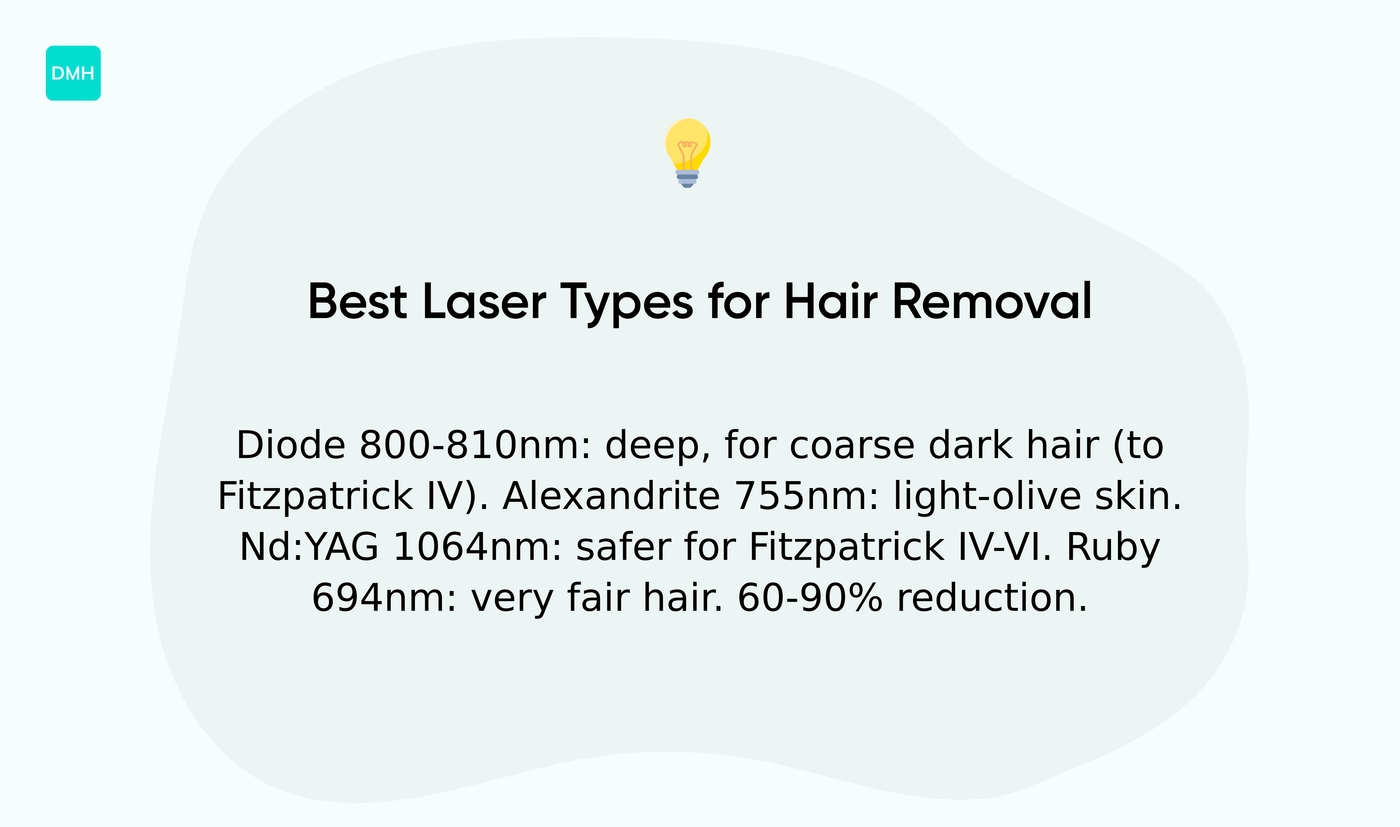
Diode laser hair uses about 800–810 nm. It penetrates deeply and targets coarse, dark hair—clinics use it for legs, back, and chest. It suits many skin tones up to Fitzpatrick IV.
Alexandrite laser hair runs at 755 nm. It works best on light to olive skin with darker hair, and sessions often feel quicker because the device covers larger areas per pulse.
Nd:YAG lasers operate at 1,064 nm. They penetrate deeply and absorb less epidermal melanin, which may lower pigment risk for Fitzpatrick IV–VI skin.
Practitioners may use higher fluence and more passes for dense hair. Ruby laser hair emits 694 nm and suits very fair skin and fine hair.
Many clinics reserve it for small facial areas due to pigment concerns on darker skin. New systems mix wavelengths and add faster repetition rates.
SHR and multi-wavelength platforms can reduce session time and discomfort. Outcomes vary by hair color, density, and body area.
Some studies suggest 60–90% hair reduction after multiple sessions. Always consult a qualified healthcare professional for medical advice specific to your situation.
Laser hair removal vs alternatives
We compare professional laser hair removal with IPL hair removal, electrolysis, and at-home devices.
Effectiveness varies by method and hair type. According to available research, clinic lasers may reduce hair by 60–90% after 4–8 sessions.
IPL in clinics shows wider results, often 30–70% reduction. Electrolysis targets individual follicles and may produce permanent removal for treated hairs.
At-home devices use lower energy and usually give modest, temporary reduction. Cost depends on area and provider—single laser sessions often cost $150–$500.
Full body laser packages can range $2,000–$5,000. Electrolysis costs per hour run $40–$120 and require many visits for large areas. At-home devices sell for $200–$600.
Permanence differs by method. Electrolysis is commonly described as permanent per treated follicle, while professional lasers deliver long-term reduction with possible regrowth.
At-home devices and IPL commonly need maintenance sessions. Ideal candidates vary—clinic lasers work best on darker hair and lighter skin with older laser types.
Nd:YAG lasers may perform better on darker skin tones. Electrolysis works across all skin and hair colors but suits small areas.
At-home devices tend to suit light to medium skin with dark hair. Consider budget, time, treated area, and hair color when choosing.
Ask for a patch test and provider credentials. Always consult a qualified healthcare professional for medical advice specific to your situation.
Is laser hair removal safe for dark skin
Advances in laser technology make hair reduction more accessible for darker skin tones. Clinicians often prefer Nd:YAG lasers with a 1064 nm wavelength.
This wavelength penetrates deeper and absorbs less epidermal melanin. Some studies suggest it lowers pigment change compared with shorter wavelengths.
Provider skill affects outcomes. Experienced clinicians adjust fluence, pulse duration, and cooling—they perform a test patch before full treatment.
This step helps detect sensitivity and reduce the chance of burns or scarring. Hyperpigmentation or hypopigmentation may occur.
Clinical reports describe pigment changes as uncommon to a few percent across treated groups. Proper settings and active skin cooling can reduce this risk.
Aftercare matters. Avoid sun exposure for several weeks around sessions and use gentle cleansers and sunblock as part of post-treatment care.
Related skin care topics include methods to tighten skin after weight loss naturally, which discuss noninvasive skin support.
Device choice matters. Diode and alexandrite lasers suit lighter tones, while laser hair removal with hyperpigmentation risk in mind favors Nd:YAG for darker skin.
We present these points for informational purposes only. Always consult a qualified healthcare professional for medical advice specific to your situation.
Is at home laser hair removal effective
At-home IPL devices may reduce hair growth but differ from clinic lasers in power and design. Clinical systems use higher fluence and optimized wavelengths.
Those factors often lead to faster, larger reductions with professional care. Some studies suggest home devices can achieve around 40–60% hair reduction after consistent use over several months.
Results can vary from person to person based on hair thickness, color, and skin tone. Safety features on consumer devices limit energy to reduce injury risk.
That limitation can reduce effectiveness on coarse or deep follicles. Devices cleared by regulators exist for hair reduction, not permanent removal, according to available research.
Risk of burns and pigment changes is higher when devices are used on darker skin tones. Patch testing on a small area and following manufacturer guidance may lower that risk.
Protective eyewear is important when devices emit visible or near-infrared light. At-home devices may suit small areas, maintenance between clinic sessions, or people seeking lower up-front professional treatment costs.
Clinic treatment may remain preferable for larger areas, darker skin safety, and faster results. Are you ready to commit to a regular schedule?
Practical tips: shave before sessions, avoid tanning, start at lower settings, and follow a regular schedule per the device manual. Track progress with photos every session.
We present information for educational purposes only. Always consult a qualified healthcare professional for medical advice specific to your situation.
You’ll also like: How To Apply Face Serum
Educational notice: This content is provided for informational and educational purposes only and is not intended as medical advice. Always consult a qualified healthcare professional for medical concerns.