Dental implants offer a durable way to replace missing teeth by mimicking a natural tooth root.
But the process, costs, and recovery can feel confusing (and a bit overwhelming) when weighing options like single tooth implants, all-on-4, or implant-supported dentures.
This guide breaks down how dental implants work, from evaluation and surgical placement through healing, abutment attachment, and final restoration.
You’ll learn what each step involves, common variations (mini or same-day options), when bone grafts or sinus lifts are needed, and how materials like zirconia or titanium compare.
By the end you’ll be able to discuss realistic timelines, potential risks, and cost factors with your dentist so you can make an informed decision.
What are dental implants and how do they work
Dental implants are artificial tooth roots surgically placed into the jawbone. Dentists often use them to replace missing teeth and to support dentures or bridges.
A common implant system has three parts:
- Implant body: a screw-like post made of titanium or zirconia that surgeons place into the jawbone at the missing tooth site.
- Implant abutment: a small connector that passes through the gum and links the implant body to the visible tooth replacement.
- Crown or prosthetic tooth: a custom-made cap that fits on the abutment. Labs match shape and color to surrounding teeth.
Bone grows around the implant in a process called osseointegration. This fusion may take about 3 to 6 months and gives stability similar to a natural root.
Success rates in many studies often exceed 90% to 95% over ten years, though outcomes can vary by health, smoking, and bone quality. Implants support single tooth implants, implant-supported dentures, and full-arch solutions like all-on-4 dental implants.
Same-day and mini dental implants may suit selected cases. For informational purposes only — not medical advice. Always consult a qualified healthcare professional for medical advice specific to your situation.
The dental implant procedure step by step
Evaluation and planning phase
The evaluation and planning phase prepares for dental implant placement. The clinician conducts a dental implant assessment that covers medical history, medications, and smoking status.
Imaging uses panoramic X-rays and 3D cone beam CT scans to measure bone volume and map nerve and sinus locations. Bone width of about 6 mm often suits implant placement, while height near 8–10 mm commonly meets support needs.
Low bone may prompt a dental bone graft. A sinus lift for dental implants helps when upper jaw height is insufficient.
The plan specifies implant position, diameter, angulation, and provisional tooth options. Cost estimates and a treatment plan timeline often appear in the plan. For informational purposes only — not medical advice, consult a professional.
Surgical implant placement
Surgical implant placement inserts the implant body into the jawbone to replace the missing tooth root. Clinicians use titanium or zirconia implants during this step of the dental implants process.
Local anesthesia numbs the area. A small incision exposes the bone, then the clinician drills a pilot hole to planned depth and threads the implant into place. A healing screw or abutment protects the site.
Common diameters range 3.0 to 5.5 mm, with lengths often between 8 and 16 mm. Target insertion torque often sits between 25 and 45 Ncm. Surgery often takes 20 to 60 minutes per implant.
High initial stability may allow immediate loading in select cases. Bone and soft tissue heal over weeks to months. Complications may include infection, implant failure, or nerve injury, with risk factors including low bone volume and smoking.
For informational purposes only — always consult a qualified healthcare professional for medical advice specific to your situation.
Healing and osseointegration process
Osseointegration describes bone bonding with dental implants over weeks to months. The implant surface encourages bone growth and fusion at the implant-bone interface.
Typical dental implant recovery time ranges from 3 to 6 months, depending on jaw location and bone quality. Large studies report implant survival near 90 to 95 percent at 10 years.
Factors that may slow healing include smoking, uncontrolled diabetes, low bone volume, and infection. Bone grafts or a sinus lift can increase bone volume before implants. Good oral hygiene and stable medical control may support bone healing and reduce complications.
Find practical tips on faster recovery at how to heal faster after dental implants.
Dental implant healing and the osseointegration process focus on implant support. Long-term stability helps prosthetic teeth function for years. For informational purposes only — not medical advice, consult a professional.
Abutment placement
The abutment attaches to the dental implant body and passes through your gum. It provides a stable base for your crown or prosthetic tooth.
Abutment placement often follows osseointegration, commonly after three to six months. Clinicians use prefabricated or custom pieces made from titanium or zirconia.
Procedure steps include exposing the implant, securing the abutment, and checking fit and bite. Soft tissue around the abutment usually heals in one to two weeks.
Some studies report implant success rates above 95% at five years, though outcomes can vary. Expect mild soreness for a few days and brief dietary adjustments while tissue heals.
Custom abutment options may improve gum contour and crown fit. For informational purposes only — not medical advice, consult a professional.
Final restoration attachment
The final step secures a prosthetic to the implant abutment. The prosthetic can be a crown, bridge, or denture designed to mimic a natural tooth.
The dental team may use a custom prosthetic crown or a multi-unit bridge for adjacent missing teeth. Clinicians commonly choose between screw-retained and cemented restorations.
Screw-retained restorations allow easier removal for maintenance. Cemented restorations can offer a more seamless gumline appearance. Materials include porcelain, zirconia, and metal-ceramic.
Shade matching and bite adjustments happen chairside to refine fit and function. The restoration restores chewing force and aesthetics. Initial follow-up often occurs at one to two weeks, with further checks over months as healing continues.
For informational purposes only — not medical advice, consult a professional.
Types of dental implants and procedures
Single tooth implant process
A single tooth implant replaces one missing tooth with an implant body, abutment, and crown. The implant body, often titanium or zirconia, is placed into the jawbone.
Bone fuses to the implant over about three to six months, providing stability. A connector piece called a dental implant abutment attaches through the gum. A custom crown is made to match your teeth and bite.
This approach preserves adjacent teeth by avoiding grinding into healthy enamel. Dental implants for single teeth avoid damage to neighboring teeth in many cases.
Typical success rates exceed 95% at five years in clinical studies. Total treatment time can vary from three to nine months. A bone graft may add several months to healing time.
Not medical advice — content for educational purposes, consult a professional.
All-on-4 dental implants vs traditional implants
All-on-4 dental implants use four implants placed strategically to support a full-arch prosthesis. Traditional implants replace each missing tooth with a separate implant and crown.
The full arch support approach reduces the number of implants and often shortens surgical time. Fewer implants may lower immediate costs and may avoid a dental bone graft by angling posterior implants. Traditional plans may require eight to twelve implants per arch for full-mouth restoration.
| Feature | All-on-4 | Traditional Implants |
|---|---|---|
| Number of implants | 4 per arch | 8-12 per arch |
| Typical cost per arch | $15,000–$30,000 | $30,000–$60,000+ |
| Surgical time | Shorter | Longer |
| Bone graft need | Often avoided | More common |
Cost estimates vary by region and provider. A single tooth implants procedure often ranges from $3,000 to $6,000. Material choice, such as titanium or zirconia implants, affects price and aesthetics.
Both options depend on osseointegration and good oral health. Some studies suggest comparable five-year survival for fixed prostheses, but outcomes can vary. Not medical advice — content for educational purposes, consult a professional.
Implant-supported dentures
Implant-supported dentures use dental implants as stable anchors in the jawbone. The system links implants, abutments, and a removable or fixed prosthesis.
Anchored attachments improve retention, reduce slipping, and boost chewing function. Some studies suggest implant-retained overdentures restore bite force to about 60%–70% of natural teeth.
Clinicians often place two implants for a lower removable overdenture. Four or more implants can support a fixed full-arch prosthesis, similar to all-on-4 dental implants. Attachment types include locators, bars, and fixed abutments, each with different maintenance needs.
You can discuss implant number, attachment style, and follow-up care with a qualified clinician. Dental implants provide bone stimulation and may reduce bone loss over time.
For informational purposes only — not medical advice, consult a professional.
Mini dental implants and same-day options
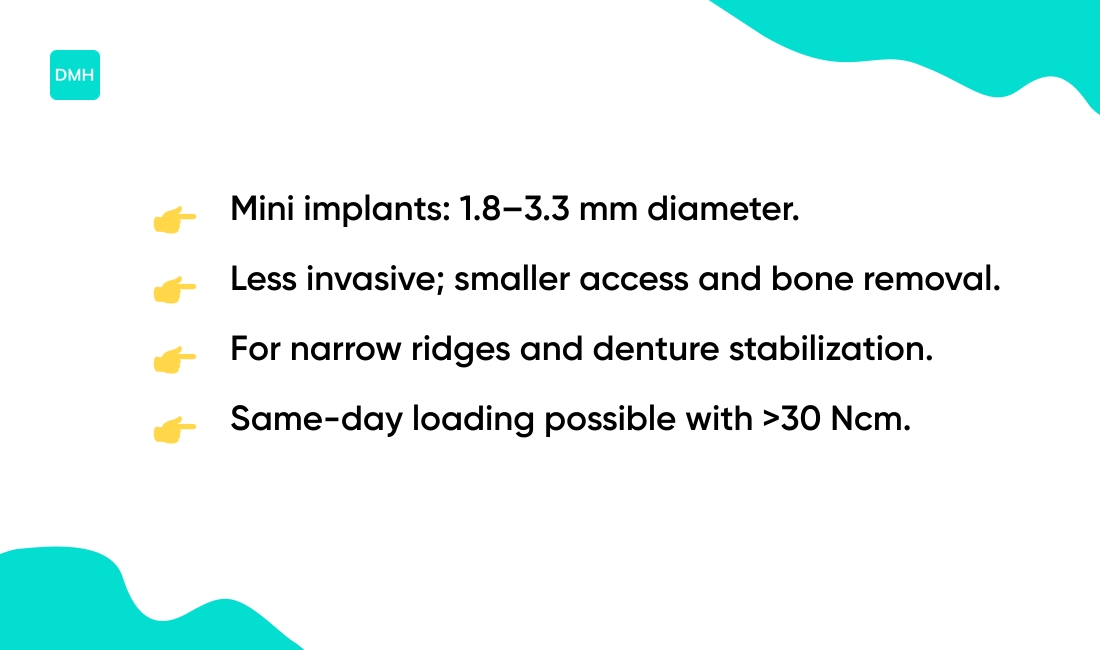
Mini dental implants use thinner implant bodies, typically 1.8–3.3 mm in diameter. They require smaller surgical access and less bone removal.
Clinicians often use them for narrow ridges and for denture stabilization. Immediate loading protocols can allow placement of a temporary tooth or denture the same day.
Same-day dental implants work when clinicians achieve high primary stability, often torque values above 30 Ncm. Bone quality and implant position affect suitability and long-term outcomes.
Implant-supported dentures may benefit from mini implants when patients seek a less invasive or lower-cost option. Survival rates vary by indication and follow-up time; some studies report short-term success between 85% and 95%.
Not medical advice — content for educational purposes, consult a professional.
Latest innovations in dental implant technology
Dental implants continue to advance across planning, materials, and functional design. Clinicians now rely on digital planning tools and 3D imaging scans to map bone volume and nerve position before a procedure.
Some studies report placement deviations near 1.0 mm and angular errors under 4°, which may improve prosthetic fit and reduce surgical time. Guided workflows use computer guided surgery to transfer plans into the clinic.
This approach can shorten the dental implant procedure for selected cases and support same-day dental implants or precise single tooth implant placement. Materials evolve alongside software.
Zirconia dental implants offer improved aesthetics and low plaque affinity, while titanium and titanium-zirconium alloys remain common for strength and long-term osseointegration. Some research finds alloy changes may boost fatigue resistance, with ongoing studies comparing long-term outcomes.
Surface science aims to speed bone bonding. Bioactive coatings such as calcium phosphate and antimicrobial layers may promote osseointegration and lower early infection risk. Evidence is mixed and larger trials are needed to confirm clinical benefits.
Experimental sensory-feedback implants reported in 2025 may restore tactile signals to implants, which could change how patients sense biting forces. Further research will clarify durability and clinical use; see a 2025 Tufts study for details.
For informational purposes only — not medical advice, consult a professional.
Do I need a bone graft or sinus lift before dental implants
When jaw bone lacks height or width, implant stability may be weak. A bone graft restores ridge width or height using autograft, allograft, xenograft, or synthetic materials.
A sinus lift raises the maxillary sinus floor when upper back jaw bone is thin. Clinicians often look for at least 6 mm of bone height beneath the sinus for standard implants.
If available bone measures under 6 mm, a sinus augmentation may be needed to reach 8–12 mm for predictable placement. Vertical or horizontal ridge defects may require 3–6 mm of added bone. Healing after grafting commonly takes 4–6 months.
Short implants, angled implants, and zygomatic implants can avoid grafts in selected cases. Success rates for grafts and sinus lifts often exceed 85–95% in published series, but outcomes can vary by technique and health factors.
Smoking, uncontrolled diabetes, and prior infections can reduce graft integration and implant survival. Planning uses 3D imaging to measure bone and map sinus anatomy, which guides whether a graft or lift will increase long-term support for dental implants.
For informational purposes only — not medical advice, consult a professional.
Dental implant materials: zirconia vs titanium
Titanium has decades of clinical data supporting its use for titanium dental implants. Bone bonds reliably to titanium surfaces through osseointegration. Some studies report five-year survival rates near 95% to 98% for established titanium systems.
Zirconia is a tooth-colored ceramic used for zirconia dental implants. It offers a strong aesthetic option for front teeth. Short-term studies show promising success rates, but long-term data remain limited.
Biocompatibility differs by material. Titanium shows high tissue tolerance in most patients. Metal sensitivity is rare but may influence material choice. Zirconia may suit patients who prefer non-metal options.
Strength and fracture risk vary. Titanium tolerates bending forces and allows angled abutments. Zirconia has high compressive strength but greater brittleness. Use of zirconia suits single-unit restorations more often than multi-unit bridges.
Aesthetics and soft-tissue outcomes matter for visible teeth. Zirconia can reduce metallic shading under thin gums. Titanium implants pair well with ceramic abutments to improve appearance when needed.
Clinical suitability depends on treatment goals. Dentists often select titanium for full mouth dental implants, all-on-4, and implant-supported dentures. Zirconia can work for a single tooth implant or narrow esthetic needs when bone quality allows.
Costs and availability vary. Zirconia options may carry higher fees and fewer manufacturers. Evidence is mixed on long-term parity. Larger studies are needed to confirm comparative longevity.
For informational purposes only — not medical advice, consult a professional.
How long does a dental implant procedure take
The overall timeline for a dental implant procedure varies. It can range from a few weeks to more than a year.
Initial consultation and planning usually take 30 to 60 minutes. Imaging with X-rays or a CBCT scan adds about 10 to 20 minutes.
Surgical placement of the implant body typically lasts 30 to 90 minutes per implant. Complex cases can require more time in the operatory.
Bone healing and fusion with the implant, known as healing and osseointegration, commonly takes 3 to 6 months. The lower jaw often integrates in about 3 to 4 months, while the upper jaw often needs 4 to 6 months.
When a dental bone graft or sinus lift is needed, add roughly 4 to 6 months for graft maturation. Abutment placement is a short appointment, often 20 to 40 minutes. Soft tissue around the abutment usually stabilizes in 2 to 6 weeks.
Final crown or prosthesis fabrication commonly requires 2 to 4 weeks. Final seating usually completes in one or two visits totaling 1 to 2 hours.
What affects your total timeline? Well, several factors come into play:
- Bone quality and volume
- Need for grafting or sinus lift
- Systemic health (uncontrolled diabetes may slow healing)
- Same-day dental implants may allow immediate temporary teeth in selected cases
A single tooth implant without grafting often finishes in about 4 to 9 months. Timelines can vary from person to person. For informational purposes only — not medical advice, consult a professional.
Dental implant recovery time and healing expectations
What to expect after surgery
Expect swelling, minor bleeding, and soreness for a few days. Pain usually peaks in the first 48 hours and eases after that. Stitches often dissolve or come out within 7 to 10 days.
Typical healing timelines
Soft tissue healing often completes in 2 to 3 weeks. Bone healing that fuses the implant to the jaw, called osseointegration, commonly takes 3 to 6 months.
Lower jaw implants may integrate in about 3 months. Upper jaw implants can take up to 6 months. Individual responses can vary from person to person.
Post-surgical care
Follow prescribed medications and clinician instructions. Try applying ice to the cheek for 15 minutes on, 15 minutes off during the first 24 hours to reduce swelling.
Avoid vigorous rinsing for 24 hours. After 24 hours, gentle saltwater rinses may help control bacteria. Maintain a soft diet for 1 to 2 weeks and avoid hard or chewy foods near the implant site.
Tips for faster healing and oral hygiene
Good oral hygiene supports healing. Brush gently around the area and use non-alcohol mouth rinses if advised. Smoking may slow bone fusion and increase failure risk.
Control chronic conditions such as diabetes to support recovery. Small lifestyle steps can speed healing. Learn how to improve gum health for better long-term outcomes.
Dental implant recovery may vary. Post-surgical care matters. Not medical advice — content for educational purposes, consult a professional.
Dental implant complications and risks
Dental implants often restore function and appearance after tooth loss. Some complications can occur despite careful planning and skilled surgery.
- Dental implant complications commonly include infection at the implant site. Infections may cause pain, swelling, and bone loss.
- Nerve injury can cause numbness, tingling, or altered sensation near the lip, chin, or tongue. Such injuries are uncommon but can be long lasting.
- Gum recession may expose implant components and affect aesthetics and hygiene.
- Implant failure rates vary by study. Early failure often ranges from about 1% to 5%. Long-term loss may relate to chronic inflammation called peri-implantitis, which some research places near 10%–20% of implants over time.
- Healing problems include poor bone integration after placement. Bone grafts or sinus lifts can increase complexity and extend healing time.
Factors that raise complication risk include smoking, uncontrolled medical conditions such as diabetes, poor oral hygiene, low bone volume, and prior head or neck radiation. Responses can vary from person to person.
Material choice, such as titanium dental implants or zirconia dental implants, doesn’t eliminate these risks. Patients benefit from a clear discussion of risks, timelines, and follow-up plans with their clinician.
More information on device safety and patient considerations is available from the FDA dental implants page.
For informational purposes only — not medical advice, consult a professional.
How much do dental implants cost
Average dental implants cost in the United States can vary widely. Typical ranges reflect materials, location, and procedure type.
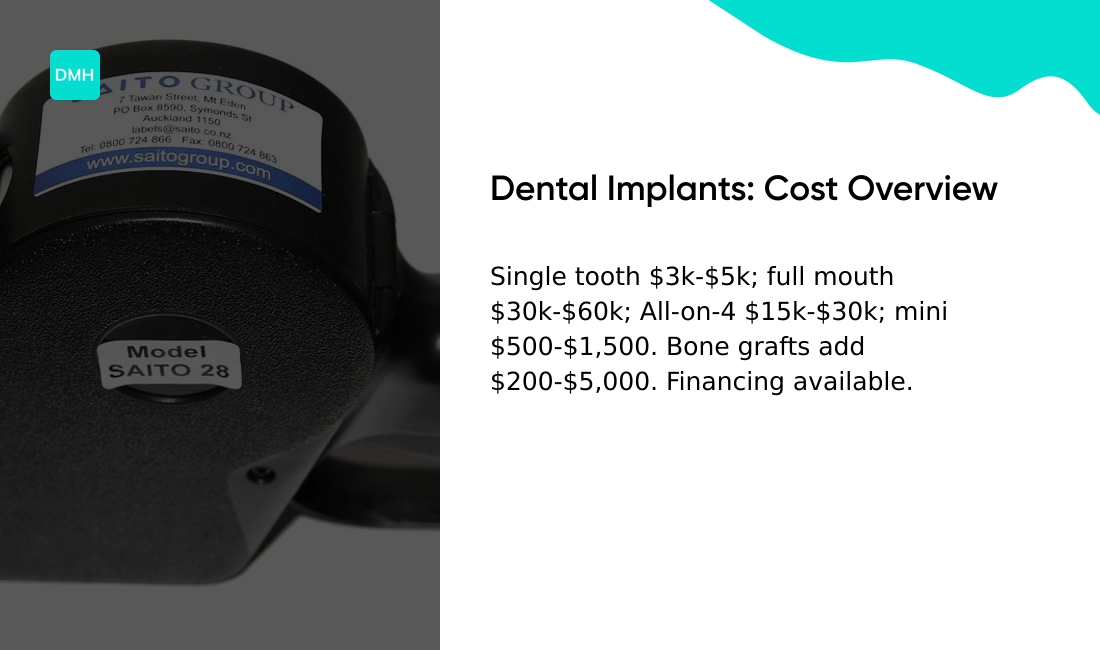
A single implant often totals $3,000 to $5,000. That price commonly includes implant fixture, abutment, and crown.
A single tooth implant breakdown looks like this:
- Implant fixture: $1,000–$2,500
- Abutment: $300–$500
- Crown: $800–$2,000
Full mouth implants often start at $30,000 and can exceed $60,000. An all-on-4 dental implants arch usually runs $15,000 to $30,000.
Mini dental implants may cost $500 to $1,500 each. Same-day dental implants sometimes increase lab and surgical fees.
Factors that affect price include geographic location, dentist experience, implant material, and lab fees. Bone grafting or a sinus lift can add $200 to $5,000.
Dental implant financing options may help spread payments over time. Options include dental insurance partial coverage, dental savings plans, in-house plans, and third-party credit.
Local market rates can change estimates. Clinical needs and healing complexity can vary from person to person. For informational purposes only — not medical advice, consult a professional.
Are dental implants worth it compared to a bridge
This section compares dental implants and bridges on longevity, bone preservation, adjacent-tooth impact, maintenance, and long-term value.
Implants often last 20 years or longer with proper care. Published implant survival rates at 10 years commonly exceed 90%. Bridges typically last about 5 to 15 years. Bridge lifespan can vary based on oral hygiene and the condition of supporting teeth.
Implants fuse with the jawbone through osseointegration and help preserve bone volume. A missing root left without an implant may lead to gradual bone loss.
Bridges rely on neighboring teeth for support. Preparing those teeth requires reduction of healthy tooth structure. Implant maintenance resembles natural tooth care. Peri-implant inflammation may affect a minority of patients and should be monitored by a clinician.
Bridges need careful cleaning under pontics and may require replacement if decay or root problems develop. Upfront costs for a single tooth implant in the United States often range from about $3,000 to $5,000. A three-unit bridge may cost roughly $2,000 to $5,000 depending on materials and location.
Higher initial cost for an implant can lead to lower replacement and repair costs over decades. Cost-effectiveness can vary from person to person.
Choice depends on bone volume, oral health, budget, and personal goals. Always consult a qualified dental professional for individualized assessment. Not medical advice — content for educational purposes, consult a professional.
How long do dental implants last
Dental implants can last for decades when they integrate well with the jawbone and receive proper care. Some long-term studies report implant survival rates above 90% at 10 years and around 80% at 20 years.
- Implant survival rates depend on bone quality and implant material.
- Oral health factors include gum disease, smoking, and uncontrolled diabetes.
- Restoration type matters: single tooth implant crowns often wear by 10–15 years.
- Procedures like dental bone graft or sinus lift may affect initial stability.
Maintenance influences outcomes. Routine dental follow-up and professional cleaning often associate with longer implant success. Good soft-tissue health around the abutment reduces risks of peri-implantitis.
Titanium dental implants and zirconia dental implants show high long-term performance in many studies, though responses can vary from person to person. Bruxism and poor bite forces may increase mechanical wear or failure risk.
Expect the implant body to last longer than the crown or prosthetic tooth. Restorations may need replacement over time because of wear or aesthetic changes.
For informational purposes only — not medical advice, consult a professional.
Read also: What Is The Strongest Natural Antibiotic For Teeth?
Am I a candidate for dental implants
Candidates for dental implants typically have good oral hygiene and adequate jawbone. Dentists confirm candidacy with clinical exams and imaging.
Bone quality matters a lot. Low bone volume may need a dental bone graft. A low upper jaw may require a sinus lift procedure.
Gum health affects healing. Active gum infection increases implant failure risk. Treating periodontal disease first may improve outcomes.
Medical conditions can influence candidacy. Uncontrolled diabetes and some autoimmune disorders can slow healing. Certain medications, such as bisphosphonates, may affect results.
Age alone rarely blocks implants. Bone density and overall health matter more than chronological age. Lifestyle factors play a role. Smoking and heavy alcohol use are linked to lower success rates. Smoking cessation often improves chances, though responses vary.
Success rates often exceed 90–95% over five to ten years in healthy patients, according to dental research. When implants aren’t suitable, alternatives exist. Options include fixed bridges, removable dentures, and implant-supported dentures.
Mini dental implants or same-day dental implants may suit some patients. Costs can vary based on the procedure type, such as single tooth implant or full mouth dental implants. Dental implant financing is commonly available.
For informational purposes only — not medical advice, consult a professional.
You might also like: How To Heal Cuts On Tongue From Teeth
Educational notice: This content is provided for informational and educational purposes only and is not intended as medical advice. Always consult a qualified healthcare professional for medical concerns.