When persistent worry or low mood starts to control daily life, small tasks quickly feel overwhelming.
Cognitive behavioral therapy helps by showing how thoughts, feelings, and behaviors are linked and what to change.
It’s structured and practical, you know?
CBT uses techniques like cognitive restructuring, exposure, and behavioral activation to test unhelpful beliefs and change behaviors.
Read on and you’ll learn how CBT works, which conditions it may help with, and simple exercises you can try at home.
You’ll also get guidance on finding a therapist, online CBT options, and realistic timelines for seeing improvement.
Daily Medical Health breaks down evidence-based tools so you can decide if CBT might be right for you.
What is cognitive behavioral therapy
Cognitive behavioral therapy (CBT) is a structured talk therapy that helps identify and change unhelpful thoughts and behaviors. It highlights the link between thoughts, feelings, and actions.
Sessions use clear goals and practical exercises. Therapists teach skills like cognitive restructuring, behavioral activation, exposure work, and thought challenging.
People learn to spot distorted thinking, test whether thoughts match reality, and replace them with more balanced alternatives. Behavior changes follow naturally.
Scheduling meaningful activities and facing feared situations reduce avoidance and support new habits. Evidence shows CBT is commonly used to address anxiety, depression, OCD, PTSD, and insomnia.
Some studies suggest CBT may be associated with measurable changes in brain activity. For instance, NIH researchers reported in 2024 that children with anxiety showed overactive brain regions before treatment, and many of these changes improved after 12 weeks of CBT.
Outcomes vary from person to person. Treatment length often runs from 12 to 16 weekly sessions, though this can vary by need and setting.
Online CBT and in-person therapy both exist. Finding a qualified CBT therapist can help clarify goals and session format. Always consult a qualified healthcare professional for medical advice specific to your situation.
Not medical advice, content for educational purposes, consult a professional.
How does CBT work
Cognitive behavioral therapy focuses on links among thoughts, feelings, and actions. We define core steps used in structured sessions.
Therapists help individuals notice distorted thinking. Patients learn to spot automatic negative thoughts and unhelpful beliefs. Ever caught yourself thinking “I always mess everything up” after one small mistake?
Therapists guide testing of thought accuracy. People examine evidence for and against a thought. This process often reduces emotional intensity.
Sessions teach replacement of biased thoughts with more realistic alternatives. New thoughts aim to match observed facts and probable outcomes.
Behavior change forms a major part of the work. Therapists identify behaviors that maintain problems, such as avoidance or withdrawal. Gradual experiments support new actions and reduce symptoms.
CBT uses practical techniques like cognitive restructuring, behavioral activation, exposure therapy, and thought challenging. Home practice often includes CBT exercises and worksheets.
Some studies suggest these methods relate to measurable brain changes. Stanford researchers reported that CBT-based problem-solving therapy changed brain circuitry in some adults with depression, and those early brain changes helped predict who would benefit most from treatment.
Session length commonly ranges from 12 to 16 weekly visits. Progress can vary from person to person and by condition. Always consult a qualified healthcare professional for medical advice specific to your situation.
Not medical advice, content for educational purposes, consult a professional.
Most effective CBT techniques
Cognitive restructuring
Cognitive restructuring is a CBT technique that helps identify automatic negative thoughts and develop more balanced, realistic thinking. It links thoughts, feelings, and actions within cognitive behavioral therapy.
We break the process into clear steps. Clinicians ask patients to notice a thought, record the context, and rate its intensity. Think of it as taking a snapshot of your mind in the moment.
Clinicians examine evidence for and against the thought. They generate alternative interpretations and run brief behavior experiments to test those ideas.
According to available research, this method may be associated with reduced anxiety and depressive symptoms. Therapists often combine it with other CBT techniques such as behavioral activation and exposure.
People can practice with thought records and worksheets between sessions to strengthen new patterns. Always consult a qualified healthcare professional for medical advice specific to your situation.
Not medical advice; content for educational purposes.
Behavioral activation
The behavioral activation technique is a CBT method that helps people reduce withdrawal and avoidance. It schedules meaningful activities to break cycles of inactivity and low mood.
People plan small, value-based tasks. Many start with 10–15 minute activities—for example, a short walk three times weekly. (No need to run a marathon on day one!)
Some studies suggest behavioral activation matches outcomes of longer cognitive behavioral therapy programs for depression. Randomized trials report similar symptom reduction over about 12 weeks in select samples.
A common CBT exercises schedule uses an activity log and brief ratings of pleasure and mastery. Tracking mood before and after activities helps measure progress and guide adjustments.
We note response can vary from person to person and depends on support and symptom severity. Always consult a qualified healthcare professional for medical advice specific to your situation.
Not medical advice, content for educational purposes, consult a professional.
Exposure therapy
We define exposure therapy as gradual controlled confrontation of feared situations or triggers. It aims to reduce avoidance and lower anxiety responses through repeated practice.
Some studies report symptom reductions of 50–80% for specific phobias and related fears. Clinicians use exposure methods for phobias, OCD, and PTSD, often pairing them with cognitive strategies.
Treatment usually involves creating a ranked list of triggers. A therapist and individual work through items from least to most distressing. Sessions may span 8–12 visits, with homework practice between sessions to reinforce gains.
Therapists often combine exposure with response prevention for OCD and with memory processing for trauma. Measure progress with simple scales, track avoidance patterns, and adjust intensity over time.
Always consult a qualified healthcare professional for medical advice specific to your situation. Not medical advice; content for educational purposes.
Thought challenging
Thought challenging helps you question automatic negative thoughts. It shows how thoughts shape feelings and actions.
The method examines evidence, considers alternative explanations, and tests predicted outcomes. Therapists often frame the steps as a brief experiment.
This approach may reduce emotional distress and lower avoidance linked to anxiety and depression. It fits within the broader practice of cognitive behavioral therapy and CBT techniques.
Use a simple thought record worksheet at home. Note the situation, mood, automatic thought, supporting evidence, alternative thought, and likely outcome.
This aligns with the cognitive restructuring technique used in CBT. Some studies suggest these steps can change thinking patterns over weeks of practice. Always consult a qualified healthcare professional for medical advice specific to your situation.
Not medical advice, content for educational purposes, consult a professional.
Conditions CBT treats effectively
CBT for anxiety disorders
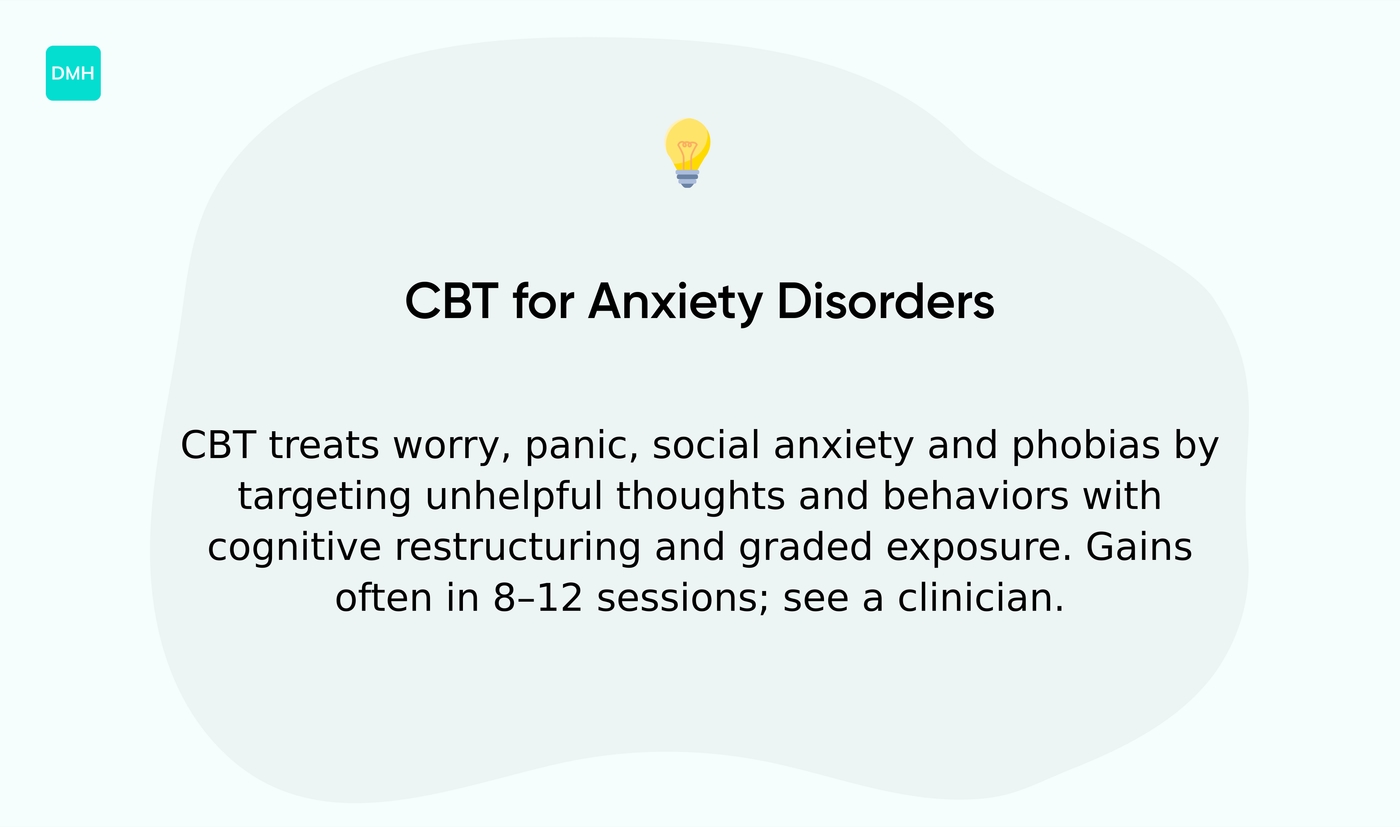
Cognitive behavioral therapy targets excessive worry, panic attacks, social anxiety, and phobias. It helps people identify unhelpful thoughts and related behaviors.
CBT uses thought records and behavioral experiments to spot anxious beliefs. Therapists apply cognitive restructuring to test and reframe those beliefs.
Exposure therapy reduces avoidance through graded, controlled contact with feared situations. Repeated practice lowers panic and phobia responses over time.
Social anxiety work may include role play and real-world practice. Therapy aims to increase daily functioning and reduce avoidance. Symptom gains often appear within 8–12 sessions, though results vary.
Some studies suggest benefits last when skills are practiced between sessions. Physical symptoms can include chest tightness or pain during panic—see this page on anxiety-related chest pain for context.
Always consult a qualified healthcare professional for medical advice specific to your situation. Not medical advice, content for educational purposes.
CBT for depression
We describe how cognitive behavioral therapy applies to depressive episodes. CBT targets negative thinking, withdrawal, and feelings of hopelessness.
Therapists use behavioral activation to reintroduce rewarding activities. Scheduling small, achievable tasks can break cycles of inactivity. Activity tracking often shows mood gains within weeks.
Therapists teach cognitive restructuring to identify automatic negative thoughts. People examine evidence for and against those thoughts and form balanced alternatives. Thought records and brief experiments test new beliefs.
Problem-solving skills help with daily functioning. Structured steps reduce overwhelm and improve decision-making.
Many programs run about 12–16 weekly sessions and may be delivered in person or online. According to available research, these methods can be associated with symptom reduction for many individuals.
Always consult a qualified healthcare professional for medical advice specific to your situation. Not medical advice, content for educational purposes, consult a professional.
CBT for OCD
We describe cognitive behavioral therapy (CBT) as a structured approach for obsessive-compulsive disorder (OCD). CBT targets intrusive thoughts and ritualized behaviors.
Exposure and response prevention (ERP) forms the main method. ERP asks people to face feared triggers in controlled steps while resisting rituals. Sounds tough, right? Well, it can be, but the results often speak for themselves.
Sessions use clear goals, homework, and gradual exposures. Therapists track progress with symptom scales and behavior logs.
Some studies suggest CBT with ERP yields symptom reductions around 40–60% for many patients. Response varies from person to person.
People often seek a trained CBT therapist or online CBT programs when access is limited. We discuss common triggers in our guide to OCD flare-ups.
Always consult a qualified healthcare professional for medical advice specific to your situation. Not medical advice, content for educational purposes, consult a professional.
CBT for PTSD
Cognitive behavioral therapy (CBT) for post-traumatic stress disorder uses trauma-focused methods. It targets trauma memories, distorted beliefs, and arousal symptoms.
Key techniques include exposure to trauma, cognitive processing skills, and training to manage flashbacks. Exposure can use guided recall in a safe setting. Cognitive work examines beliefs about safety, responsibility, and blame.
Sessions teach grounding and breathing to reduce panic and hypervigilance. Skills aim to lessen avoidance and improve daily functioning.
According to available research, trauma-focused CBT can reduce PTSD symptom severity for many people. Response can vary from person to person. We summarize evidence—outcomes depend on trauma history and coexisting conditions.
Always consult a qualified healthcare professional for medical advice specific to your situation. Not medical advice, content for educational purposes, consult a professional.
CBT for insomnia
CBT for insomnia (CBT-I) is a structured therapy that targets thoughts and behaviors that disrupt sleep. It addresses unhelpful beliefs and daytime habits.
Therapists use techniques to change those patterns. Core elements include sleep restriction, stimulus control, cognitive restructuring, and relaxation skills.
Sleep restriction reduces time in bed to match actual sleep. Stimulus control links bed with sleep only. (Yes, that means no scrolling through your phone at 2 a.m.)
Some studies suggest 50–70% of people show clinically meaningful improvement after CBT-I. Meta-analyses report medium to large effects on sleep onset and wake after sleep.
Typical treatment spans 4–8 weekly sessions. Digital and therapist-led programs may offer comparable short-term gains in trials. Always consult a qualified healthcare professional for medical advice specific to your situation.
Not medical advice, content for educational purposes, consult a professional.
CBT exercises and worksheets you can do at home
We offer practical cognitive behavioral therapy exercises you can use between sessions. These activities help people practice cognitive restructuring and behavior change.
| Exercise | Purpose | How to Use |
|---|---|---|
| Thought record template | Track and challenge negative thoughts | Record situation, automatic thought, emotion rating, evidence for/against, alternative thought, outcome |
| Behavioral activation plan | Counter withdrawal and low mood | Schedule activities, track mood before/after, note effort level |
| Exposure task list | Reduce anxiety through gradual exposure | Break feared situation into steps, rate anxiety for each, note change after practice |
| Behavioral experiments | Test accuracy of beliefs | Predict outcome, try brief test, record what happened |
Short practice sessions of 10–20 minutes per day may help skills stick. We suggest using printable CBT worksheets to make tracking consistent.
Some worksheets come with clear columns and example entries for beginners. Available evidence shows structured practice can change how people respond to thoughts and situations. Effect sizes vary by condition and study methods.
Always consult a qualified healthcare professional for medical advice specific to your situation. Not medical advice, content for educational purposes, consult a professional.
How to access CBT treatment
We outline practical steps for finding and using cognitive behavioral therapy locally and online.
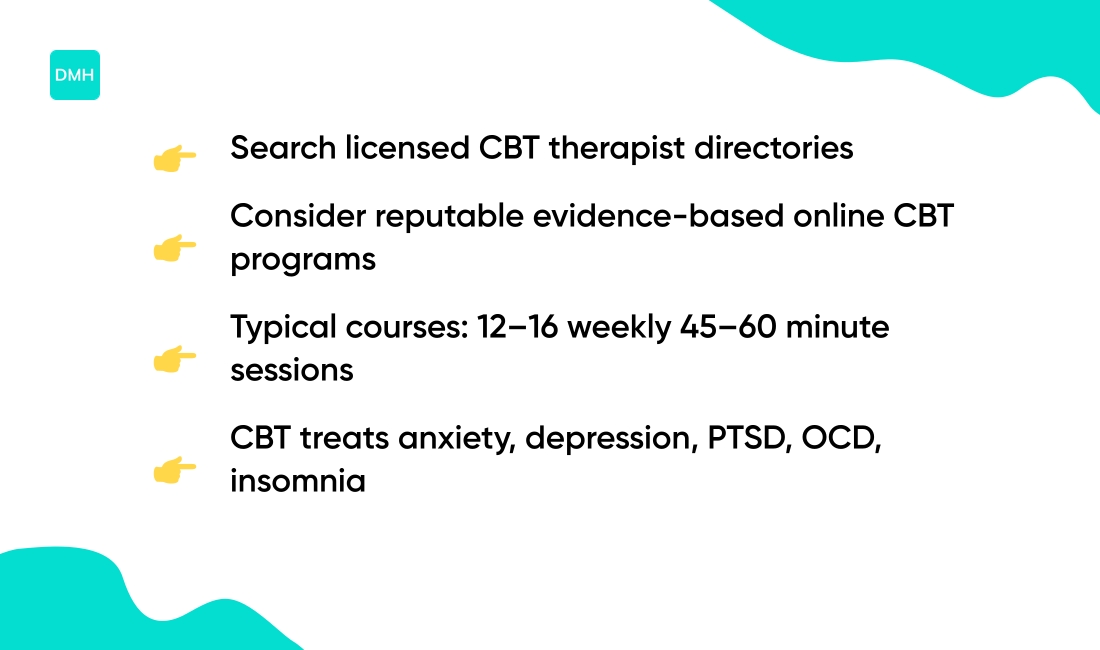
Search licensed provider directories from state boards or national psychology associations for a qualified CBT therapist. Look for training in CBT, session format, and licensure details. People often search “CBT near me” or “CBT therapist” when starting a search.
Plus, consider evidence-based online CBT programs. Visit reputable sites like ABCT and read program research and user reviews.
Find telehealth options that list therapist credentials and session structure. Online CBT programs can offer flexible scheduling and guided modules.
Expect structured sessions with goal setting, skill practice, and homework. Sessions usually last 45–60 minutes. Typical courses run 12–16 weekly sessions, with symptom change often emerging within weeks for some individuals.
CBT is commonly used for anxiety, depression, OCD, PTSD, and insomnia. Techniques include cognitive restructuring, behavioral activation, exposure therapy, and thought challenging. Simple CBT exercises and worksheets help practice between sessions.
Insurance coverage and sliding-scale clinics affect access. Primary care referrals or community mental health centers often list local CBT options. People may verify telehealth rules and out-of-pocket costs before starting.
Always consult a qualified healthcare professional for medical advice specific to your situation. Not medical advice, content for educational purposes, consult a professional.
You might also like: Is Agoraphobia a Disability? Everything You Need to Know
CBT vs other therapy approaches
Cognitive behavioral therapy (CBT) focuses on the link between thoughts, feelings, and actions. Sessions use structured exercises to test beliefs and change behaviors.
Core methods include cognitive restructuring, behavioral activation, and exposure work.
Dialectical behavior therapy (DBT) grew from CBT. It adds skills for emotion regulation, distress tolerance, and interpersonal effectiveness. DBT often targets severe emotion dysregulation and self-harm.
Some trials suggest DBT can reduce self-injury by about half for people with borderline personality features.
Mindfulness-based cognitive therapy (MBCT) blends mindfulness practice with cognitive techniques. MBCT aims to shift how people relate to thoughts rather than change thought content.
Meta-analyses indicate MBCT may lower relapse risk in recurrent depression by roughly 30–40% for some groups.
Technique differences shape clinical use. CBT emphasizes direct testing of thoughts and graded exposures for anxiety, OCD, and PTSD. DBT emphasizes group skills training and coaching for crisis management. MBCT emphasizes present-moment awareness to prevent depressive relapse.
Clinical fit can vary from person to person. CBT often appears in guidelines for anxiety and depression. DBT often appears in specialist services for emotion dysregulation. MBCT often appears in preventive care for recurrent depression.
We summarize available evidence and explain common terms to aid understanding. Always consult a qualified healthcare professional for medical advice specific to your situation.
Not medical advice, content for educational purposes, consult a professional.
Read also: How to Tell PTSD vs Anxiety Apart: Key Differences
How long does CBT take to show results
Cognitive behavioral therapy typically runs for about 12-16 weekly sessions. Sessions last 45–60 minutes. Many therapists use a manualized plan with clear goals.
Symptom improvement may begin within 4–8 sessions for mild to moderate anxiety or depression. Progress can vary from person to person. Severity, co-occurring conditions, life stress, and session frequency all affect pace.
Therapy format matters. Short-term online CBT programs often deliver structured CBT exercises and homework across 8–12 weeks.
Intensive formats or combined approaches can speed gains for some individuals. Therapist skill and patient engagement influence outcomes.
Recent brain imaging research links clinical gains to measurable neural change. Some studies suggest changes in prefrontal regulation and limbic reactivity that align with symptom reduction.
We summarize available evidence and note that not everyone follows the same timeline. Maintenance work and booster sessions may help preserve gains.
Practical CBT techniques include cognitive restructuring, behavioral activation, exposure therapy, and thought challenging. Always consult a qualified healthcare professional for medical advice specific to your situation.
Not medical advice, content for educational purposes, consult a professional.
Read also: How to Stop an OCD Spiral: 5 Effective Strategies
Educational notice: This content is provided for informational and educational purposes only and is not intended as medical advice. Always consult a qualified healthcare professional for medical concerns.