When bright lights glare and reading becomes a struggle, many people start considering cataract surgery.
Vision loss from cataracts can make driving, hobbies, and household tasks harder.
It’s often gradual, so patients delay care.
Cataract surgery is a common outpatient lens replacement that restores clarity by removing the cloudy natural lens and placing an intraocular lens (IOL).
This article walks through the cataract surgery procedure step-by-step, compares IOL choices (monofocal, multifocal, toric), explains laser versus traditional techniques, and outlines recovery, risks, and costs so you’ll know what to expect.
You’ll learn how surgeons select lenses, what to ask your doctor, and how recovery typically progresses so you can plan with confidence.
What is cataract surgery
Cataract surgery is an outpatient procedure that removes the eye’s cloudy natural lens. Surgeons replace that lens with a clear artificial intraocular lens (IOL) to restore clearer vision.
Most procedures take 10 to 20 minutes per eye. Local anesthesia keeps patients comfortable while they remain awake.
Most surgeons perform a modern technique called phacoemulsification. Ultrasound energy breaks the lens into tiny pieces for suction removal. Some centers offer femtosecond laser-assisted surgery, which may increase precision for corneal incisions and capsule openings.
IOL power gets chosen from precise eye measurements. These measurements help target distance vision or reduce dependence on glasses. Many studies report improved vision in over 90% of treated eyes, with vision often improving within 24 to 48 hours.
Full recovery usually occurs within a few weeks. Follow-up visits check healing, eye pressure, and visual outcomes.
Risks include infection, inflammation, and posterior capsule opacification. Most complications remain uncommon and manageable when identified early. Medicare often covers standard cataract surgery, though out-of-pocket costs may apply for premium IOLs or laser upgrades.
For informational purposes only — always consult a qualified healthcare professional for medical advice specific to your situation.
The cataract surgery procedure: step-by-step
Pre-surgery evaluation and IOL selection
Ophthalmologists measure the eye before cataract surgery to predict post-op vision. Optical biometry (IOLMaster) measures axial length and anterior chamber depth with sub-millimeter accuracy.
Axial length often ranges 21–25 mm, and a 0.1 mm error can change IOL power by about 0.27 diopters. Corneal shape gets assessed through keratometry and corneal topography to map astigmatism.
Retina health receives spectral-domain OCT to check for macular disease that might limit visual outcomes. Endothelial cell count comes from specular microscopy to assess surgical risk.
IOL power uses formulas such as SRK/T, Holladay, or Barrett Universal II. Surgeons choose an intraocular lens type like monofocal or toric based on corneal astigmatism and patient goals. Toric lens cataract surgery often suits corneal astigmatism above about 0.75 diopters.
Not medical advice. Content for educational purposes only. Always consult a qualified healthcare professional for medical advice specific to your situation.
Anesthesia and patient preparation
Before cataract surgery, staff review medical history and medications. Most patients receive topical anesthesia through numbing eye drops applied to the surface of the eye.
Some patients receive a local injection around the eye for deeper numbness. Light intravenous sedation may be offered to reduce anxiety while patients remain awake during the procedure.
Staff monitor heart rate and oxygen saturation. The eye is cleaned and a sterile drape placed to reduce infection risk. The surgeon explains intraoperative steps and expected sensations — light pressure or movement may be felt during phacoemulsification and lens insertion.
Recovery varies by person and may affect overall healing time. For informational purposes only. Always consult a qualified healthcare professional for medical advice specific to your situation.
Small incision and capsule opening
A tiny corneal incision creates access to the lens during cataract surgery. Surgeons commonly make incisions that measure 2.2–2.8 mm, which preserves eye shape and may avoid sutures.
A circular opening in the anterior lens capsule, called a capsulotomy, lets the surgeon reach the cloudy lens material. Some clinics offer femtosecond laser cataract surgery that creates a highly consistent capsulotomy.
Laser planning can reduce ultrasound energy during phacoemulsification and may improve reproducibility of the capsulotomy. The small incision then allows insertion of a folded intraocular lens into the capsule where it unfolds and stays in place.
For informational purposes only. Always consult a qualified healthcare professional for medical advice specific to your situation.
Phacoemulsification: breaking up and removing the cataract
Phacoemulsification is the common method used during cataract surgery to remove the cloudy lens. The technique uses high-frequency ultrasound to break the lens into tiny pieces.
A small probe vibrates at about 40 kHz and emulsifies the tissue for suction. Surgeons typically use a tiny corneal incision, often 2.2 to 2.8 mm. The probe suctions fragments and maintains the lens capsule for the intraocular lens placement.
Newer machines use lower ultrasound power and advanced pumps. These systems offer improved fluid control and more stable pressure during aspiration. Effective phaco time often falls below 30 seconds in routine cases, which may reduce stress on the cornea.
Not a medical advice, content for educational purposes. Always consult a qualified healthcare professional for medical advice specific to your situation.
Intraocular lens implantation and closing
During cataract surgery, the surgeon inserts a folded intraocular lens through a small corneal incision that measures about 2.2–2.8 mm. The lens passes through an injector and unfolds inside the capsular bag.
The optic and haptics seat within the capsule to provide stable positioning. Phacoemulsification removes the cloudy lens first, so implantation typically adds only a few minutes to the operation.
Many lens types work in this step, including monofocal, multifocal, and toric lenses for astigmatism correction. Surgeons usually don’t place sutures for incisions under 3 mm — the wound often self-seals with normal eye pressure and corneal architecture, leaving no stitches needed in most cases.
Healing times can vary and often span days to weeks. Always consult a qualified healthcare professional for medical advice specific to your situation.
Types of intraocular lenses: choosing the right IOL
Monofocal vs multifocal lenses
Standard single-focus lenses set the intraocular lens for one distance, usually distance vision. These lenses are common in cataract surgery and often require reading glasses for near tasks.
Advanced multifocal options split incoming light to provide both near and distance focus. Some studies report spectacle independence in roughly 50–80% of patients after implantation. But here’s the thing: multifocal IOLs may cause halos, glare, and reduced contrast sensitivity.
Some people notice these effects more at night and while driving. Multifocal lenses can increase out-of-pocket expenses. Medicare often covers lens replacement but not premium IOL upgrades.
Choice depends on lifestyle, visual priorities, and tolerance for trade-offs. Always consult a qualified ophthalmologist for a personalized assessment.
Toric lenses for astigmatism correction
Toric intraocular lenses are IOLs designed to reduce corneal astigmatism during lens replacement. Surgeons measure corneal curvature and axis before surgery to choose the right cylinder power.
The surgeon aligns the toric lens with the corneal axis inside the capsular bag. Correct alignment reduces astigmatic blur and often lowers reliance on distance glasses. Many toric models correct about 0.75 to 4.00 diopters of corneal astigmatism.
Small lens rotation can reduce effect. Rotation under 10 degrees preserves most benefit. Toric lenses work with modern phacoemulsification and femtosecond laser methods to aid precise placement.
How predictable are your astigmatism correction outcomes? Results vary by corneal regularity and healing. Careful preoperative planning and intraoperative marking improve predictability.
Not medical advice; content for educational purposes. Always consult a qualified healthcare professional for medical advice specific to your situation.
Light-adjustable and advanced IOL technology
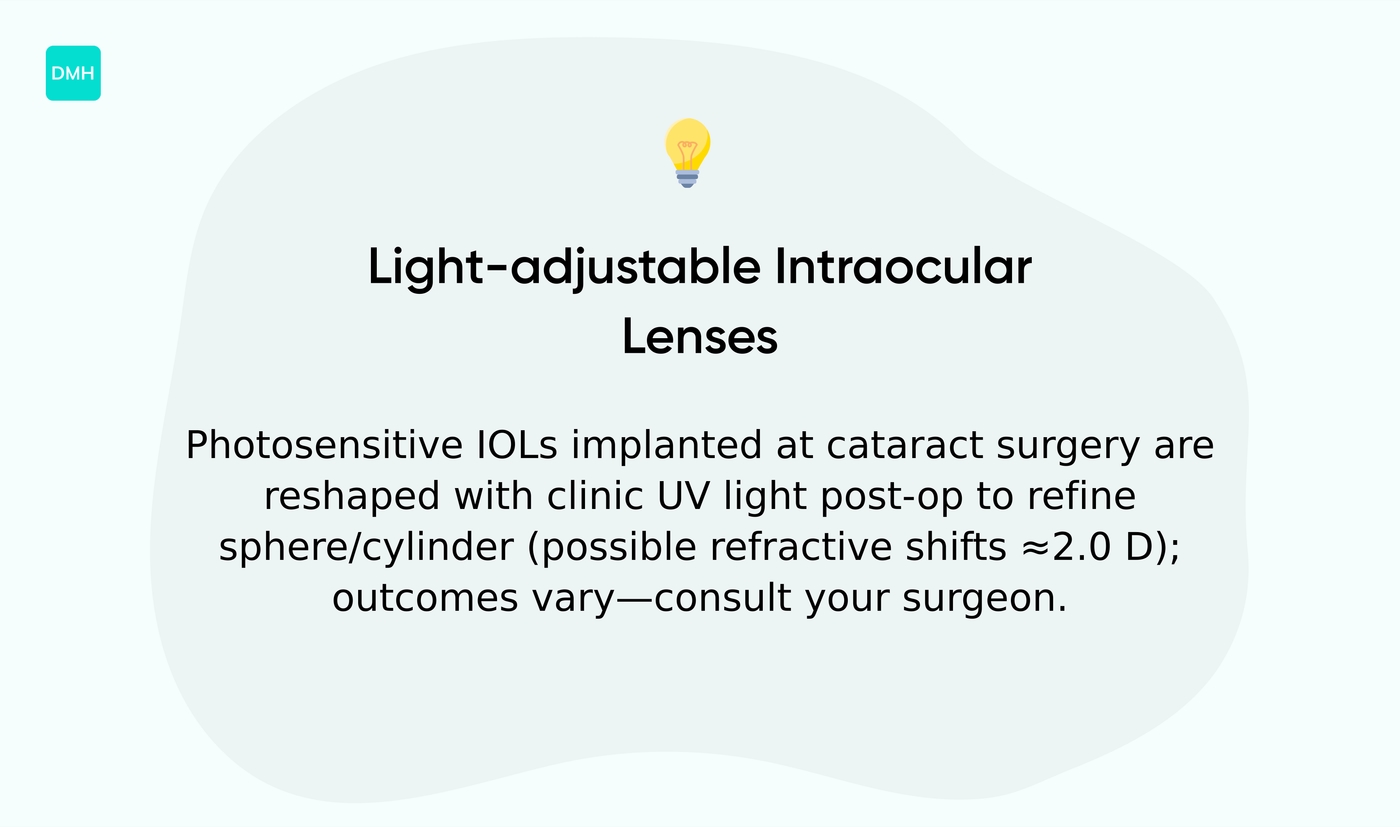
Light-adjustable lenses contain a photosensitive polymer that changes shape when exposed to controlled UV light. Surgeons implant the intraocular lens during routine cataract surgery through a small incision.
After the eye heals, brief clinic-based light treatments refine the lens power. This option may allow postoperative adjustments to sphere and cylinder. Some studies report refractive shifts up to about 2.0 diopters and improved accuracy in achieving target vision (though outcomes can vary from person to person based on healing and baseline measurements).
These lenses join monofocal, multifocal, toric, and extended depth of focus options as part of modern lens selection. Patients considering lens choices for lens replacement surgery can review reputable summaries such as Yale Medicine for detailed descriptions and comparisons.
For informational purposes only — always consult a qualified healthcare professional for medical advice specific to your situation.
Laser cataract surgery vs traditional cataract surgery
Two main approaches exist for cataract surgery: femtosecond laser assistance and conventional phacoemulsification. The laser creates a circular capsulotomy with submillimeter consistency, and some studies show improved centration and repeatable capsulotomy size.
Laser pretreatment can reduce phacoemulsification energy by about 20–40% in selected cases. Lower energy may mean less corneal swelling and faster visual clarity during early recovery.
Final visual acuity often matches between methods for standard monofocal IOLs. Reports show similar long-term outcomes for routine lens replacement surgery. Laser cataract surgery typically adds out-of-pocket cost, commonly $700–2,000 per eye.
Medicare coverage for the basic cataract procedure usually applies, while the laser fee may not. Laser may offer advantages for dense cataracts, small pupils, or precise astigmatism correction. This approach can assist with accurate toric lens alignment and challenging anatomy.
Ask about surgeon experience, measured complication rates, and expected recovery time. Some studies suggest reduced ultrasound exposure lowers certain risks, yet evidence varies by study design.
Not medical advice, content for educational purposes only. Always consult a qualified healthcare professional for medical advice specific to your situation.
Cataract surgery recovery time and aftercare
Recovery after cataract surgery can vary from person to person. Many patients notice clearer vision within 24 to 48 hours. Full healing around the incision and eye tissues often takes 4 to 6 weeks.
Clinic staff usually place a protective shield on the eye. Mild discomfort, tearing, and light sensitivity are common. Surgeons commonly prescribe antibiotic and steroid drops — use a strict schedule for prescription eye drops to lower infection and inflammation risks.
Here’s a typical timeline and limits:
| Timeframe | What to Expect |
|---|---|
| 24–48 hours | Vision often improves enough for basic tasks |
| 48 hours to 1 week | Resume light activities if comfort allows |
| 1 week | Avoid strenuous lifting and heavy bending to reduce pressure spikes |
| 2 weeks | Avoid swimming and hot tubs to limit infection risk |
| 4–6 weeks | Tissues usually reach near-normal strength |
Driving may resume when vision meets local legal standards and the surgeon confirms safety. Many people resume driving within a few days to a week, depending on clarity and reaction time.
Follow-up visits often occur within 24–48 hours, at one week, and at four to six weeks to check the intraocular lens and healing. Report sudden vision loss, severe pain, or increasing redness right away.
For minor surface irritation, read guidance on how to heal a scratched eye naturally.
Not medical advice. Content for educational purposes only. Always consult a qualified healthcare professional for medical advice specific to your situation.
Cataract surgery risks and complications
Cataract surgery can improve vision but carries potential risks. You may encounter complications after lens replacement surgery.
Common issues include infection, inflammation, bleeding, and posterior capsule opacification. Retinal detachment and corneal edema occur less often. Postoperative infection (endophthalmitis) is rare — large studies report rates around 0.04% to 0.1%.
Mild inflammation is common and usually resolves with drops. Significant bleeding or suprachoroidal hemorrhage remains very uncommon, often under 0.1%. Clouding of the capsular bag may affect 10–30% of patients over several years and often follows implantation of an intraocular lens.
Surgeons use specific steps to lower risks. They apply povidone-iodine to the eye preoperatively and maintain strict sterile technique. Phacoemulsification through a small incision reduces wound problems. Perioperative topical antibiotics and steroid drops control infection and inflammation.
Management depends on the complication. YAG laser capsulotomy clears capsule clouding quickly and safely for many people. Suspected infection prompts urgent antibiotic injections and close follow-up. Retinal detachment may require vitrectomy or retinal repair surgery.
Risk varies by patient factors such as prior eye surgery, diabetes, or ocular inflammation. What’s your individual risk profile? Discuss individualized risk with a surgeon before booking surgery.
Not medical advice. For informational purposes only. Always consult a qualified healthcare professional for medical advice specific to your situation.
Posterior capsule opacification and YAG laser capsulotomy
Posterior capsule opacification occurs when residual lens cells grow on the thin capsule that holds the intraocular lens after cataract surgery. The clouding can develop months or years after lens replacement surgery.
Patients may notice blurred vision, glare, or reduced contrast. Surgeons leave the posterior capsule intact to support the artificial lens, but lens epithelial cells can migrate and form a fog on that capsule.
Incidence varies by lens type and surgical technique and may range from about 10% to 50% within five years. Modern IOL designs and careful polishing reduce that risk.
YAG laser capsulotomy is a quick outpatient procedure to restore clear vision. The ophthalmologist uses a YAG laser to make a small opening in the cloudy capsule. The treatment takes minutes, and vision often improves within days. Success rates often exceed 90% for clearing the visual axis.
The procedure may carry small risks. Possible issues include transient pressure spikes, floaters, IOL shift, or a slightly higher risk of retinal detachment.
For example, a person with new blur six months after cataract surgery can have a YAG laser session and regain useful vision within days.
Not a medical advice, content for educational purposes. Always consult a qualified healthcare professional for medical advice specific to your situation.
Cataract surgery cost and Medicare coverage
Cataract surgery removes a cloudy natural lens and replaces it with an intraocular lens. Costs vary by technique, lens choice, and regional rates.
Traditional phacoemulsification often costs between $3,000 and $5,000 per eye billed to the insurer. Medicare Part B generally covers medically necessary surgery and a standard monofocal IOL. Medicare typically pays about 80% of the Medicare-allowed amount after the Part B deductible, leaving roughly 20% coinsurance for the patient unless supplemental coverage applies.
Laser cataract surgery usually adds an out-of-pocket fee. Practices report laser fees from $1,000 to $2,500 per eye, and practices may bill that fee separately from Medicare-covered charges.
Premium IOLs cost extra fees. Multifocal, extended depth of focus, toric, and light-adjustable lenses commonly add $1,500 to $4,000 per eye. Medicare often doesn’t cover these premium lens upgrades.
An example clarifies totals. If Medicare-allowed charges equal $4,000 and Medicare covers 80%, the patient’s coinsurance would be about $800. Adding a $2,000 premium IOL raises out-of-pocket cost to about $2,800 for that eye. Actual amounts can vary by provider, region, and insurance plan.
Other charges may include anesthesia, preoperative testing, or postoperative enhancements. Some Medicare Advantage plans or Medigap policies reduce out-of-pocket exposure. Patients can request an itemized estimate and confirm coverage with Medicare or their plan.
For informational purposes only — always consult a qualified healthcare professional for medical advice specific to your situation.
You’ll also like: How To Tighten Eyelid Skin Without Surgery
How to find the best cataract surgeon near you
Choosing a qualified ophthalmologist can influence cataract surgery outcomes and recovery. Look for verifiable credentials and clear outcome data when evaluating providers.
Key credentials to verify:
- Board certification from the American Board of Ophthalmology or equivalent
- Fellowship training in cataract or refractive surgery when available
- Active hospital privileges and facility accreditation
- Transparent published complication rates and patient satisfaction data
Ask focused questions during consultations to compare surgeons and clinics:
- How many cataract surgeries do you perform per year and overall?
- What’s your rate of posterior capsule rupture or other major complications?
- Which intraocular lens options do you offer and what are trade-offs?
- Do you offer femtosecond laser cataract surgery and what are added costs?
- What follow-up care covers recovery time and YAG capsulotomy if needed?
- How does insurance or Medicare coverage affect costs and premium IOLs?
Experience often links to lower complication rates. Some studies suggest higher-volume surgeons report fewer surgical complications. Individual outcomes can vary with ocular health, such as macular disease, corneal issues, or diabetes.
Facility resources, surgical technique like phacoemulsification, and IOL choice influence visual results and risks. Compare measurable data, seek a second opinion for complex eyes, and review patient testimonials for practical insight.
For informational purposes only — always consult a qualified healthcare professional for medical advice specific to your situation.
You might also like: How to Remove Age Spots Naturally at Home
Latest advances in cataract surgery technology
Recent technology may improve precision and customization for cataract surgery. Intraoperative imaging advances such as intraoperative OCT provide live cross-sectional views during lens removal.
Surgeons can confirm capsule integrity and lens placement during the procedure. Real-time aberrometry measures refractive error immediately after lens placement, and that information can refine intraocular lens (IOL) power choices and reduce refractive surprises.
Same-day bilateral surgery offers the option to treat both eyes on one day for selected patients. Some reports describe faster visual restoration and higher patient convenience with careful case selection (though this approach isn’t suitable for everyone).
Femtosecond laser cataract surgery improves capsulotomy and lens fragmentation precision. Modern phacoemulsification systems cut ultrasound time and improve fluid control during lens removal.
Precision lens customization appears in toric IOLs for astigmatism correction and light-adjustable IOLs for post-op tuning. Some series report 80–90% of eyes achieve refractive outcomes within ±0.5 D of target after advanced planning.
Artificial intelligence tools aim to refine IOL calculations by integrating large biometric datasets. Advances may shorten recovery time and lower the rate of refractive complaints. Patients should weigh costs and risks when considering premium options.
Further reading on the latest advances in cataract surgery is available at Cohen Eye Institute.
For informational purposes only — always consult a qualified healthcare professional for medical advice specific to your situation.
You’ll also like: What Is Heterochromia and Why Does It Occur?
Educational notice: This content is provided for informational and educational purposes only and is not intended as medical advice. Always consult a qualified healthcare professional for medical concerns.