That sudden jaw pain that wakes you at night is hard to ignore.
It often signals a deeper dental issue.
Wisdom teeth removal is one of the most common solutions when third molars cause pain, impaction, infection, or crowding.
Left untreated, problematic wisdom teeth can lead to infections, damage to nearby teeth, persistent swelling, or painful complications like dry socket.
This guide breaks down how extractions work, anesthesia options, what to expect during recovery, and practical aftercare tips (yes, even what and when to eat).
You’ll learn how to recognize signs that need extraction, how to prepare for surgery, how to reduce swelling and pain, and when to contact an oral surgeon.
By the end you’ll be able to make an informed choice about timing, costs, and choosing a qualified oral surgeon near you.
What are wisdom teeth and when do they need removal
Third molars are the last permanent teeth to emerge. They appear between ages 17 and 25 in many people.
These molars often lack room to come in straight. Limited jaw space can lead to impaction or partial eruption.
Common reasons for wisdom teeth removal include:
- Pain that doesn’t ease with short-term measures
- Repeated gum or tooth infection near the back molars
- Impaction where a tooth sits trapped under gum or bone
- Crowding or shifting of nearby teeth
- Decay or gum disease that affects the wisdom tooth or adjacent teeth
- Cyst formation or bone damage visible on X-ray
Simple extractions may take 20 to 40 minutes per tooth. Surgical removals for impacted teeth can take longer, with recovery time varying by complexity and patient factors.
People often have an oral surgery evaluation when symptoms persist or X-rays show problems. Imaging helps determine if removal lowers future risk.
Here’s the thing: not everyone needs their wisdom teeth removed. Current guidance suggests removal is typically recommended only when teeth are causing problems or are likely to in the future. If your wisdom teeth are healthy, fully erupted, and not harming nearby structures, they may be left alone.
More information about related conditions is available at wisdom teeth conditions.
Not medical advice. Content for educational purposes; consult a professional.
Always consult a qualified healthcare professional for medical advice specific to your situation.
Signs you need wisdom teeth extraction
What are the signs of impacted wisdom teeth
A third molar that stays trapped under gum or jawbone is called impacted wisdom teeth.
Symptoms can vary from person to person and by how the tooth sits.
- Persistent pain near the back molar that may spread to the ear or temple
- Swelling of the gum or cheek next to the tooth
- Limited mouth opening or difficulty opening mouth
- Red, tender gum tissue around a partially erupted tooth
- Recurrent bad taste, pus discharge, or persistent bad breath suggesting infection
- Fever, swollen lymph nodes, or trouble swallowing in more advanced cases
- Pressure on adjacent teeth or bite changes noted by a dentist or on X-ray
Dental imaging often confirms impaction and helps plan wisdom teeth removal. People with ongoing pain or signs of infection may need prompt dental evaluation.
Not medical advice. Content for educational purposes; consult a professional.
Always consult a qualified healthcare professional for medical advice specific to your situation.
How do I know if I have a wisdom tooth infection
A wisdom teeth infection means inflammation or pus around a third molar. The term pericoronitis describes infection around a partially erupted tooth.
What warning signs should you watch for?
- Persistent pain near the back molar that lasts more than 48 hours or worsens with chewing
- Visible swelling of the gum or cheek that may limit mouth opening
- Fever above 100.4°F (38°C) or tender lymph nodes in the neck
- Foul taste or chronic bad breath, which can signal pus drainage
- Difficulty swallowing or breathing (these signs may indicate a serious spread and need urgent care)
Redness, trouble opening the jaw, and pain radiating to the ear also occur. Severe or persistent symptoms may require immediate dental attention.
Not medical advice. Content for educational purposes; consult a professional.
Always consult a qualified healthcare professional for medical advice specific to your situation.
What age is best for removing wisdom teeth
Wisdom teeth removal is often simplest in the late teens to early twenties.
Roots finish forming around the mid-20s. Bone density increases with age, which can make extraction more complex later on.
Earlier extraction may mean easier surgery and shorter procedures. Young patients often have faster healing and less swelling after wisdom teeth surgery.
Plus, impacted wisdom teeth can cause pain, infection, crowding, and decay. Those problems prompt evaluation and possible extraction.
Oral surgeons use panoramic X-rays to check tooth position and root development. Imaging helps plan whether a simple extraction or surgical removal suits the case.
Some studies suggest complication rates rise with age. Adults, especially older adults, can face more difficulty and higher complication risk than younger patients.
A consultation with a qualified oral surgeon can clarify timing, risks, and recovery expectations.
Not medical advice. Content for educational purposes; consult a professional.
Always consult a qualified healthcare professional for medical advice specific to your situation.
How to prepare for wisdom teeth removal surgery
Preparation can make the surgical day smoother and the recovery easier. This section outlines practical steps often recommended before a wisdom teeth removal procedure.
- Oral surgeon consultation: Schedule a visit to review X-rays, anesthesia options, and expected extraction complexity. Share full medical history and a current medication list, including herbal supplements.
- Fasting rules vary by anesthesia. The American Society of Anesthesiologists commonly recommends no solid food for 6–8 hours and no clear liquids for 2 hours before general anesthesia or deep sedation.
- Arrange transportation. Many forms of sedation impair driving for 24 hours. Plan a ride home and someone to stay for the first night if moderate or deep sedation is used.
- Plan recovery time off work or school. Simple extractions often need 1–3 days; impacted or surgical removals may require 5–7 days or more depending on pain and swelling.
- Prepare the home. Stock soft foods, ice packs, clear liquids, and easy-to-open items. Have commonly used items within reach to limit activity during the first 48 hours.
- Confirm insurance details and bring ID. Ask the office about expected costs and whether preauthorization is needed for sedation or surgical removal.
Not medical advice. Content for educational purposes; consult a professional.
Always consult a qualified healthcare professional for medical advice specific to your situation.
The wisdom teeth removal procedure explained
Is sedation or local anesthesia better for wisdom teeth removal
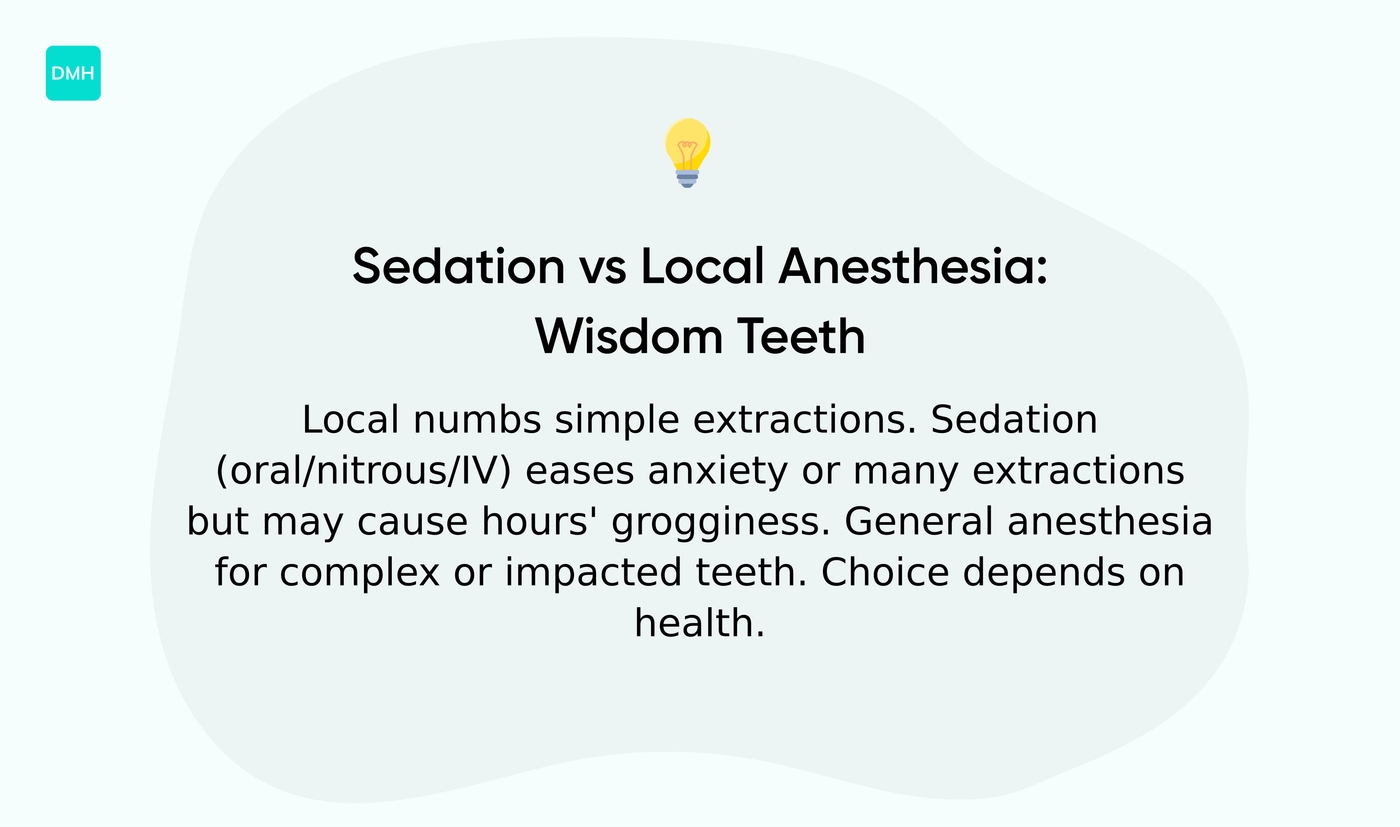
Wisdom teeth removal can use local anesthesia, sedation, or general anesthesia.
Local anesthesia numbs the area. It suits straightforward, erupted teeth. Procedures often last under 30 minutes for a single, simple extraction.
Moderate sedation reduces anxiety and awareness. Sedation options include oral pills, nitrous oxide, or IV medication. Sedation for anxiety may suit patients with dental fear or multiple extractions. Recovery from sedation can add several hours of grogginess.
General anesthesia places patients fully asleep. Oral surgeons reserve it for very complex cases, extensive surgery, or medical needs. General anesthesia requires monitored care and longer recovery.
Choice depends on tooth position, surgical complexity, medical history, and patient comfort. Impacted wisdom teeth may require surgical removal under sedation or general anesthesia.
Not medical advice. Content for educational purposes; consult a professional.
Always consult a qualified healthcare professional for medical advice specific to your situation.
How painful is wisdom teeth surgery
Most patients report mild to moderate discomfort after wisdom teeth surgery.
Local anesthesia usually blocks pain during the procedure. Sedation or general anesthesia can reduce awareness for complex cases.
Pain often peaks 24-48 hours after extraction. Swelling and soreness typically decline after three days.
Many people return to normal activities within seven days. Full soft-tissue healing may take up to two weeks, though the procedure commonly takes about an hour and full recovery is often around two weeks.
Sharp, worsening pain that appears several days after surgery may signal a dry socket. That complication affects a small percentage of patients and often needs prompt dental care.
Clinical practice commonly uses over-the-counter anti-inflammatory medications for pain control. Prescribed analgesics may appear for more difficult extractions.
Wisdom teeth removal and wisdom teeth pain vary from person to person depending on impaction and health factors.
Not medical advice. Content for educational purposes; consult a professional.
Always consult a qualified healthcare professional for medical advice specific to your situation.
Do I need stitches after wisdom tooth removal
This section explains when stitches appear after wisdom teeth removal.
Simple extractions often heal without sutures. Surgical extractions for impacted wisdom teeth commonly need stitches to close the gum flap and control bleeding.
Clinicians use two main suture types. Dissolvable suture types often dissolve in about 7–10 days. Removable suture removal usually occurs at a clinic visit around 5–7 days.
Suture material can vary by surgeon and case. Absorbable sutures may be made from gut or synthetic polymers, while nonabsorbable sutures often use nylon or silk.
Postoperative care follows common clinical practice. Gentle saltwater rinses (1/2 teaspoon salt in 8 ounces warm water) may begin 24 hours after surgery. Clinicians commonly advise against straws and smoking for 72 hours to lower dry socket risk.
Monitor for heavy bleeding, increasing pain, fever, or unusual discharge and contact a provider if these occur.
Stitches after extraction require follow-up when nonabsorbable material is used. Dissolvable stitches often fall out or dissolve on their own.
Not medical advice. Content for educational purposes; consult a professional.
Always consult a qualified healthcare professional for medical advice specific to your situation.
Wisdom teeth removal recovery timeline and care
What can I eat after wisdom teeth removal
After wisdom teeth removal, choose gentle textures that limit pressure on extraction sites.
Day 1–3: Stick to clear liquids and cold options. Try broths, plain yogurt, and smoothies without seeds. Straws may dislodge blood clots and increase risk (so skip them for now).
Day 3–7: Shift to purees and warm soups. Try mashed potatoes, applesauce, oatmeal, and blended vegetable soups. Keep foods lukewarm to avoid irritation.
Week 2+: Reintroduce soft solids as comfort allows. Soft pasta, scrambled eggs, tender fish, and ripe banana can work. Hard, crunchy, and sticky items can irritate healing tissue.
Chewing near extraction sites can cause discomfort. Hydration supports healing, and pain can be managed with prescribed medications per provider guidance.
Not medical advice. Content for educational purposes; consult a professional.
Always consult a qualified healthcare professional for medical advice specific to your situation.
How soon can I brush my teeth after wisdom teeth removal
After wisdom teeth removal, people can brush teeth not near the extraction sites right away. Gentle cleaning of adjacent teeth limits plaque buildup.
Dentists often advise waiting 24 hours before brushing directly over the socket. Rough brushing can dislodge the blood clot and raise the risk of dry socket.
When practicing brushing after extraction, choose a soft-bristled brush. Use small, light strokes and avoid the surgical area for the first day.
After 24 hours, warm saline rinses may help. Mix 1/2 teaspoon salt with 8 ounces warm water and rinse gently three to four times daily.
Seek prompt dental attention for increasing pain, heavy bleeding, fever, or persistent swelling. Smoking, using straws, and vigorous rinsing can delay healing.
Warm saline rinses complement mechanical cleaning and may reduce bacterial load around sockets.
Not medical advice. Content for educational purposes; consult a professional.
Always consult a qualified healthcare professional for medical advice specific to your situation.
What helps with swelling after wisdom teeth removal
Swelling after wisdom teeth removal is common. It often peaks 48 to 72 hours after surgery.
Ice pack application helps most in the first 24 to 48 hours. Apply cold to the cheek in 15-minute intervals. Wrap the ice in a thin cloth to protect skin.
Head elevation reduces fluid buildup while resting. Use extra pillows and sleep with the head above heart level for 48 to 72 hours.
Prescribed medications may include anti-inflammatories and pain relievers prescribed by a clinician. Over-the-counter options can reduce swelling for many patients, according to clinical guidance.
Most swelling subsides by day 7. Many people see near-full resolution by day 10. Worsening swelling after 72 hours or fever may indicate infection and warrant prompt clinical assessment.
Not medical advice. Content for educational purposes; consult a professional.
Always consult a qualified healthcare professional for medical advice specific to your situation.
Preventing and managing wisdom teeth removal complications
How do I prevent dry socket after wisdom tooth extraction
Dry socket, or alveolar osteitis, happens when a blood clot fails to form or is lost after a wisdom tooth extraction.
Reported incidence ranges from about 2% to 5% for routine extractions and can reach around 20% after impacted lower molar surgery.
- Avoid tobacco use. Smoking and nicotine use may raise the risk of a dry socket. Avoid smoking cigarettes for at least 72 hours.
- Avoid suction actions. Using straws or strong spitting can dislodge the clot after wisdom teeth removal.
- Avoid vigorous rinsing. Gentle saline rinses often begin about 24 hours after surgery and may help clear debris. Gentle saline rinse
- Follow postoperative guidance closely. Rest, avoid heavy exertion for 48–72 hours, and follow medication instructions from the oral surgeon.
- Know symptoms to watch for: severe pain starting 3–5 days after extraction, a foul taste, or visible bone in the socket. Dry socket symptoms
Not medical advice. Content for educational purposes; consult a professional.
Always consult a qualified healthcare professional for medical advice specific to your situation.
Warning signs of post-extraction complications
After wisdom teeth removal, certain symptoms may indicate complications.
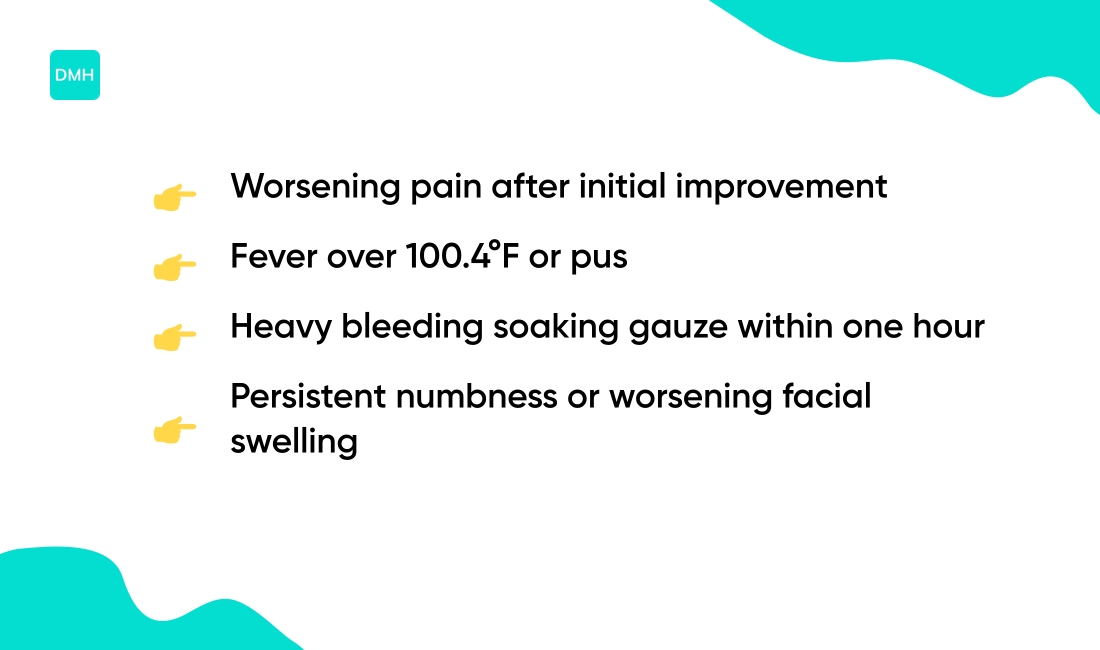
If you notice worsening pain after initial improvement, this may signal a dry socket or infection.
A fever above 100.4°F (38°C) or pus-like drainage suggests infection.
Heavy bleeding that soaks a gauze pad within one hour or bright red flow calls for immediate dental contact.
A persistent foul taste or bad breath that doesn’t improve may mean infection.
Growing swelling after 48 hours or new swelling of the face, jaw, or throat can impair breathing or swallowing.
Persistent numbness beyond two weeks, or sudden loss of sensation, may reflect nerve injury and needs prompt assessment.
These signs can be truly urgent. Not medical advice. Content for educational purposes; consult a professional.
Always consult a qualified healthcare professional for medical advice specific to your situation.
How much does wisdom teeth removal cost
Does insurance cover wisdom teeth extraction
Insurance coverage varies by plan and procedure. Many dental plans cover 50–80% for simple extractions.
Surgical removal of impacted wisdom teeth often classifies as major services and may receive lower percentage coverage. Medical insurance can cover the procedure when documented as medically necessary, such as severe infection or related hospitalization.
Preauthorization may affect payment.
| Procedure Type | With Insurance (Out-of-Pocket) | Without Insurance |
|---|---|---|
| Simple Extraction | $75–$200 per tooth | $200–$400 per tooth |
| Surgical Impacted Extraction | $225–$600 per tooth | $400–$800 per tooth |
Annual dental maximums often range $1,000–$2,000 and deductibles vary by plan.
Patients may contact the insurer for estimated benefits and request an itemized quote from the oral surgeon. According to Delta Dental and the American Dental Association, plan limits, waiting periods, and provider networks cause wide variation in coverage.
Wisdom tooth extraction medical necessity requirements out-of-pocket cost
Not medical advice. Content for educational purposes; consult a professional.
Always consult a qualified healthcare professional for medical advice specific to your situation.
You might also like: About us – Daily Medical Health
How to find a good oral surgeon for wisdom teeth near me
Choosing a qualified surgeon can affect comfort, recovery time, and outcomes. Look for clear credentials and relevant experience.
- Check credentials. Confirm board certification from the American Board of Oral and Maxillofacial Surgery. Verify hospital privileges and years of surgical experience.
- Read patient reviews. Focus on comments about pain control, follow-up care, and recovery. Watch for repeated praise or repeated concerns.
- Verify insurance acceptance. Ask about in-network status and typical out-of-pocket costs for wisdom teeth removal and related services.
- Evaluate office technology. Practices that use cone beam CT and modern sedation options often provide clearer surgical planning for wisdom tooth extraction.
- Schedule a consultation. Use the visit to assess communication, ask about expected recovery time, and learn the surgeon’s complication rates and pain-control plan.
Consider proximity and emergency access when searching for an oral surgeon near you. Compare two or three surgeons to see differences in care models and fees.
Use local wellness resources for background checks and patient education wellness resources.
Not medical advice. Content for educational purposes; consult a professional.
Always consult a qualified healthcare professional for medical advice specific to your situation.
Read also: All about Nutrition – DailyMedicalHealth
Educational notice: This content is provided for informational and educational purposes only and is not intended as medical advice. Always consult a qualified healthcare professional for medical concerns.