
That mirror reflection with heavy, hooded eyelids can change how someone feels about their face.
When heavy upper lids limit vision or under-eye bags create a tired appearance, blepharoplasty offers a surgical option that treats those issues.
This eyelid surgery removes or repositions excess skin, fat, and muscle through incisions hidden in natural creases, then uses fine stitches to minimize scarring.
Modern approaches (including laser-assisted and transconjunctival techniques) can produce natural-looking results with shorter downtime.
Recovery is usually gradual—bruising and swelling ease over days to weeks, and it’s common to return to desk work within about a week.
You’ll learn how upper and lower procedures differ, what to expect during recovery, typical risks, and how to find a qualified surgeon.
What is blepharoplasty
Eyelid surgery is a surgical procedure that removes or repositions excess skin, fat, and muscle from the upper or lower eyelids.
Surgeons perform blepharoplasty to reduce eyelid droop and under-eye puffiness. The procedure can improve peripheral vision when heavy lids obstruct sight.
Surgeons use small incisions placed along natural creases. They may remove fat, trim loose skin, or tighten muscle to restore a smoother eyelid contour.
Upper eyelid surgery targets hooding and droop that can block vision. Lower eyelid surgery focuses on under-eye bags and puffiness.
Some techniques hide cuts inside the eyelid, such as transconjunctival blepharoplasty. Laser blepharoplasty and resurfacing may be associated with reduced visible scarring and speed recovery.
Recovery can vary from person to person. Many patients see major improvement in 8–10 days, with residual swelling fading over weeks.
Possible risks include temporary dry eyes, scarring, asymmetry, and difficulty closing the eyes. Risk levels vary by anatomy and surgeon experience.
If you consider an eyelid lift, consult a board-certified plastic or oculoplastic surgeon for an individualized assessment. Not a medical advice, content for educational purposes, consult a professional.
How does blepharoplasty work
Upper eyelid surgery technique
Upper blepharoplasty addresses hooding and drooping of the upper lids.
Surgeons place an incision along the natural crease. They remove or reposition excess skin and fat and may trim muscle to refine the contour.
Incision length varies with anatomy and can span a few millimeters to over a centimeter. Fine stitches close the wound for minimal scarring and a subtle eyelid lift.
Surgeons perform the procedure under local anesthesia with sedation or general anesthesia. Early swelling and bruising often subside within days, while final contour can take weeks and can vary from person to person.
Outcomes depend on skin quality, fat distribution, and surgeon technique. Always consult a qualified healthcare professional for medical advice specific to your situation.
Lower eyelid surgery technique
Lower eyelid surgery or lower blepharoplasty removes or repositions fat and tightens loose skin. Surgeons may combine fat sculpting, muscle tightening, and skin trimming to improve puffiness and contour.
The external approach uses an incision just below the lash line. Surgeons remove excess skin and reshape fat pockets. Scars often rest in natural creases and fade over months.
Transconjunctival lower blepharoplasty places the incision inside the eyelid. This hides scars and allows direct access to fat pads. The approach often suits patients with good skin tone and mainly fat-related bulges.
Adjunct steps include fat repositioning and mild skin resurfacing to smooth texture. Typical swelling and bruising often peak at 48 to 72 hours. Recovery can vary from person to person and depends on technique and patient factors.
For related information, see our guide to removing dark circles under eyes. Always consult a qualified healthcare professional for medical advice specific to your situation.
Laser blepharoplasty and modern techniques
Laser blepharoplasty uses focused light to cut and vaporize tissue during eyelid surgery. Surgeons use it for precise skin removal and for resurfacing around the eyes.
According to available research, laser-assisted blepharoplasty techniques may be associated with reduced bleeding and less postoperative bruising. Clinics report that combining fractional laser resurfacing with excision can smooth fine lines and refine texture.
Recovery often runs about 8–10 days. You may notice reduced swelling and less visible scarring compared with some traditional methods. Some patients return to normal activities within a week.
Results can vary from person to person based on skin type and surgical extent. Limitations include variable healing and a need for surgeon experience with lasers.
Not all eyelid concerns suit a laser approach. Faster recovery times may occur for select patients, but evidence varies. Not medical advice—consult a qualified healthcare professional for medical advice specific to your situation.
Types of blepharoplasty procedures
Asian blepharoplasty (double eyelid surgery)
Asian blepharoplasty is commonly used to describe surgery that creates an upper eyelid crease. Double eyelid surgery forms a defined fold while respecting ethnic features.
Surgeons account for unique anatomy such as low crease height, thicker skin, and orbital fat. They choose from incision, suture, or limited tissue adjustment.
The plan preserves eyelid movement and a natural appearance. Upper eyelid surgery methods vary by patient anatomy and aesthetic goals.
Surgery can take 30 to 90 minutes depending on technique. Swelling usually falls by 7 to 10 days, and the crease may settle over about three months.
Blepharoplasty recovery often ranges 7 to 14 days for basic activities. Blepharoplasty risks can include asymmetry, scarring, dry eyes, and lid closure problems. Eyelid lift procedure outcomes can vary from person to person.
Not medical advice, content for educational purposes. Always consult a qualified healthcare professional for medical advice specific to your situation.
Transconjunctival lower blepharoplasty
Transconjunctival lower blepharoplasty removes or repositions fat through an incision made inside the lower eyelid. Surgeons perform this scarless technique to address puffiness without external marks.
Surgeons often select this approach for younger patients with good skin tone and elasticity. If you have under-eye bulges but firm skin, this method may suit your needs.
The procedure targets fat pockets only and avoids skin removal. Recovery can vary from person to person and often shows reduced swelling within 7 to 14 days. Visible scarring remains minimal or absent.
Limitations include limited benefit for loose or excess skin. Surgeons may pair this approach with skin tightening or an external lower eyelid surgery when skin laxity exists. Not a medical advice, content for educational purposes.
Male blepharoplasty techniques
Male blepharoplasty adapts eyelid surgery to male anatomy and aesthetic goals.
Surgeons aim to preserve masculine features while addressing concerns such as heavy upper lids and under eye bags.
Upper eyelid surgery uses incisions in the natural crease. Surgeons remove excess skin conservatively to keep a natural crease.
Lower eyelid surgery may use a transconjunctival approach. This hides scars inside the eyelid and can reduce visible puffiness.
Fat repositioning often fills hollows without over-resection. Canthopexy or canthoplasty reinforces lateral support and helps maintain a strong eyelid shape.
Laser blepharoplasty can lower bleeding and swelling. Recovery can vary from person to person. Typical downtime ranges seven to fourteen days, with some laser methods reporting eight to ten days.
Outcomes depend on anatomy and surgeon technique. Not a medical advice, content for educational purposes, consult a professional.
Revision blepharoplasty
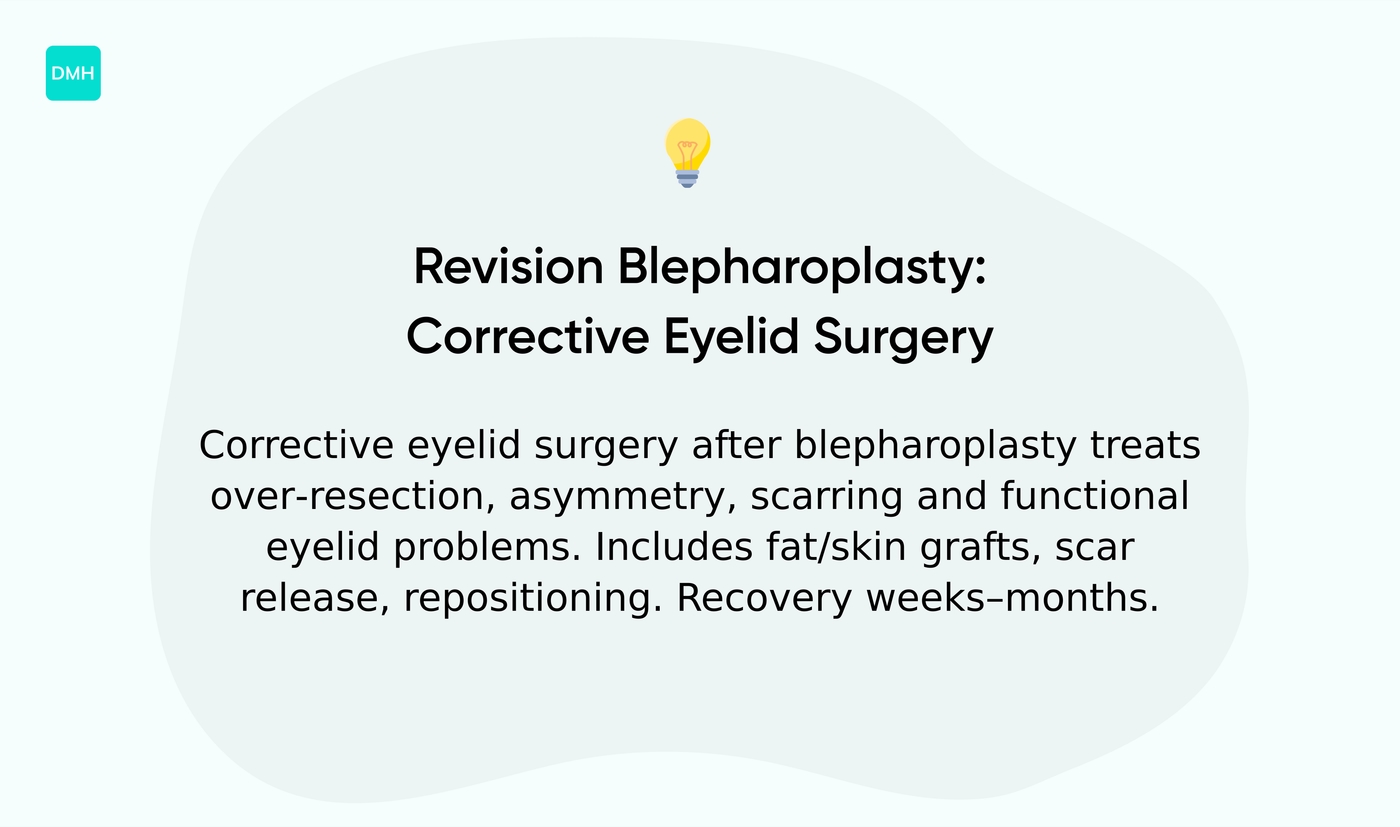
Revision blepharoplasty describes corrective eyelid surgery after an unsatisfactory prior procedure. Surgeons address problems such as excess tissue removal, eyelid asymmetry, scarring, and functional issues that affect blinking.
Common causes include over-removal of skin, uneven fat excision, or wound healing that pulls the lid outward. Reported revision rates vary and are often under 10% according to surgical series.
Surgeons may use fat grafting, skin grafts, scar release, or repositioning of eyelid support structures. These approaches aim for improved eyelid contour and restored function.
Recovery can vary from several weeks to a few months. Outcomes depend on tissue quality, prior scarring, and the surgeon’s technique. Corrective eyelid surgery can address cosmetic and functional concerns.
Not a medical advice, content for educational purposes; always consult a qualified healthcare professional for medical advice specific to your situation.
What is the difference between blepharoplasty and ptosis surgery
Blepharoplasty is eyelid surgery that removes or repositions excess skin, fat, and muscle to refresh appearance and can improve peripheral vision blocked by hooding. Ptosis surgery corrects drooping caused by levator muscle weakness or aponeurotic dehiscence.
Both affect the eyelid, but they target different problems. Blepharoplasty focuses on contour. Surgeons use incisions along natural creases for upper eyelid surgery and hidden approaches for lower eyelid surgery.
Typical recovery ranges from eight to ten days for visible swelling to subside. Outcomes often address under eye bag surgery, double eyelid surgery, or cosmetic eyelid lift goals.
Ptosis surgery restores eyelid elevation and eyelid margin position. Ophthalmic surgeons measure MRD1 (margin reflex distance 1) to quantify droop. An MRD1 under 2 mm often indicates clinically significant ptosis that can affect vision.
Repair may tighten or advance the levator muscle. Functional concerns such as impaired superior visual field or compensatory brow lift make ptosis repair more likely to qualify for insurance coverage.
Deciding between procedures depends on cause and goals. Patients with excess skin but normal eyelid muscle function often choose blepharoplasty. Patients with true muscle weakness correction often need ptosis correction, sometimes combined with blepharoplasty for best contour.
Not a medical advice, content for educational purposes, consult a qualified healthcare professional for personalized guidance.
Am I a good candidate for blepharoplasty
Blepharoplasty may suit people with excess eyelid skin that causes heaviness or a tired look. Surgeons often treat loose upper lids, under-eye bags, and fat prolapse with eyelid surgery.
Age commonly ranges from mid-30s to 70s. Many patients are in their 40s or 50s. Younger adults may seek surgery for congenital issues or trauma.
Good overall health matters. Controlled hypertension or diabetes often qualifies. Active smoking, bleeding disorders, or uncontrolled thyroid eye disease can increase risk.
Specific eyelid problems influence technique. Excess eyelid skin suits upper blepharoplasty. Lower eyelid puffiness suits lower blepharoplasty or transconjunctival approaches.
Vision obstructing droop may improve after surgery but may require ptosis correction instead of eyelid lift. Realistic goals help planning. Blepharoplasty can refine eyelid contour and reduce under-eye bags.
Results can vary from person to person and may not stop normal aging. Discuss medications and eye health at consultation. Mention dry eye, prior eyelid surgery, or medications such as blood thinners.
Surgeons often review photos and vision tests before surgery. Expect a recovery period that can vary but often shows major improvement by 8 to 10 days. Discuss risks such as asymmetry, scarring, or dry eyes with a qualified surgeon.
Not a medical advice, content for educational purposes. Always consult a qualified healthcare professional for medical advice specific to your situation.
How much does blepharoplasty cost
Blepharoplasty is eyelid surgery that removes or repositions excess skin, fat, and muscle. Costs vary by procedure, surgeon, and location.
Typical pricing in the United States may range as follows:
| Procedure Type | Estimated Cost Range |
|---|---|
| Upper eyelid surgery | $2,000 to $6,000 (both eyes) |
| Lower eyelid surgery | $2,500 to $5,000 |
| Combined upper and lower | $4,000 to $8,000 |
Final price can vary from person to person. Surgeon fee, facility fee, anesthesia, geographic region, and the need for concurrent procedures drive cost differences.
Revision blepharoplasty and complex anatomy increase fees. Laser-assisted techniques may add to the total.
Insurance may cover functional blepharoplasty when excess eyelid tissue impairs vision. Payers often request visual field testing, medical records, and preoperative photos. Coverage rules and prior authorization requirements differ across plans and regions.
Ask for an itemized estimate during consultation. Compare surgeon experience, complication rates, and facility accreditation as part of cost decisions. Request before-and-after photos and recovery timelines to set realistic expectations.
Not medical advice. Content for educational purposes only. Always consult a qualified healthcare professional for medical advice specific to your situation.
Blepharoplasty recovery and what to expect
Blepharoplasty recovery refers to healing after eyelid surgery that removes or repositions excess skin, fat, or muscle. Patients may notice quick changes and gradual refinement over months.
Immediate post-op care includes cold compresses, head elevation while resting, and prescribed ointment or drops. Stitches often come out around day 5 to 7. Pain tends to be mild and controllable with short-term medication.
Bruising usually peaks at 48 to 72 hours. Most bruises fade within 10 to 14 days. Swelling often subsides noticeably by 2 weeks.
Residual puffiness can persist for 4 to 6 weeks and sometimes longer. Final eyelid contour may take 3 to 6 months to settle, which can vary from person to person.
Activity limits focus on reducing strain and pressure on the eyes. Here’s what to expect:
- Avoid heavy lifting and intense aerobic exercise for 2 to 4 weeks.
- Refrain from bending or strenuous chores that raise blood pressure for about 1 week.
- Contact lens wear may resume after 1 to 2 weeks, depending on healing.
Return-to-work timing depends on job demands and visible bruising. Many desk-based workers resume duties in 7 to 10 days. People with physically demanding jobs often wait 3 to 4 weeks.
Social events may feel comfortable after 2 weeks for many patients. Blepharoplasty recovery timeline and outcomes can vary. Some studies suggest older skin heals more slowly.
For informational purposes only. Not medical advice. Always consult a qualified healthcare professional for medical advice specific to your situation.
How long do blepharoplasty results last
Blepharoplasty removes or repositions excess eyelid tissue to create a more open appearance. Blepharoplasty results last for years, but exact timing can vary.
Upper eyelid surgery often shows durable change. Many sources indicate visible benefit for about five to ten years. Some patients report benefits that last longer, depending on anatomy and lifestyle.
Lower eyelid surgery may address under-eye bags and hollows. Results can persist for several years. Recurrence can occur as skin thins and fat shifts with age.
Several factors influence longevity:
- Skin elasticity: better elasticity links to longer-lasting results.
- Age at surgery: younger patients may enjoy results for more years.
- Sun exposure and smoking: both can accelerate eyelid aging.
- Surgical technique: transconjunctival approaches spare skin and affect longevity.
- Genetics and weight changes: both can alter outcomes over time.
Some patients seek revision blepharoplasty decades later for recurrent droop or asymmetry. Non-surgical eyelid lift options may offer temporary improvement between procedures.
Eyelid surgery longevity varies from person to person and with surgical choices. Evidence comes mainly from clinical series and surgeon reports rather than large randomized trials.
Not a medical advice, content for educational purposes, consult a professional. Always consult a qualified healthcare professional for medical advice specific to your situation.
Read also: How to Heal a Scratched Eye Naturally
What are the risks and complications of blepharoplasty
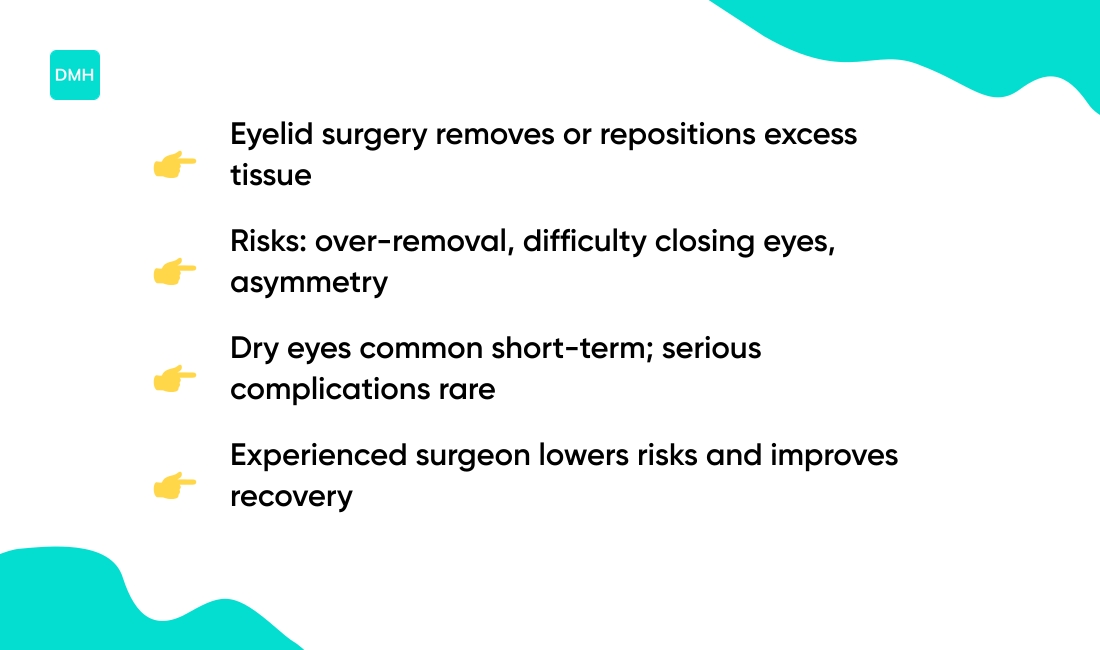
Blepharoplasty is eyelid surgery that removes or repositions excess skin, fat, and muscle. The procedure can improve vision and appearance, but it carries potential risks.
Common complications include:
- Over-removal of skin: Excess skin removal can cause eyelid retraction. This may leave the eye more exposed and require revision surgery.
- Difficulty closing eyes: Incomplete eyelid closure can occur after upper or lower eyelid surgery. Persistent lagophthalmos can lead to irritation and corneal problems.
- Asymmetry and scarring: Uneven results or visible scars may appear after surgery. Scar visibility often depends on incision placement and healing.
- Dry eyes and irritation may increase after surgery. Short-term dry eye symptoms may affect up to 10–20% of patients, according to available research.
- Bleeding, infection, and temporary vision changes occur but remain uncommon. Some studies suggest serious complications occur in fewer than 1% to 2% of cases.
Revision blepharoplasty can address functional or cosmetic problems. Revision needs can vary from person to person.
Technique choice influences risk. Transconjunctival approaches reduce visible scarring for lower eyelid surgery. An experienced oculoplastic or facial plastic surgeon may lower complication rates and improve blepharoplasty recovery.
If you consider eyelid surgery, discuss risks, expected recovery, and revision rates with a qualified specialist. Not medical advice. Always consult a qualified healthcare professional for medical advice specific to your situation.
Read also: How To Apply Face Serum
Non-surgical alternatives to blepharoplasty
Blepharoplasty refers to eyelid surgery that removes or repositions excess skin, fat, and muscle. Non-surgical options aim to reduce hooding, under-eye hollows, and mild puffiness without an incision.
Here are the main alternatives:
- Laser resurfacing: Ablative and non-ablative lasers can tighten eyelid skin and improve texture. Sessions often range from one to three. Recovery can vary from a few days to two weeks. Some studies report measurable skin contraction after multiple sessions.
- Radiofrequency tightening: Energy-based devices heat deeper layers to stimulate collagen. Many clinics report 20–40% visible tightening after several treatments. Results can vary by device, skin type, and number of sessions.
- Dermal fillers: Hyaluronic acid fillers can soften tear trough hollows and reduce shadowing under the eye. Results last months to a year. Injection technique affects outcome and risk of swelling or lumps.
- Botulinum toxin: Small doses can lift the brow and open the eye aperture by relaxing specific muscles. Effects appear within days and last about three months.
Expect multiple visits for optimal effect. Downtime tends to be shorter than for eyelid lift surgery. Risks include bruising, swelling, temporary asymmetry, and changes that can vary from person to person.
For more information, see our guide on how to tighten eyelid skin without surgery.
Not a medical advice, content for educational purposes. Always consult a qualified healthcare professional for medical advice specific to your situation.
You’ll also like: How To Use Oil On Face
How to find a qualified blepharoplasty surgeon
Choosing the right surgeon affects safety and results for blepharoplasty. Clear credentials and visible experience reduce uncertainty.
Look for a board-certified surgeon in plastic surgery or ophthalmology. Board certification by the American Board of Plastic Surgery or the American Board of Ophthalmology often indicates focused training in eyelid surgery.
Many surgeons list case volume and specialties. Fifty or more eyelid procedures often signals practical experience. Years doing upper eyelid surgery or lower eyelid surgery matter for complex cases.
What questions should you ask during your consultation? Common ones include:
- What incision technique will be used for an eyelid lift?
- Who will provide anesthesia and where will surgery occur?
- What are the surgeon’s complication and revision rates?
- How long is recovery and typical downtime for blepharoplasty?
- Can I see recent blepharoplasty before and after results?
Examine before-and-after photos closely. Favor images with consistent lighting, multiple angles, and recent cases. Look for natural eyelid shape and symmetric results.
Confirm hospital privileges and state board status online. Use the hospital website to verify surgeon credentials and check for disciplinary records. Patient reviews can add context but may not reflect outcomes.
Outcomes can vary from person to person. Not a medical advice, content for educational purposes, consult a professional. Always consult a qualified healthcare professional for medical advice specific to your situation.
Read also: How To Make Face More Symmetrical
Educational notice: This content is provided for informational and educational purposes only and is not intended as medical advice. Always consult a qualified healthcare professional for medical concerns.