That uneasy pit in the stomach before a medical test is more common than you think.
An endoscopy is a common diagnostic tool, but the idea of prep, sedation, and what comes after often causes worry.
Not knowing how to prepare or what to expect can lead to last-minute cancellations, unexpected costs, or unnecessary anxiety.
This guide breaks down endoscopy preparation step-by-step—from fasting and medication adjustments to transportation and recovery—so the day goes smoothly.
You’ll learn practical instructions for upper endoscopy and colonoscopy, what sedation involves, possible risks, and how long recovery usually takes.
Clear checklists and simple tips will help you feel prepared (and confident) before, during, and after the procedure.
What is an endoscopy
An endoscopy is a medical procedure that uses a flexible tube with a light and camera to view internal organs. The device, called an endoscope, transmits live video to help clinicians inspect tissue.
Endoscopy can examine the digestive tract, airways, urinary tract, and bile ducts. Types include upper endoscopy (gastroscopy) to view the esophagus, stomach, and upper small intestine, and colonoscopy and flexible sigmoidoscopy to inspect the large intestine. Capsule endoscopy uses a swallowed camera pill to image the small bowel.
Specialized techniques exist. Endoscopic ultrasound combines ultrasound with endoscopy to assess nearby structures. ERCP targets the bile and pancreatic ducts and can remove blockages. Bronchoscopy evaluates airways, while cystoscopy inspects the bladder.
Clinicians may use endoscopy for diagnosis and treatment. The procedure can identify ulcers, inflammation, bleeding sources, tumors, and suspicious areas for biopsy. Therapeutic actions may include polyp removal, stopping bleeding, or placing stents.
Procedures often use local numbing and sedation for comfort. Recovery time varies by procedure and sedation level. Risks can include bleeding, infection, or perforation, which are uncommon but possible.
Not medical advice; content for educational purposes. Consult a qualified healthcare professional for advice specific to your situation.
Types of endoscopy procedures
Upper endoscopy and EGD
Upper endoscopy, also called esophagogastroduodenoscopy (EGD), uses a thin flexible tube with a camera. It inspects the esophagus, stomach, and upper small intestine for possible digestive issues.
Clinicians may order it for persistent heartburn, unexplained bleeding, low blood counts, or trouble swallowing. The procedure lets doctors view mucosa and take tissue samples.
The endoscopy biopsy capability helps guide diagnosis by allowing small tissue removal for lab analysis. Most procedures last about 15 to 30 minutes under light sedation.
Recovery often takes an hour in the recovery area and mild throat soreness may persist for a day. People with chronic reflux symptoms may wish to read the guide on acid reflux causes and prevention.
Not medical advice; content for educational purposes. Consult a qualified healthcare professional for advice specific to your situation.
Colonoscopy and flexible sigmoidoscopy
A colonoscopy uses a flexible tube with a camera to inspect the large intestine. It provides an entire colon examination from the rectum to the cecum, roughly 1.5 m (5 feet).
Flexible sigmoidoscopy examines the rectum and the lower colon. The scope typically reaches about 50–60 cm (20–24 inches) and offers a lower colon exam.
Both procedures fall under endoscopy procedures. They differ from upper endoscopy, which inspects the esophagus, stomach and duodenum. Both colonoscopy and sigmoidoscopy allow biopsy and polyp removal using accessory tools.
Sedation may be used and recovery times can vary from person to person. For bowel preparation guidance, see how to prepare for colonoscopy for practical steps that may affect visibility.
Not medical advice; content for educational purposes. Consult a qualified healthcare professional for advice specific to your situation.
Specialized endoscopic procedures
Endoscopy uses a flexible tube with a camera to inspect internal organs. Several specialized types target specific areas.
Capsule endoscopy uses a swallowed camera capsule to image the small intestine. It can help locate obscure bleeding or small lesions.
Endoscopic ultrasound exam combines endoscopy with ultrasound to view organ layers and nearby lymph nodes. It may guide a fine needle aspiration to obtain a biopsy sample for lab analysis.
ERCP (endoscopic retrograde cholangiopancreatography) accesses the bile and pancreatic ducts to diagnose or manage blockages. Clinicians may remove stones or place stents during ERCP. Bronchoscopy inspects the airways and can collect fluid or tissue for testing, while cystoscopy examines the bladder lining and can sample suspicious areas.
Procedure time, sedation use, recovery, and risks such as bleeding or infection can vary by procedure and patient factors. Not medical advice; content for educational purposes. Consult a qualified healthcare professional for advice specific to your situation.
What can an endoscopy diagnose
The procedure uses a flexible tube with a camera to view internal linings. Visual inspection can reveal visible causes of symptoms.
- Ulcers in the stomach or duodenum. An upper endoscopy can show open sores and their location.
- Inflammation such as gastritis, esophagitis, or colitis. Mucosal redness and swelling appear on camera.
- Tumors and polyps in the digestive tract. A colonoscopy can find growths in the colon.
- Sources of bleeding. Endoscopy may locate sites of active bleeding or recent blood loss.
- Cancer or suspicious lesions that need further study.
An important capability is endoscopy biopsy. Small tissue samples can be taken during the procedure for lab analysis. Pathology can identify inflammation type, infection, precancerous changes, or cancer.
Some specialized endoscopies can view bile ducts, airways, or the bladder. Capsule endoscopy may detect small‑bowel lesions not seen by standard scopes. Endoscopic ultrasound can stage tumors by imaging layers and nearby lymph nodes.
Findings vary from person to person and depend on the endoscopy type and indication. You may wish to discuss results, biopsy plans, and follow-up with a gastroenterologist or relevant specialist. Not medical advice; content for educational purposes. Consult a qualified healthcare professional for advice specific to your situation.
How to prepare for an endoscopy
Fasting and dietary restrictions
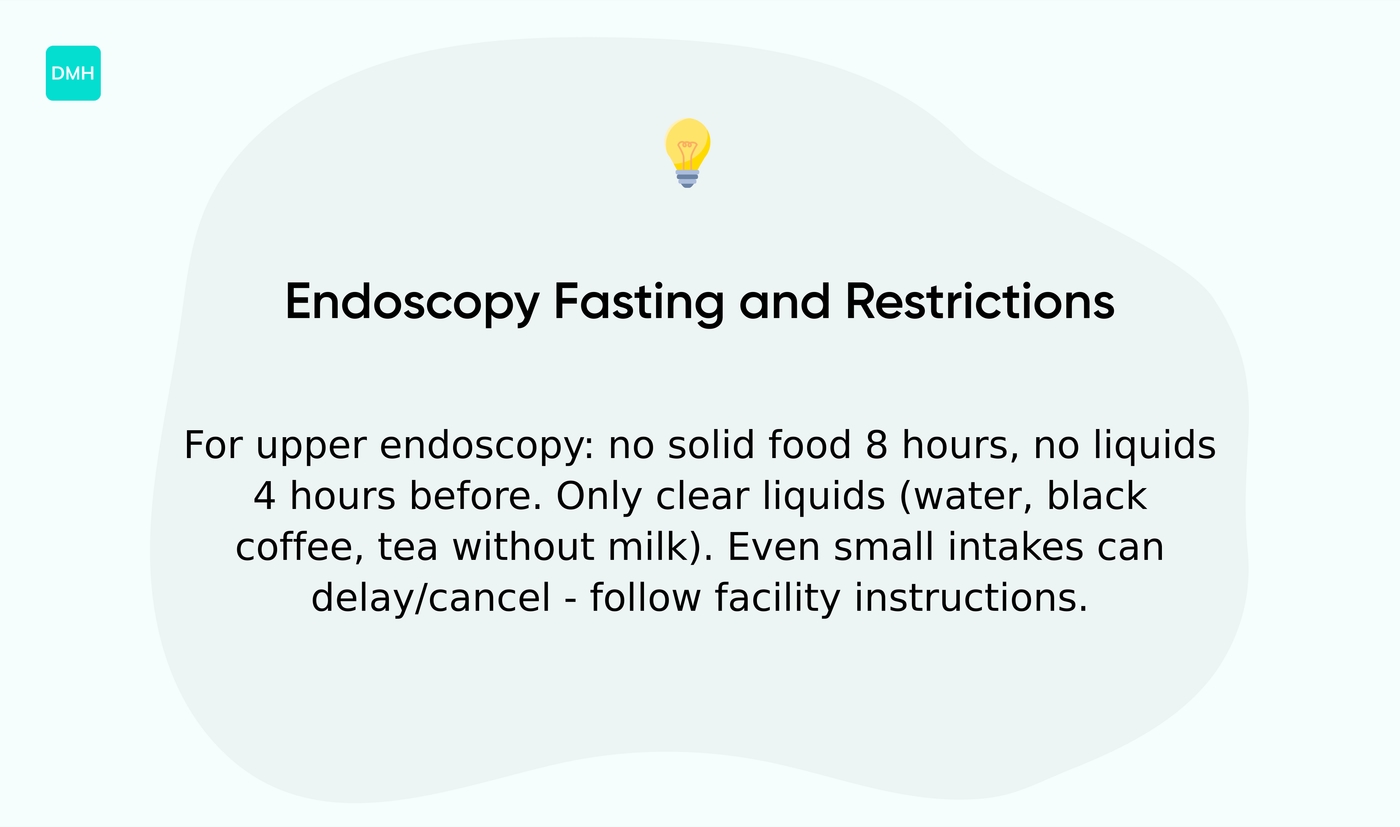
For an endoscopy such as an upper endoscopy, facilities typically require no solid food for 8 hours and no liquids for 4 hours before the procedure. Some centers use slightly different cutoffs, such as no food or drink after midnight or clear liquids only until a few hours before the exam, so your own facility’s instructions matter most.
Clear liquids include water, black coffee, and tea without milk. Avoid milk, juice with pulp, and alcohol.
Specific instructions can vary by facility and by sedation plan. Some centers ask for longer fasting for certain medications or medical conditions. Here’s the thing: even small amounts of food, gum, or water too close to the procedure can lead to delay or cancellation.
Following the facility’s directions exactly may reduce the chance of cancellation and may improve safety during sedation. Clarifying instructions with the facility may help avoid confusion on the day of the test.
Not medical advice; content for educational purposes. Consult a qualified healthcare professional for advice specific to your situation.
Medication review and adjustments
You should tell your care team about every medication, supplement, and vitamin you take. Include prescription drugs, over-the-counter pills, herbal remedies, and topical treatments.
Clinicians may ask about blood thinners, NSAIDs and aspirin, and diabetes medications. Stopping or changing blood thinners can reduce bleeding risk during an endoscopy, though timing can vary by drug and by the reason the drug is used.
Diabetes medications may need dose changes if you fast or receive IV fluids. If you have diabetes or take blood thinners, you should get individualized instructions rather than following generic fasting advice. Sedation can affect blood sugar and coordination.
You may wish to bring a written list or pill bottles to the pre-procedure visit. Ask how to manage inhalers, eye drops, and insulin on the day of the procedure. Many facilities advise avoiding iron, aspirin, NSAIDs such as ibuprofen or naproxen, and some supplements like fish oil or vitamin E for several days beforehand, but this isn’t universal and should only be done if your doctor instructs it.
Discuss laxatives and bowel-prep interactions. See foods to avoid while taking Miralax for related guidance.
Not medical advice; content for educational purposes. Consult a qualified healthcare professional for advice specific to your situation.
Transportation and companion requirements
Sedation for endoscopy can impair judgment, coordination, and reaction time. People may feel groggy and have slowed thinking for several hours. Some effects can persist up to 24 hours after medication.
Most facilities ask that a responsible adult drive the patient home. The same person may be asked to stay until the patient meets recovery criteria. In some facilities, a companion is required to stay with you overnight.
Deep sedation or unexpected reactions can extend recovery time. Medications such as midazolam or propofol act differently—midazolam may cause longer drowsiness than short‑acting agents.
Plan for transport and overnight support when advised. Bring a phone number for the companion and clear post‑procedure instructions. Endoscopy recovery varies from person to person and may depend on sedation type and dose.
Not medical advice; content for educational purposes. Consult a qualified healthcare professional for advice specific to your situation.
What happens during an endoscopy procedure
An endoscopy uses a flexible tube with a camera to inspect internal organs. The description below focuses on upper endoscopy steps and what people may experience.
- A throat numbing spray may be applied to reduce the gag reflex. The spray often takes a few minutes to take effect.
- The team places an IV line for sedating medication. IV sedation medication may include short-acting agents that take effect within minutes.
- The patient lies on a procedure table. Oxygen and heart rate are monitored continuously by staff.
- The endoscope enters through the mouth and advances gently to view the esophagus, stomach, and duodenum. The camera sends live images to a monitor.
- Small tools travel through the scope when needed. Biopsies or minor polyp removal often take under a minute per sample.
- The visual exam commonly lasts 15 to 30 minutes, though complexity can extend that time to about 45 minutes.
- The procedure room team takes photos, documents findings, and manages any minor interventions. Staff provide suction and airway support as required. Team roles include nursing, an endoscopist, and an assistant.
After the scope is removed, the person moves to a recovery area for observation. Recovery typically requires 30 to 60 minutes before discharge criteria are met.
Not medical advice; content for educational purposes. Consult a qualified healthcare professional for advice specific to your situation.
Is endoscopy painful and do you need sedation
Pain during an endoscopy can vary from person to person. Many people report mild discomfort rather than sharp pain.
Throat numbing spray often comes first. A topical lidocaine spray numbs the back of the throat and reduces the gag reflex.
Staff may offer IV sedation options to improve comfort. Sedation ranges from light relaxation to deeper sleep-like states. Light sedation often uses midazolam plus an opioid, while deeper sedation frequently uses propofol and requires trained personnel.
Most outpatient centers report about 80–90% of patients select some sedation. Sedation helps with tolerance during upper endoscopy, colonoscopy, or when a biopsy is needed.
Clinicians monitor oxygen, heart rate, and blood pressure while sedated. Monitoring aims to detect changes quickly and maintain safety. People with lung or heart conditions may need a tailored approach, and the choice of sedation can vary by facility and medical history.
Do you know what to expect after sedation? Patients may wish to discuss sedation risks and recovery with the care team before the procedure. Recovery time often ranges from 30 to 90 minutes.
Mild throat soreness or bloating may occur after the procedure and usually resolves within 24 hours. Not medical advice; content for educational purposes. Consult a qualified healthcare professional for advice specific to your situation.
How long does an endoscopy take
Procedure time for an endoscopy procedure can vary with the type and reason for the test.
| Procedure Type | Typical Duration |
|---|---|
| Upper endoscopy (EGD) | 10 to 30 minutes |
| Colonoscopy | 30 to 45 minutes |
| ERCP & endoscopic ultrasound | 30 to 60 minutes |
| Capsule endoscopy (recording) | About 8 hours |
| Bronchoscopy & cystoscopy | 15 to 60 minutes |
Preparation and recovery add time. Facilities may ask patients to arrive 30 to 120 minutes early for intake and prep.
Recovery after sedation often lasts 30 to 60 minutes. Total time at the facility commonly ranges from 2 to 4 hours. Biopsy or polyp removal can extend procedure time by about 10 to 30 minutes, and observation after therapeutic steps may lengthen recovery time.
You’ll need a companion to drive you home because sedating medication can impair judgment and coordination for up to 24 hours. Not medical advice; content for educational purposes. Consult a qualified healthcare professional for advice specific to your situation.
Recovery after endoscopy and what to expect
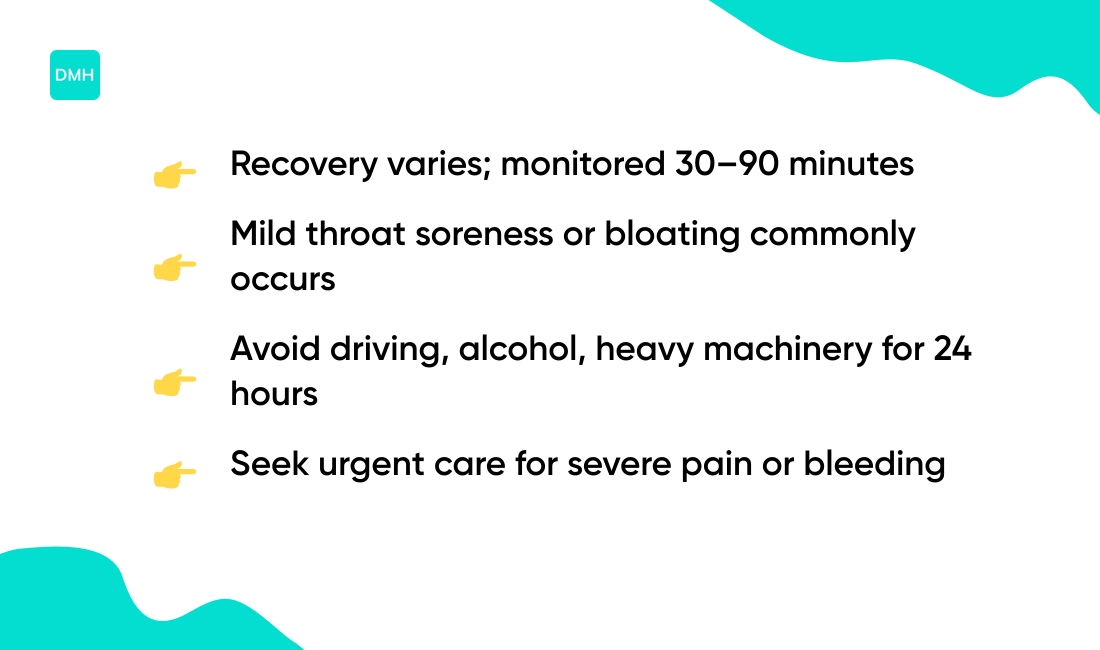
Recovery after an endoscopy varies by procedure and sedation. Patients may rest in a recovery area for 30 to 90 minutes while staff monitor breathing, heart rate, and alertness.
Throat soreness or mild bloating can appear after an upper endoscopy or colonoscopy. Soreness may last 24 to 48 hours and usually eases with soft drinks and lozenges. People who had a biopsy may notice minor throat or rectal spotting. Significant bleeding or severe pain is uncommon but may require urgent care.
Most facilities advise avoiding driving, alcohol, and operating heavy machinery for 24 hours after sedation. Light activity is often safe after that period, but strenuous exercise and heavy lifting can wait for 24 hours or until a clinician clears the person.
Diet often starts with clear liquids, then light meals as tolerated. If questions arise about specific foods, see this guide to foods to avoid after endoscopy for practical options.
Signs that may warrant medical contact include fever over 100.4°F, increasing pain, persistent vomiting, or difficulty breathing. Symptoms can vary from person to person and depend on procedure type.
Not medical advice; content for educational purposes. Consult a qualified healthcare professional for advice specific to your situation.
Read also: What Does Appendicitis Feel Like? Signs to Know
What are the risks of endoscopy
Endoscopy uses a flexible scope to view internal organs. The procedure carries small but real risks that can vary by type and patient health.
- Bleeding and perforation: Bleeding can follow biopsies or polypectomy. Perforation of the gut occurs in about 0.1% of colonoscopies, though rates vary by procedure and patient factors.
- Infection and fever: Infection after endoscopy is uncommon. Procedures that access bile ducts or the urinary tract may have higher infection rates.
- Sedation reaction risks: Sedation can lower breathing or blood pressure. Serious sedation reactions appear rare, often under 0.01% to 0.1% in large series.
- Other effects: Sore throat, bloating, cramping, or mild nausea can occur after an upper endoscopy or colonoscopy. For tips on nausea management, see help with nausea.
Emergency evaluation may be needed for severe abdominal pain, persistent or heavy bleeding, trouble breathing, chest pain, or high fever. Such signs may indicate complications that need prompt attention.
Risk factors include older age, significant medical problems, recent surgery, and procedures that remove tissue. Pre-procedure medication review and monitoring during sedation may lower some risks.
Not medical advice; content for educational purposes. Consult a qualified healthcare professional for advice specific to your situation.
You’ll also like: When To Go To Hospital For Gallbladder Attack
How much does an endoscopy cost
Costs for an endoscopy vary widely. Pricing depends on procedure type, facility, insurance coverage, and location.
- Upper endoscopy (EGD/gastroscopy): $700 to $2,500
- Colonoscopy: $1,000 to $3,000
- Capsule endoscopy: $600 to $2,000
- ERCP or endoscopic ultrasound: $2,000 to $6,000
Out-of-pocket amounts can differ. Insured patients may pay nothing for preventive tests. Diagnostic procedures often carry copays or coinsurance, and out-of-pocket totals may range from $0 to $1,000 or more, based on plan details.
Uninsured patients commonly see full billed charges. Rates may range from $500 at low-cost centers to $6,000 at hospital outpatient departments.
Facility type affects price. Ambulatory surgery centers often charge less than hospital outpatient departments. Anesthesia, pathology for biopsies, and facility fees add separate line items. Geographic price variation may reach 20% to 50% between regions.
Practical steps:
- Request an itemized estimate from the facility.
- Confirm in-network status with the insurer.
- Ask whether anesthesia and pathology are included.
- Inquire about payment plans or financial assistance options.
Costs may vary from person to person. Patients may wish to discuss estimates with insurers or care teams. Not medical advice; content for educational purposes. Consult a qualified healthcare professional for advice specific to your situation.
You’ll also like: Pancreatitis When To Worry: Warning Signs Guide
Educational notice: This content is provided for informational and educational purposes only and is not intended as medical advice. Always consult a qualified healthcare professional for medical concerns.