A small bruise or a rash might be more than just clumsiness.
Thrombocytopenia, or a low platelet count, can cause those signs and sometimes serious bleeding.
Because platelets stop bleeding, low levels can lead to prolonged or internal bleeding and anxiety about unexplained bruises.
This guide explains common causes—from immune disorders and medications to pregnancy-related drops—and how doctors diagnose the problem.
You’ll learn treatment options ranging from watchful waiting and medicines to platelet transfusion and newer drugs for refractory cases.
Practical tips for when to seek urgent care and what to expect at a hematology visit are also included.
By the end you’ll be able to recognize key thrombocytopenia symptoms and feel more confident discussing tests and treatments with your clinician.
What is thrombocytopenia
Low platelet count describes thrombocytopenia. It means fewer platelets than normal circulating in your blood.
Platelets are tiny blood cells that help clot blood. They plug vessel injuries and work with clotting proteins to stop bleeding. Without enough of them, even minor cuts can bleed longer than expected.
The platelet count range considered normal is 150,000 to 450,000 platelets per microliter (µL). Mild thrombocytopenia may register between 100,000 and 150,000/µL. Moderate levels often sit between 50,000 and 100,000/µL.
Bleeding risk rises below 50,000/µL. Values under 20,000/µL raise urgent concern, and spontaneous bleeding can occur near 10,000/µL—a level associated with severe risk.
Dangerous platelet levels and thresholds are described at what platelet levels are dangerous for careful reference.
Causes may include reduced marrow production, immune destruction such as immune thrombocytopenic purpura, drug-induced platelet loss, or platelet pooling in an enlarged spleen. Each mechanism requires different evaluation and management approaches.
Diagnosis usually uses a complete blood count and a blood smear. Bone marrow testing may follow if counts stay low or the cause is unclear. Some guidelines suggest platelet transfusion at counts below 10,000/µL or for active bleeding, though transfusion is a temporary measure.
Tests may include antibodies for heparin to evaluate heparin-induced thrombocytopenia. Care paths vary by cause and severity. If you’re concerned about symptoms, consult a qualified healthcare professional.
Not medical advice. Content for educational purposes only; consult a professional.
What are the symptoms of thrombocytopenia
Petechiae and skin changes
Petechiae appearance: Petechiae are tiny red or purple dots on the skin. They measure about 1 to 2 mm and don’t blanch when you press on them (which helps distinguish them from other rashes).
Distribution often favors the lower legs, forearms, and areas of pressure. Clusters may appear after minor trauma. Widespread spots can signal a very low platelet count and warrant medical evaluation.
Purpura and bruising appear as larger skin findings. Purpura measure about 3 to 10 mm, while ecchymoses or bruises exceed 1 cm. Size often helps distinguish severity of bleeding manifestations.
Normal platelet count ranges from 150,000 to 450,000 per microliter. Bleeding risk often rises below 20,000/µL. Spontaneous skin bleeding may occur under about 10,000 to 20,000/µL.
If you notice unexplained petechiae or large bruises, consider medical evaluation. Not medical advice—content for educational purposes only; consult a professional.
Bleeding symptoms
Thrombocytopenia refers to a low platelet count. Platelets help form clots and stop bleeding, so when they’re low, bleeding becomes harder to control.
Nosebleeds and bleeding gums occur commonly with low platelets. Heavy menstrual flow can become markedly heavier. Small pinpoint red spots called petechiae and easy bruising may appear on the skin without any clear injury.
Blood in urine or stools can indicate bleeding inside the urinary or gastrointestinal tract. Blood in vomit or dark, tarry stools may also appear. Sudden, severe headache or changes in consciousness may suggest internal bleeding in the brain—a medical emergency.
Normal platelet count ranges from 150,000 to 450,000 per microliter. Bleeding risk often rises when platelets fall below 30,000/µL, and spontaneous severe bleeding becomes more likely below 10,000/µL.
Have you noticed any unusual bleeding that won’t stop? These thrombocytopenia symptoms can vary from person to person and may be associated with multiple causes. Not medical advice—content for educational purposes only; consult a professional.
When to see a doctor
If you have thrombocytopenia, watch for warning signs that may need immediate medical attention. Some symptoms shouldn’t wait for a routine appointment.
- Severe bleeding from any site, including heavy nosebleeds or prolonged bleeding from cuts
- Persistent petechiae—tiny red or purple skin spots that don’t fade
- New or severe headaches, vision changes, confusion, or other neurologic symptoms with low platelets
- Blood in urine or stool, or coughing up blood
- Sudden, unexplained bruising or rapid symptom onset
See the guide on abnormal blood tests for related warning signs and steps to take.
Very low platelet counts raise bleeding risk substantially. Counts under 20,000/µL carry high risk, while counts between 20,000 and 50,000/µL increase bleeding with injury. Emergency care is more likely with signs of internal bleeding, fainting, or sudden neurologic changes.
Not medical advice. Content for educational purposes only; consult a professional. If concerned about your symptoms, consult a qualified healthcare professional.
What causes thrombocytopenia
Immune thrombocytopenic purpura
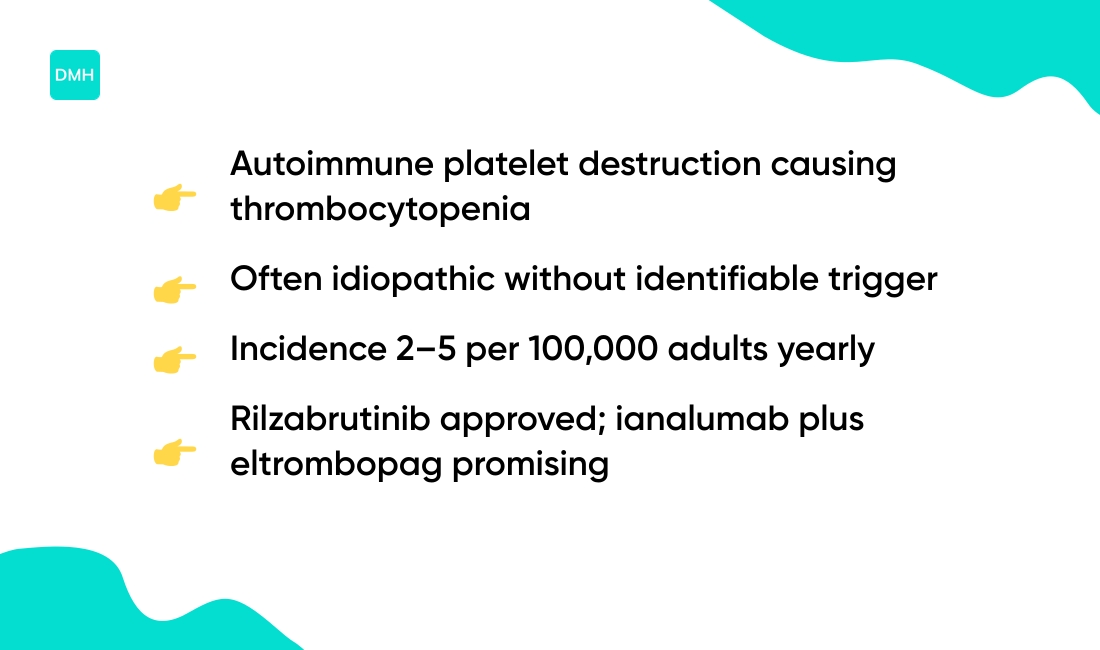
ITP is a form of thrombocytopenia where the immune system mistakenly targets platelets. Platelet loss reduces the blood’s ability to clot properly.
Immune thrombocytopenic purpura can appear without an identifiable trigger. Many cases are described as idiopathic (meaning the exact cause isn’t clear).
Incidence in adults runs about 2 to 5 per 100,000 people each year. Normal platelet counts range 150,000–450,000/µL, and counts below 30,000/µL increase bleeding risk significantly.
Treatment often begins with steroids or IVIG and may move to thrombopoietin receptor agonists for persistent cases. New oral options include BTK inhibitors aimed at modulating immune activity. Actually, rilzabrutinib (Wayrilz) recently gained approval for adults with persistent or chronic ITP after prior treatments failed.
A promising phase III trial showed ianalumab plus eltrombopag extended time to treatment failure to over one year versus 4.7 months for eltrombopag alone. Some studies suggest durable platelet responses in refractory patients, though outcomes vary by individual factors.
Low platelet count management depends on severity, symptoms, and patient context. Not medical advice—content for educational purposes only; consult a professional.
Drug-induced thrombocytopenia
Drug-induced thrombocytopenia is a drop in platelet count caused by medicines. Platelets help blood clot and stop bleeding, so medication-related drops can be serious.
Common culprits include heparin-induced thrombocytopenia, certain chemotherapy agents, some antibiotics, and anticonvulsants. Immune-mediated reactions and direct marrow suppression are two main mechanisms. (Sometimes it’s the body’s immune response, other times it’s direct toxicity to the marrow.)
Normal platelet counts range from 150,000 to 450,000/µL. Counts under 50,000/µL raise bleeding risk, and counts under 20,000/µL associate with higher spontaneous bleeding risk.
Management may include stopping the suspected drug and close platelet monitoring. Immune cases can respond to IVIG or corticosteroids. Severe bleeding may prompt platelet transfusion. HIT often requires non-heparin anticoagulants such as argatroban or bivalirudin and hematology consultation.
HIT occurs in roughly 0.1–5% of patients exposed to heparin, depending on dose and setting. Not medical advice—content for educational purposes only; consult a qualified healthcare professional for personalized guidance.
Thrombocytopenia in pregnancy
Pregnancy can lower platelet counts and cause specific forms of thrombocytopenia. Hormonal shifts and increased blood volume play a role.
Thrombocytopenia in pregnancy covers several causes and varying severity. Gestational thrombocytopenia is mild and occurs in about 5–10% of pregnancies. Platelet counts in that form often stay above 100,000 per µL.
Preeclampsia can cause faster platelet drops and may pair with high blood pressure. HELLP syndrome involves hemolysis and elevated liver enzymes—it can drop platelets below 50,000 per µL and raise bleeding risk substantially.
Maternal antibodies can cause neonatal alloimmune thrombocytopenia in newborns. This newborn condition may lead to severe low platelet count and bleeding. Normal platelet counts range from 150,000 to 450,000 per µL, and counts below 20,000 per µL carry high bleeding risk.
Neonatal alloimmune thrombocytopenia may occur in about 1 in 1,000 to 1 in 2,000 births. Monitoring platelet counts and coordinating obstetric and hematology care is common practice. Not medical advice—content for educational purposes only; consult a qualified healthcare professional.
Other causes of low platelet count
Thrombocytopenia can result from bone marrow disorders. Aplastic anemia, leukemia, and myelodysplastic syndromes reduce platelet production directly at the source.
Viral infections may destroy platelets or suppress marrow function. Common examples include dengue, HIV, and hepatitis C. Liver disease lowers thrombopoietin and can cause portal hypertension, while an enlarged spleen traps platelets and lowers circulating counts.
Nutritional deficiencies such as low vitamin B12 or folate can reduce platelet numbers. Children may develop low platelets from infections, immune causes, or inherited platelet problems like large or giant platelets.
Severe drops may prompt platelet transfusion or bone marrow tests for diagnosis. Findings guide thrombocytopenia treatment and monitoring. Not medical advice—content for educational purposes only; consult a qualified healthcare professional for personal guidance.
Read also: What is Hematocrit in Blood Test
How is thrombocytopenia diagnosed
Diagnosis starts with a blood test. Platelet count under 150,000/µL defines thrombocytopenia. Normal range lies between 150,000 and 450,000/µL, and counts below 30,000/µL often raise concern for spontaneous bleeding.
A complete blood count with differential is the first diagnostic step. Lab reports show platelet numbers and other cell lines. Patterns help separate isolated low platelets from broader blood disorders.
Microscopic review follows. A blood smear examination looks for platelet clumping, giant platelets, and abnormal red cells. Clumping can cause falsely low counts—a condition called pseudothrombocytopenia (which isn’t a real problem, just a lab artifact).
Clinical history and medications guide the differential diagnosis. What drugs have you taken recently? Consider immune thrombocytopenic purpura, heparin-induced thrombocytopenia, drug-induced thrombocytopenia, viral infections, liver disease, and splenic sequestration. Age, recent infections, and pregnancy also inform the evaluation.
When platelet production appears low or results remain unexplained, clinicians may order a bone marrow biopsy. This test assesses marrow cellularity and megakaryocyte numbers. It helps detect marrow failure syndromes, leukemia, or infiltrative disease.
Additional testing can include platelet function studies, viral serology, and autoimmune panels. Imaging may evaluate spleen size. Findings guide monitoring frequency and treatment choices. Not medical advice—content for educational purposes only; consult a qualified healthcare professional for medical advice specific to your situation.
You might also like: Anemia: Symptoms, Causes & Treatments
How is thrombocytopenia treated
Care varies by platelet level and underlying cause. Mild reductions in platelets (above 50,000/µL) often need observation and repeat counts. Counts between 30,000 and 50,000/µL may prompt medications such as corticosteroids or intravenous immunoglobulin for immune-related causes.
Severe thrombocytopenia (platelet transfusion or hospital-based interventions. Surgical options include splenectomy for persistent immune platelet destruction, though it’s typically reserved for refractory cases.
Immune thrombocytopenic purpura responds to several second-line approaches. Thrombopoietin receptor agonists such as eltrombopag, romiplostim, and avatrombopag raise counts in many people with refractory low platelets. Avatrombopag demonstrated efficacy in relapsed severe ITP cases unresponsive to other therapies, achieving rapid platelet increases in Phase II/III trials.
Newer agents include fostamatinib, a spleen tyrosine kinase inhibitor, and rilzabrutinib, a Bruton tyrosine kinase inhibitor. Real-world data on fostamatinib showed durable response in one-third of 31 heavily pretreated patients. Plus, rilzabrutinib’s Phase III LUNA 3 trial showed 23% achieved durable platelet response versus 0% on placebo, with rapid improvements in platelets, fatigue, and bleeding.
Read a contemporary review on novel mechanisms at AJMC.
Simple precautions reduce bleeding risk. Avoid nonsteroidal anti-inflammatory drugs. Use gentle dental care. Discuss pregnancy plans with a specialist.
Preparing for specialist care can help. See guidance on the first hematology appointment for questions to bring and tests to expect. Not medical advice—content for educational purposes only; consult a professional.
| Platelet Count (per µL) | Severity | Bleeding Risk | Typical Management |
|---|---|---|---|
| 100,000–150,000 | Mild | Low | Observation, repeat counts |
| 50,000–100,000 | Moderate | Moderate | Monitor, consider treatment if symptomatic |
| 30,000–50,000 | Moderate to severe | Increased | Corticosteroids, IVIG, or other agents |
| Severe | High, spontaneous bleeding | Platelet transfusion, urgent treatment |
You might also like: Low Red Blood Cell Count: Causes, Symptoms And Treatment
Educational notice: This content is provided for informational and educational purposes only and is not intended as medical advice. Always consult a qualified healthcare professional for medical concerns.