
That restless hour before bed shouldn’t become the norm.
If you’re asking which magnesium is best for sleep, you’re not alone.
Many people try supplements without knowing which form helps anxiety, muscle tension, or racing thoughts at night.
Magnesium comes in different forms that target specific sleep issues, and the right choice can actually improve sleep quality.
You’ll learn how magnesium glycinate, L-threonate, citrate and other types compare, plus dosing and timing tips.
The goal is to make it easy to pick a magnesium supplement for sleep that fits your symptoms and digestive sensitivity.
Safety notes and when to consult a healthcare provider are included so trying magnesium before bed is clear and sensible.
Why magnesium matters for sleep quality
Magnesium is an essential mineral involved in nerve signaling and muscle function. It may be associated with sleep regulation through multiple pathways.
Magnesium can support nervous system balance by influencing GABA, a calming neurotransmitter. GABA (gamma-aminobutyric acid) helps slow brain activity at night.
Magnesium also helps muscles relax by modulating calcium flow in muscle cells. It plays a role in melatonin synthesis, the hormone that helps time sleep-wake cycles.
Some studies suggest low magnesium levels link with poorer sleep quality and more nighttime awakenings. Research strength varies; trials often show modest improvements in sleep duration and onset, especially for people with low baseline magnesium or older adults.
Magnesium deficiency may be associated with restless legs, night cramps, and trouble falling asleep. People who may benefit from supplementation include older adults, those with low dietary intake, people on certain diuretics, and athletes with high sweat losses. Responses can vary from person to person.
Typical guidance notes a commonly suggested range of about 127–150 mg elemental magnesium nightly, though individual needs differ. Start with lower doses and monitor effects before adjusting. Some forms absorb better and cause less digestive upset.
Not medical advice; content for educational purposes, consult a professional. Always consult a qualified healthcare professional for medical advice specific to your situation.
Best types of magnesium for sleep
Magnesium glycinate for sleep
Magnesium glycinate pairs elemental magnesium with the calming amino acid glycine.
Glycine acts as an inhibitory neurotransmitter and may support calmer brain activity at night. This form shows higher absorption than magnesium oxide and often causes less digestive upset.
It may ease muscle tension and quiet racing thoughts linked to anxiety and stress. Typical supplements provide about 100–200 mg elemental magnesium per dose.
Some studies suggest modest improvements in sleep onset and sleep quality, but evidence remains limited. Have you noticed if stress keeps you awake at night?
People with kidney disease or those taking certain medications may need medical advice before supplementing. High absorption and gentle digestion make this form a common choice for sleep support.
Well, according to multiple expert sources, magnesium glycinate tops the list for sleep due to its calming effects from glycine and low risk of side effects like diarrhea. It’s particularly helpful for stress, anxiety, muscle tension, or racing thoughts (basically, the whole package for restless nights).
Not medical advice; content for educational purposes, consult a professional. Always consult a qualified healthcare professional for medical advice specific to your situation.
Magnesium L-threonate for sleep
Brain-focused form: Magnesium L-threonate is a magnesium salt that readily crosses the blood-brain barrier. It aims to raise magnesium levels inside the brain.
Higher brain magnesium may support calmer neuronal activity and promote mental relaxation. Some studies suggest improved cognitive calm and reduced stress-related sleep disturbances, but evidence is limited.
Here’s the thing: magnesium glycinate shows high absorption and gentle digestion. Glycinate often helps muscle tension and anxiety-linked sleeplessness. L-threonate may better target racing thoughts or cognitive hyperarousal.
Practical note: effect size can vary from person to person. Dosing strategies in trials used compound amounts rather than elemental magnesium, which can complicate comparisons.
Plus, research remains preliminary and individual responses differ. Not medical advice; content for educational purposes, consult a professional. Always consult a qualified healthcare professional for medical advice specific to your situation.
Magnesium citrate for sleep
Magnesium citrate pairs magnesium with citric acid and is a well-absorbed form. It dissolves well and absorbs in the gut.
If asking which magnesium is best for sleep, citrate offers clear trade-offs. It may support muscle relaxation and nervous system regulation linked to sleep.
Some studies suggest citrate shows better absorption than magnesium oxide, but evidence can vary. Citrate has a mild laxative effect caused by an osmotic draw of water into the colon.
That effect can relieve occasional constipation while you try to sleep. People with sensitive digestion may notice loose stools or cramping.
Taking it earlier in the evening may reduce late-night bathroom trips. (Nobody wants that 3 a.m. wake-up call, right?) Doses and response can vary from person to person.
Not medical advice; content for educational purposes, consult a professional. Always consult a qualified healthcare professional for medical advice specific to your situation.
Other magnesium forms to consider
Other magnesium forms include oxide, taurate, and malate. Each affects sleep and digestion differently.
Magnesium oxide contains a high percentage of elemental magnesium but low bioavailability. Magnesium oxide absorption can be under 10%, and it often causes loose stools. Some studies suggest oxide isn’t the best choice for sleep support.
Magnesium taurate pairs magnesium with the amino acid taurine. Magnesium taurate benefits may include mild nervous system calming and heart support. Evidence comes from small trials and biochemical studies, so sleep-specific data remain limited.
Magnesium malate binds magnesium to malic acid, an energy-related compound. Magnesium malate stimulating effects are reported by some people. If you notice nighttime alertness, malate may be the cause.
Actually, recent 2026 guides emphasize that malate suits daytime stress but may feel stimulating at night. Research quality varies across forms and can vary from person to person.
Not medical advice; content for educational purposes, consult a professional. Always consult a qualified healthcare professional for medical advice specific to your situation.
How much magnesium should I take for sleep
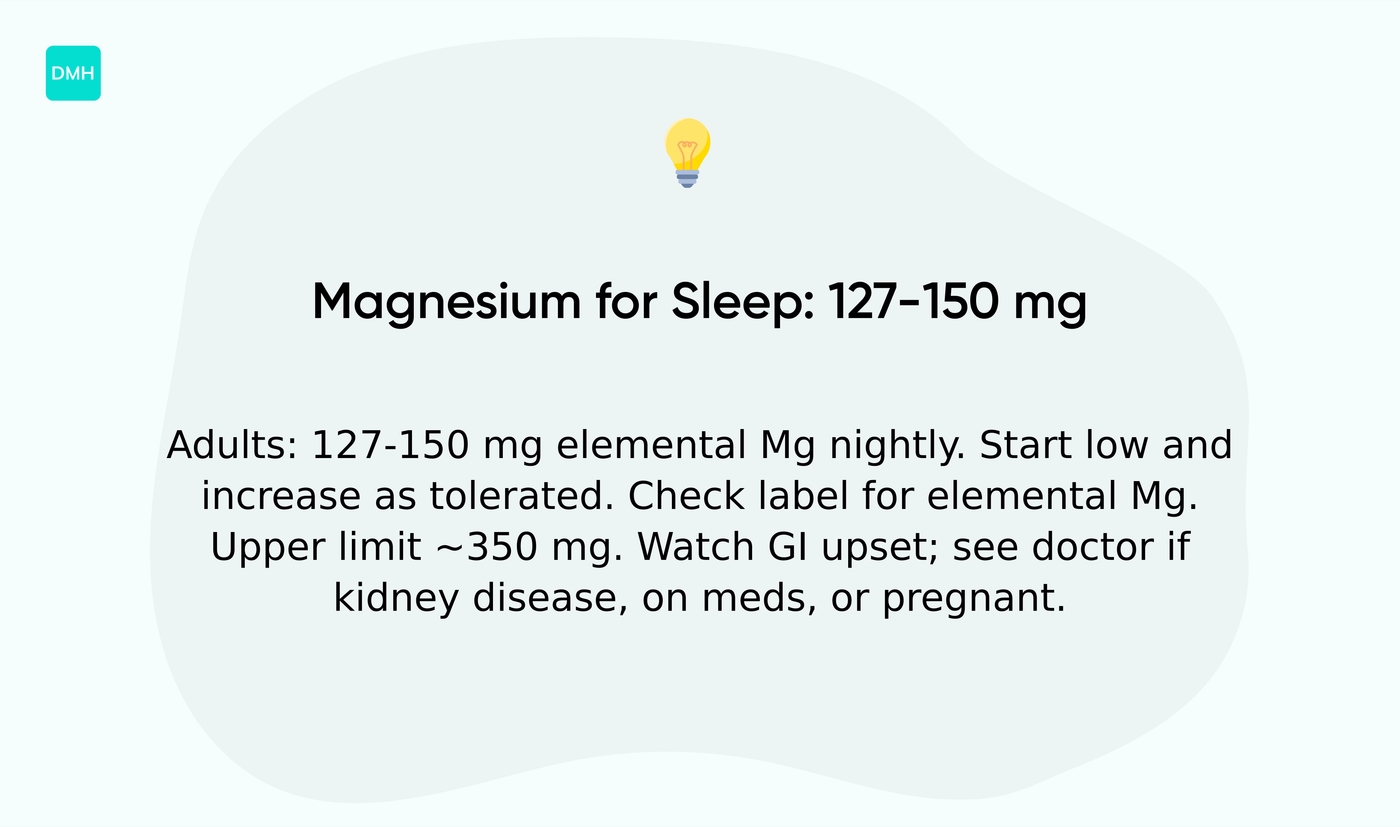
Typical recommended range for adults is 127–150 mg of elemental magnesium nightly. Magnesium helps regulate the nervous system. It supports muscle relaxation and sleep hormone production.
Some studies suggest modest sleep benefits at doses in that range, but effects can vary from person to person. A common approach involves starting lower than the target dose and increasing slowly based on response and tolerance.
Forms differ in the amount of elemental magnesium per pill. Labels often list total salt weight, not elemental amount. (This can be confusing, so check the label twice.)
Gastrointestinal upset or loose stools can occur with higher doses. The tolerable upper intake level for supplemental magnesium is about 350 mg per day, according to public health sources.
People with kidney disease, those taking certain medications, and pregnant people merit medical review before starting supplements. Are you tracking your symptoms to spot patterns?
Track sleep quality and side effects over two to four weeks while adjusting dose. If sleep doesn’t improve, consider a different magnesium form or clinical advice.
Magnesium dosage for sleep varies by individual. Not medical advice; content for educational purposes, consult a professional. Always consult a qualified healthcare professional for medical advice specific to your situation.
When to take magnesium for better sleep
Taking magnesium at a consistent time may influence sleep quality. Magnesium helps calm the nervous system and relax muscles. It’s often discussed in relation to melatonin, the sleep hormone.
Some studies suggest magnesium can shorten time to fall asleep and increase sleep time, but evidence varies and doesn’t establish causation. Individual response can vary from person to person.
A common approach is to take magnesium 30 minutes to 2 hours before bed. This timing allows absorption and a gentle calming effect prior to lights out. Aim for the same window each night to build a routine.
- Start with a low dose and monitor response over several nights.
- Pair intake with a calm activity, such as light reading or a short breathing exercise.
- Reduce evening screens and place your phone away from the bed; see guidance on phone distance when you sleep.
- Note digestive effects for some forms; choose formulas like glycinate for gentler digestion when relevant.
Regular timing appears more important than exact minute precision. Responses can depend on magnesium form, dose, and individual factors such as age or medication use.
Not medical advice; content for educational purposes, consult a professional. Always consult a qualified healthcare professional for medical advice specific to your situation.
Magnesium vs melatonin for sleep
Magnesium for sleep: a mineral that supports nervous system regulation, muscle relaxation, and sleep-related hormones. Some studies suggest low magnesium links with poorer sleep, but evidence varies.
Melatonin for sleep: a hormone that signals sleep timing. Low doses around 0.3–1 mg may help shift circadian timing. Doses of 1–5 mg may help falling asleep for some people.
The key difference lies in mechanism. Magnesium works by calming nerves and relaxing muscles. Melatonin alters the body clock and sleep onset timing.
Use cases differ. Magnesium may suit restless legs, muscle cramps, or anxiety-related sleep difficulty. Melatonin may suit shift work, jet lag, or delayed sleep phase.
Combining magnesium with melatonin happens often in supplements. Limited research tests combined effects. Interactions appear uncommon, but responses can vary from person to person.
If you take blood pressure drugs or have heart concerns, review sleep options if you have high blood pressure before adding supplements.
Practical note on doses: some guidance lists 127–150 mg elemental magnesium nightly, while many supplements provide 200–400 mg total magnesium. Start low and track effects.
Evidence strength varies across studies. Individual responses can vary. Not medical advice; content for educational purposes, consult a professional. Always consult a qualified healthcare professional for medical advice specific to your situation.
Magnesium for anxiety and sleep
Magnesium is an essential mineral that supports nerve and muscle function. It often appears in discussions about sleep and anxiety.
The mineral may calm the nervous system by supporting GABA activity and modulating the hypothalamic-pituitary-adrenal (HPA) axis. This action can be associated with lower nighttime cortisol levels and reduced arousal.
Some studies suggest magnesium supplementation can improve sleep onset and sleep efficiency. Typical trial doses range from 100–400 mg elemental magnesium per day, though responses can vary from person to person.
Stress may deplete magnesium stores, which can worsen anxiety-driven insomnia. Addressing stress and learning how to lower cortisol levels can complement magnesium use and may improve sleep quality.
Which magnesium is best for sleep often depends on symptoms. For anxiety-driven restlessness, formulations that absorb well and are gentle on digestion may be preferable. People with digestive sensitivity might find some forms less tolerable.
Side effects can include loose stools at higher doses. Interactions with certain medications can occur. Evidence is mixed and doesn’t establish causation, so individual results vary.
Not medical advice; content for educational purposes, consult a professional. Always consult a qualified healthcare professional for medical advice specific to your situation.
You’ll also like: How Supplements Affect Blood Test Results: Guide
Side effects and safety considerations
Magnesium supplements may ease sleep for some people. They can affect digestion, circulation, and nerve signals.
Magnesium side effects often involve the gut. Common complaints include diarrhea, abdominal cramping, and nausea. Loose stools may appear with doses above about 300–400 mg of elemental magnesium per day, though sensitivity can vary.
Certain groups face higher risk. People with reduced kidney function may retain magnesium. Those with low blood pressure or certain heart rhythm disorders may experience worsening symptoms. Pregnant or breastfeeding people may need tailored advice from a clinician.
- Magnesium supplement safety: Some antibiotics (tetracyclines, quinolones) can bind magnesium and lower antibiotic absorption.
- Bisphosphonates and levothyroxine may require timing adjustments to avoid reduced absorption.
- Diuretics can change magnesium levels; effects depend on the diuretic type and dosing.
Watch for signs of overdose. Mild excess causes persistent diarrhea and nausea. More serious excess may cause low blood pressure, slowed breathing, muscle weakness, and irregular heartbeat. Emergency care may be needed for severe symptoms.
Some studies suggest interactions and risks, but individual response can vary. Available research supports cautious use and dose adjustments when other conditions or drugs are present.
Not medical advice; content for educational purposes, consult a professional. Always consult a qualified healthcare professional for medical advice specific to your situation.
You might also like: What Happens When You Sleep High

Choosing the right magnesium supplement
Choosing a magnesium supplement means checking quality, dose, and formulation. You can focus on trusted testing and clear labeling.
Look for third-party tested seals from NSF, USP, or ConsumerLab. Those labs test purity and verify ingredient amounts.
Read labels for elemental magnesium. Many products list total compound weight instead of elemental magnesium. Typical doses for sleep range from about 100 to 200 mg elemental per serving.
Consider combos with calming ingredients. Formulas with L-theanine may support relaxation. Formulas with vitamin D may affect magnesium status according to some studies, but evidence is mixed.
Match form to needs. Magnesium glycinate often feels gentle and suits anxiety or muscle tension. Magnesium threonate targets the brain and may help racing thoughts. Magnesium citrate may aid constipation but can act as a mild laxative.
| Magnesium Form | Best For | Absorption | Digestive Impact |
|---|---|---|---|
| Glycinate | Anxiety, muscle tension, general sleep | High | Gentle |
| L-Threonate | Racing thoughts, cognitive calm | High (brain-focused) | Gentle |
| Citrate | Constipation, general sleep | Moderate | Laxative effect |
| Malate | Daytime stress | Moderate | May be stimulating |
| Oxide | Not ideal for sleep | Low (<10%) | Loose stools |
Check capsule size, serving count, and cost per elemental milligram. Calculate mg per dollar for practical comparison.
Read user reviews for side effect patterns. Pay attention to reports of digestion changes and daytime drowsiness. What matters most to you—absorption or price?
Top 2026 product picks from recent reviews include:
- Momentous Magnesium L-Threonate (best overall; 145 mg per capsule)
- Innerbody Labs Sleep Support (glycinate with ashwagandha, L-theanine; melatonin-free)
- Organifi Essential Magnesium (150 mg glycinate; easy dosing)
- HUM Nutrition Dream Team (vegan glycinate with L-theanine and tart cherry)
Keep expectations realistic. Effects can vary from person to person and evidence quality varies across studies. Recent 2026 guides emphasize absorption and tolerability over total magnesium amount.
Not medical advice; content for educational purposes, consult a professional. Always consult a qualified healthcare professional for medical advice specific to your situation.
You might also like: How To Test Cortisol Levels At Home
Educational notice: This content is provided for informational and educational purposes only and is not intended as medical advice. Always consult a qualified healthcare professional for medical concerns.