The moment a routine blood test leaves more questions than answers, it’s unsettling.
An MCH blood test result can be one of those numbers that triggers worry if it’s high or low.
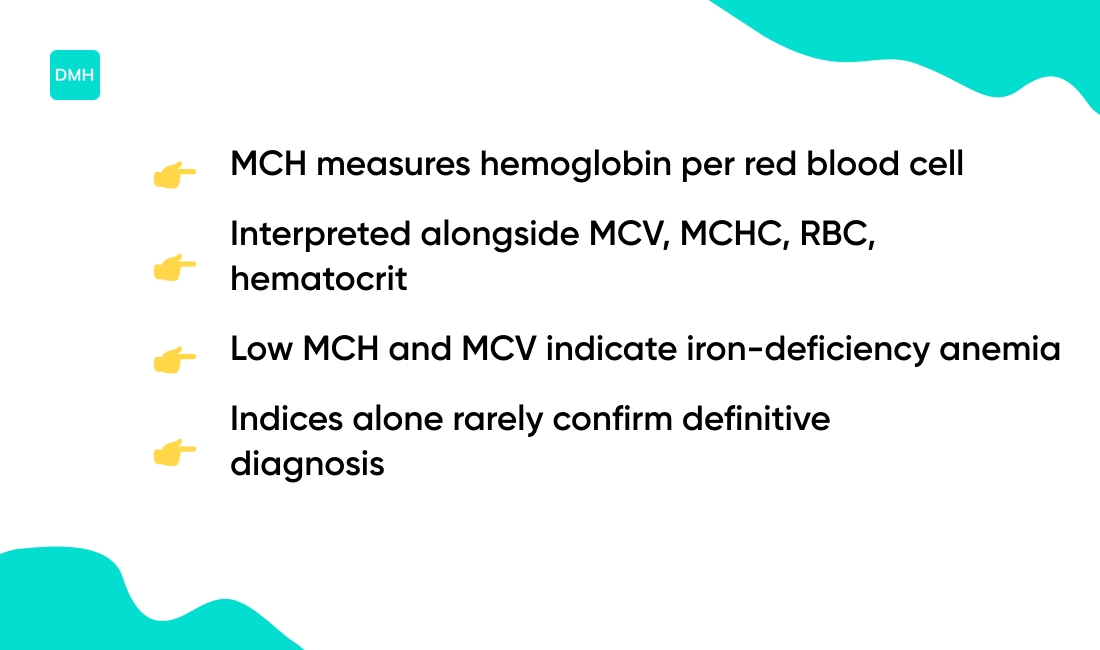
MCH measures the average hemoglobin per red blood cell and helps show whether cells are pale, small, or oversized.
This article breaks down MCH normal ranges, how labs calculate the value, common causes for low or high MCH, and what the numbers mean on a CBC.
You’ll learn when MCH points to iron deficiency or B12 issues, simple steps to address abnormal values, and when to see your clinician.
By the end, you’ll be better prepared to read your report and discuss clear next steps with your healthcare team.
What is MCH in a blood test
The mean corpuscular hemoglobin (MCH) measures average hemoglobin per red blood cell. Laboratories report MCH in picograms (pg).
The value appears on a complete blood count, the CBC. Refer to CBC with differential values and meanings for related indices. This index may help classify types of anemia alongside MCV and MCHC.
Typical adult MCH normal range runs 27–33 pg per cell, though labs vary slightly. Clinicians calculate MCH as (hemoglobin in g/dL × 10) ÷ RBC count in million/µL.
Here’s an example: hemoglobin 14 g/dL and RBC 5.0 million/µL gives MCH about 28 pg.
Low MCH may indicate iron deficiency or hypochromic microcytic anemia. High MCH may point to B12 or folate deficiency or macrocytic anemia.
Not a medical advice, content for educational purposes, consult a professional.
Normal MCH ranges and interpretation
MCH normal range for females and males
Mean corpuscular hemoglobin measures average hemoglobin per red blood cell. Labs report it in picograms (pg) per cell. The MCH blood test appears on a standard CBC panel.
Typical adult ranges often sit at 27–31 pg per cell. Some laboratories use a wider reference such as 28–34 pg. Reports may show 27–33 pg depending on the lab.
Many labs list similar ranges for females and males. Certain reference sets give females 27–31 pg and males 27–31 pg. Other lab reports may show 28–34 pg for both sexes.
Ranges may vary due to analyzer model, calibration, reference population, and sample handling. Age, pregnancy, and local laboratory standards can shift cutoffs slightly. Small differences rarely change clinical interpretation.
Persistent abnormal values may prompt further testing. Not a medical advice, content for educational purposes, consult a professional.
How is MCH calculated
Mean corpuscular hemoglobin (MCH) measures average hemoglobin per red blood cell. Labs derive it from hemoglobin concentration and red blood cell count on a CBC.
The common formula reads: MCH (pg) = (Hemoglobin [g/dL] × 10) ÷ RBC count [million cells/µL].
An example clarifies the math. Hemoglobin 14 g/dL with RBC 4.5 million/µL gives MCH = (14 × 10) ÷ 4.5 = 31.1 pg.
Automated hematology analyzers measure hemoglobin spectrophotometrically and count cells electronically. The analyzer applies the formula and reports MCH with other indices. Laboratories use venous blood in an EDTA tube and run quality controls to ensure accuracy.
Reported values can vary slightly by instrument and reference range. MCH calculation formula appears on many lab reports and may guide clinical interpretation alongside MCV and MCHC.
MCH vs MCV and MCHC differences
Mean corpuscular hemoglobin (MCH) measures average hemoglobin per red blood cell. Values appear in picograms (pg). Typical range is about 27–33 pg.
MCH vs MCV compares hemoglobin amount to cell size. Mean corpuscular volume (MCV) shows cell volume in femtoliters (fL). Normal MCV runs near 80–100 fL.
MCHC vs MCH contrasts concentration and amount. Mean corpuscular hemoglobin concentration (MCHC) reports g/dL. Typical MCHC sits near 32–36 g/dL.
| Index | What It Measures | Normal Range |
|---|---|---|
| MCH | Average hemoglobin per cell | 27–33 pg |
| MCV | Average cell volume | 80–100 fL |
| MCHC | Hemoglobin concentration | 32–36 g/dL |
Low MCH with low MCV may indicate microcytic, hypochromic anemia and often links to iron deficiency. High MCH with high MCV may point to macrocytic anemia from B12 or folate issues.
A low MCH with normal MCHC can mean fewer hemoglobin molecules per cell without a concentration change. Not a medical advice, content for educational purposes, consult a professional.
What causes low MCH levels
Symptoms of low MCH
The MCH blood test measures average hemoglobin per red blood cell. Normal MCH often ranges 27–33 pg per cell.
Low MCH may cause persistent fatigue and generalized weakness. Pale skin and reduced exercise tolerance often appear. Shortness of breath during activity, lightheadedness, and dizziness can occur.
Concentration problems and slower thinking may show up. Have you noticed feeling unusually tired even after a full night’s sleep?
Mean corpuscular hemoglobin values below about 27 pg per cell often suggest hypochromic, microcytic anemia linked to low iron stores. Interpretation pairs MCH with hemoglobin, MCV, and other CBC indices.
Medical attention may be warranted for fainting, chest pain, severe breathlessness, or a very rapid heart rate. Follow-up testing and evaluation by a clinician may clarify causes and possible management.
Is low MCH a sign of anemia
MCH measures average hemoglobin per red blood cell. Low MCH values may indicate reduced hemoglobin in each cell.
Low MCH levels often point to hypochromic microcytic anemia. Values below about 27 pg per cell are commonly labeled low on an MCH blood test. Low MCH can be linked to iron deficiency anemia, though other causes may exist.
Clinicians interpret MCH alongside MCV, MCHC, RBC count, and hematocrit for a clearer diagnosis. A low MCH with low MCV typically suggests iron-related anemia.
A low MCH with normal MCV might prompt further testing, including assessment of RBC production and iron studies. See related details on low red blood cell count.
How to increase MCH levels
Low MCH indicates less hemoglobin per red blood cell. This value appears on an MCH blood test and reflects mean corpuscular hemoglobin.
Raising MCH often involves correcting nutrient gaps and addressing underlying causes. Here’s the thing: treatment response varies by cause.
- Iron supplementation therapy: Oral iron may raise hemoglobin and MCH over weeks to months.
- Vitamin B6 supplements: Supplementation may help if testing shows B6 deficiency.
- Dietary iron sources: Eat lean red meat, legumes, spinach, and iron-fortified cereals.
Evaluation for blood loss, malabsorption, or chronic disease often matters. Clinicians may order iron studies and retesting. Severe or persistent low MCH might prompt intravenous iron or specialist referral.
Not a medical advice, content for educational purposes, consult a professional.
What causes high MCH levels
Symptoms of high MCH
Elevated MCH reflects a higher average hemoglobin amount per red blood cell. Levels above 33–34 pg per cell often indicate high MCH on an MCH blood test.
People may report persistent fatigue and generalized weakness. Shortness of breath with light exertion can occur. Neurological signs may appear with vitamin B12 deficiency.
Symptoms can include numbness, tingling, balance problems, and memory lapses. Cognitive slowing or trouble concentrating may develop. Mood changes have been reported in some studies.
Untreated causes of high MCH can lead to lasting nerve injury and other complications. Clinicians may investigate vitamin B12 and folate. They may request MCV and reticulocyte counts to clarify the cause.
When should I worry about high MCH
Mean corpuscular hemoglobin shows average hemoglobin per red blood cell. A single reading above 33–34 pg may occur with lab variation.
When should you actually be concerned? Well, persistently elevated levels over several tests often warrant evaluation.
High MCH with symptoms such as numbness, balance problems, severe fatigue, jaundice, or unexplained bleeding should prompt clinical assessment. Concurrent findings like high MCV or low hemoglobin raise concern.
Elevated MCH can reflect macrocytic anemia from vitamin B12 or folate deficiency. It can also be associated with liver disease, hypothyroidism, recent transfusion, certain medications, or bone marrow disorders. These conditions may need targeted testing.
Follow-up may include repeat CBC, B12 and folate levels, peripheral smear, and other diagnostic tests as indicated by a clinician. Findings guide further evaluation and management.
Treatment for high MCH levels
Elevated MCH on an MCH blood test often reflects larger red cells or vitamin deficiency. B12 injections or oral B12 may address deficiency-related macrocytic anemia.
Folic acid supplementation may be used when folate levels are low. Dietary modifications add leafy greens, fortified cereals, legumes, eggs, and lean meat.
Clinicians may review medications, alcohol use, and thyroid function as contributing factors. Addressing vitamin deficiencies may include targeted blood tests for B12 and folate. Clinical management can take weeks to months to show change on a CBC.
MCH values should be read with MCV and MCHC for diagnostic context. Persistent values above 33–34 pg per cell may prompt specialist referral. Normalize MCH values often involves correcting deficiencies and monitoring labs.
Not a medical advice, content for educational purposes, consult a professional.
Read also: When Should You Worry About Abnormal Blood Test Results
How MCH is used to diagnose anemia
The mean corpuscular hemoglobin shows the average hemoglobin mass per red blood cell. The MCH blood test appears on a CBC panel and guides interpretation when paired with other indices.
Clinicians read MCH alongside MCV, MCHC, RBC count, and hematocrit to classify anemia types. Typical adult MCH sits near 27–33 pg. Typical MCV is about 80–100 fL. Typical MCHC runs near 32–36 g/dL.
See details on the hematocrit blood test for hematocrit interpretation.
Pattern recognition helps. Low MCH with low MCV and low MCHC commonly points to hypochromic microcytic anemia, often linked to iron deficiency or chronic blood loss. High MCH with high MCV often indicates macrocytic anemia that may relate to vitamin B12 or folate issues.
But here’s the catch: single indices rarely give a final diagnosis. Combining indices, iron studies, B12/folate tests, reticulocyte count, and clinical findings improves accuracy.
Laboratories use automated analyzers that calculate MCH from hemoglobin and RBC count, so repeat testing may help when values sit near cutoffs. Not a medical advice, content for educational purposes, consult a professional.
You’ll also like: How to Increase Hemoglobin: What Research Suggests
Factors that affect MCH levels
MCH blood test measures the average hemoglobin per red blood cell. You may see fluctuations linked to common life events and health issues.
Pregnancy causes plasma volume to rise by up to 50%, which can dilute hemoglobin and lower MCH. You may notice mild drops during the second and third trimesters.
Medications can change MCH. Some antibiotics, chemotherapy drugs, and anticonvulsants may alter red blood cell production. A recent blood transfusion can raise MCH temporarily.
Acute illness or recent bleeding can shift MCH values for days to weeks. Infections and inflammation may suppress red blood cell production and affect MCH in CBC results.
Age affects MCH patterns. Men over 60 may show higher variability due to chronic disease, reduced marrow reserve, or long-term medication use (actually, UK data notes MCH among top abnormal biomarkers for this group). Older adults often need closer follow-up.
Temporary fluctuations happen with dehydration, heavy alcohol use, or short-term nutrient changes. Dietary shifts in B12, folate, or iron can move MCH up or down within weeks.
Repeat testing helps confirm an abnormal result. Clinicians commonly order a follow-up CBC within four to eight weeks to confirm trends or after correcting a reversible cause. Rapid retest may occur if bleeding or transfusion happened.
Learn how red blood cell lifespan can affect indices by checking the average lifespan of a red blood cell.
Not a medical advice, content for educational purposes, consult a professional.
You’ll also like: Anemia: Symptoms, Causes & Treatments
Educational notice: This content is provided for informational and educational purposes only and is not intended as medical advice. Always consult a qualified healthcare professional for medical concerns.