Reticulocyte count can reveal whether your bone marrow is keeping up with red blood cell production or if there’s a problem with loss or destruction.
But abnormal results often leave patients and clinicians unsure.
Does that number signal recovery, iron deficiency, hemolysis, or just lab variation?
Low and high values tell very different stories, and interpretation needs context like the full blood count, hemoglobin level, and patient age.
This guide explains the reticulocyte count test, normal ranges for adults and children, and when to use absolute, corrected, and production index calculations.
You’ll learn how high counts point to bleeding or hemolysis and how low counts suggest production problems.
By the end, you’ll be able to interpret reticulocyte results, understand common causes, and know what questions to ask your clinician.
What is a reticulocyte count
The reticulocyte count measures immature red blood cells circulating in blood. Reticulocytes form in bone marrow during erythropoiesis and mature into red blood cells within days.
The test helps assess bone marrow activity. A higher reticulocyte percentage can indicate an active marrow response. Clinicians order the test to evaluate anemia, monitor recovery after blood loss, and check treatment response.
Results appear as a percentage and as an absolute reticulocyte count. Typical adult values often range from 0.5% to 2.5% of red blood cells, with a mean near 1.0% to 1.5%.
Interpreting a reticulocyte percentage requires context. Hemoglobin, hematocrit, and total red blood cell count affect the result. Calculations such as the corrected reticulocyte count or reticulocyte production index adjust for anemia severity.
More detail on reticulocyte testing and clinical use appears at reticulocyte count. Results may vary by laboratory method and patient factors.
Not medical advice; content for educational purposes; consult a qualified healthcare professional for advice specific to your situation.
Why is a reticulocyte count test done
A reticulocyte count test measures immature red blood cells to assess marrow activity. Doctors order it to clarify the cause of low hemoglobin or visible anemia.
Clinicians use the result to separate production problems from increased loss or destruction. A low reticulocyte count often suggests reduced erythropoiesis from iron, B12, or folate deficiency or bone marrow suppression.
A high reticulocyte count can indicate active marrow response after bleeding or in hemolysis. Values rise within 3 to 7 days after acute blood loss or effective therapy for anemia.
Physicians monitor bone marrow function during chemotherapy, after bone marrow transplant, and while using erythropoiesis-stimulating agents. Serial reticulocyte percentage and the absolute reticulocyte count show trends in recovery.
Corrected reticulocyte count and the reticulocyte production index adjust for anemia severity and maturation time. These indices prevent misleading interpretation when hemoglobin or hematocrit are low.
Automated parameters such as reticulocyte hemoglobin and immature reticulocyte fraction add information about iron availability and early marrow response. (Pretty useful when you’re trying to spot iron problems early!) Combining these data with a complete blood count and clinical context improves diagnosis accuracy.
Test results often guide further testing, treatment decisions, or transfusion planning. Clinicians interpret reticulocyte count with patient age, recent bleeding, medications, and kidney function in mind.
Not medical advice; content for educational purposes; consult a qualified healthcare professional for advice specific to your situation.
Normal range for reticulocyte count
Adult normal range for reticulocyte count
The adult normal range for reticulocyte count is 0.5% to 2.5% of total red blood cells. Mean values commonly fall between 1.0% and 1.5% in healthy adults.
Labs may report the reticulocyte percentage normal or an absolute number. The absolute reticulocyte count equals the reticulocyte percentage multiplied by the total red blood cell count.
Here’s an example: 1% reticulocytes with an RBC count of 5,000,000/µL gives an absolute count of 50,000/µL.
High reticulocyte count may indicate a marrow response to blood loss or hemolysis. Low reticulocyte count may reflect reduced marrow production from iron or B12 deficiency, chronic kidney disease, or bone marrow disorders.
Values can vary by laboratory method and by patient hemoglobin level. Use age, clinical context, and paired CBC measures for accurate reticulocyte count interpretation.
Not medical advice; content for educational purposes; consult a qualified healthcare professional for advice specific to your situation.
Pediatric reticulocyte count normal range
The reticulocyte count measures immature red blood cells and reflects marrow activity. Newborns often show values of 2% to 6% during the first days of life.
Percentages drop toward the adult range over weeks to months. Healthy children commonly show a corrected reticulocyte count similar to adults, about 0.5% to 2.5% with a mean near 1%.
Labs may report an absolute reticulocyte count per µL or a reticulocyte percentage. Clinicians adjust values for hemoglobin and age when interpreting results.
Elevated pediatric reticulocyte percentages can indicate recovery from blood loss or hemolysis. Low percentages may suggest decreased production from nutritional deficiency or marrow disorders. Reticulocyte production index and corrected reticulocyte count aid interpretation in anemia and after transfusion.
Not medical advice; content for educational purposes; consult a qualified healthcare professional for advice specific to your situation.
Reticulocyte count vs RBC count
Reticulocyte count measures immature red blood cells in circulation. It reflects recent bone marrow activity and erythropoiesis.
RBC count measures total circulating red blood cells per microliter. It reflects overall oxygen carrying capacity.
The reticulocyte count test complements the red blood cell count. Reticulocyte percentage indicates marrow response. RBC count indicates cell mass.
A high reticulocyte percentage with a low RBC count may suggest marrow response after blood loss or hemolysis. A low reticulocyte percentage with a low RBC count may reflect reduced production from iron or B12 deficiency, chronic kidney disease, or marrow disorders.
Calculate the absolute reticulocyte count by multiplying reticulocyte percentage by RBC count. This number helps standardize interpretation across different hemoglobin levels.
If an RBC count is low, review causes of low red blood cell count and consider reticulocyte indices for context.
Not medical advice; content for educational purposes; consult a qualified healthcare professional for advice specific to your situation.
What causes a high reticulocyte count
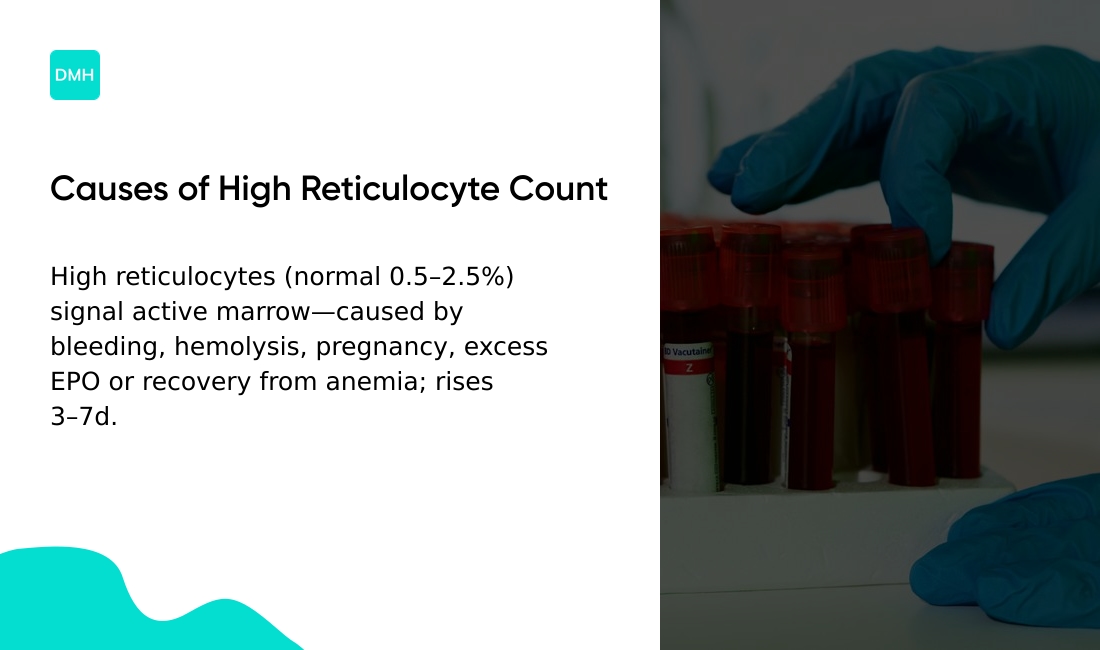
High reticulocyte count means a higher-than-expected percentage of immature red blood cells. A reticulocyte count test helps assess bone marrow response and overall erythropoiesis.
What triggers your marrow to ramp up production? Several conditions can cause elevated values:
- Acute blood loss — marrow ramps up production to replace lost red cells
- Hemolysis and hemolytic anemia — red cells break down faster than usual, prompting increased reticulocyte output
- Pregnancy — plasma volume expands and marrow activity often increases slightly
- Kidney issues with excess erythropoietin — tumors or disorders can raise erythropoietin and stimulate red cell production
- Recovery after treatment for anemia — iron or B12 therapy can trigger a brisk reticulocyte rise
- Erythroblastosis fetalis in newborns — a hemolytic condition that drives up reticulocyte production
Adults commonly show a normal reticulocyte count in the 0.5% to 2.5% range. Values above this range often indicate an active marrow response. The absolute reticulocyte count and the reticulocyte production index give clearer context.
After significant bleeding, reticulocyte percentage may rise within three to seven days. A high reticulocyte count with low hemoglobin often points toward loss or destruction of red cells rather than poor production.
Interpretation should combine reticulocyte percentage, absolute reticulocyte count, hemoglobin, and clinical findings. The reticulocyte count test forms one part of that assessment.
Not medical advice; content for educational purposes; consult a qualified healthcare professional for advice specific to your situation.
What causes a low reticulocyte count
A low reticulocyte count signals reduced production of young red blood cells by the bone marrow. Values below about 0.5% often indicate an inadequate marrow response.
The low reticulocyte count commonly appears with several conditions:
- Iron deficiency — limits hemoglobin production and lowers the reticulocyte percentage
- Vitamin B12 or folate deficiency — impairs DNA synthesis in red cell precursors, reducing the absolute reticulocyte count
- Bone marrow disorders — conditions like aplastic anemia and bone marrow failure directly reduce new red cell output
- Chronic kidney disease — can lower reticulocyte production through reduced erythropoietin
- Myelodysplastic syndromes — cause ineffective blood cell production alongside abnormal cell shapes
- Cancer treatments — chemotherapy, radiation, or bone marrow infiltration by tumor cells can suppress production
- Infections affecting marrow — certain viral or bacterial infections may temporarily reduce output
- Cirrhosis — liver disease can affect red cell production through multiple mechanisms
Low reticulocyte results require context. Clinicians compare the reticulocyte production index and reticulocyte hemoglobin to other lab values for accurate interpretation.
Refer to the anemia symptoms and treatments page for related information on causes and management of low reticulocyte states.
Not medical advice; content for educational purposes only. Consult a qualified healthcare professional for advice specific to your situation.
Reticulocyte count formulas and calculations
How to calculate absolute reticulocyte count
The absolute reticulocyte count gives the number of immature red cells per microliter. Use this reticulocyte percentage based formula:
Absolute reticulocyte count = (reticulocyte percentage ÷ 100) × total RBC count per µL
Here’s a practical example: reticulocyte percentage 1.5% with total RBC count 5.0×10⁶/µL.
- Convert 1.5% to 0.015 by dividing by 100
- Multiply 0.015 × 5,000,000 to get 75,000 reticulocytes per µL
You can compare this value with reference ranges to assess marrow response and reticulocyte count interpretation. Laboratory methods and reporting units can vary between facilities. Report results as reticulocytes/µL or ×10⁹/L as the lab uses.
Not medical advice; content for educational purposes; consult a qualified healthcare professional for advice specific to your situation.
How to calculate corrected reticulocyte count
The corrected reticulocyte count adjusts reticulocyte percentage for anemia severity. It helps avoid misleadingly high reticulocyte values in severe anemia.
Use this formula: Corrected reticulocyte count = reticulocyte percentage × (patient hematocrit / 45)
Example: reticulocyte percentage 5% and hematocrit 30%. Calculation: 5 × (30/45) = 5 × 0.67 = 3.33%. The corrected value shows actual marrow response.
Compare the result with the absolute reticulocyte count or the reticulocyte production index for fuller interpretation. The reticulocyte production index accounts for reticulocyte maturation time and refines assessment.
See more on hematocrit levels to confirm the patient hematocrit used in the formula.
Not medical advice; content for educational purposes; consult a qualified healthcare professional for advice specific to your situation.
Reticulocyte production index and interpretation
The reticulocyte production index (RPI) adjusts a reticulocyte count for shorter maturation time in circulation. It gives a clearer view of bone marrow response.
RPI uses the corrected reticulocyte count divided by a maturation factor tied to hematocrit. The maturation factor rises as anemia worsens.
An RPI above 3% usually indicates an appropriate marrow response to anemia or blood loss. An RPI below 2% suggests inadequate red cell production. Values between 2% and 3% may sit in a borderline zone and require clinical context.
Clinicians compare RPI with hemoglobin, absolute reticulocyte count, and peripheral smear findings. The RPI may vary by laboratory method and patient factors such as recent transfusion or kidney disease. Use RPI alongside other reticulocyte count tests for interpretation.
Not medical advice; content for educational purposes; consult a qualified healthcare professional for advice specific to your situation.
You might also like: What Happens at Your First Hematology Appointment
Advanced reticulocyte parameters
Modern hematology analyzers give more detail than a simple reticulocyte count. These measures help clarify iron status and early marrow response.
One value is reticulocyte hemoglobin content. It reports hemoglobin in newly made red cells. Values below approximately 28 to 29 pg may suggest low iron available for erythropoiesis. Changes show within days to weeks and can precede hemoglobin shifts.
Another value is immature reticulocyte fraction (IRF). It measures the youngest reticulocytes. A rising fraction can appear before total reticulocyte percentage rises. That pattern may signal a prompt marrow response after blood loss or therapy.
Laboratories also report the absolute reticulocyte count alongside these indices. Combining absolute counts with reticulocyte hemoglobin and IRF refines interpretation of anemia type. This approach helps distinguish iron deficiency from marrow production problems or hemolysis.
Peer-reviewed summaries describe practical cutoffs and timing for these markers. See the detailed review at PMC for specific study findings and method comparisons.
Use these parameters with standard indices like hemoglobin and RBC indices. Patterns matter more than single values.
Not medical advice; content for educational purposes; consult a qualified healthcare professional for advice specific to your situation.
You’ll also like: What Type Of Cancer Causes Low Hemoglobin
How to interpret reticulocyte count in anemia
Reticulocyte count measures immature red blood cells. It shows how actively the bone marrow makes new cells. You can use this result to separate production problems from loss or destruction.
Low reticulocyte percentage or a low reticulocyte production index often points to reduced marrow output. Causes may include iron, B12, or folate deficiency, chronic kidney disease, or marrow disorders. A corrected reticulocyte count below expected for the hemoglobin suggests poor production.
High reticulocyte percentage with a raised absolute reticulocyte count usually indicates increased red cell loss or destruction. Hemolysis and acute blood loss cause the marrow to release young cells. Expect a measurable rise within about 3 to 7 days after significant bleeding. A reticulocyte production index above 3 often shows an adequate marrow response.
How do you make sense of the numbers? Use simple calculations for clarity:
| Calculation | Formula | Purpose |
|---|---|---|
| Absolute reticulocyte count | Reticulocyte % × RBC count | Standardizes across different RBC levels |
| Corrected reticulocyte count | Reticulocyte % × (patient hematocrit / 45) | Adjusts for anemia severity |
| Reticulocyte production index | Corrected count / maturation factor | Accounts for maturation time in circulation |
Compare reticulocyte results with hemoglobin and red cell indices. For guidance on related hemoglobin patterns see low hemoglobin.
Not medical advice; content for educational purposes; consult a qualified healthcare professional for advice specific to your situation.
You might also like: What Is MCHC in Blood Test: Complete Guide
Reticulocyte count in specific conditions
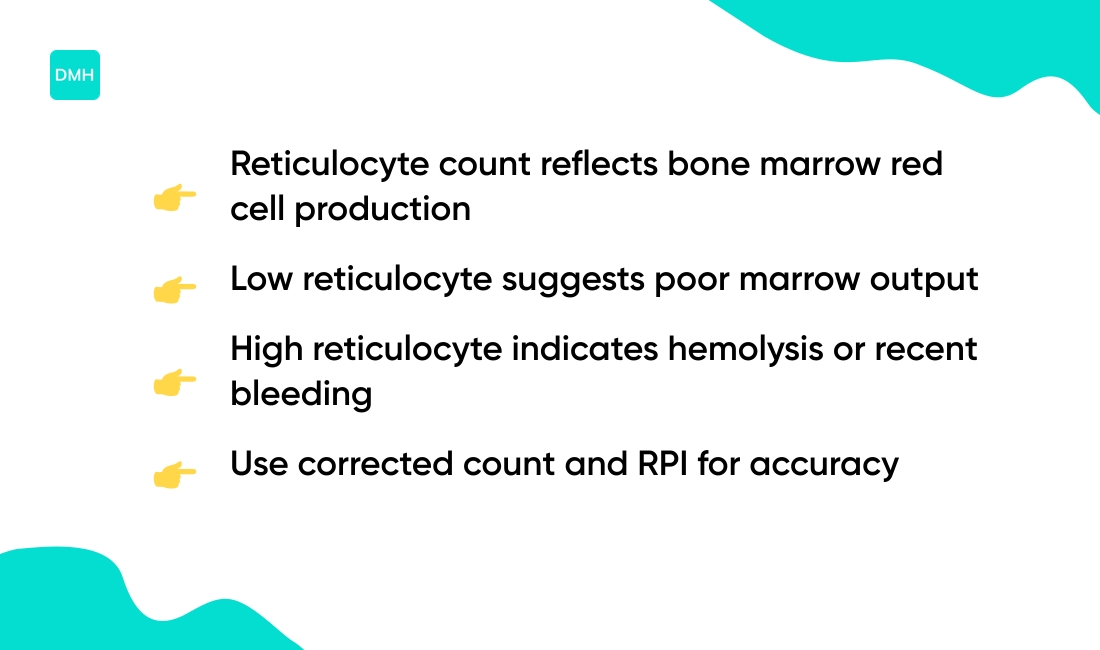
The reticulocyte count helps distinguish low production from active red cell loss or destruction. Low counts suggest marrow underproduction. High counts suggest marrow response to loss or hemolysis.
In iron deficiency anemia the baseline reticulocyte percentage often stays low. A measurable rise may appear 3 to 7 days after effective iron therapy. Peak reticulocyte response commonly occurs around 7 to 14 days. Hemoglobin rise may lag by several weeks.
In hemolysis the marrow usually increases output rapidly. Reticulocyte percent can exceed 3% within 2 to 3 days and peak at 5 to 7 days. The absolute reticulocyte count and a reticulocyte production index above 3 often support a robust marrow response. Additional tests help confirm hemolysis.
After acute blood loss the reticulocyte response resembles that of hemolysis. Counts often rise by day 3 and peak at 7 to 10 days. Magnitude depends on iron stores and marrow reserve. Check concurrent CBC values, such as those described in the CBC with differential values, for context.
Erythropoietin therapy and transfusion recovery show variable timelines. Reticulocyte increases may appear at 7 to 10 days with erythropoietin. Transfusion can suppress native reticulocyte output briefly and complicate interpretation.
Interpretation uses reticulocyte percentage, corrected reticulocyte count, and RPI alongside clinical data. Not medical advice; content for educational purposes; consult a qualified healthcare professional for advice specific to your situation.
You’ll also like: What Is MCV In Blood Test: Complete Guide
Educational notice: This content is provided for informational and educational purposes only and is not intended as medical advice. Always consult a qualified healthcare professional for medical concerns.