A small nutrient can have outsized effects on pregnancy, blood health, and even heart risk.
Folic acid is the synthetic form of vitamin B9 used in supplements and fortified foods to support cell growth and red blood cell formation.
Many people don’t know when to start it, how much to take, or how it differs from natural folate.
Without enough, you might face anemia or neural tube defects during pregnancy.
This guide covers when and why to use folic acid, dosages, food sources, and safety (including when methylfolate might be preferable).
You’ll find clear comparisons of folate vs folic acid, pregnancy and men’s fertility advice, and deficiency signs to watch for.
By the end you’ll know whether prenatal vitamins with folic acid suit your needs.
What is folic acid
Folic acid is the synthetic form of folate, or vitamin B9. It supports DNA synthesis and cell division in many body processes.
Folic acid helps form healthy red blood cells. Red blood cell production relies on sufficient folate.
Natural folate is found in leafy greens, legumes, and some fruits. The body absorbs these food forms differently than the synthetic version.
Folic acid appears in fortified foods and supplements. Your supplement label may list folic acid content.
The body converts folic acid into active forms such as methylfolate. Conversion speed can vary from person to person.
Methylfolate is the bioactive folate the body uses directly. Some people have gene variants that affect this conversion.
Many health agencies cite 400 mcg daily as a baseline for adults. Pregnant people often have higher needs for vitamin B9.
Public health programs add folic acid to grain and cereal. That policy can lower folic acid deficiency rates in populations.
Not medical advice; content for educational purposes—consult a qualified healthcare professional.
Folate vs folic acid: Understanding the difference
Folate describes the natural forms of vitamin B9 found in foods. Folic acid names the synthetic form used in supplements and fortified foods.
Natural folate sources appear in leafy greens, legumes, and liver. Folate in food exists in polyglutamate forms that require digestion before absorption.
Synthetic folic acid arrives as a stable monoglutamate. The body absorbs it more readily.
Nutrition science uses Dietary Folate Equivalents (DFE). One DFE equals 1 mcg food folate or 0.6 mcg folic acid from fortified foods or supplements taken with meals.
Folic acid must undergo enzymatic conversion. Dihydrofolate reductase (DHFR) reduces folic acid to dihydrofolate and tetrahydrofolate. Further steps produce 5-methyltetrahydrofolate (5-MTHF), the bioactive form.
5-MTHF is often sold as L-methylfolate. L-methylfolate bypasses MTHFR-dependent steps.
Some individuals with MTHFR gene variants may generate less 5-MTHF from folic acid. According to available research, this can vary from person to person.
Some studies suggest unmetabolized folic acid appears in blood after single doses around 200–400 mcg. Clinical relevance remains under study.
Choice between folic acid and L-methylfolate may hinge on genetics, absorption, and clinical needs.
Not medical advice; content for educational purposes—consult a qualified healthcare professional.
Key uses of folic acid
Folic acid for pregnancy and preventing neural tube defects
Folic acid supports DNA synthesis and rapid cell division in early embryos. It supplies methyl groups needed for neural tube closure.
Adequate folic acid intake around conception is associated with a 50–70% lower risk of neural tube defects such as spina bifida, according to the CDC.
Guidelines commonly advise starting a supplement that provides 400 mcg daily at least one month before conception and continuing through the first trimester. The neural tube closes by about day 28 after conception, so timing matters for effective risk reduction.
For more on how prenatal supplements work, see prenatal vitamin mechanism of action. Early folic acid use may help reduce the risk of neural tube issues by supporting the neural tube during its critical closure period.
Actually, all women capable of becoming pregnant should consider supplementation because neural tube defects often develop before pregnancy is known.
Not medical advice; content for educational purposes—consult a qualified healthcare professional.
Treating and preventing folic acid deficiency anemia
Folic acid supports DNA synthesis and red blood cell formation. In megaloblastic anemia caused by folate shortage, folic acid supplementation can aid recovery of blood counts.
Reticulocyte counts often rise within 3–5 days. Hemoglobin may improve over 2–4 weeks according to clinical reports.
Supplementation plays a role in managing nutritional shortfalls during pregnancy, infancy, and childhood. Clinicians commonly assess dietary intake and lab values before and during therapy.
Administering folic acid may obscure vitamin B12 deficiency, so B12 status often undergoes evaluation. More on diagnosis and management appears at anemia symptoms, causes, and treatments.
Not medical advice; content for educational purposes—consult a qualified healthcare professional.
Managing homocysteine levels for heart health
High homocysteine is an amino acid linked to higher risk of cardiovascular disease and stroke. Folic acid helps convert homocysteine into other benign compounds.
Some studies suggest lower homocysteine levels by about 20–30% with folic acid supplementation, especially when paired with vitamins B6 and B12 (meta-analyses).
Common supplement formulations include 400 mcg folic acid alongside B6 and B12 in balanced amounts. Testing blood homocysteine can clarify whether levels are elevated and if targeted strategies may help.
| Supplement Component | Typical Dose | Role in Homocysteine Metabolism |
|---|---|---|
| Folic Acid | 400 mcg | Converts homocysteine to methionine |
| Vitamin B6 | 1.3–2 mg | Supports cystathionine pathway |
| Vitamin B12 | 2.4 mcg | Cofactor for methionine synthase |
How might you know if your homocysteine is high? Check a fasting homocysteine blood test through your clinician. Discuss whether a combined B-complex supplement fits your needs and monitor levels over 8–12 weeks if a change is made.
Some studies suggest benefits for heart risk markers, yet individual responses can vary. Not medical advice; content for educational purposes—consult a qualified healthcare professional.
Folic acid for men and fertility support
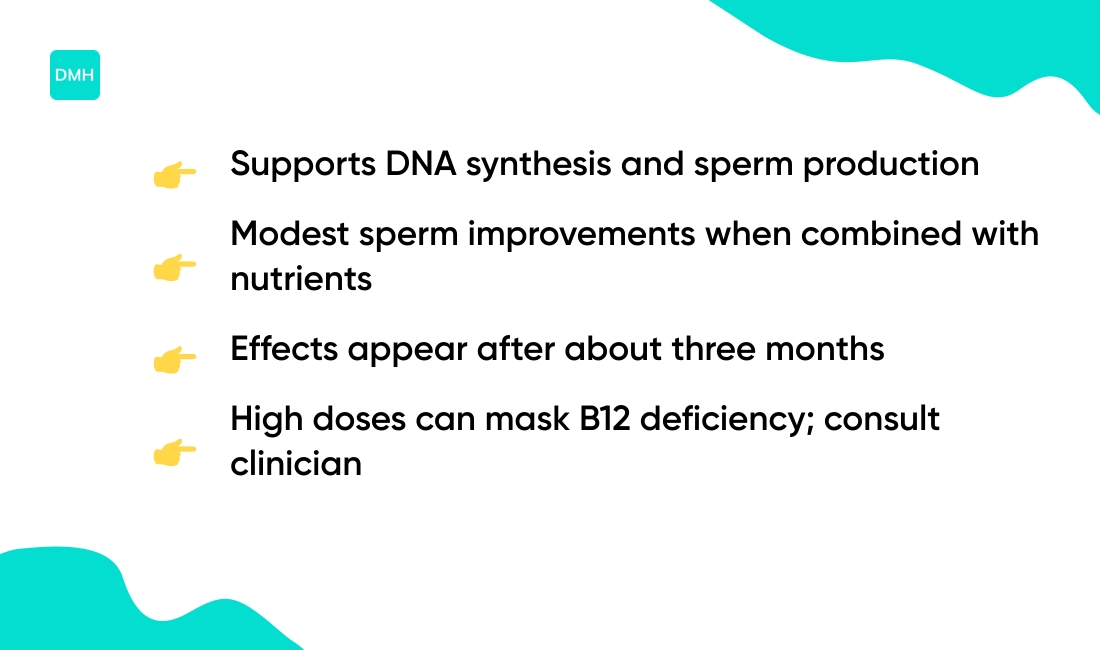
Folic acid helps DNA synthesis and cell division relevant to sperm production. Some studies suggest folic acid benefits male reproductive health.
Research links folic acid with modest gains in sperm concentration, motility, and DNA integrity when combined with other nutrients. Trials often test folic acid with zinc or vitamin B12.
Sperm production takes about 72 days, so measurable changes may appear after three months of consistent use. Typical adult intake is about 400 mcg daily from food and supplements.
Higher doses require clinical oversight because excess folic acid can mask vitamin B12 deficiency. Men considering supplements may discuss options with a healthcare professional.
Not medical advice; content for educational purposes—consult a qualified healthcare professional.
What are the benefits of folic acid
Folic acid is the synthetic form of vitamin B9 that supports DNA synthesis and red blood cell formation. Well, here’s what the research shows:
- Cell production support: Folic acid helps make new cells by aiding DNA and RNA synthesis. Supplementation corrects megaloblastic anemia caused by low folate levels.
- Cognitive function support: Some studies suggest higher folate status links to better memory and slower cognitive decline. Observational cohorts report associations rather than proven cause.
- Cardiovascular risk reduction: Clinical trials show folic acid can lower homocysteine by about 25–30%. Lower homocysteine levels may be associated with reduced stroke risk in some groups.
- Cancer research shows mixed results. Observational data link adequate folate to lower colorectal cancer rates. Randomized trials report variable outcomes, so findings remain nuanced.
- Emerging studies report that periconceptional folate exposure may be associated with lower neural tube defect risk and lower autism risk in some populations. Evidence on depression shows possible benefit in specific cohorts.
Common guideline references list 400 mcg as the standard daily folic acid amount for general adults. Product labels often show folic acid content or list folate under ingredients.
For an accessible summary and safety notes, see the WebMD overview of folic acid. Not medical advice; content for educational purposes—consult a qualified healthcare professional.
Folic acid dosage: How much should you take daily
Recommended daily intake for adults
General guidance lists 400 mcg daily of folic acid equivalents for most adults. This figure refers to dietary folate equivalents and aims to support DNA synthesis and red blood cell formation.
Dietary folate equivalents clarify absorption differences. One microgram of food folate equals 1 DFE. Synthetic folic acid is more bioavailable.
About 1 mcg folic acid taken with food equals 1.7 DFE. A supplement on an empty stomach may equal about 2.0 DFE. A 400 mcg folic acid tablet provides roughly 680 mcg DFE when taken with food.
Some situations call for higher doses. Pregnant people and those with prior neural tube defect risk may follow separate clinical guidance, which can range to much larger amounts under medical supervision.
Not medical advice; content for educational purposes—consult a qualified healthcare professional.
Folic acid dosage for pregnancy
Folic acid supports DNA synthesis and cell growth during early fetal development. Guidelines suggest starting folic acid at least one month before conception and continuing through the initial 12 weeks of pregnancy to support neural tube formation.
Standard recommendations list 400–800 mcg daily during pregnancy. Higher-risk situations, such as a previous neural tube defect or certain antiseizure medications, may be associated with specialist-guided doses of 4,000 mcg (4 mg) daily to reduce the chance of neural tube defects like spina bifida.
Check prenatal vitamin labels for prenatal vitamins that include folic acid 400 mcg. Dietary intake from leafy greens and fortified foods can help, but supplement content determines total daily folate equivalents.
Not medical advice; content for educational purposes—consult a qualified healthcare professional.
When to take folic acid: Morning or night
Timing for folic acid focuses on taking it every day at a steady time. Consistency supports steady blood levels and reliable benefit.
Folic acid is water-soluble and absorbs in the small intestine. Food doesn’t greatly change absorption. Taking it with food can reduce stomach upset from iron in prenatal vitamins.
Many public health sources cite 400 mcg daily for adults, with higher amounts noted for pregnancy risk groups. Here’s the thing—pick a time that fits a daily routine to improve adherence:
- Choose a time that fits your daily routine to improve adherence.
- If nausea occurs, take with a light meal or snack.
- Separate from high-dose anticonvulsant or antifolate drugs by clinician advice.
- Track intake with a pill box or phone reminder to maintain steady dosing.
Individual needs can vary. Some people may benefit from alternative forms such as folate-rich foods or methylfolate based on health history.
Not medical advice; content for educational purposes—consult a qualified healthcare professional.
Folic acid rich foods and dietary sources
Folate is the natural form of vitamin B9 found in foods. Folic acid refers to the synthetic form used in supplements and food fortification. Dietary folate supports DNA synthesis and red blood cell production.
Common folate-rich foods supply meaningful amounts per serving:
- Leafy greens: cooked spinach provides about 130 mcg folate per 1/2 cup.
- Legumes: cooked lentils supply roughly 175 mcg per 1/2 cup.
- Fortified cereals: many brands offer 100–400 mcg folic acid per serving.
- Asparagus and broccoli: 1/2 cup cooked contains about 50–90 mcg.
- Citrus fruit and juices: a cup yields near 50–80 mcg.
- Liver and organ meats: high concentrations, often over 200 mcg per 3 oz.
Food folate is measured in dietary folate equivalents (DFE) because natural folate and synthetic folic acid convert differently in the body. Fortified foods provide folic acid with higher bioavailability than many natural sources.
Typical diets may supply much folate, but intake can fall short of the 400 mcg folic acid target often cited for people planning pregnancy. Supplements and fortified foods help meet that target when needed.
Not medical advice; content for educational purposes—consult a qualified healthcare professional.
Symptoms of folic acid deficiency
You may notice signs when folic acid levels fall. Symptoms often reflect reduced red blood cell production and changes in brain function.
- Fatigue and weakness: Low energy and easy tiredness are common. People may report needing more rest for daily tasks.
- Memory and concentration: Short-term memory lapses, slower thinking, or mood shifts can occur. Cognitive effects can vary from person to person.
- Mouth changes: sore tongue, mouth ulcers, or cracked corners of the lips (angular cheilosis).
- Pale skin, shortness of breath, and a fast heartbeat from anemia. Folic acid deficiency can cause megaloblastic anemia and a low red blood cell count.
- Laboratory clues: serum folate below about 3 ng/mL and mean corpuscular volume (MCV) above 100 fL are often used to suggest deficiency.
Common causes include poor dietary intake, chronic alcohol and malnutrition, malabsorption (celiac disease), certain medications such as methotrexate or some anticonvulsants, and increased needs during pregnancy. Older adults and people with prior bariatric surgery face higher risk.
Symptoms can develop slowly and overlap with vitamin B12 deficiency. Not medical advice; content for educational purposes—consult a qualified healthcare professional.
You might also like: What Vitamin Deficiency Causes You To Crave Salt
What are the side effects of folic acid
Folic acid is a synthetic form of vitamin B9 used in supplements and fortification. Mild side effects may be associated with oral supplements.
Common reactions include nausea, abdominal discomfort, bloating, and loss of appetite. Some people report headaches, sleep changes, or skin rash. These effects tend to occur at higher supplement doses rather than from dietary folate.
High doses can create safety concerns. The tolerable upper intake level for adults is generally cited as 1,000 mcg of synthetic folic acid from supplements and fortified foods. Exceeding this level may mask vitamin B12 deficiency, which can delay diagnosis and allow neurological damage to progress.
Folic acid interacts with certain medications. People taking methotrexate may experience altered effects (low-dose folic acid often reduces methotrexate side effects in rheumatology, while high doses can influence chemotherapy outcomes). Mention of methotrexate interactions appears in clinical guidance and varies by treatment goal.
Some studies suggest very high folic acid intake might relate to faster growth of existing pre-cancerous cells, though evidence remains mixed. Individuals with active cancer or a history of malignancy may need individualized assessment before taking large supplement doses.
People on anticonvulsant medications or those with undiagnosed neurological symptoms should seek evaluation before starting supplements. Supplement needs can vary from person to person and by life stage, such as pregnancy.
Not medical advice; content for educational purposes—consult a qualified healthcare professional.
You might also like: Why Is My Pregnant Belly Soft When I Lay Down
L-methylfolate vs folic acid: Which is better
L-methylfolate is the bioactive form of vitamin B9. Folic acid is the synthetic form used in supplements and food fortification.
Synthetic folic acid requires enzymatic conversion to 5-methyltetrahydrofolate (5-MTHF). The liver and other tissues perform that conversion through MTHFR enzyme activity.
Some genetic variants of the MTHFR enzyme reduce conversion efficiency. MTHFR gene variations such as C677T can lower enzyme activity, and some studies suggest reductions range widely by genotype.
Active methyl folate bypasses the conversion step. That can raise circulating 5-MTHF more directly. Studies show improved blood folate markers with methylfolate in participants with reduced MTHFR function.
Common folic acid supplements supply 400 mcg. Methylfolate supplements often match or exceed that level in micrograms. Blood folate increases vary by dose and baseline status.
Methylfolate may suit individuals with documented MTHFR variants or persistent low folate despite supplementation. Clinicians may consider methylfolate when metabolic conversion is a concern.
Folic acid remains effective for many people. Fortified foods and standard supplements supply a reliable folate source for the general population.
Not medical advice; content for educational purposes—consult a qualified healthcare professional.
Read also: Water Sound In Belly During Pregnancy
Educational notice: This content is provided for informational and educational purposes only and is not intended as medical advice. Always consult a qualified healthcare professional for medical concerns.