MCV measures the average size of your red blood cells.
Mean corpuscular volume is the laboratory term for that measurement.
It appears on a CBC and reports the average red blood cell volume in femtoliters (fL).
What is MCV in a blood test
This value helps separate small cells from large cells. It gives a footprint used in anemia assessment.
We use MCV to flag potential anemia types early. In my opinion, MCV gives quick, practical clues for diagnosis and follow-up. See the CBC with differential values and meanings guide to view how MCV fits other CBC numbers.
The typical MCV normal range for adults sits near 80–100 fL. Values below that show microcytosis.
Values above that show macrocytosis.
MCV pairs with other indices such as MCH, MCHC, and RDW to refine interpretation. A single MCV value rarely gives a final answer.
Use trends, symptoms, and additional tests to decide next steps.
Think of the MCV blood test as a fast screening metric. It’s simple to read and widely available.
If your MCV falls outside 80–100 fL, talk to your clinician. Bring your CBC report and ask for targeted tests within two weeks.
What does MCV measure and how is it calculated
MCV reflects the average volume of each red blood cell. Labs express it in fL.
Clinicians use it to classify anemia patterns.
Lab technicians calculate MCV with a simple formula: MCV (fL) = (Hematocrit (%) ÷ RBC count (1012/L)) × 10.
Example: Hematocrit 45% and RBC 5.0 ×10¹²/L gives MCV = (45 ÷ 5.0) × 10 = 90 fL. That value sits in the normal range.
I’d say MCV gives a fast footprint for anemia classification. I’ve reviewed many CBCs where a single MCV value pointed toward microcytosis or macrocytosis.
Use MCV with other indices for better answers. Pair it with MCH, MCHC and RDW to refine diagnosis.
Low MCV suggests microcytic anemia. High MCV suggests macrocytic anemia.
MCV calculation is robust but depends on accurate hematocrit and RBC counts. Lab errors or timing differences can skew results.
If numbers conflict with symptoms, repeat the CBC.
Check your CBC for the MCV value and share it with your clinician within a week if you have symptoms like fatigue or breathlessness.
MCV normal range and interpretation
Microcytic RBCs (low MCV below 80 fL)
Mean corpuscular volume under 80 fL means red blood cells are smaller than normal and usually points to iron deficiency or thalassemia.
MCV appears on your CBC and the normal range is 80–100 fL. Microcytic values often sit between 60 and 79 fL.
Low MCV levels pair with low hemoglobin and a higher RDW in many iron-deficient cases.
Thalassemia produces low MCV with normal iron studies and a normal RDW. Small cells reduce oxygen delivery and cause fatigue, pallor, and reduced exercise tolerance.
Lab work includes iron studies, hemoglobin electrophoresis, and a peripheral smear.
Early follow-up speeds accurate diagnosis and prevents worsening symptoms. We recommend you review any low MCV with your clinician and check for a low red blood cell count within two weeks.
Normocytic RBCs (normal MCV 80-100 fL)
Normocytic RBCs are normal-sized red blood cells with MCV 80–100 fL.
Anemia can exist despite a normal MCV range. Causes include acute blood loss and chronic kidney disease.
A patient with MCV 90 fL and hemoglobin 8 g/dL may have recent bleeding. Actually, a normal MCV shouldn’t end an evaluation.
MCV in CBC gives average cell volume in femtoliters. MCV interpretation pairs with RDW and MCHC for clear diagnosis.
Use RDW to spot mixed or evolving anemia patterns. Low reticulocyte count suggests low production.
High reticulocyte count indicates bleeding or hemolysis.
Do you experience fatigue or pallor? Check hemoglobin now and bring prior CBC results to your visit.
Request reticulocyte count, iron studies, kidney panel, and a peripheral smear. We advise follow-up within two weeks if symptoms persist.
Macrocytic RBCs (high MCV above 100 fL)
High MCV above 100 fL points to macrocytic anemia from vitamin B12 or folate deficiency.
Alcohol use, liver disease, hypothyroidism, and bone marrow disorders can cause large red blood cells.
Check serum B12, folate, liver enzymes, and TSH early. Testing these markers first speeds diagnosis and reduces unnecessary tests.
Mean corpuscular volume measures average red blood cell size in femtoliters. Clinicians use MCV to classify anemia type and guide further testing.
If your MCV remains above 100 fL, ask your clinician about bone marrow evaluation and review our page on high red blood cell count for related findings.
Ask for these tests within two weeks and follow up with a hematologist if abnormal results persist.
What does low MCV mean and what causes it
Low MCV points to microcytic anemia and shows smaller red blood cells than normal.
Low MCV meaning covers several specific disorders with unique tests and treatments.
| Cause | Typical MCV Range (fL) | Key Diagnostic Test |
|---|---|---|
| Iron deficiency | 60–80 | Ferritin, serum iron, TIBC |
| Thalassemia trait | 55–75 | Hemoglobin electrophoresis |
| Chronic inflammation | 70–80 | CRP, ESR |
| Lead poisoning | 65–80 | Blood lead level |
| Sideroblastic anemia | 60–90 | Bone marrow biopsy |
Common microcytic anemia causes include iron deficiency, thalassemia, chronic inflammation, lead poisoning, and sideroblastic anemia.
Low MCV is defined as under 80 fL. Normal range runs 80 to 100 fL.
Symptoms often include fatigue, pallor, shortness of breath, fast heartbeat, and pica (that unusual craving for non-food items).
Microcytosis often yields MCV from 60 to 80 fL in iron deficiency. Thalassemia trait can produce MCV near 55 fL despite normal iron stores.
Follow a clear diagnostic approach starting with CBC, RDW, reticulocyte count, and peripheral smear. Add iron studies: serum iron, ferritin, and TIBC to confirm iron deficiency.
Use hemoglobin electrophoresis for thalassemia screening. Measure blood lead if exposure risk exists.
Consider bone marrow biopsy when sideroblastic anemia is suspected or tests remain unclear.
We advise tracking ferritin and hemoglobin trends over weeks. I really think ferritin gives the clearest signal for iron deficiency.
If low MCV lowers your hematocrit, read about how to raise hematocrit.
Start by sharing these results with your clinician and request iron studies within one week.
What does high MCV indicate and what causes it
High MCV signals enlarged red blood cells, a finding called macrocytosis. MCV above 100 fL defines macrocytosis.
Common causes include nutrient shortages, organ dysfunction, alcohol exposure, medications, and marrow disorders.
- Vitamin B12 deficiency — impaired DNA synthesis; treat with B12 replacement.
- Folate deficiency — oral folic acid corrects many cases.
- Alcohol use — raises MCV and alters marrow function.
- Liver disease — disrupts red blood cell production and size.
- Hypothyroidism — low thyroid function can increase MCV.
- Chemotherapy medications — several agents cause macrocytosis.
- Myelodysplastic syndromes — marrow disorders that need hematology care.
Treatment targets the cause: replace missing vitamins, stop alcohol, manage liver disease, give thyroid replacement, modify chemotherapy, or refer to hematology for marrow evaluation.
Severe anemia may need transfusion or bone marrow biopsy.
I’d say testing B12 and folate first gives the fastest diagnostic yield. Simple labs and a blood smear often narrow causes within days.
We recommend checking MCV with B12, folate, TSH, liver panel, and a peripheral smear. If alcohol is a factor, review strategies to lower hematocrit.
For a clinical review of macrocytic anemia and evaluation, see the NCBI summary on macrocytic anemia. Act on abnormal MCV by contacting your clinician within one week for targeted testing.
MCV and RBC indices: Understanding the relationship
What is the difference between MCV and MCH
MCV and MCH report different aspects of your red blood cells. Mean Corpuscular Volume measures average cell size in femtoliters (fL).
Normal MCV sits around 80–100 fL.
Mean Corpuscular Hemoglobin measures average hemoglobin mass per red blood cell in picograms (pg). Typical MCH ranges near 27–33 pg.
Low MCV points toward microcytic anemia from iron deficiency or thalassemia. Low MCH shows reduced hemoglobin per cell and often mirrors low MCV.
High MCV suggests macrocytosis from B12 or folate problems while MCH may rise proportionally or stay normal, giving different clues.
I really think that reading both values together improves diagnostic clarity. I’ve seen cases where MCV looked normal but MCH flagged low hemoglobin content.
We use MCV, MCH, MCHC and RDW as a panel. If your CBC shows abnormal MCV or MCH, ask your clinician for iron studies and B12 testing within two weeks.
What is the difference between MCV and MCHC
MCV measures red blood cell size while MCHC shows hemoglobin concentration inside each cell.
Mean corpuscular volume appears on the CBC as fL. Hemoglobin concentration appears as g/dL.
Low MCV (below 80 fL) and low MCHC (below 32 g/dL) suggest iron deficiency. That pattern produces microcytic anemia.
Low MCV with normal MCHC favors thalassemia trait. High MCV (above 100 fL) with normal MCHC suggests macrocytosis from B12 or folate issues.
We recommend checking RDW and iron studies when MCV and MCHC disagree. Combining these RBC indices speeds diagnosis and reduces unnecessary tests.
If your CBC shows abnormal MCV or MCHC, talk to your clinician within seven days and ask about targeted testing.
How RDW complements MCV interpretation
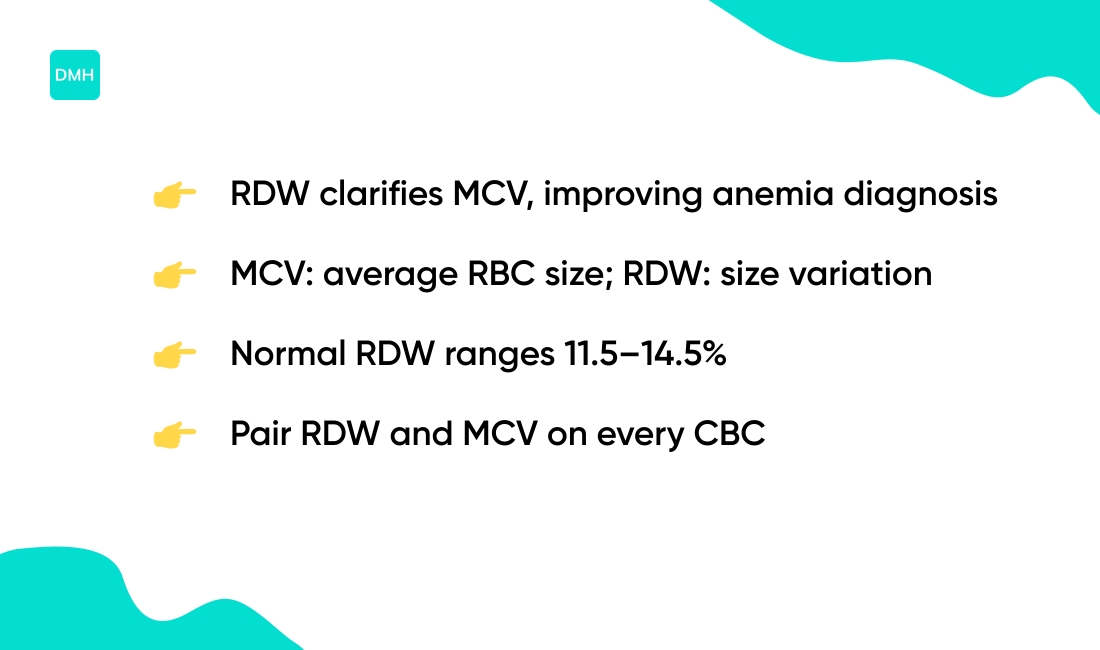
RDW clarifies MCV results and improves anemia diagnosis.
Mean corpuscular volume reports average red blood cell size in fL. Red cell distribution width quantifies size variation as a percent.
Normal RDW sits near 11.5–14.5%.
High RDW with low MCV usually points to iron deficiency. Normal MCV with high RDW suggests early iron deficiency or mixed microcytic and macrocytic changes.
High MCV and high RDW raise concern for marrow disorders. They may reflect B12 or folate deficiency.
We recommend reviewing RDW and MCV together on every CBC. Pairing these indices reduces diagnostic delay and guides targeted tests such as ferritin and B12.
Ask your clinician to check both values and interpret them within two weeks. Learn more about RDW (RBC distribution width) for practical thresholds and recommended steps.
You might also like: What Is Basophils In Blood Test
MCV quickly classifies anemia as microcytic, normocytic, or macrocytic.
Mean corpuscular volume shows average red blood cell size in femtoliters (fL).
Microcytic results (below 80 fL) point toward iron deficiency or thalassemia. Normocytic results (80–100 fL) suggest acute blood loss or chronic disease.
Macrocytic results (above 100 fL) raise concern for B12 or folate deficiency, liver disease, or bone marrow problems.
MCV guides which follow-up tests doctors order. Low MCV usually triggers iron studies, ferritin, and hemoglobin electrophoresis.
High MCV prompts B12, folate, liver panel, and thyroid tests. Normocytic anemia often leads to reticulocyte count and kidney function tests.
We advise linking MCV findings to a clear diagnostic plan. Order one targeted test at a time.
Track results over 4–8 weeks when treatment starts.
I’d say combining MCV with RDW and MCHC gives the clearest direction. RDW shows size variation. MCHC shows hemoglobin concentration per cell.
Consider cancer as a possible cause of low hemoglobin in select patients; see resources on cancers that cause low hemoglobin for more detail.
Ask your clinician for iron studies or B12 testing within two weeks if MCV is abnormal. That step speeds accurate diagnosis and treatment.
You’ll also like: What Is Neutrophils In Blood Test
What to expect during an MCV blood test
Expect a simple blood draw that delivers same-day MCV results.
An MCV blood test measures mean corpuscular volume as part of a CBC to report average red blood cell size.
- Procedure time: 1–5 minutes for the draw.
- Preparation: no fasting or special prep required.
- Results: most labs return MCV levels the same day via routine analysis.
- Needle: small gauge used; you may feel brief pinprick pain.
- Recovery: light pressure for 1–2 minutes prevents bleeding.
Minor side effects include bruising, slight soreness or faintness at the site; minimal risks expected.
We recommend telling your phlebotomist about blood thinners and recent illness before the draw. Bringing a short medication list helps your clinician interpret MCV results more accurately.
If your MCV is outside the normal range of 80–100 fL, your provider will suggest follow-up tests to clarify causes such as microcytic anemia or macrocytic anemia.
Bring ID, a medication list, and any recent lab reports. Ask for same-day MCV interpretation and follow-up steps before you leave.
You’ll also like: What Is Lymphocytes In Blood Test
Educational notice: This content is provided for informational and educational purposes only and is not intended as medical advice. Always consult a qualified healthcare professional for medical concerns.