You can usually take Mucinex and Sudafed together safely.
Mucinex uses guaifenesin to loosen mucus and improve cough clearance.
Sudafed uses pseudoephedrine to shrink swollen nasal tissues and open airflow.
These medicines target separate problems, so they don’t overlap in action.
Is it safe to take Mucinex and Sudafed together?
Mucinex and Sudafed offer complementary relief for chest congestion and nasal stuffiness. Guaifenesin and pseudoephedrine have no known direct pharmacologic interaction, meaning combining them doesn’t create a new drug interaction in most healthy adults.
Dosing matters. Common guaifenesin dosing is 600–1,200 mg extended-release every 12 hours, up to 2,400 mg per day. Pseudoephedrine often comes as 30–60 mg every 4–6 hours or 120 mg every 12 hours, up to 240 mg per day.
Avoid taking multiple products that contain the same active ingredient to prevent overdose. (Trust me, doubling up on decongestants isn’t fun.)
Pairing an expectorant and decongestant can speed symptom relief when you feel both chest mucus and nasal blockage. Watch your blood pressure and heart rate while using pseudoephedrine, especially if you have cardiovascular concerns.
We recommend reading labels and checking with your clinician if you have high blood pressure, heart disease, thyroid issues, or use antidepressants. See this safety guide on taking Mucinex and Sudafed together for more details.
How Mucinex and Sudafed work differently
What Mucinex does (guaifenesin)
Guaifenesin helps thin mucus in the airways and makes coughs more productive. It increases water in secretions so mucus flows and clears the bronchi more easily.
You can buy it as 200–400 mg immediate-release or 600–1,200 mg extended-release tablets. Many people notice easier breathing within 30–60 minutes of a dose.
Ever wonder why drinking water helps when you’re congested? Guaifenesin works best when you stay well-hydrated throughout the day.
Read about recovery timelines at how long chest colds last to match treatment to symptom length. Ask your pharmacist or follow the label for dosing and safety before combining guaifenesin with other cold medicines.
What Sudafed does (pseudoephedrine)
Pseudoephedrine shrinks swollen nasal blood vessels to reduce congestion and help you breathe through your nose. It acts as a nasal decongestant that stimulates alpha receptors in the nasal lining.
This shrinking nasal vessels effect reduces mucosal swelling and opens airways. Relief often begins within 15 to 30 minutes and may last about four to six hours.
Common side effects include increased blood pressure, trouble sleeping, and mild nervousness. Pseudoephedrine gives reliable, fast nasal relief for many people — patients often report noticeable improvement in nasal airflow after one dose.
Avoid pseudoephedrine if you have hypertension or heart disease. If you deal with a constant runny nose, check that resource and talk with your pharmacist or doctor before using Sudafed.
Why they complement each other
Combining an expectorant and a decongestant treats both chest and nasal congestion effectively. Guaifenesin thins mucus so you cough it up more easily, while pseudoephedrine constricts nasal blood vessels and restores nasal airflow within 30–60 minutes.
No direct drug interaction exists between guaifenesin and pseudoephedrine. They act on different targets, so guaifenesin and pseudoephedrine work without overlapping mechanisms.
Can you take Mucinex and Sudafed together? Yes, when you follow label dosing.
Extended-release guaifenesin typically lasts about 12 hours. Pseudoephedrine effects last roughly 4–6 hours, so you may need to stagger your doses throughout the day.
Watch your blood pressure and heart rate. Ask your clinician before mixing them if you have hypertension, heart disease, or take other stimulants.
Proper dosage and timing guidelines
Clear dosing and timing matter when you take Mucinex and Sudafed together. Here’s the breakdown:
| Medication | Dosage | Frequency | Daily Maximum |
|---|---|---|---|
| Guaifenesin (immediate-release) | 200–400 mg | Every 4 hours | 2,400 mg |
| Guaifenesin (extended-release) | 600–1,200 mg | Every 12 hours | 2,400 mg |
| Pseudoephedrine (immediate-release) | 30–60 mg | Every 4–6 hours | 240 mg |
| Pseudoephedrine (12-hour) | 120 mg | Every 12 hours | 240 mg |
You can take Mucinex and Sudafed at the same time because guaifenesin and pseudoephedrine act differently. Space repeat doses to respect each drug’s schedule.
If you use immediate-release forms, you may dose both together and repeat guaifenesin every 4 hours and pseudoephedrine every 4–6 hours. If you use long-acting forms, stick to the 12-hour intervals.
Avoid combination products that contain pseudoephedrine plus guaifenesin in addition to separate Sudafed. Mixing duplicates the decongestant and risks overdose. Choosing single-ingredient products makes dosing safer and simpler.
Watch for high heart rate, severe headache, or marked blood pressure rise. Stop the medicines and seek care if those happen. Read every label, follow label directions, and ask your pharmacist or doctor if you have heart, blood pressure, pregnancy, or other health concerns.
What’s the difference between Mucinex D and Sudafed?
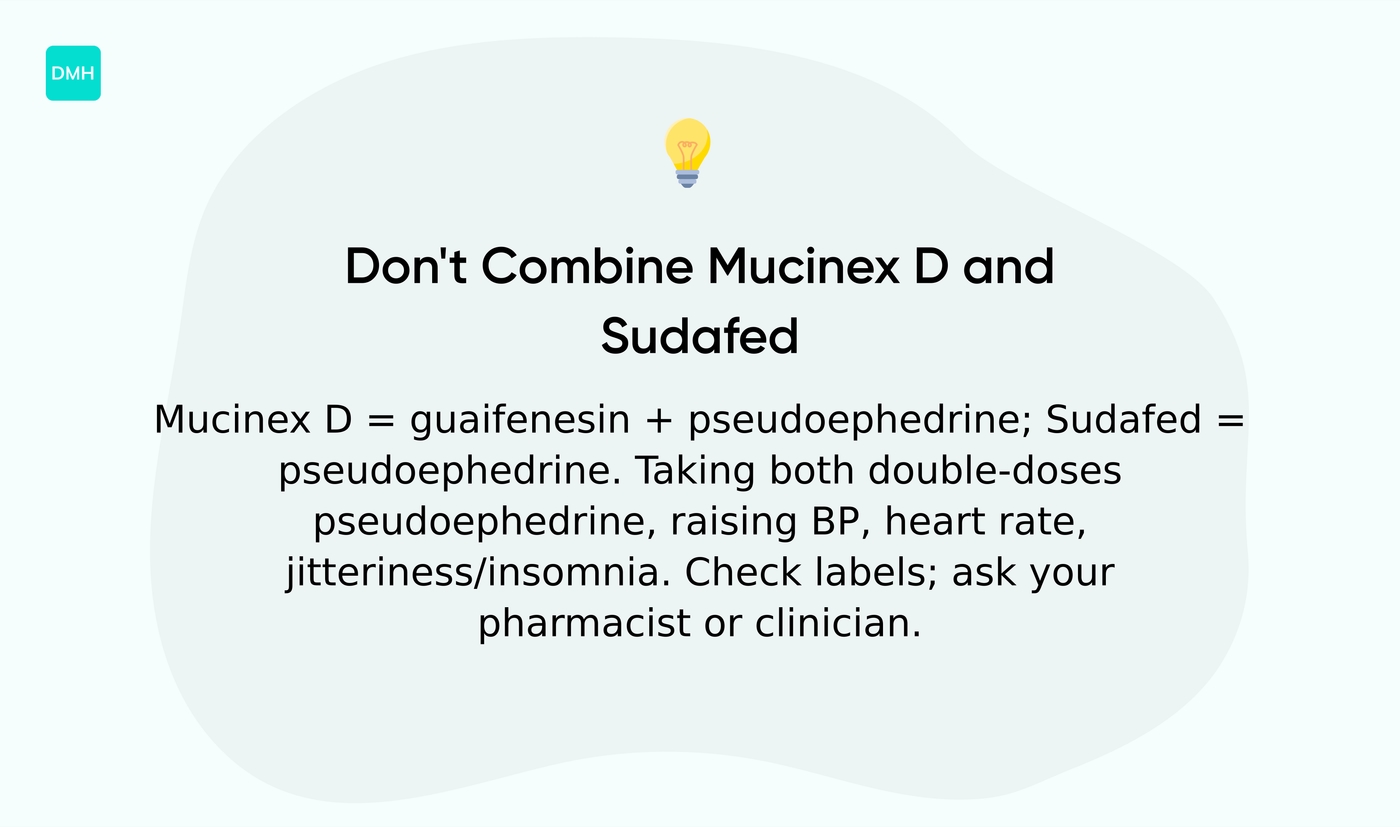
You should not take Mucinex D with extra Sudafed. Here’s why:
Mucinex D combines guaifenesin expectorant with pseudoephedrine decongestant. Sudafed contains pseudoephedrine only. The combination product treats chest mucus and nasal swelling in one pill, while Sudafed treats nasal congestion alone.
Pseudoephedrine dosing commonly runs 60 mg every 4–6 hours with a 240 mg daily limit. Extended-release guaifenesin often comes as 600 mg every 12 hours with a 2,400 mg daily cap.
Taking Mucinex D plus standalone Sudafed can cause double-dosing pseudoephedrine and push you past safe limits. (And that’s when things get dicey.)
Excess pseudoephedrine raises blood pressure, speeds heart rate, and causes jitteriness or insomnia. Those risks matter if you have hypertension, heart disease, thyroid problems, or are pregnant.
Check labels before mixing products. If you search “can you take Mucinex and Sudafed together” online, look for dosing numbers and product ingredients on the label.
Avoid extra decongestant when you already take Mucinex D. Ask a pharmacist if you need separate guaifenesin without added pseudoephedrine. If you feel unsure, stop and call your pharmacist or clinician and bring both medication labels.
Can you take Mucinex DM and Sudafed at the same time?
You can take Mucinex DM and Sudafed together in many cases. Guaifenesin in Mucinex thins and loosens chest mucus, while pseudoephedrine in Sudafed narrows nasal blood vessels to reduce congestion.
No direct interaction exists between guaifenesin and pseudoephedrine, so the drugs often complement each other. This makes expectorant and decongestant therapy useful for chest and nasal symptoms.
But here’s the catch: Mucinex DM includes dextromethorphan, a cough suppressant that can interact with MAO inhibitors and some antidepressants. Tell your clinician or pharmacist about all medications before you mix them.
Avoid doubling up on decongestants. Don’t take Sudafed with Mucinex D at the same time.
Typical Sudafed dosing is 30–60 mg every 4–6 hours. Mucinex extended-release runs 600–1,200 mg every 12 hours, per label directions.
Watch for faster heart rate, trouble sleeping, or higher blood pressure when you combine these medicines. Seek medical advice if you have hypertension, heart disease, thyroid issues, prostate problems, or pregnancy.
Talk to a pharmacist before mixing over-the-counter cold medicines.
Who should avoid taking Mucinex and Sudafed together
High blood pressure concerns
People with high blood pressure should use Sudafed with caution. Pseudoephedrine narrows blood vessels to reduce nasal swelling, but that action can raise blood pressure by about 5–10 mmHg in some studies.
People with hypertension risk rapid heartbeat, chest pain, and dangerous pressure spikes on pseudoephedrine. Mucinex with Sudafed PE (phenylephrine) may cause less systemic change than pseudoephedrine but still narrows vessels.
Guaifenesin alone treats chest congestion without raising blood pressure. People on blood pressure meds should avoid pseudoephedrine unless a clinician approves.
Patients often switch to guaifenesin-only options and feel safer. Have you checked your medication list lately? If you’re on antihypertensives, check with your doctor or pharmacist before mixing products.
Drug interactions to watch for
Avoid Sudafed if you take an MAOI or tricyclic antidepressants like amitriptyline. Pseudoephedrine raises blood pressure and heart rate, and that effect can trigger severe hypertension with MAOIs.
Wait at least 14 days after stopping an MAOI before using pseudoephedrine. Mucinex DM contains dextromethorphan, which can interact with MAOIs and some antidepressants to cause serotonin syndrome.
Combining guaifenesin and pseudoephedrine adds decongestant effects and a separate risk for high blood pressure. Always tell your pharmacist about prescriptions, OTCs, herbal supplements, and recreational drugs. Full disclosure prevents dangerous surprises.
Check all medicines first and get a pharmacist or prescriber to confirm. Seek care for sudden chest pain, severe headache, or fast heartbeat.
Pregnancy and breastfeeding safety
Don’t take Mucinex and Sudafed during pregnancy or while nursing without your obstetrician’s approval. Guaifenesin (Mucinex) has limited safety data for pregnancy.
Pseudoephedrine (Sudafed) can raise blood pressure and may reduce uterine blood flow. If you’re wondering “can you take Mucinex and Sudafed together” while pregnant, seek medical clearance first.
Pseudoephedrine can lower milk supply for some people. Guaifenesin transfers into breast milk in small amounts, though evidence remains limited.
If you take supplements like Emergen-C, see our guide on taking Emergen-C while pregnant for related advice. Discuss cough and cold plans with your obstetrician or pharmacist. Avoid self-mixing over-the-counter decongestants and expectorants until you get written clearance.
Potential side effects of combining Mucinex and Sudafed
You can usually take Mucinex and Sudafed together without a direct drug interaction, but watch for stimulant effects from Sudafed. Guaifenesin thins mucus to ease chest congestion, while pseudoephedrine narrows nasal blood vessels to relieve stuffiness.
No pharmacologic interaction exists between guaifenesin and pseudoephedrine, so symptoms often improve faster when both target separate problems.
Expect these common side effects:
- Guaifenesin: nausea, dizziness, headache, stomach upset
- Pseudoephedrine: nervousness, insomnia, increased heart rate, raised blood pressure
Watch for serious signs that need immediate care. Seek help for chest pain, rapid heartbeat, fainting, severe shortness of breath, severe headache, sudden vision change, or hives and facial swelling.
Follow label dosing and avoid duplicate decongestants. People with high blood pressure, heart disease, thyroid disease, or prostate issues should check with their clinician before mixing these drugs.
If you notice worrying symptoms, stop the medicines and seek emergency care for any bolded signs. Call your prescriber if mild side effects persist beyond 48–72 hours or if you need dosing guidance.
Read also: How Long Does It Take To Get Your Taste Back After The Flu
Can children take Mucinex and Sudafed together?
Avoid giving Mucinex and Sudafed together to young children. Don’t combine these medicines for kids under four.
Pseudoephedrine can raise heart rate and blood pressure. Guaifenesin can cause nausea and thickened secretions in some children. Parents should prefer children under 4 safety rules and simple remedies first.
Use single doses only under guidance for ages four to eleven. Choose single-ingredient options when a doctor approves dosing.
Safer alternatives include:
- Saline nose drops
- Cool-mist humidifier
- Fever reducers when needed
- Plenty of fluids
Watch for rapid breathing, high fever, persistent cough, or poor feeding. See this safety guide for kids for clear age limits and red flags.
When in doubt, what should you do? Ask your pediatrician before giving any combination. Call your child’s doctor for dose guidance and safer options.
You’ll also like: How To Get Rid Of Bitter Taste From Medicine

Using Mucinex and Sudafed with other cold medicines
You can combine Mucinex and Sudafed with other OTC cold medicines when you avoid duplicate ingredients. Mucinex contains guaifenesin, an expectorant. Sudafed contains pseudoephedrine, a decongestant.
Those two don’t interact pharmacologically, so they can address chest and nasal congestion together. Check every product label before you take more than one medicine:
- Ingredient duplication risk: watch for acetaminophen, dextromethorphan, pseudoephedrine, and phenylephrine listed more than once
- Follow label directions: typical pseudoephedrine dosing is 60 mg every 4–6 hours, not exceeding 240 mg daily; extended-release guaifenesin usually caps at 2,400 mg daily
- Avoid Mucinex D plus extra Sudafed to prevent double-dosing the decongestant
- If you use DayQuil or NyQuil, check ingredients and timing, or read guidance about how long after DayQuil can I drink before adding other medicines
Single-ingredient products simplify safe layering and reduce overdose risk. Ask a pharmacist when in doubt. See a doctor if symptoms worsen or if you have high blood pressure, heart disease, or pregnancy concerns.
Read also: When To Take Baby To Doctor For Cough
When to see a doctor instead
See a doctor if symptoms last longer than 7–10 days or if they get worse. Persistent symptoms may indicate a bacterial infection, and severe signs need prompt care.
If you took Mucinex and Sudafed together and you still feel worse, stop and call your provider. Here are the red flags:
- Worsening condition with growing pain or new high fever
- Shortness of breath, wheezing, or severe breathing trouble
- Chest pain, fainting, trouble speaking, or sudden confusion
- Temperature above 102°F for adults, persistent high fever, or fever that returns after improving
- Symptoms that follow recent surgery, immunosuppressive therapy, or chronic disease
- Severe sinus pain or facial swelling — see guidance on when to go to hospital for sinus infection
Avoid guessing about serious signs. Early evaluation prevents worse outcomes and limits complications. Call your doctor now or go to the emergency room if you have any red flag.
You might also like: How Long After Drinking Coffee Can I Take Medicine
Educational notice: This content is provided for informational and educational purposes only and is not intended as medical advice. Always consult a qualified healthcare professional for medical concerns.