That odd “MPV” value on a blood report often raises more questions than answers.
An mpv blood test measures mean platelet volume — one of the platelet indices clinicians use to assess clotting and platelet health.
Abnormal MPV results can point to bleeding, clotting, or bone marrow problems, but they rarely mean much without clinical context.
This guide explains how to interpret high and low MPV values, common causes of changes, and when those findings warrant further evaluation.
You’ll learn the normal MPV reference range, how MPV is measured in a CBC, and how to read MPV alongside platelet count.
By the end you’ll be better prepared to discuss mpv results with your clinician and to spot when elevated or decreased MPV needs prompt attention.
What is MPV in a blood test
The mpv blood test measures the average size of platelets in a blood sample. Platelets are cell fragments that help form clots and stop bleeding.
Labs report MPV in femtoliters (fL). Mean platelet volume gives insight into platelet production and turnover. Larger platelets tend to be younger and more active, while smaller platelets may reflect reduced marrow production.
Complete blood count panels commonly include MPV alongside platelet count and platelet indices such as PDW (platelet distribution width). Clinicians compare MPV and platelet count to improve diagnostic clarity.
MPV plays a role in clotting assessment. Increased MPV may be associated with greater clotting tendency or inflammation. Decreased MPV can be associated with marrow suppression or inherited platelet disorders.
Laboratory methods influence MPV values. Instruments calculate MPV from the platelet volume distribution curve, so results can vary by analyzer and sample handling. Typical adult MPV reference ranges often fall near 7–12 fL, though some labs cite 7–9 fL or 7.5–11.5 fL.
Accurate MPV interpretation depends on clinical context. MPV results gain meaning when paired with platelet count, symptoms, and other blood tests. For more detailed background visit mean platelet volume (MPV).
Not medical advice. Content for educational purposes only; consult a professional. Always consult a qualified healthcare professional for medical advice specific to your situation.
What is the normal MPV range
Mean platelet volume measures the average size of platelets in blood. Labs report it in femtoliters (fL).
Standard adult values usually range between 7 fL and 12 fL. This is the common mpv normal range used by many labs. Some facilities list ranges from about 7–9 fL, 7.5–11 fL, or 7.5–11.5 fL.
Reference ranges can vary by laboratory and by the analyzer used. Sample handling and the time between draw and analysis can change mpv blood test results. (Platelets can swell if left sitting too long!)
Pregnancy can shift MPV values. Some pregnancies show slightly lower MPV values, while preeclampsia and certain complications may show increased MPV. Platelet size also changes with age — newborns and older adults may have different reference values than younger adults.
Interpreting MPV values works best with the platelet count and other platelet indices, such as PDW. A higher MPV often suggests larger, younger platelets. A lower MPV often suggests smaller, older platelets or reduced marrow production.
Lab-to-lab variation means a single abnormal value often prompts repeat testing or comparison to prior results. Not medical advice. Content for educational purposes only; consult a professional. Always consult a qualified healthcare professional for medical advice specific to your situation.
How is MPV measured in a CBC
The lab measures mpv blood test as part of a complete blood count. A phlebotomist draws blood from a vein, usually the arm. The tech places the sample into an EDTA tube to stop clotting.
The lab runs the sample on an automated hematology analyzer. The machine counts platelets and calculates mean platelet volume in femtoliters (fL). The report often shows MPV alongside other platelet indices such as PDW.
No fasting or special preparation is required. Most people tolerate the draw well. Minor bruising or lightheadedness may occur, but serious complications are rare.
Turnaround time varies by facility. Many outpatient labs return results the same day or within 24 to 48 hours. Hospital labs can provide results within 1 to 3 hours for urgent tests.
Preanalytic factors can affect mpv interpretation. Platelets may swell if the sample sits longer than two hours in EDTA. Different analyzers may give slightly different MPV values. Compare results to the lab’s reference range when available.
If MPV or platelet count seems abnormal, the value often needs clinical correlation and repeat testing. Related reading: CBC with differential values and meanings.
Not medical advice. Content for educational purposes only; consult a professional. Always consult a qualified healthcare professional for medical advice specific to your situation.
Understanding high MPV results
What does high MPV mean
An elevated value on an mpv blood test shows that the mean platelet volume is larger than typical. This outcome may indicate that the bone marrow produces platelets more rapidly.
Larger platelets tend to be younger and more active in clotting processes. Values above about 12 femtoliters (fL) are often reported as high on common lab reports.
High MPV often reflects marrow response to platelet destruction or loss. This pattern signals increased platelet turnover and replacement by larger newer platelets.
Conditions associated with elevated MPV include inflammation, recent bleeding, autoimmune platelet destruction, and recovery after chemotherapy. Clinicians interpret MPV results alongside platelet count and symptoms to assess clinical meaning.
Not medical advice. Content for educational purposes only; consult a professional. Always consult a qualified healthcare professional for medical advice specific to your situation.
What causes elevated MPV
Mean platelet volume measures average platelet size. Elevated MPV means larger platelets and increased platelet turnover. Clinicians see elevated MPV on an mpv blood test as a flag for further assessment.
Common causes may be associated with several medical conditions:
- Cardiovascular disease, including coronary artery disease and heart attack risk
- Diabetes mellitus with chronic inflammation
- Cancer, where marrow response can change platelet size
- Preeclampsia during pregnancy
- Autoimmune disorders like lupus, rheumatoid arthritis, and psoriasis
- Inflammatory disorders such as Crohn’s disease
- Essential thrombocythemia, a myeloproliferative disorder
- Lung diseases including COPD and asthma
Elevated MPV can signal higher clotting risk and may prompt further testing. Lab methods affect MPV results, and evidence is mixed across studies. Correlation does not equal causation.
Not medical advice. Content for educational purposes only; consult a professional. Always consult a qualified healthcare professional for medical advice specific to your situation.
Is high MPV dangerous
High MPV on an mpv blood test means platelets are larger than average. The mean platelet volume may be associated with higher platelet activity and turnover.
Increased clotting risk can follow an elevated MPV. Some studies suggest links to higher rates of heart attack, stroke, pulmonary embolism, and deep vein thrombosis.
Many labs report an mpv normal range of 7–12 fL. Values above about 12 fL may be called high. Risk depends on context — high MPV with high platelet count or cardiovascular risk factors raises clinical concern. Isolated mild MPV elevation often needs repeat testing and clinical correlation.
Are you experiencing chest pain, sudden weakness, or unexplained shortness of breath? Consider urgent evaluation. Diagnostic tests can include Doppler ultrasound or cardiac workup.
Check platelet thresholds at what level of platelets is dangerous. Not medical advice. Content for educational purposes only; consult a professional. Always consult a qualified healthcare professional for medical advice specific to your situation.
Symptoms of high MPV
A high mpv blood test may indicate larger, more active platelets. Mean platelet volume measures average platelet size.
Common clinical signs include:
- Frequent blood clots
- Unexplained prolonged bleeding
- Unusual skin spots or easy bruising
- Nosebleeds
- Headaches and dizziness
- Chest pain
- Fatigue and weakness
- Unintended weight loss
These symptoms may be associated with increased clotting risk and inflammatory conditions. If signs occur, medical evaluation may be needed.
MPV reference range for adults is about 7 to 12 femtoliters. Values above that range, often over 12 fL, may reflect increased platelet production. Clinicians compare mpv results with platelet count and symptoms for interpretation.
A single abnormal mpv result rarely gives a full diagnosis. Not medical advice. Content for educational purposes only; consult a professional. Always consult a qualified healthcare professional for medical advice specific to your situation.
Understanding low MPV results
What does low MPV mean
Mean platelet volume (MPV) measures average platelet size in a blood sample. It appears on a CBC as the MPV blood test result.
Low MPV may indicate smaller platelet size and reduced platelet production by bone marrow. We interpret low MPV as part of MPV interpretation that includes platelet count and clinical history.
Typical MPV reference range runs 7–12 femtoliters (fL). Values below about 7 fL may be reported as low and can reflect decreased marrow output.
Common low MPV causes include bone marrow suppression, chemotherapy effects, some genetic mutations (like JAK2, CALR, or MPL), and marrow failure syndromes. Low MPV with low platelet count often points to impaired production rather than peripheral destruction, a finding relevant to platelet count correlation.
Clinical context and repeat testing improve diagnostic accuracy. Not medical advice. Content for educational purposes only; consult a professional. Always consult a qualified healthcare professional for medical advice specific to your situation.
What causes low MPV
Low MPV on an mpv blood test means platelets are smaller than average. MPV measures mean platelet volume and helps assess clotting potential.
Thrombocytopenia from increased platelet destruction or reduced production often links with decreased MPV. When platelet count falls, MPV and count together guide interpretation.
Bone marrow suppression from chemotherapy, radiation, or marrow-infiltrating disease reduces platelet production and can lower MPV. Certain myeloproliferative disorders can produce many small platelets and may decrease MPV.
Mutations in JAK2, CALR, and MPL affect megakaryocyte function. These genetic changes can alter platelet size and lower mean platelet volume in some cases. Typical MPV normal range sits near 7–12 fL.
Low MPV must be interpreted with platelet count and clinical context. Some studies suggest patterns, but evidence is mixed and varies by condition. Not medical advice. Content for educational purposes only; consult a professional. Always consult a qualified healthcare professional for medical advice specific to your situation.
How to interpret MPV in thrombocytopenia
Thrombocytopenia means a low platelet count. Mean platelet volume measures average platelet size on a CBC. The mpv blood test adds context to platelet numbers.
Low platelets with high MPV may indicate increased platelet destruction. The bone marrow can release larger, younger platelets to replace those lost. This pattern is often seen with immune-mediated platelet loss and some infections.
Low platelets with low MPV suggests reduced platelet production. Causes can include marrow suppression, certain drugs, or inherited disorders that produce small platelets.
Evaluating MPV and platelet count together helps distinguish peripheral destruction from marrow dysfunction. Lab methods and timing can affect MPV results. Use MPV as one part of a broader assessment that includes clinical signs, other bone marrow function tests, and specialist input.
Not medical advice. Content for educational purposes only; consult a professional. Always consult a qualified healthcare professional for medical advice specific to your situation.
MPV vs platelet count—what’s the difference
The mean platelet volume (MPV) in an mpv blood test measures average platelet size. Platelet count measures how many platelets exist per microliter of blood.
Normal MPV reference range sits near 7–12 femtoliters (fL). Typical platelet counts range from about 150,000 to 450,000/µL.
| Measure | What It Shows | Normal Range |
|---|---|---|
| MPV | Average platelet size | 7–12 fL |
| Platelet Count | Number of platelets | 150,000–450,000/µL |
Platelet indices give context that a single number can’t. A high MPV with a low platelet count often points to increased marrow production replacing destroyed platelets. A low MPV with a high platelet count can indicate many small platelets produced in reactive or myeloproliferative states.
Patterns guide mpv interpretation. Increased MPV and normal platelet count may reflect inflammation or early marrow response. Decreased MPV and low platelets may reflect marrow suppression.
Large platelets can appear in inherited conditions like giant platelets, which may influence both MPV and count interpretation. Compare MPV with platelet count, peripheral smear, and clinical signs for clearer mpv results interpretation.
Not medical advice. Content for educational purposes only; consult a professional. Always consult a qualified healthcare professional for medical advice specific to your situation.
Why is MPV high with normal platelet count
Large platelets raise MPV while total numbers stay within the reference range. Bone marrow may release younger, larger platelets after increased destruction. This pattern may be seen during early marrow recovery.
Inflammation can raise MPV independently of platelet count. Cytokines and inflammatory signals can alter platelet production. Studies report higher MPV in inflammatory states such as infection and autoimmune disease, though evidence is varied.
Certain conditions may produce a discordant pattern. Immune platelet destruction with brisk marrow response can keep counts normal while MPV climbs. Smoking, diabetes, and cardiovascular disease often show increased MPV values in observational studies.
Laboratory factors can influence results. Delayed sample processing or different analyzers can change MPV by 0.5–2.0 fL. Typical adult mpv normal range sits near 7–12 fL, so small shifts may look notable.
For instance, recent bleeding or platelet loss can trigger the marrow to boost production. The marrow may send out large platelets, raising MPV while counts recover. (Your body’s way of playing catch-up!)
Increased MPV doesn’t diagnose a specific disease by itself. MPV results require correlation with symptoms, other platelet indices, and clinical history. Not medical advice. Content for educational purposes only; consult a professional. Always consult a qualified healthcare professional for medical advice specific to your situation.
Why is MPV low with high platelets
Mean platelet volume measures average platelet size. A low MPV with a high platelet count creates an inverse pattern. Clinicians use that pattern to narrow causes.
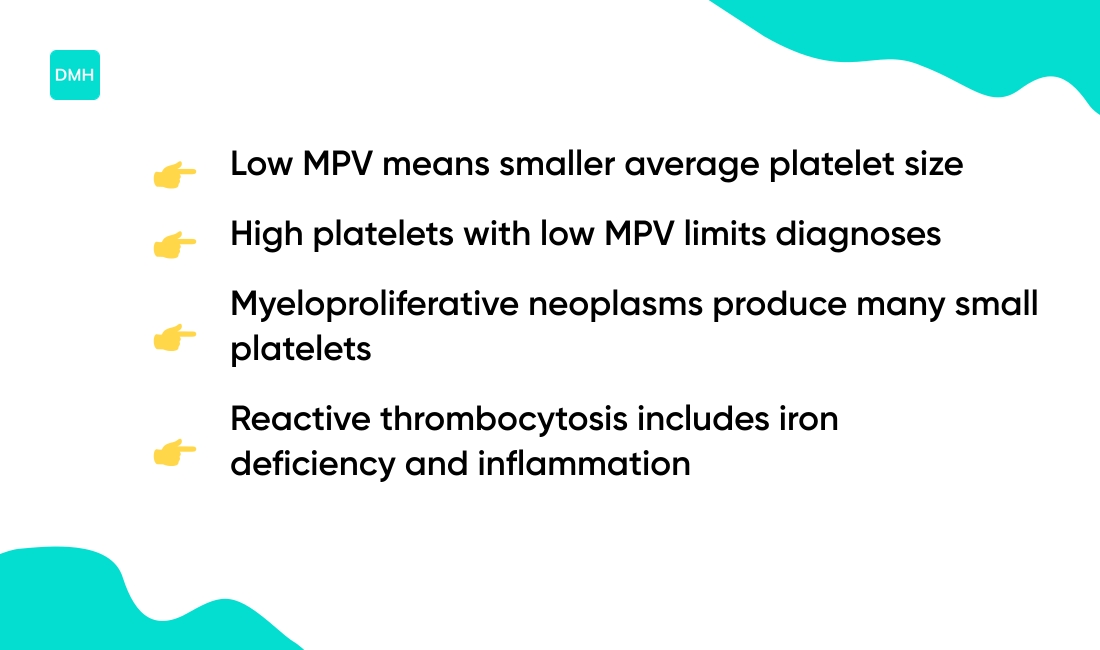
Bone marrow disorders called myeloproliferative neoplasms may produce many small platelets. Essential thrombocythemia often shows platelet counts above 450 x109/L with MPV near or below the mpv blood test lower range (about 7 fL). Genetic changes such as JAK2, CALR, or MPL mutations can be present.
Reactive thrombocytosis can produce high platelets with low MPV. Iron deficiency, acute inflammation, and recent blood loss commonly raise platelet count while platelets remain small. Lab handling and timing of the blood draw can also lower measured MPV.
Interpreting the pattern requires both indices. Low MPV with thrombocytosis may point toward bone marrow overproduction or a reactive process. Combining MPV with platelet count and clinical history improves diagnostic accuracy.
For example, MPV 6 fL with platelet count 800 x109/L often prompts evaluation for essential thrombocythemia or iron deficiency. Peripheral smear and molecular tests often follow if a myeloproliferative disorder is suspected.
Not medical advice. Content for educational purposes only; consult a professional. Always consult a qualified healthcare professional for medical advice specific to your situation.
Read also: Leukocytosis: definition, causes, symptoms and treatments
Factors affecting MPV results
The mean platelet volume can vary for many reasons. Lab numbers can change without underlying disease.
- Anticoagulant effect: EDTA commonly causes platelets to swell after collection. MPV may rise 1–3 fL after a few hours in EDTA tubes.
- Chemotherapy and medications: Certain drugs can reduce platelet size or alter production. These changes affect MPV interpretation alongside platelet count.
- Inflammation: Inflammatory states often raise MPV and may track with markers such as CRP. This pattern can reflect increased platelet turnover.
- Dehydration: Low plasma volume can shift MPV values. Rehydration can change results toward the mpv normal range.
- Infection: Viral infections, including COVID-19, can increase or decrease MPV. Some studies observe higher MPV in COVID-19 patients, though more research is needed. Reported patterns vary by disease severity and timing.
- Sample handling: Delayed processing, temperature swings, and tube type affect numbers. Automated counters and manual methods may report different MPV values.
- Timing of draw: Circadian variation, recent bleeding, or transfusion can alter MPV. A repeat CBC can clarify transient changes.
- Laboratory variation: Different analyzers report MPV in femtoliters. Many labs list an MPV reference range near 7–12 fL, but values can differ by instrument.
A single mpv blood test may not reflect stable platelet behavior. Interpret MPV with platelet count and clinical context when reviewing MPV results. Not medical advice. Content for educational purposes only; consult a professional. Always consult a qualified healthcare professional for medical advice specific to your situation.
You might also like: Low White Blood Cell Count: Causes, Symptoms, Leukopenia
When should I worry about MPV results
We define mpv blood test results by comparing values to the mpv normal range. Typical adult ranges sit near 7–12 femtoliters (fL). Labs can vary the reference range.
Higher MPV often indicates larger, younger platelets. Increased MPV may be associated with higher platelet turnover. Elevated MPV above about 12–13 fL with symptoms may prompt faster evaluation.
Lower MPV often indicates smaller platelets or reduced marrow production. MPV below about 7 fL combined with low platelet count may signal marrow suppression or thrombocytopenia.
When should you actually worry? Interpret MPV with the complete blood count and clinical signs. Compare MPV vs platelet count and look for bleeding or clotting signs.
Symptoms that may need urgent attention include:
- Sudden chest pain
- Shortness of breath
- Focal weakness
- Unexpected heavy bleeding
- Recurrent clots
Lab factors can affect MPV results. Delayed processing, anticoagulant type, and instrument differences can shift values. Repeat testing can clarify unexpected increased MPV or decreased MPV.
Severe increases in MPV may be associated with cardiovascular disease, diabetes, inflammatory states, and some cancers. Low MPV may be linked to chemotherapy effects, bone marrow disorders, or genetic causes. Evidence is mixed for some links.
If you’re concerned about abnormal MPV results, consult your clinician for personalized evaluation. Not medical advice. Content for educational purposes only; consult a professional. Always consult a qualified healthcare professional for medical advice specific to your situation.
You might also like: High White Blood Cell Count: Causes, Symptoms and more
Educational notice: This content is provided for informational and educational purposes only and is not intended as medical advice. Always consult a qualified healthcare professional for medical concerns.