Propranolol is a beta-blocker medication that reduces heart rate and eases blood vessel tension.
Doctors prescribe it for anxiety, high blood pressure, certain heart rhythm problems, and migraine prevention.
But how long does it actually stay in your system?
Let’s break down the timing, effects, and factors that matter most.
What is propranolol?
Propranolol blocks beta-adrenergic receptors in the heart and blood vessels. That action lowers your heart rate and reduces the force of each heartbeat.
Lower cardiac output brings down your blood pressure and calms physical anxiety signs like tremors and a racing pulse. (Think of those shaky hands before a big presentation.)
Immediate-release tablets often start working within 30 to 60 minutes. Effects for situational anxiety commonly last about 4 to 6 hours. Extended-release forms deliver steadier levels and can support once-daily dosing for ongoing control.
Plasma half-life for typical tablets sits around 3 to 6 hours, so most of the drug clears over a day for immediate-release dosing. Side effects, liver function, dose size, and your metabolism change how long propranolol lasts and how long it stays in your system.
Talk with your clinician to match dose and timing to your needs and to avoid abrupt stopping.
What is the half-life of propranolol?
Half-life measures the time a drug takes to drop by half in the bloodstream. Immediate-release propranolol typically shows a half-life of about 3–6 hours.
An intravenous propranolol dose clears faster with a half-life near 2–3 hours. Extended-release propranolol has a longer half-life, roughly 8–20 hours depending on individual factors.
Use the four-to-five half-life rule to estimate clearance. Multiply the half-life by 4–5. Immediate-release pills clear in about 15–30 hours. An IV dose clears in about 10–15 hours. Extended-release forms may take about 40–100 hours to leave your system, which is roughly 2–3 days in many cases.
Actually, knowing these numbers helps you time doses for events or manage side effects. For more measured half-lives and clinical notes, see this propranolol half-life reference.
How long does propranolol stay in your system?
Propranolol follows a predictable elimination pattern. The body removes about 75 to 97 percent over several half-lives.
Immediate-release propranolol has a half-life near 3 to 6 hours. Applying five half-lives gives clearance around 15 to 30 hours for IR formulations.
Extended-release propranolol has a longer half-life, commonly 8 to 20 hours. Using four to five half-lives, ER formulations clear for most people in about 2 to 3 days.
Individual factors shift those windows. Age, liver function, dose, and metabolism change elimination speed. Liver health matters most for clearance—impaired liver function can prolong half-life significantly.
Here’s a real example: a single 10 mg IR dose affects heart rate for 4 to 6 hours. Yet the drug can still be detectable for up to 15 to 30 hours. Expect ER tablets to give roughly 24-hour symptomatic coverage, with drug traces lingering for up to a few days after stopping ER dosing.
If you need precise timing for a test or procedure, tell your clinician the exact dose and timing. And never stop propranolol suddenly—ask a clinician for a taper plan tailored to your situation.
How long does it take for propranolol to start working?
Immediate-release propranolol usually starts working within 30 to 60 minutes. Its effects often peak between 1 and 4 hours, which matches common guidance for anxiety and tremor relief.
Extended-release formulations absorb slower and give steadier blood levels. Onset commonly appears within 1 to 2 hours, with peak effect between 4 and 6 hours. That supports once-daily dosing for blood pressure and daily anxiety control.
Timing varies by dose, food, liver function, age, and metabolism. The propranolol half-life for oral immediate-release sits near 3 to 6 hours, while IV dosing clears faster. These factors change how long propranolol lasts and when effects peak.
| Formulation | Onset Time | Peak Effect | Duration |
|---|---|---|---|
| Immediate-Release | 30-60 minutes | 1-4 hours | 4-6 hours |
| Extended-Release | 1-2 hours | 4-6 hours | Up to 24 hours |
| Intravenous | Minutes | ~30 minutes | 2-3 hours |
Take extended-release at the same time each day for steady symptom control.
Most people notice heart rate and tremor reduction within an hour. If you need precise timing, track your response for two to three doses. Talk with your clinician before changing dose or timing.
How long do the effects of propranolol last?
How long does propranolol last for anxiety?
Immediate-release propranolol usually starts working within 30–60 minutes. It reduces heart rate and tremors quickly.
Immediate-release doses generally last 4–6 hours for anxiety peaks. Use that window for situational symptoms. Take a dose 30–60 minutes before an event for performance or public speaking—that timing gives peak effects at 1–2 hours.
We suggest spacing doses every 4–6 hours for daytime coverage. Choose an extended-release tablet for once-daily control if you want steady levels. Planning doses around your highest anxiety moments improves symptom control.
Talk with your clinician before changing schedules. When does your anxiety hit hardest? Answering that helps you time doses better.
How long does propranolol last for performance anxiety?
It usually begins working within 30 to 60 minutes, with peak effects at one to four hours.
Immediate-release doses reduce tremors and racing heart for about four to six hours. That span typically covers most short events. Aiming for about 45 minutes before gives steady symptom control during many performances.
Low doses such as 10 or 20 mg often suffice for situational anxiety. Higher doses can feel stronger but have a similar duration. Fatty meals may delay absorption and shift the onset, so timing matters.
Extended-release forms provide longer coverage and require different timing. Ask your prescriber for dose and timing tailored to your needs, and know the safety risks before you start.
How long does propranolol last for migraines?
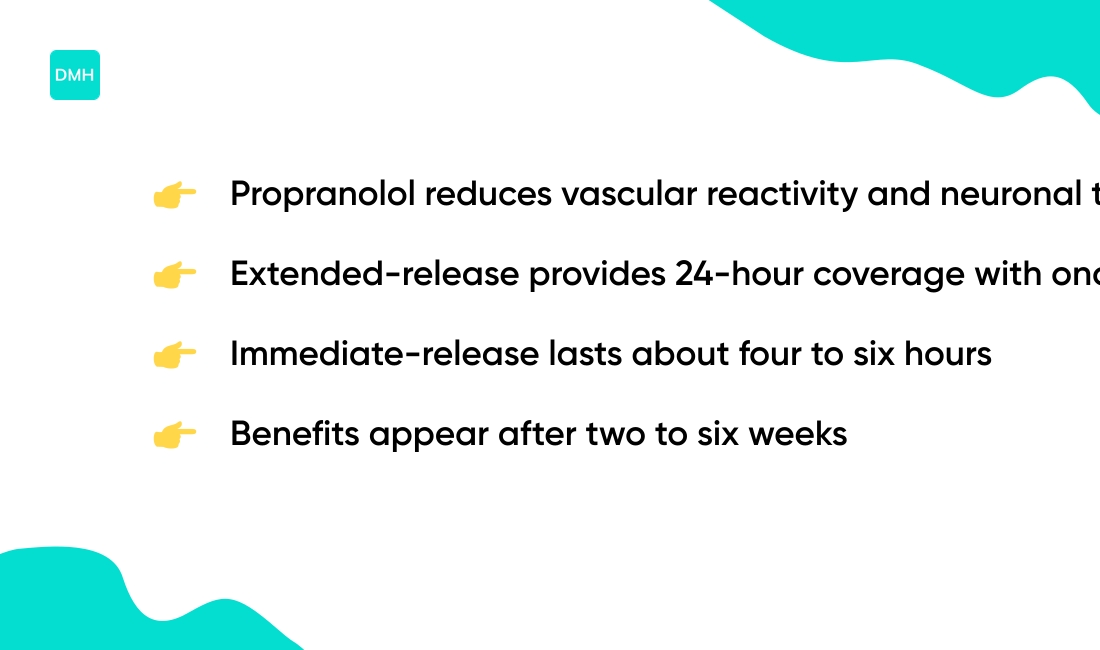
Propranolol prevents migraine attacks by lowering vascular reactivity and calming neuronal triggers.
The ER option gives 24-hour steady coverage with one daily dose. Plus, ER helps with adherence and steady symptom control.
Immediate-release tablets need multiple doses each day. IR effects last about four to six hours. How long propranolol lasts depends on formulation and dose.
Drug levels clear slower than symptoms. Propranolol can stay in your system for two to three days. Expect preventive benefit after two to six weeks of consistent dosing.
Discuss dose changes and monitoring with your clinician. The practical difference is clear: propranolol ER vs IR guides dosing frequency and daily routine.
How long does extended-release propranolol last?
Extended-release propranolol keeps blood levels steady for a day. ER tablets provide 24-hour coverage and support once-daily dosing.
Typical propranolol ER half-life ranges from 8 to 20 hours. Most people clear the drug within 2–3 days based on five half-lives. ER suits patients who need steady blood pressure or migraine prevention—it avoids the peaks and troughs of immediate-release doses.
If you wonder how long propranolol stays in your system, expect up to 2–3 days for ER. Immediate-release versions clear faster, roughly 15–30 hours. That highlights the propranolol ER vs IR duration gap.
For performance anxiety, take IR 30–60 minutes before a task since it peaks sooner. Monitoring heart rate in real patients shows steadier control with ER over 24 hours. Ask your clinician before you switch formulations or change dose.
How long does propranolol last by dosage?
How long does 10 mg propranolol last?
We find 10 mg propranolol lasts about 4-6 hours. You feel heart-rate and tremor relief within 30-60 minutes.
This dose suits situational anxiety and performance anxiety. Side effects tend to be mild at this dose for most people. Effects peak around one to four hours for immediate-release.
Plan dosing 30 to 60 minutes before a presentation for best timing. Blood levels fall over 15-30 hours as the drug clears. Extended-release formulations need different timing and provide longer coverage.
Don’t stop beta blockers abruptly. Talk to your clinician about dosing, interactions, and any liver function concerns. A 40 mg dose often increases intensity without changing total hours much.
How long does 40 mg propranolol last?
Immediate-release 40 mg propranolol typically provides symptom relief for about 4-6 hours. It gives stronger effects than lower doses.
Onset occurs within 30-60 minutes, and peak effects often arrive within one to four hours. Propranolol half-life for immediate-release runs near 3-6 hours.
In my opinion, 40 mg taken 45 minutes before an event balances onset and duration. Talk with your prescriber before changing dose or timing. Monitor heart rate and blood pressure after a dose and report concerns promptly.
Full elimination after immediate-release usually occurs across 4-5 half-lives. That equals roughly 15 to 30 hours for most people. For performance anxiety, take it 30 to 60 minutes before the event—effects tend to last through a typical presentation.
Propranolol ER vs IR duration differences
We compare extended-release propranolol and immediate-release propranolol to help you choose the right fit.
- ER lasts about 24 hours with once-daily dosing
- IR lasts about 4-6 hours per dose
- IR needs dosing every 4-6 hours, usually two to four times daily
- ER fits daily blood pressure control and migraine prevention
- IR fits situational anxiety and performance anxiety before events
Typical immediate-release doses for anxiety range 10-40 mg. Extended-release tablets often use 80-160 mg once daily for consistent blood levels.
Many patients prefer ER for simple schedules and steadier control. We use IR when you need short-term relief or dose adjustments. This difference explains propranolol duration of action across uses and helps you pick the right form.
How often can you take propranolol?
Follow your prescriber’s schedule for propranolol. Immediate-release tablets are usually taken 2 to 4 times per day, spaced about 6 to 8 hours apart.
Extended-release capsules are taken once daily. They provide steady blood levels for 24 hours.
Dosing frequency affects blood levels and symptom control. Typical daily totals vary by indication:
- Low-dose situational use: 10 to 40 mg per event
- Chronic conditions: 80 to 240 mg per day in divided doses
- Specialist regimens: higher totals under supervision
Don’t shorten the interval between doses to catch up. Missing a dose rarely needs doubling. If you use liquid propranolol, measure volume carefully—see measuring liquid doses.
Clear timing lowers side effects and improves results. Start with the lowest effective dose and review response after a week.
Immediate-release 40 mg is common for performance anxiety. Take it 30 to 60 minutes before an event for effects lasting about 4 to 6 hours. Extended-release 80 to 160 mg works once daily, giving stable control for 24 hours.
Always follow medical advice. Ask your prescriber before changing dose, and stop changes only with medical guidance. Tapering avoids rebound symptoms.
Factors that affect how long propranolol lasts
How long propranolol lasts depends on several personal variables. Age alters the drug half-life—children often show a half-life near 5 hours, while older adults can have half-lives near 11 hours.
Liver function drives clearance. Reduced liver function slows metabolism and raises blood levels. Severe impairment can roughly double the half-life and extend effects for many hours.
Metabolism rate matters. Fast metabolizers clear propranolol sooner, while slow metabolizers feel effects longer and may need lower doses.
Body composition changes distribution. Higher body fat increases volume of distribution and can prolong measurable drug in the system. Muscle mass shifts clearance in the opposite direction.
Food alters absorption. A high-fat meal delays onset and can modestly extend duration. Take note if you time propranolol before an event.
Gender differences exist. Women may clear propranolol slightly differently than men because of hormonal and body composition factors. Dosage affects duration—higher doses raise plasma levels and can lengthen effect windows by a few hours.
We watch these variables when advising timing and dose. Tracking your response after a dose gives the clearest guide for adjustment.
When to take propranolol for best results
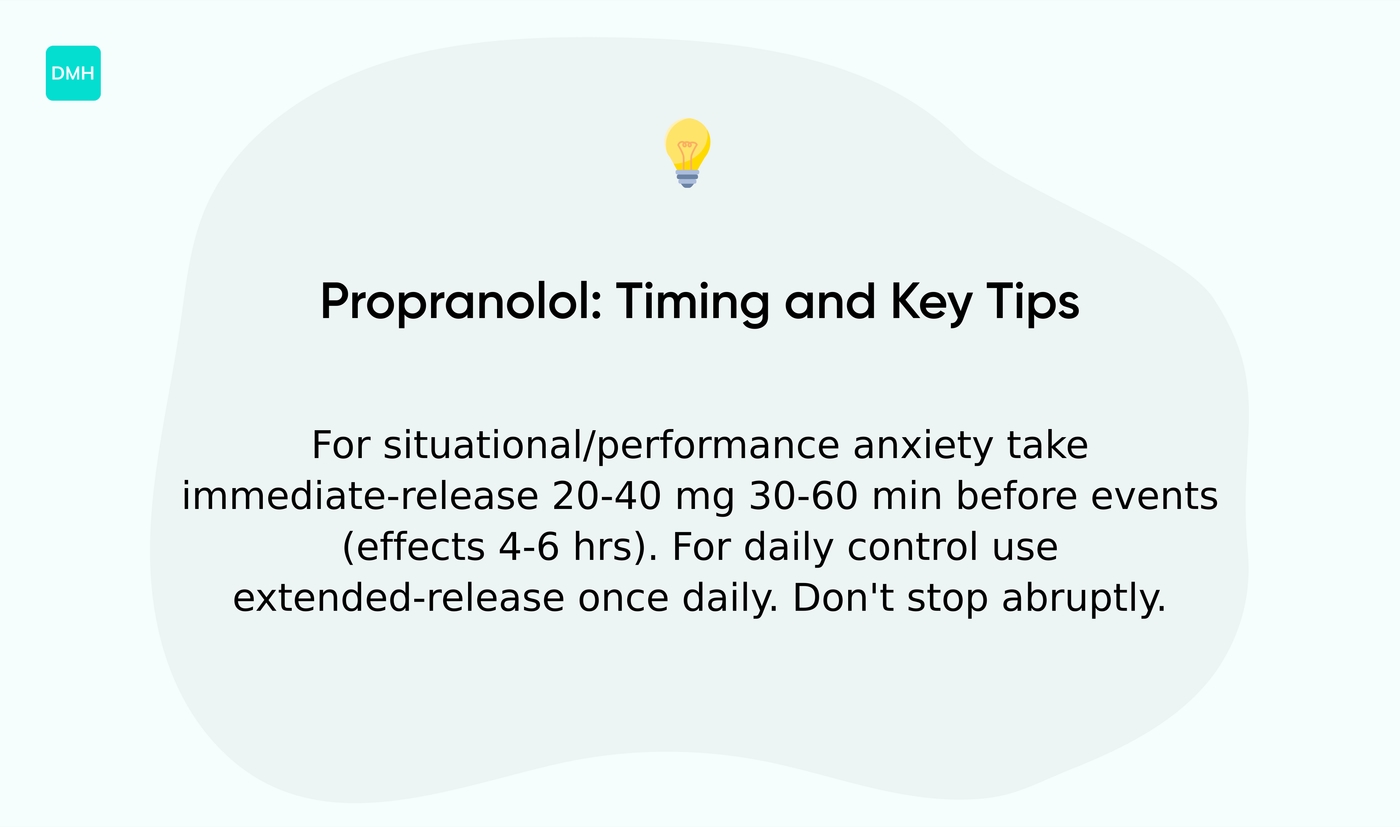
Timing based on your treatment goal makes all the difference. For situational anxiety, take immediate-release propranolol 30–60 minutes before an event.
For presentations, take 20–40 mg about 30–60 minutes before speaking. Effects typically last 4–6 hours for immediate-release formulations. For performance anxiety, this window covers onset and peak effect during the event.
For daily anxiety control, use extended-release once daily. Extended-release provides up to 24 hours of steady coverage and smoother blood levels. Starting low and tracking symptoms daily helps find the right dose.
Food can slow absorption and delay onset by up to an hour. Take propranolol with food if it causes stomach upset. If you drink coffee, see this guide on timing medicine with coffee.
Ask your prescriber how often you can take propranolol and which formulation fits you. Don’t stop propranolol abruptly—taper under medical advice to avoid rebound symptoms.
You might also like: How To Get Rid Of Bitter Taste From Medicine
Does propranolol make you feel calm?
Propranolol lowers physical signs of anxiety by blocking beta receptors in the heart and muscles. It reduces heart rate and tremors, cutting the body’s alarm signals.
The main effect is relief of bodily symptoms rather than a direct change in mood. Onset is fast—propranolol begins working within 30–60 minutes.
Immediate-release pills usually provide 4–6 hours of relief, which covers situational stress. The drop in physical arousal creates an indirect calming effect. (Your brain gets calmer when the body stops shouting.)
Propranolol doesn’t erase worry or negative thoughts. It doesn’t fix the psychological cause of anxiety. For lasting change, combine medication with therapy or longer-term treatments.
What triggers your anxiety most? Understanding that helps you decide if propranolol fits your needs.
If you plan to use propranolol for performance, take it 30–60 minutes before the event. That timing addresses how long propranolol lasts for performance anxiety and when it wears off.
Read also: How Often Do You Need To See A Doctor For Prescription Refills
Important safety considerations
We recommend tapering propranolol rather than stopping abruptly. Abrupt cessation can trigger rebound hypertension, fast heart rate, angina, or dangerous arrhythmias.
Taper slowly. Aim for a 25% dose reduction every 3 to 7 days for short courses. For long-term or high-dose therapy, extend the taper to 2 to 4 weeks. Discuss exact timing with your prescriber.
Personalized plans cut risks. Watch for warning signs that need immediate care:
- Chest pain or pressure
- Fainting or severe dizziness
- Sudden weakness or speech problems
- Severe shortness of breath
- Blood pressure above 180/120 mmHg
- Heart rate above 120 bpm
Call emergency services for any of the above. Contact your prescriber for worsening palpitations, marked anxiety, or new symptoms.
Discuss dose changes if you take other heart or blood pressure medicines. Your doctor will tailor a plan around liver function and daily dose.
If you have high blood pressure and trouble sleeping, read our guide on sleep aids for high blood pressure.
Keep your appointments and monitor blood pressure at home. Avoid abrupt stopping to reduce rebound risk. Seek immediate help for dangerous signs.
Read also: How Long Does A Vitamin B12 Shot Last
Educational notice: This content is provided for informational and educational purposes only and is not intended as medical advice. Always consult a qualified healthcare professional for medical concerns.