A surprising number of people get confused by a normal platelet count and what it means for their health.
Lab reports often list platelet values without context, leaving you unsure whether a slightly low or high result matters.
This guide breaks down platelet normal range across ages, sexes, and pregnancy so it’s easier to interpret your CBC.
You’ll learn what typical ranges look like for children, adults, and older adults, how pregnancy changes counts, and what PLT and MPV mean on your report.
You’ll also see common causes of thrombocytopenia and thrombocytosis and when to seek medical advice.
Armed with this information, you’ll be able to read platelet count values per microliter with more confidence and avoid unnecessary worry.
What is a normal platelet count
A normal platelet count in adults usually falls between 150,000 and 450,000 platelets per microliter of blood. Labs report this as the platelet count or PLT. This range is the common reference used by many clinical labs.
Platelets are tiny blood cells that help form clots. They stop bleeding by clumping at a damaged blood vessel. Low platelet levels may be associated with more bleeding, while high levels may be associated with increased clotting risk.
Doctors and labs use the term platelet normal range to describe expected counts. Reports show values per microliter, written as µL or mcL. One microliter equals one cubic millimeter, so the terms are interchangeable. The label PLT on a CBC stands for platelet count.
Normal values can vary by lab method and population. Counts can vary from person to person and may change with age, pregnancy, or illness. Some studies suggest small daily fluctuations are common. According to available research, adult ranges above apply broadly but individual results need clinical context.
For informational purposes only. Always consult a qualified healthcare professional for medical advice specific to your situation.
Normal platelet count by age group
Normal platelet count for children under 15
A 2024 study in Haematologica reported a normal platelet count of 165,000 to 473,000 per microliter for children under 15. This applied regardless of gender.
According to available research, children tend to show higher counts than adults. Some studies suggest higher bone marrow activity and rapid growth explain this pattern. Blood volume and immune responses may be associated with the higher range.
The adult platelet normal range runs from 150,000 to 450,000 per microliter. These numbers use platelet count units per microliter and depend on age. Values above adult limits may not signify disease in children.
Platelet numbers can vary from person to person and with age. Always consult a qualified healthcare professional for medical advice specific to your situation. Not medical advice; content is for informational purposes only.
Normal platelet range for adults aged 15-64
Working-age adults show sex-specific platelet counts. Women have 136,000–436,000 per microliter, while men have 120,000–369,000 per microliter.
Sex hormones, iron status, smoking, and medications may be associated with these differences. Normal platelet levels can vary from person to person. Population data show some studies suggest small average differences by sex.
The broader 150,000–450,000 interval normal platelet count is commonly used to describe adult ranges in many labs. Clinicians read the PLT normal range alongside symptoms and other tests, according to available research.
If you see values outside these ranges, it may help you to discuss results with a clinician. Not medical advice; for informational purposes only. Always consult a qualified healthcare professional for medical advice specific to your situation.
Normal platelet count for adults over 64
A normal platelet count in adults over 64 falls into narrower ranges. Platelet levels reflect gradual bone marrow changes with age.
For women, the platelet reference range is 119,000–396,000 per microliter. For men, the range is 112,000–361,000 per microliter.
Platelets form in bone marrow from megakaryocytes. Aging can reduce marrow cellularity and megakaryocyte function, which may be associated with lower platelet production.
Counts change with health, medications, and hydration. They can vary from person to person. Mild declines may reflect normal aging, but values below 100,000 per microliter may prompt evaluation for thrombocytopenia.
According to available research, age ranges overlap and individual results need clinical context. Always consult a qualified healthcare professional for medical advice specific to your situation. Not medical advice; content for informational purposes only.
Normal platelet count for women vs men
A typical adult platelet reference range sits near 150,000–450,000 per microliter. Women often show a narrower, slightly higher band. Reported averages lie at normal platelet count 157,000–371,000 for women and 135,000–317,000 for men.
Midpoint averages are useful. Women average about 264,000 platelets per microliter, while men average about 226,000 per microliter. These figures reflect population data and can vary.
Biological factors may be associated with these differences. Hormonal influences, particularly estrogen, can affect platelet production and function. Menstrual blood loss and iron status can influence counts. Body size and blood volume create concentration differences. Some studies suggest subtle sex-linked regulation of marrow activity.
Clinical context matters. A CBC platelet count lists PLT, and a lab-specific PLT normal range appears on the report. Counts below about 150,000 may prompt investigation for thrombocytopenia. Counts above about 450,000 may prompt investigation for thrombocytosis. Individual results can vary from person to person and require clinical interpretation.
According to available research, average gender gaps remain modest. Platelet levels normal values depend on age, health, and lab reference standards. This information is for informational purposes only. Always consult a qualified healthcare professional for medical advice specific to your situation.
Normal platelet count during pregnancy
Pregnancy often lowers platelet counts slightly. A normal adult platelet count runs from 150,000 to 450,000 per microliter. You may see lower PLT values on your CBC as plasma volume rises and platelets are consumed by the placenta.
Trimester patterns often show a mild decline. First trimester values usually fall within the standard normal platelet count. Second trimester averages can drop by about 5–10%. Third trimester values often sit at the lower end of the platelet normal range.
Gestational thrombocytopenia is commonly used to describe mild drops in platelets during pregnancy. Some studies suggest this affects about 5–11% of pregnancies and may be associated with increased platelet turnover at the placenta. Counts between 100,000 and 150,000 per microliter are often observed and can vary from person to person.
Lower counts need clearer evaluation when other conditions occur. Platelet counts under 100,000 per microliter prompt referral for hematology in many clinics. Counts below 50,000 per microliter increase bleeding risk and usually require closer monitoring. Signs to report include unusual bruising, heavy bleeding, or petechiae.
Lab reports label the test as PLT and report platelets per microliter. MPV and trend data help interpret single readings. According to available research, trend monitoring gives better context than one isolated value. Not medical advice; for informational purposes only. Always consult a qualified healthcare professional for medical advice specific to your situation.
How to read platelet count on a CBC report
What does PLT mean on a CBC
PLT stands for platelet marker or thrombocyte on a complete blood count. When you read a CBC, PLT shows the platelet number per microliter.
A normal platelet count for adults often ranges from 150,000 to 450,000 per microliter. Labs report counts as x10³/µL or as platelets per microliter—for example, 220,000 per microliter.
Automated hematology analyzers count platelets using electrical impedance or optical light scatter. Technicians may confirm low counts with a manual smear under a microscope.
Platelet levels may be associated with bleeding or clotting tendencies. Reference ranges can vary from person to person and by lab. Some studies suggest platelet counts decline with age. “Platelet normal range” is commonly used to describe lab reference limits.
According to available research, pediatric ranges often run higher than adult ranges. This yields the lab’s normal thrombocyte count output. For informational purposes only. Always consult a qualified healthcare professional for medical advice specific to your situation.
Understanding MPV normal range
Mean platelet volume (MPV) measures the average platelet size in blood. The MPV normal range is 7.5–11.5 femtoliters (fL).
Clinicians commonly use MPV to describe platelet size on a CBC report. Additional technical notes appear on the Mean platelet volume page.
High MPV often reflects larger, younger platelets from active marrow production. It may be associated with increased platelet turnover or inflammatory states. Low MPV points to smaller, older platelets and can vary from person to person. Low values may be associated with bone marrow suppression or certain genetic conditions.
Clinicians interpret MPV alongside platelet count to assess production versus consumption. For informational purposes only. Always consult a qualified healthcare professional for medical advice specific to your situation.
Platelet count units per microliter explained
Labs report platelet numbers as a count per microliter of blood. The term per microliter is the same as per cubic millimeter. Reports may also show values as x10⁹/L.
Conversion uses simple math. Multiply a per-microliter value by 1,000,000 to get per liter. Divide the per-microliter number by 1,000 to get x10⁹/L. For instance, 150,000 per microliter equals 150 x10⁹/L.
Knowing units helps you read a CBC platelet count and compare reports. Misreading units can make a normal platelet count look abnormal. Reference labs use different formats for the platelet reference range.
Platelet levels can vary from person to person and may be associated with many conditions. Some studies suggest unit choice affects clinical communication, according to available research. Content for informational purposes only. Always consult a qualified healthcare professional for medical advice specific to your situation.
What causes low platelet count (thrombocytopenia)
A low platelet count means platelet levels fall below 150,000 per microliter. Platelet normal range for adults is 150,000–450,000 per microliter.
Certain medications may be associated with lower platelets. Heparin, some antibiotics, and chemotherapy drugs are common examples. Autoimmune conditions can destroy platelets—the term immune thrombocytopenia is commonly used to describe this immune attack.
Viral infections may be associated with drops in platelet numbers. HIV, hepatitis, and dengue have links to thrombocytopenia. Bone marrow disorders can reduce platelet production. Leukemia, aplastic anemia, and myelodysplastic syndromes are often involved.
Pregnancy can alter platelet levels, and gestational thrombocytopenia may appear. Counts that fall below 150,000 trigger closer monitoring.
Severity can vary. Counts between 100,000 and 150,000 often cause no symptoms. Counts between 50,000 and 100,000 raise bleeding risk. Counts under 20,000 to 30,000 carry high bleeding risk, according to available research and the NHLBI.
Symptoms and risk can vary from person to person. Some studies suggest symptoms don’t correlate perfectly with numbers. For guidance on thresholds and danger levels, see what level of platelets is dangerous.
This content is for informational purposes only and may be associated with general clinical findings. Always consult a qualified healthcare professional for medical advice specific to your situation.
What causes high platelet count (thrombocytosis)
A platelet count above 450,000 per microliter is labeled thrombocytosis. Platelet levels normal range centers on 150,000–450,000 per microliter for adults.
Reactive thrombocytosis causes often explain elevated counts. Inflammation, acute infection, recent bleeding, iron deficiency, and recovery after surgery can raise platelets. Post-splenectomy rises may exceed 600,000 per microliter. Some studies suggest reactive causes account for more than 80% of cases.
Primary blood disorders describe true bone marrow problems. Essential thrombocythemia and other myeloproliferative neoplasms can push platelets above 1,000,000 per microliter. These disorders may be associated with genetic changes such as JAK2 mutations.
Medication effects can raise counts. Erythropoietin, corticosteroids, and growth factors appear linked to higher platelets.
Risk from high platelets can vary. Very high counts raise clot or bleeding risk in some people. Risk can vary from person to person and depends on symptoms and other blood test results.
Persistent elevation or new symptoms may prompt further evaluation. Investigation may include repeat CBC, inflammatory markers, iron studies, and targeted genetic tests according to available research. Results should be interpreted with clinical context in mind. For informational purposes only. Always consult a qualified healthcare professional for medical advice specific to your situation.
When should I worry about my platelet count
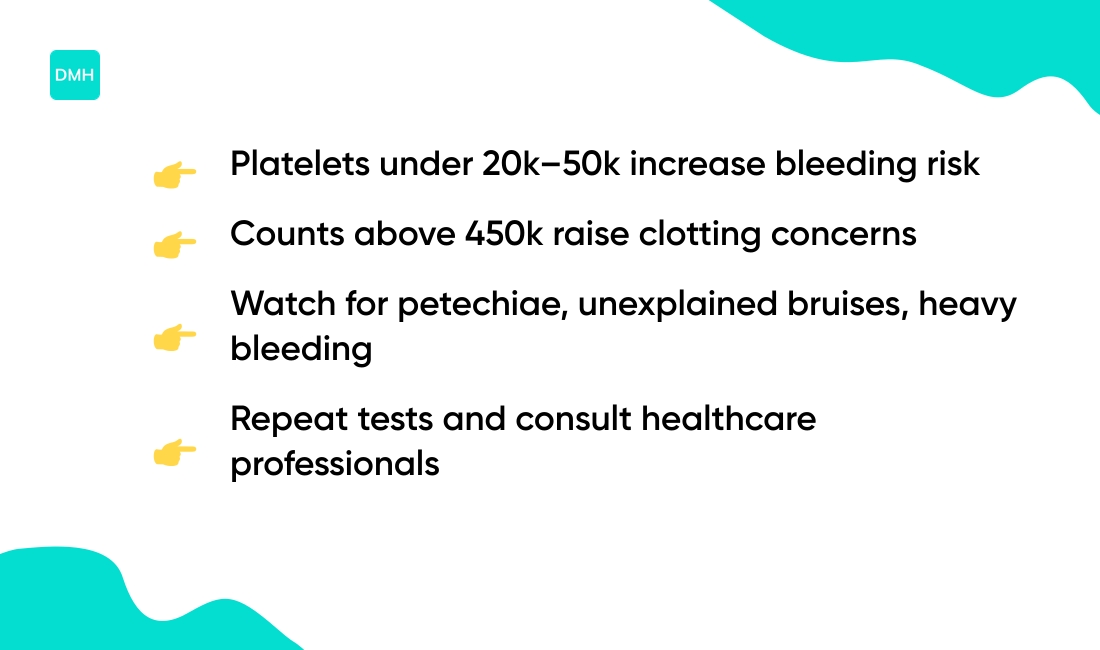
Low or high counts can be concerning. Counts below dangerous platelet levels of 20,000–50,000 per microliter often increase bleeding risk. Counts above 450,000 per microliter raise clotting concerns. These numbers follow standard PLT normal range reporting on a CBC.
Watch for warning signs. Small red spots on the skin (petechiae) or large unexplained bruises may signal low platelets. Heavy menstrual bleeding, prolonged bleeding from cuts, blood in stool or urine, severe headaches, chest pain, or sudden weakness may signal a serious problem.
Short-term shifts can be normal. Exercise, stress, infection, dehydration, and some medicines can change values. Platelet counts can vary from person to person and may be associated with recent illness or medication use. Some studies suggest temporary rises after infection. Thrombocytopenia is commonly used to describe low counts. Thrombocytosis is often discussed in relation to inflammation or iron deficiency.
One abnormal test may not mean disease. Repeat testing and clinical context help interpretation. For more detail on lab flags and what merits follow-up, see when to worry about abnormal blood tests for practical thresholds and signs.
According to available research, very low counts below 20,000 per microliter often need urgent evaluation. Mild drops near 100,000–150,000 can be monitored in many people. Always consult a qualified healthcare professional for medical advice specific to your situation. Not medical advice; content for informational purposes only.
You might also like: How Supplements Affect Blood Test Results: Guide
Can platelet counts fluctuate day to day
Platelet counts can change from one day to the next. This natural variability may be associated with short-term factors rather than disease.
Common triggers include physical activity, acute stress, hydration, infection, and recent blood loss. Intense exercise can raise counts for hours. Dehydration concentrates blood and can raise values. Mild viral infections may lower counts temporarily.
| Factor | Effect on Platelet Count |
|---|---|
| Exercise | Short-term rise of 10–20% |
| Stress/Hormones | Can shift with menstrual cycles |
| Dehydration | Raises values by concentrating blood |
| Medications/Alcohol | May alter counts |
Lab factors can affect results. Poor sample handling or timing of the draw may alter the CBC platelet value. The label PLT on reports stands for platelet and links to the PLT normal range reference used by each lab.
A single abnormal result often doesn’t indicate thrombocytopenia or thrombocytosis. Clinicians often compare repeat tests to confirm persistence. Counts that remain low or high prompt further evaluation with clinical context and additional labs.
Normal platelet count values and the platelet reference range can vary by lab and by age. These ranges normal platelet count reflect population averages and platelet count normal may be associated with individual differences. This content is for informational purposes only. Always consult a qualified healthcare professional for medical advice specific to your situation.
Read also: What is Hematocrit in Blood Test
How to increase platelet count safely
Platelets help blood clot. A normal platelet count ranges from 150,000 to 450,000 per microliter.
Dietary shifts may support platelet production. Higher intake of vitamin B12 and folate may be associated with improved counts in some studies.
- Vitamin B12 foods: meat, fish, eggs, dairy, fortified cereals
- Leafy green vegetables: spinach, kale, and legumes supply folate
- Vitamin C sources: citrus and peppers may aid iron absorption
- Iron-rich foods: red meat and beans when iron deficiency exists
Certain substances can lower platelet levels. Alcohol use, some antibiotics, heparin, and some anticonvulsants may reduce counts. Medication changes require clinician oversight. Testing and management can vary from person to person.
Some studies suggest platelet trends respond to treating underlying causes. For instance, resolving viral infections or correcting nutritional deficits often raises counts.
Very low counts or active bleeding need urgent evaluation. Counts below 20,000–50,000 per microliter increase bleeding risk, according to available research and NIH guidance.
Evidence may be limited for many supplements. Benefits can vary and are often discussed in relation to specific diagnoses. Not medical advice; content for informational purposes only. Always consult a qualified healthcare professional for medical advice specific to your situation.
You might also like: What Are Hematocrit Levels and Why Do They Matter?
Educational notice: This content is provided for informational and educational purposes only and is not intended as medical advice. Always consult a qualified healthcare professional for medical concerns.