Most adults wonder how much magnesium per day they should aim for to support energy, muscles, and heart health.
Many people don’t get enough from diet alone — nearly half of U.S. adults fall short.
Supplement labels can be confusing, and figuring out the right dose isn’t always straightforward.
This guide explains recommended magnesium intake, how supplements differ (elemental vs. compound), and safe daily dosages so you can choose what’s right.
You’ll learn the RDA by age and sex, which foods pack the most magnesium, and practical supplement doses like citrate or glycinate.
You’ll also see common signs of low magnesium and what can happen if you take too much.
Read on to get clear, practical recommendations for magnesium mg per day and when to check with a healthcare provider.
What is the recommended daily intake of magnesium?
How much magnesium per day depends on age, sex, and life stage. Magnesium is an important mineral that supports muscle, nerve, and bone function.
The U.S. National Institutes of Health lists a standard range for adults. Magnesium daily intake for men is 400–420 mg per day, while the recommended magnesium intake for women is 310–320 mg per day.
Values vary by age. Men aged 19–30 often see 400 mg listed, while men 31 and older often see 420 mg. Women aged 19–30 commonly see 310 mg, and women 31 and older commonly see 320 mg.
Pregnancy and breastfeeding change needs. Pregnant people may require 350–400 mg daily, and lactation often adjusts the daily value to 310–360 mg. Health authorities include these adjustments in detailed tables.
Different agencies may set slightly different numbers. Surveys find many adults don’t reach these targets through diet alone. Dietary sources such as leafy greens, nuts, seeds, whole grains, and legumes can supply tens to hundreds of milligrams per serving.
Recommendations can vary from person to person based on health, medications, and nutrient interactions. According to available research, individual requirements may shift with chronic conditions or age.
Not medical advice. Content for educational purposes; consult a professional. Always consult a qualified healthcare professional for medical advice specific to your situation.
Magnesium RDA by age and sex
How much magnesium per day for men
Adult men need specific magnesium levels based on age. Men aged 19–30 have an RDA of 400 mg per day, while men aged 31 and older have an RDA of 420 mg per day.
These numbers refer to elemental magnesium. Individual needs can vary from person to person due to factors like health status and medication use. One ounce of almonds supplies about 80 mg of magnesium, which helps put totals in context.
Are you tracking your daily intake? Magnesium daily intake and daily magnesium requirement can guide dietary planning. Some studies suggest certain conditions may increase magnesium needs.
Not medical advice. Always consult a qualified healthcare professional for medical advice specific to your situation.
How much magnesium per day for women
Magnesium is a mineral involved in nerve function and muscle contraction. How much magnesium per day depends on age and sex.
Recommended magnesium intake is 310 mg daily for ages 19–30. The daily magnesium requirement is 320 mg daily for ages 31 and older.
Women over 50 typically keep the 320 mg target. However, absorption can decline with age, and women over 60 may face higher risk of low intake.
Medications and lower appetite can affect magnesium status. Dietary sources often cover much of the need, and supplements can help when diet falls short.
Values reflect NIH RDA estimates and available research. Not medical advice. For informational purposes only. Always consult a qualified healthcare professional for medical advice specific to your situation.
Magnesium dosage during pregnancy and breastfeeding
Magnesium for pregnancy typically ranges 350–400 mg per day. The dose depends on age and specific guidelines.
Breastfeeding women often need 310–360 mg daily. Age affects the exact amount, and maternal magnesium needs may support muscle, nerve, and bone function.
NIH lists similar ranges for pregnant and lactating people. Women aged 19–30 often target the lower end of ranges, while those 31 and older may need slightly more.
Many prenatal supplements include about 100 mg of elemental magnesium. Separate supplements commonly add 100–350 mg, so total intake varies.
One ounce of almonds supplies about 80 mg of magnesium. Dietary sources can cover a portion of daily needs. (Plus, they taste better than pills!)
Too much supplemental magnesium can cause diarrhea and cramping. Individual tolerance can vary from person to person. Always consult a qualified healthcare professional for medical advice specific to your situation.
How much magnesium should children get each day
If you check magnesium daily intake for kids, amounts vary by age. Values below follow NIH guidance and may vary from child to child.
- 0–6 months: 30 mg per day (Adequate Intake)
- 7–12 months: 75 mg per day (Adequate Intake)
- 1–3 years: 80 mg per day
- 4–8 years: 130 mg per day
- 9–13 years: 240 mg per day
- 14–18 years: girls 360 mg per day; boys 410 mg per day
Food sources may meet much of a child’s needs. Leafy greens, nuts, seeds, whole grains, and fortified foods contain measurable magnesium.
Individual needs can vary with growth, health, and medications. This information is for informational purposes only. Always consult a qualified healthcare professional for medical advice specific to your situation.
How much magnesium can you get from food daily?
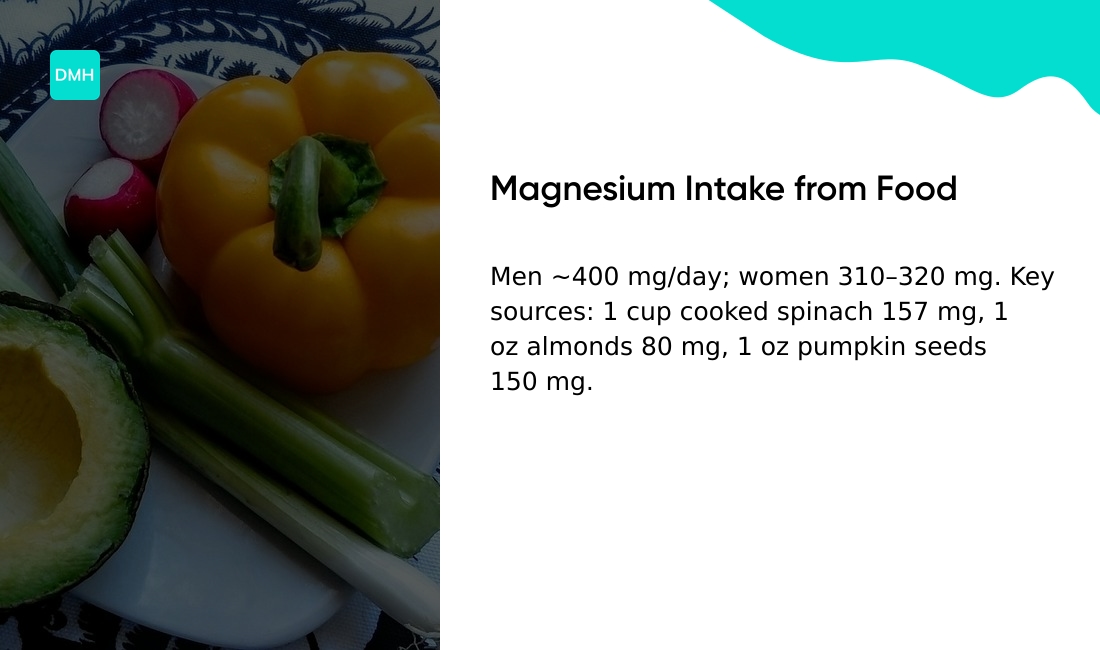
How much magnesium per day you get from food depends on what you eat. Daily magnesium requirement often sits near 400 mg for men and 310–320 mg for women.
Here’s a breakdown of common magnesium-rich foods:
- Leafy greens: 1 cup cooked spinach ≈ 157 mg
- Nuts and seeds: 1 oz almonds ≈ 80 mg; 1 oz pumpkin seeds ≈ 150 mg
- Whole grains: 1 cup cooked brown rice ≈ 84 mg; 1 cup cooked quinoa ≈ 118 mg
- Legumes: 1 cup cooked black beans ≈ 120 mg
- Dark chocolate: 1 oz (70–85% cocoa) ≈ 64 mg
- Oats and seeds: 1 cup cooked oats ≈ 60 mg; 1 oz chia seeds ≈ 95 mg
A few servings often meet a typical adult requirement. A breakfast of oats (60 mg) and almonds (80 mg) adds 140 mg. Lunch with spinach salad (about 157 mg) reaches nearly 300 mg. Adding seeds or dark chocolate can push intake over 350 mg.
Can you hit your daily target with food alone? Food sources may be better absorbed than some supplements. Individual needs can vary from person to person.
For more on magnesium dosage, review the Healthline summary. For recipe ideas that support stable blood sugar while boosting magnesium, see lower blood sugar foods.
For informational purposes only. Always consult a qualified healthcare professional for medical advice specific to your situation.
Best magnesium supplement dosage and types
How much elemental magnesium per day from supplements
Elemental magnesium describes the actual magnesium ion available from a supplement. Labels sometimes list the total compound weight instead of elemental magnesium.
Calculate elemental magnesium by using the compound’s percentage of elemental magnesium. Magnesium oxide contains about 60% elemental magnesium. A 400 mg tablet of magnesium oxide supplies roughly 240 mg elemental magnesium.
| Magnesium Type | % Elemental Magnesium | Example Dose | Elemental Mg Provided |
|---|---|---|---|
| Magnesium Oxide | ~60% | 400 mg | ~240 mg |
| Magnesium Citrate | ~16% | 200 mg | ~32 mg |
| Magnesium Glycinate | ~14% | 200 mg | ~28 mg |
Magnesium citrate provides about 16% elemental magnesium. A 200 mg citrate dose gives roughly 32 mg elemental magnesium. Magnesium glycinate generally offers near 14% elemental magnesium, so a 200 mg dose yields about 28 mg elemental magnesium.
Look for the term “elemental magnesium” on labels when possible. If the label omits that term, use the compound percentage to estimate intake.
For context on supplement testing and interpretation, see supplements and blood test results. Not medical advice. Always consult a qualified healthcare professional for medical advice specific to your situation.
Magnesium citrate dosage per day
Magnesium citrate is a citrate salt of magnesium that may absorb better than oxide forms. Many people ask how much magnesium per day they need from supplements.
Supplement doses commonly range from 100 to 350 mg of elemental magnesium per day. Typical tablets or capsules supply 100–200 mg elemental magnesium each.
For bowel relief, manufacturers offer higher single doses. Laxative products frequently provide a constipation relief dose of about 200–400 mg elemental magnesium taken once. (Yes, magnesium citrate can really get things moving!)
For routine use, aim to keep daily magnesium intake within set supplemental limits. Some agencies note an upper supplement limit near 350 mg elemental magnesium per day. Individual needs can vary from person to person.
If you take medicines or have kidney impairment, magnesium can accumulate and effects may differ. For informational purposes only. Always consult a qualified healthcare professional for medical advice specific to your situation.
How much magnesium glycinate per day is recommended
Magnesium glycinate refers to magnesium bound to the amino acid glycine. It offers high absorption and a gentle digestive profile.
People often ask how much magnesium per day is typical. Common supplemental ranges provide 100–400 mg of elemental magnesium daily. Many sources list about 200–350 mg for routine use.
The NIH notes a 350 mg limit for supplemental magnesium. Glycinate tends to be well tolerated, and you may find it gentler on your gut than citrate.
Individual needs can vary with age, health, and medications. Always consult a qualified healthcare professional for medical advice specific to your situation.
What are the signs of low magnesium?
Low magnesium describes a state where the body lacks sufficient magnesium to support normal cellular functions. Signs can vary from mild to severe and can differ between people.
Dietary surveys suggest nearly half of U.S. adults fall short of the recommended magnesium intake. Limited consumption of leafy greens, whole grains, nuts, and seeds helps explain the gap. Certain medications, gastrointestinal conditions, and older age can reduce absorption or increase losses.
Here are common signs to watch for:
- Fatigue and low energy: General tiredness that may be subtle at first and grow worse over time
- Muscle cramps and twitches: These can occur in calves, feet, or around the eyes and may worsen with exertion
- Muscle weakness symptoms: A sense of generalized weakness and slower recovery after exercise
- Digestive issues: Nausea, loss of appetite, and occasional vomiting can appear with moderate deficiency
- Heart rhythm changes: Irregular heart rhythms or palpitations may appear in significant deficits and require prompt medical evaluation
Could you be running low? Recommended magnesium intake ranges roughly from 310 mg to 420 mg per day, depending on age and sex, according to available research.
Serum magnesium tests can miss intracellular shortfalls. Dietary review and targeted testing may help identify insufficiency. Evidence can vary and more research is needed to define subclinical thresholds.
Always consult a qualified healthcare professional for medical advice specific to your situation.
You’ll also like: What Vitamin Is Good For Weight Loss
What happens if you take too much magnesium in a day?
Excess magnesium occurs when total intake exceeds the body’s usual needs. High intake often comes from supplements rather than food.
Here’s what can happen:
- Diarrhea and nausea: Loose stools and stomach cramping are the most common signs
- Lightheadedness: Low blood pressure may follow with larger doses
- Serious complications: Severe excess can affect heart rhythm and breathing and might require urgent care
The NIH sets a 350 mg per day upper limit for magnesium from supplements. Recommended magnesium intake from food differs by sex and age and can be higher without the same risks. According to available research, individual responses can vary from person to person.
Very high supplemental doses may be associated with irregular heart rhythms. Evidence suggests such serious effects tend to occur at doses far above 350 mg per day or with impaired kidney function.
The Harvard Nutrition Source offers a clear overview of magnesium safety and sources. Symptoms from excess magnesium can overlap with other supplement reactions. For a comparison of supplement overload effects, see too much vitamin C symptoms.
Not medical advice. Content for educational purposes; consult a professional. Always consult a qualified healthcare professional for medical advice specific to your situation.
Read also: How Many Vitamin Waters Can You Drink A Day
Is it safe to take magnesium every day?
Daily magnesium supplements refer to consistent use of oral magnesium pills, powders, or liquids. Safety depends on dose, health status, and interactions.
The NIH lists adult magnesium RDA values at about 400–420 mg for men and 310–320 mg for women. Many guidelines set a 350 mg per day limit for supplemental magnesium separate from dietary intake.
Kidney function affects safety. Impaired kidneys can reduce magnesium clearance, which may raise blood magnesium and cause symptoms like low blood pressure or irregular heartbeat.
Certain drugs can change magnesium levels or absorption. Diuretics, proton pump inhibitors, some antibiotics, and bisphosphonates can interact with magnesium. If you take multiple supplements, read interactions such as how long to rid body of vitamin B6 toxicity for timing guidance.
Absorption varies by age, gut health, and supplement form. Magnesium citrate and glycinate often absorb better than magnesium oxide. Higher doses may cause loose stools or cramping.
Daily use can meet needs for people with low dietary intake or higher losses. Individual responses vary and benefit evidence differs by condition.
Not medical advice. Always consult a qualified healthcare professional for medical advice specific to your situation.
You’ll also like: Prenatal Vitamin Mechanism Of Action
Educational notice: This content is provided for informational and educational purposes only and is not intended as medical advice. Always consult a qualified healthcare professional for medical concerns.