Your morning pick-me-up might contain more (or less) caffeine than it seems.
Knowing how much caffeine in a shot of espresso matters for energy, sleep, and medication timing.
Many variables — from bean type to extraction time — mean a single shot’s caffeine can vary widely, so it’s easy to misjudge intake.
This guide explains typical espresso caffeine amounts and what influences them, from single shots to decaf.
You’ll discover average milligram ranges, differences between ristretto, lungo and double shots, and how espresso stacks up against drip or cold brew.
Practical tips will help pick the right drink for tolerance and avoid unwanted jitters or sleep disruption.
Whether ordering at a café or pulling a shot at home, you’ll be able to estimate caffeine more confidently.
How much caffeine is in a single shot of espresso
A standard 1-ounce (30 ml) espresso shot contains about 63–65 mg of caffeine on average. This answers the common question of how much caffeine in a shot of espresso for many café-style pours.
Measured values can span from roughly 25 mg up to 214 mg per 1-ounce shot. Variation may stem from bean variety, roast level, dose of ground coffee, grind fineness, extraction time, water temperature and machine pressure.
Robusta beans can contain nearly twice the caffeine of Arabica by weight, so blends heavy in Robusta push the value toward the upper range. A finer grind and longer extraction can increase total caffeine extracted, while a very short pull like a ristretto may yield less.
Want to know what really drives those numbers? Tracking the grams of coffee per shot and the extraction time gives the best practical estimate of espresso caffeine content for your drinks. You can use those two numbers to compare café shots or to adjust your home brew.
Always consult a qualified healthcare professional for medical advice specific to your situation.
Caffeine content in espresso variations
Double shot espresso caffeine
A 2-ounce double shot espresso usually contains about 125–150 mg of caffeine. (That’s roughly double what you’d get in a single shot, which makes sense!)
Cafés commonly use double shots in lattes and cappuccinos, so those drinks carry the same caffeine amount as the shot. Starbucks lists a double espresso near 150 mg per serving, while Nespresso espresso caffeine can vary by capsule and blend.
If you search how much caffeine in a shot of espresso, expect single shots near 63 mg and doubles near the values above. A double shot offers a reliable pick-me-up, but your sensitivity and total daily intake matter.
Ristretto vs regular espresso caffeine
Ristretto uses the same coffee dose with a shorter extraction. It yields a smaller volume and a richer taste.
Regular espresso shot volumes vary, but a 1-ounce shot averages about 63–65 mg of caffeine. How much caffeine in a shot of espresso can range from 25 to 214 mg depending on several factors.
A ristretto may deliver slightly less caffeine per shot because less water passes through the grounds. Per-ounce, espresso caffeine concentration rises in a ristretto. Most people feel a stronger kick from a ristretto, though that effect comes from flavor intensity rather than a much higher caffeine dose.
Extraction time affects caffeine yield. Longer pulls like lungos extract more caffeine. Always consult a qualified healthcare professional for medical advice specific to your situation.
Long shot espresso caffeine content
A long shot espresso, often called a lungo, uses more water and a longer extraction than a standard 1-ounce shot.
Long shot espresso caffeine often falls between about 70 and 150 mg per 2–3 ounce serving. Variability stems from dose, grind, extraction time, water temperature, and bean variety.
Per ounce, espresso averages near 63 mg, so total caffeine rises when volume increases. That means a lungo can raise total caffeine even if its concentration falls slightly. Consider your tolerance and the number of shots you drink.
Always consult a qualified healthcare professional for medical advice specific to your situation.
Decaf espresso caffeine levels
Decaffeinated espresso still contains small amounts of caffeine. Actual caffeine per decaf espresso shot usually falls between 2 mg and 5 mg.
How much caffeine in a shot of espresso? Roughly 63 to 65 mg per ounce for regular shots. Decaf beans undergo chemical or water-based extraction that removes most caffeine but not all.
The process often cuts caffeine by about 97%, which leaves a small residue in the final shot. Decaf espresso caffeine remains lower than regular espresso but not zero.
Decaf suits people who want lower intake while keeping espresso flavor. If you need near-zero caffeine, look for naturally low-caffeine varieties or caffeine-free alternatives. Always consult a qualified healthcare professional for medical advice specific to your situation.
Espresso vs coffee caffeine comparison
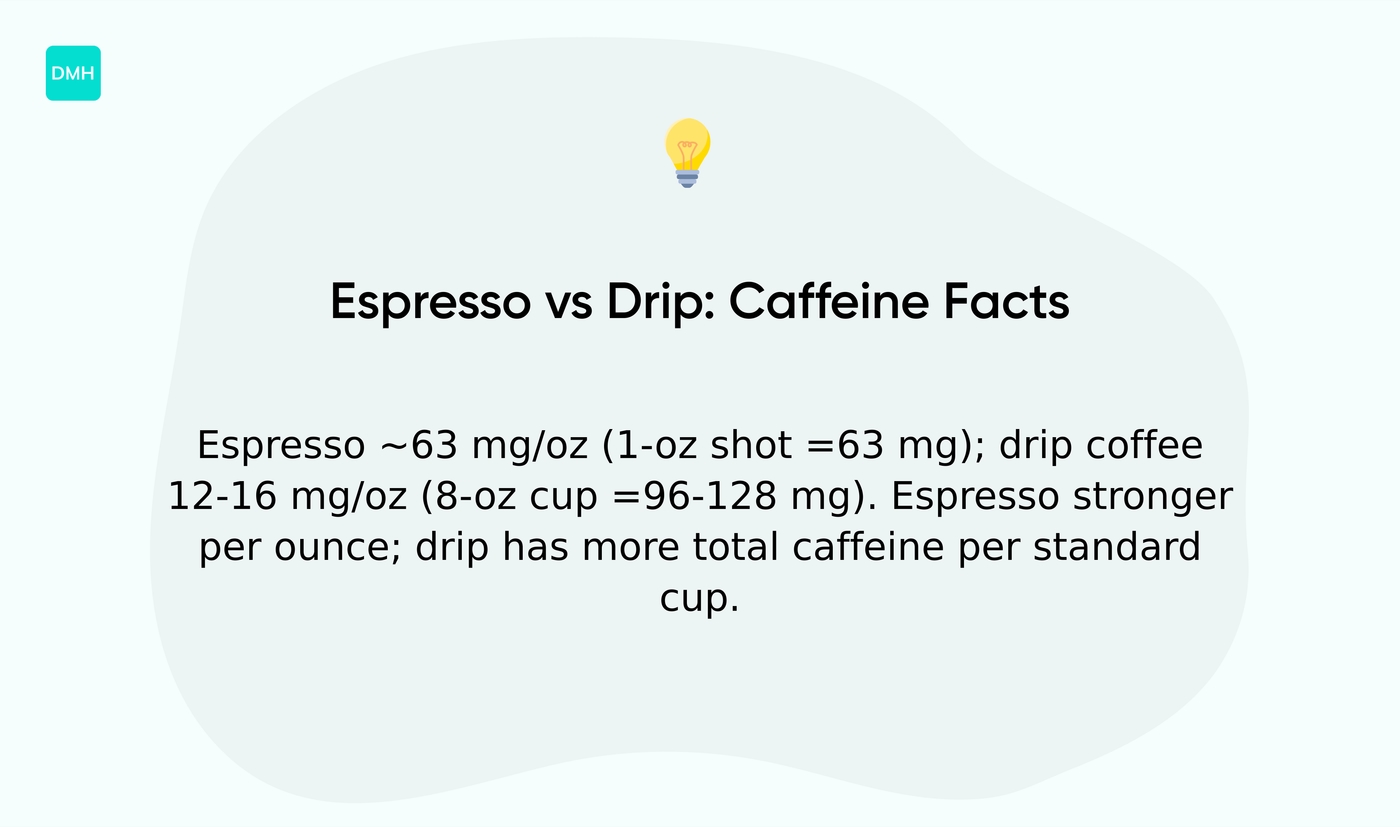
Espresso delivers about 63 mg of caffeine per ounce on average. Espresso caffeine concentration shows high milligrams per fluid ounce.
Drip coffee typically contains 12 to 16 mg per ounce. Drip coffee concentration yields lower milligrams per ounce than espresso.
Here’s where it gets interesting: a single 1-ounce espresso shot contains roughly 63 mg of caffeine, while an 8-ounce cup of drip coffee holds about 96 to 128 mg. Espresso wins on concentration per ounce, but a standard cup of drip coffee usually has higher total caffeine.
| Beverage | Serving Size | Caffeine per Ounce | Total Caffeine |
|---|---|---|---|
| Espresso (single shot) | 1 oz | 63 mg/oz | 63 mg |
| Drip Coffee | 8 oz | 12-16 mg/oz | 96-128 mg |
| Double Espresso | 2 oz | 63 mg/oz | 125-150 mg |
If you search for how much caffeine in a shot of espresso, expect about 63 mg on average. Espresso may suit short, concentrated caffeine needs, while you may prefer drip coffee for larger, sustained intake.
See a clear coffee vs espresso caffeine comparison for more numbers. Always consult a qualified healthcare professional for medical advice specific to your situation.
Factors that affect espresso caffeine content
Bean type: Arabica vs Robusta caffeine
Espresso caffeine content varies by bean variety. Robusta vs Arabica shows clear differences.
Arabica has about 1.2% caffeine by weight, while Robusta has about 2.2% by weight. That’s nearly double!
A single espresso often uses 7 to 9 grams of ground coffee. Arabica may yield about 40 to 70 mg of caffeine, while Robusta may yield about 80 to 140 mg. Extraction and roast can alter these numbers.
Blends with Robusta explain why some shots pack more punch. For related notes on coffee and histamine, see coffee histamine.
If you have caffeine sensitivity, consult a qualified healthcare professional for advice.
Roast level and grind size effects
Roast level changes bean mass but not caffeine much by weight. Light and dark roasts show minimal difference, often within a few percent in lab tests.
Measuring by volume gives different results. A scoop of light roast can hold more mass than a scoop of dark roast, which raises espresso caffeine content per scoop.
Grind size drives extraction efficiency. Finer grinds expose more surface area and speed up extraction, which increases caffeine yield during a short espresso pull.
Espresso uses very fine grind to extract in 20-30 seconds. Finer grinds can raise espresso shot caffeine mg modestly, though overly fine grinds risk over-extraction and bitterness. (Nobody wants a bitter shot, right?)
Grind matters more for how much caffeine ends up in your cup. Roast level affects density and dose instead. Some studies suggest brew parameters and dose can shape caffeine per weight and perceived strength.
If you want to experiment, change grind before adjusting roast. Measure results.
Extraction time and machine settings
Extraction time alters caffeine in a shot. Short pulls like ristretto last 15-20 seconds, standard espresso often pours in 25-30 seconds, and long shots or lungos can run 45-60 seconds.
Watch the extraction time effect on shot strength. Some tests show longer pulls extract up to 30% more caffeine.
Water pressure is usually near 9 bars, which affects flow and extraction consistency. Ideal brew temperature sits between 90°C and 96°C. Maintaining water temperature control helps limit variation, and higher temperatures can increase caffeine extracted per shot.
Grind size, dose, and tamp affect extraction and caffeine yield. Fine-tuning grind gives the best control over strength. Check espresso machine calibration with a scale and timer, then test a few pulls and note how much caffeine in a shot of espresso changes.
Caffeine in popular espresso drinks
Americano vs espresso caffeine
An Americano contains the same caffeine as its espresso base. Added hot water changes volume and taste, not caffeine amount.
Most Americanos use one or two shots. Espresso caffeine content averages 63 to 65 mg per shot. Two shots deliver roughly 125 to 150 mg of caffeine.
Many people confuse cup size with caffeine. Taste weakens with water, but caffeine remains unchanged. If you monitor intake, count shots rather than total volume.
Always consult a qualified healthcare professional for medical advice specific to your situation. How much caffeine in a shot of espresso varies by bean, roast, and extraction. Robusta beans can nearly double caffeine compared with Arabica.
Latte vs straight espresso caffeine
A latte vs espresso difference is mostly taste. Wondering how much caffeine is in a shot of espresso? Expect about 63–65 mg per espresso shot caffeine.
Café lattes usually include one or two shots. Steamed milk adds volume and softens bitterness, but milk doesn’t remove or dilute caffeine molecules. The drink’s mg stays tied to shot count.
If a latte uses a double shot espresso, caffeine rises to roughly 125–150 mg. Amounts can vary by bean, roast, grind, and extraction method. Measurements can differ between shops.
Many people mistake milder flavor for weaker caffeine. (I’ve seen full-strength lattes served with large milk portions!) If you want less caffeine, request fewer shots or decaf. That reduces total mg while keeping texture and flavor.
Cold brew vs espresso caffeine levels
Cold brew concentrate often yields higher total caffeine per serving than a single espresso shot. A 1-ounce espresso shot contains about 63–65 mg on average.
Ready-to-drink cold brew in an 8-ounce serving may contain roughly 100–200 mg. Concentrate diluted per serving can reach 150–300 mg, depending on steep time and coffee-to-water ratio.
Robusta blends and longer steep times tend to raise caffeine per ounce. Caffeine per ounce in espresso stays high, near 60–65 mg/oz.
Cold brew yields higher total caffeine from larger volumes. Cold brew often delivers more total caffeine than a single espresso shot. If you monitor intake, check serving sizes and product labels. A double shot espresso caffeine measure is about 125–150 mg.
Starbucks and Nespresso espresso caffeine
How much caffeine in a shot of espresso depends on shot size, blend, and machine settings.
Here’s a quick breakdown of popular brands:
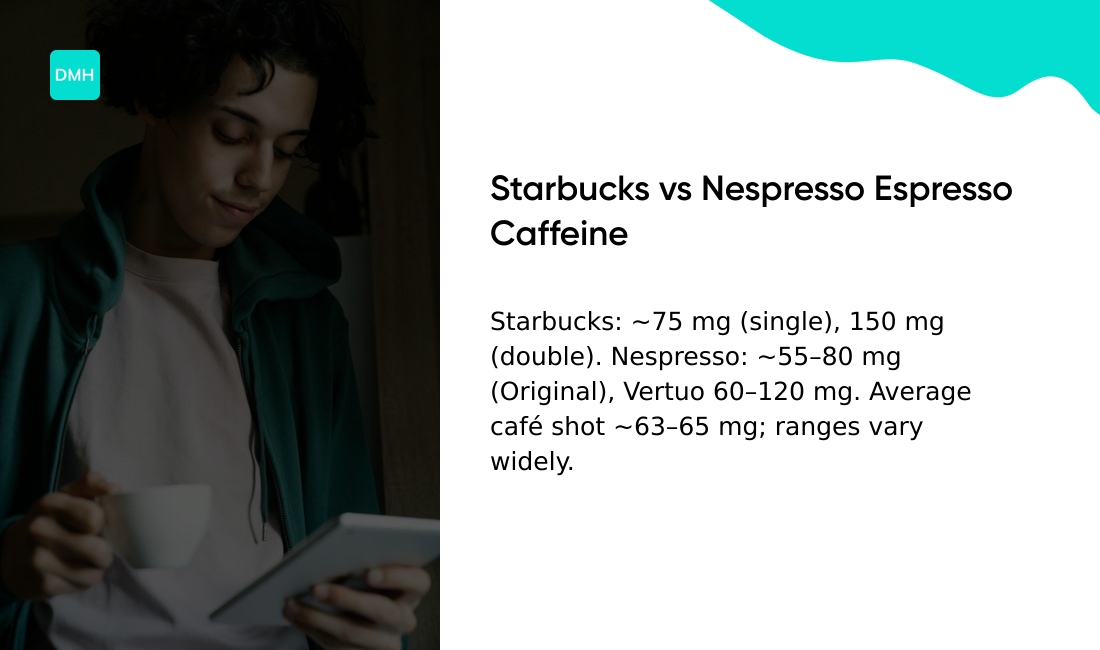
- Starbucks single shot contains about 75 mg of caffeine
- Starbucks double shot contains roughly 150 mg
- Nespresso capsule range varies by line and blend
- OriginalLine espresso capsules commonly fall near 55–80 mg per capsule
- Vertuo and larger pod formats can reach about 60–120 mg per serving
Typical café espresso averages about 63–65 mg per 1-ounce shot. Reported values for single shots can range from 25 mg up to 214 mg, depending on beans and extraction. See a practical breakdown here: how much caffeine in a shot of espresso.
Starbucks shots sit above the average per-ounce figure. Nespresso capsules often match or fall slightly below café single-shot numbers, but pod size changes that comparison.
Checking the product label or the café’s shot size gives the best estimate of espresso caffeine. Caffeine tolerance and daily limits vary, and individual response can differ. Always consult a qualified healthcare professional for medical advice specific to your situation.
You’ll also like: Foods to Avoid While Taking Spironolactone
Is 2 shots of espresso a lot of caffeine
How much caffeine in a shot of espresso varies. A typical single shot holds about 63–65 mg. Two shots usually contain about 125–150 mg.
The FDA cites a 400 mg daily limit for healthy adults. Two shots use roughly 30–38% of that limit, which fits a moderate range for many adults.
But what about your personal tolerance? Espresso caffeine affects people differently. Body weight, sensitivity, sleep, anxiety, pregnancy, and medications change response. Some people feel jittery after 50 mg, while others tolerate 300 mg with little effect.
Brand and brew matter. Starbucks lists higher per-shot values. Nespresso and café shots can differ by roast and extraction. Double shot espresso often lands in the 125–150 mg band.
If you take medicines, timing matters. Read about how long after drinking coffee you can take medicine for safe spacing: how long after drinking coffee can I take medicine.
Monitoring your total daily caffeine works best. Count all sources: espresso, soda, tea, energy drinks, chocolate. Track symptoms like racing heart or poor sleep. Always consult a qualified healthcare professional for medical advice specific to your situation.
You’ll also like: How Long After Drinking Coffee Can I Take Medicine
Why caffeine amounts vary between espresso shots
Shot size and grind fineness change extraction and caffeine yield. Espresso caffeine content can vary because bean type differs. Robusta beans can contain nearly double the caffeine of Arabica.
Roast level alters density and extraction more than caffeine per weight. Machine pressure, temperature, and water volume affect solubility and extraction.
Home machine setups produce wider variation than commercial equipment. Barista technique matters too — dosing, tamping, and pull time shift caffeine per shot.
Typical single shots average about 63 to 65 mg of caffeine. Caffeine calculators use averages and may miss real shot variability. (Plus, extraction time often affects caffeine more than volume.)
If you ask me, how much caffeine in a shot of espresso can range widely. Sensitivity to caffeine may trigger head pain; read more at why do naps give me headaches.
Here are key factors that influence variation:
- Bean variety (Arabica vs Robusta)
- Roast level and density
- Grind size and consistency
- Extraction time and temperature
- Machine pressure and calibration
- Barista technique and dosing
Measure shots and weigh grounds to reduce guesswork. Small checks improve consistency. Track grams, time, and pressure for repeatable results. Always consult a qualified healthcare professional for medical advice specific to your situation.
Read also: Can Sugar Cause Headaches
Educational notice: This content is provided for informational and educational purposes only and is not intended as medical advice. Always consult a qualified healthcare professional for medical concerns.