A CO2 blood test measures bicarbonate (HCO3-) in your serum.
Bicarbonate acts as your body’s main buffer to keep blood pH stable.
It shows how well your acid and base processes work together.
Your kidneys regulate bicarbonate by reabsorbing or excreting it. Meanwhile, your lungs remove CO2 gas and affect bicarbonate balance.
Typical lab ranges fall near 20–29 mmol/L or 23–30 mEq/L. Labs may label this value as total CO2 on metabolic panels.
Knowing your bicarbonate levels helps you spot acid-base problems early. Abnormal values often point to kidney, lung, or metabolic issues.
If your CO2 reads low, doctors test for metabolic acidosis causes like diabetic ketoacidosis or severe diarrhea.
If CO2 reads high, they evaluate for respiratory retention or metabolic alkalosis.
If you see abnormal results, discuss them with your clinician. They may order arterial blood gas, kidney function, and electrolyte testing to clarify the cause.
How CO2 is measured on metabolic panels
The CO2 result on a basic metabolic panel (BMP) or comprehensive metabolic panel (CMP) reports total CO2. Labs use that value to estimate serum bicarbonate.
Technicians draw venous blood. Automated analyzers measure dissolved CO2 and convert values into bicarbonate.
Results appear in mmol/L or mEq/L.
You’ll find CO2 near sodium, potassium, and chloride on the electrolyte line. That set gives a quick view of acid-base balance, kidney status, and electrolyte shifts.
Common reference ranges sit near 20–29 mmol/L. Individual labs may list 23–30 mEq/L instead.
Hydration, age, and medications affect readings.
If your CO2 is abnormal, a clinician may order an arterial blood gas. An ABG measures PaCO2 and pH directly.
That test clarifies respiratory versus metabolic causes.
Compare electrolyte trends with the guide on CBC with differential values to see how panels work together.
Ever wonder what those numbers actually mean for your health? Knowing what your CO2 number means gives you power in clinic conversations.
Track values over time and share them with your provider for targeted next steps.
Bicarbonate levels appear as total CO2 on reports. Monitoring that value helps detect metabolic acidosis and alkalosis early.
Normal CO2 levels in blood test
Standard reference for CO2 on metabolic panels sits around 20 to 29 mmol/L. Some labs report 23 to 30 mEq/L instead.
CO2 normal range reflects total bicarbonate measured in blood. This measure helps check acid-base balance, kidney function, and lung status.
mmol/L and mEq/L are equivalent for bicarbonate values.
Here’s the thing: arterial PaCO2 differs from serum bicarbonate. PaCO2 normally sits between 35 and 45 mmHg.
Reference values vary by lab method, patient age, pregnancy, and hydration. Minor deviations often prompt repeat testing and clinical review.
| Test Type | Normal Range | Unit |
|---|---|---|
| Serum CO2 (Bicarbonate) | 20–29 or 23–30 | mmol/L or mEq/L |
| Arterial PaCO2 | 35–45 | mmHg |
| Blood pH | 7.35–7.45 | pH units |
If your result falls below 18 mmol/L, suspect metabolic acidosis or bicarbonate loss. Readings above 35 mmol/L may indicate hypoventilation, metabolic alkalosis, or kidney dysfunction.
Your clinician may order arterial blood gas testing for a clearer CO2 picture. Bicarbonate blood test appears on BMP and CMP panels alongside sodium and chloride.
Track trends rather than single numbers. A steady rise or fall matters most.
Knowing your lab’s specific range reduces anxiety and speeds care.
Check your report against your lab range and the Cleveland Clinic CO2 blood test page for reliable details.
Serum CO2 levels that stay abnormal deserve timely follow-up.
What causes high CO2 in blood tests
Lung conditions and respiratory issues
COPD narrows airways and slows exhalation. Elevated CO2 appears on a CO2 blood test.
Respiratory infections and weak respiratory muscles reduce ventilation. That increases serum CO2 and raises bicarbonate on metabolic panels.
Your kidneys respond by raising bicarbonate to buffer pH.
Those bicarbonate compensation mechanisms show high HCO3 on a bicarbonate blood test. Arterial blood gas CO2 gives a direct measure of dissolved CO2 gas.
Venous CO2 on CMP reports total bicarbonate.
Chronic CO2 rise often raises bicarbonate about 3 mEq per 10 mmHg change in PaCO2. Tracking CO2 trends helps guide safer care.
A single CO2 in blood test may mislead decisions.
Watch worsening breathlessness, daytime drowsiness, or confusion and discuss abnormal CO2 levels in blood with your provider.
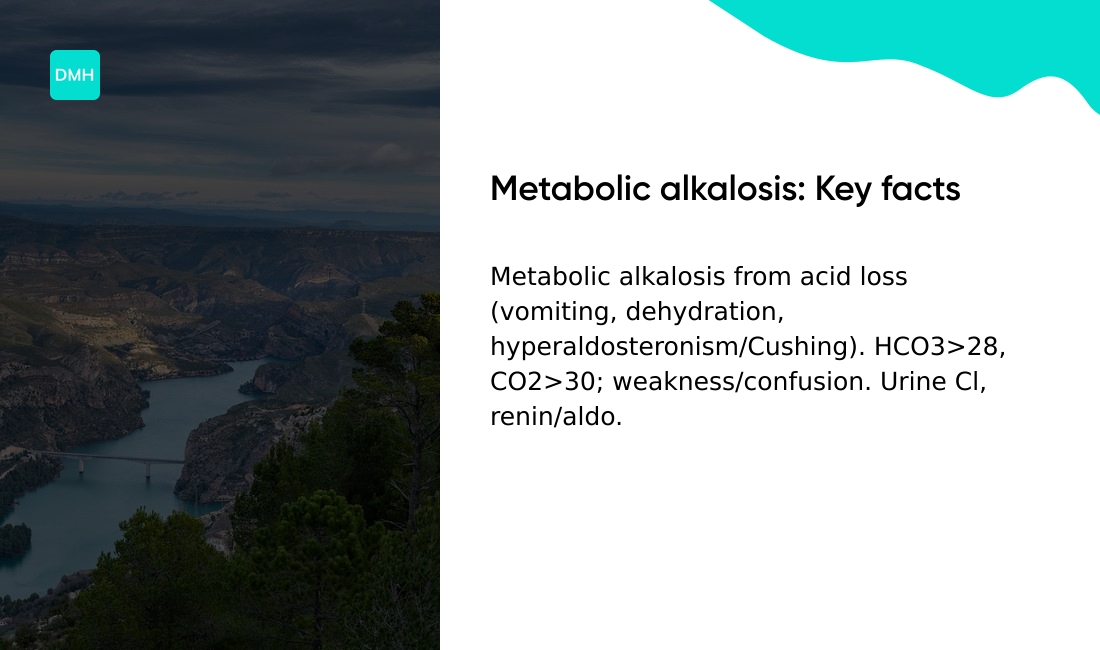
Metabolic alkalosis causes
Metabolic alkalosis happens when you lose acid. Bicarbonate then raises blood pH above 7.45.
Common triggers include:
- Excessive vomiting
- Severe dehydration
- Prolonged anorexia
- Hyperaldosteronism
- Cushing’s syndrome
These processes increase bicarbonate and raise serum CO2 on tests. Expect bicarbonate levels often above 28 mmol/L and elevated blood pH.
Serum CO2 or total CO2 on a metabolic panel often measures above 30 mmol/L. That indicates high CO2 readings.
If you feel weakness, confusion, or slow breathing, seek care. Treating fluids and electrolytes often lowers bicarbonate and CO2.
Checking recent vomiting and fluid losses gives the fastest clue.
Measure electrolytes and urine chloride. Low chloride suggests vomiting as a cause.
Get aldosterone and renin tested if you suspect hyperaldosteronism.
Symptoms of high CO2 levels
People with high CO2 levels often have retained carbon dioxide or excess bicarbonate.
Common signs:
- Shortness of breath and rapid breathing
- Drowsiness and mental confusion
- Marked fatigue and trouble staying awake
- Headache, flushed skin, raised heart rate
On metabolic panels, values above 30 mmol/L often reflect elevated bicarbonate. Severe drowsiness or growing confusion needs urgent care.
Very high arterial CO2 (PaCO2 over 60 mmHg) can cause loss of consciousness. If you have breathing slowdown, fainting, or worsening confusion, seek medical attention now.
What causes low CO2 in blood tests
Metabolic acidosis and low bicarbonate
Acids such as ketones, uremic toxins, and lactate consume bicarbonate reserves. Measured CO2 falls in metabolic acidosis states such as DKA.
Diabetic ketoacidosis produces high ketone levels that often drop HCO3 below 18 mEq/L. Patients with severe DKA may have HCO3 under 10 mEq/L.
Kidney failure limits acid excretion and lowers bicarbonate steadily. Liver disease impairs lactate clearance and can cause lactic acidosis.
Severe lactic acidosis often drives low bicarbonate levels and drops CO2 readings.
A low CO2 blood test result signals acidemia. It reflects bicarbonate and acid-base balance.
Plus, conditions like Addison’s disease, severe diarrhea, and shock can also trigger low CO2 levels. Checking HCO3 guides urgency and treatment choices.
Urgent follow-up matters for HCO3 below 15 mEq/L.
Respiratory alkalosis from hyperventilation
Rapid breathing lowers CO2 and raises pH. Hyperventilation from anxiety, panic attacks, or high altitude removes CO2 fast.
Low CO2 shows on a metabolic panel as reduced bicarbonate. Values under about 20 mmol/L often signal respiratory alkalosis.
Check a bicarbonate blood test to confirm low serum CO2.
Arterial blood gas shows low PaCO2 below 35 mmHg. A lab value of 18 mmol/L clearly reflects decreased bicarbonate levels.
Watch for respiratory alkalosis signs like dizziness and tingling. Lab trends showing low CO2 levels over time need review.
Symptoms include lightheadedness, tingling, and brief muscle cramps. Controlled breathing restores CO2 and eases symptoms.
Try paced breathing: inhale four seconds, hold one, exhale six. Treatments focus on rebalancing breathing and treating underlying anxiety.
Seek urgent care if you faint or symptoms worsen.
Symptoms of low CO2 levels
Low CO2 often means bicarbonate falls below about 20 mmol/L and your body shifts to an acidic state.
Common signs include low CO2 symptoms:
- Rapid breathing
- Persistent fatigue
- Frequent headaches
- Lightheadedness
- Muscle twitching
- Clouded thinking
Sudden confusion or worsening breathing deserves urgent attention. When should you actually worry?
Seek immediate medical evaluation for trouble breathing, fainting, chest pain, seizures, severe weakness, or sudden mental changes. Call emergency services for those signs.
See your clinician for a repeat CO2 blood test, electrolyte checks, and an arterial blood gas. Quick follow-up helps guide treatment and reduce risk.
Read also: Leukocytosis: definition, causes, symptoms and treatments
CO2 vs bicarbonate vs HCO3 on blood tests
CO2, total CO2, bicarbonate, and HCO3 refer to the same blood buffer measured on metabolic panels. Clinical labs report a total CO2 test as a serum value.
Most CO2 in blood exists as bicarbonate.
The value appears as HCO3- or CO2 on the panel. Typical reference ranges run about 20–29 mmol/L or 23–30 mEq/L depending on the lab.
The result reflects acid-base status and kidney and lung function.
Serum reporting differs from arterial measurements. An arterial blood gas gives PaCO2, the gas pressure.
That measures breathing function rather than serum bicarbonate.
If your report shows high or low CO2, compare sodium, potassium, and chloride on the same panel. Reviewing the full metabolic panel helps pinpoint metabolic acidosis or alkalosis quickly.
Actionable step: ask your clinician to correlate the CO2 value with symptoms and, when needed, order an arterial blood gas or repeat labs.
Clear labeling avoids confusion about what a bicarbonate levels blood result means and how CO2 on CMP maps to HCO3-.
You’ll also like: Which Infections Cause High White Blood Cell Count?
Arterial blood gas CO2 vs venous CO2 test
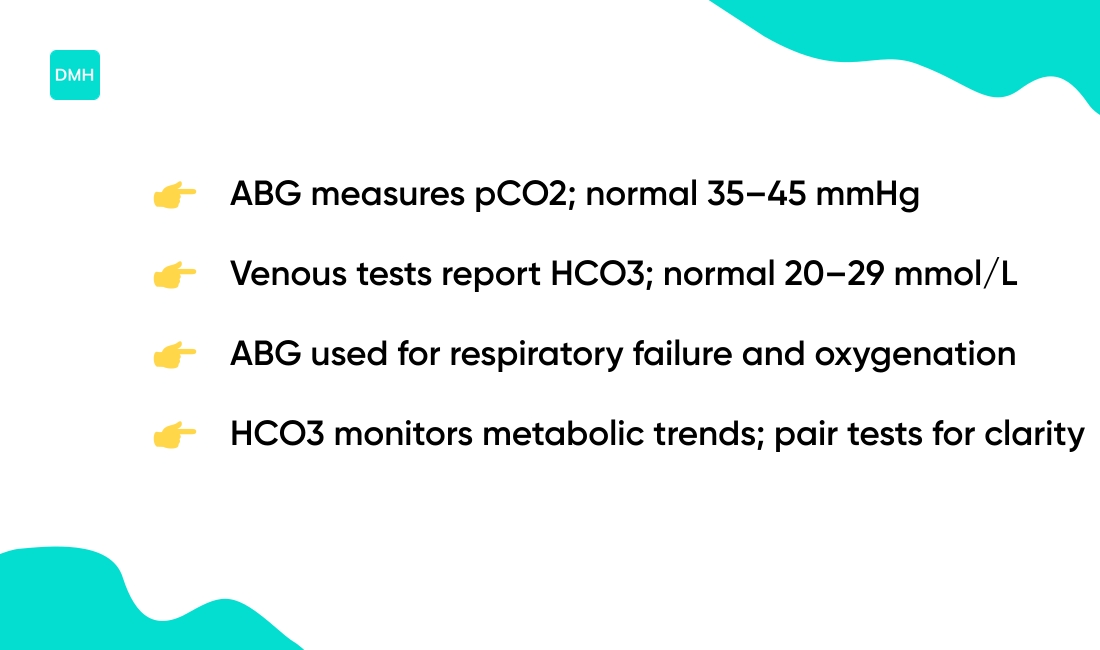
Arterial blood gas measures dissolved CO2 as partial pressure, labeled pCO2. pCO2 reflects respiratory function and normal values range 35–45 mmHg.
Venous tests report total CO2 mainly as bicarbonate (HCO3-). That value appears on CMP or BMP with typical range 20–29 mmol/L.
Arterial blood gas helps diagnose respiratory failure and monitor ventilated patients. Venous bicarbonate levels assess metabolic acid-base trends and kidney handling of bicarbonate.
Here’s how to interpret patterns:
- High pCO2 with low pH signals respiratory acidosis
- Low pCO2 with high pH signals respiratory alkalosis
- High HCO3 with high pH suggests metabolic alkalosis
- Low HCO3 with low pH suggests metabolic acidosis
Look for mixed disorders when pH doesn’t match a single pattern. Order an ABG for sudden shortness of breath or severe acid-base shifts.
Use venous bicarbonate for routine electrolyte checks and metabolic monitoring. Pairing both tests gives the clearest clinical view.
Compare pH, pCO2, and HCO3 to decide respiratory versus metabolic causes. ABG reports oxygenation as PaO2 and immediate gas values.
Venous tests don’t provide reliable PaO2 values and lag rapid changes.
Acid base balance often demands trending over single snapshot values. Talk to your clinician if values fall outside lab ranges listed.
You might also like: What Is A Dangerous White Blood Cell Count
What to do about abnormal CO2 results
Abnormal CO2 results deserve a clear plan. Confirm the finding with a repeat serum test within 24 to 48 hours.
We recommend ordering a basic metabolic panel or comprehensive metabolic panel right away. Request a kidney panel that includes BUN, creatinine, sodium, potassium, chloride, and serum bicarbonate.
Ask for liver function tests such as AST, ALT, and bilirubin to check for organ causes. Obtain arterial blood gases when respiratory or severe acid-base problems are suspected.
Note normal pCO2 of 35–45 mmHg and HCO3- around 22–28 mEq/L.
You should bring a symptom list and current medications to your appointment. That helps your provider link numbers to your health.
Next steps:
- Repeat labs to confirm trends
- Get ABG for precise gas values if breath issues exist
- Consider imaging or pulmonology referral for chronic lung disease
- Review medications that may affect acid-base balance
Treatment depends on the cause. Your provider may use IV fluids for dehydration, bronchodilators for COPD, insulin for diabetic ketoacidosis, or bicarbonate therapy for severe acidosis.
Read a clear overview of the carbon dioxide blood test on MedlinePlus for more details.
Read also: What Is Lymphocytes In Blood Test
Educational notice: This content is provided for informational and educational purposes only and is not intended as medical advice. Always consult a qualified healthcare professional for medical concerns.