Sciatica can turn a simple walk into a painful chore when the sciatic nerve flares up.
Leg pain, numbness, or weakness from sciatica often gets mistaken for general back pain, leaving people without the right care.
This guide explains causes, symptoms, and evidence-based treatments so it’s clear what steps to take.
You’ll learn how herniated discs, spinal stenosis, and even piriformis syndrome trigger sciatica and when home remedies may be appropriate.
Practical options like targeted stretches, therapeutic exercises, medications, physical therapy, and when to see a doctor are covered.
Advice also includes pregnancy-specific tips, sleeping positions, and complementary options such as acupuncture.
Read on to understand your options and get actionable steps that may help reduce pain and support recovery.
What is sciatica
Sciatica describes nerve pain along the sciatic nerve. The sciatic nerve runs from the lower spine through the buttock and down the leg.
Sciatica differs from general lower back pain by its radiating pattern. General back pain tends to stay local in the lumbar area, while sciatica typically produces pain that shoots into the buttock, thigh, or foot.
People may report numbness, tingling, or muscle weakness in the affected leg. Sciatica often stems from pressure on a lumbar nerve root.
Structures such as a herniated disc, bone narrowing, or tight muscle can cause nerve root compression. Pressure on the root sends pain signals along the nerve, producing sciatic nerve pain.
Clinicians may label symptomatic nerve root involvement as lumbar radiculopathy. Estimates vary, and prevalence data suggest about 5% of people experience sciatica yearly, with 5-10% of lower back pain cases progressing to sciatica.
Herniated discs and spinal stenosis rank among common sciatica causes. Symptom severity can vary from mild discomfort to pain that limits walking.
Not medical advice, for educational purposes only. Always consult a qualified healthcare professional for medical advice specific to your situation.
What causes sciatica pain
Can a herniated disc cause sciatica
A herniated disc occurs when the soft inner gel (nucleus pulposus) pushes through the outer disc wall. The displaced disc material can press on nearby spinal nerves.
Pressure and irritation of a lumbar nerve root can produce nerve root compression. That irritation may cause sharp, burning sciatic nerve pain that radiates down the leg.
The pattern of pain, numbness, or weakness depends on which nerve root is affected. This pattern is often called lumbar radiculopathy and differs from general lower back pain.
Imaging and clinical exam help confirm a disc-related source. Read guidance on how to tell if back pain is muscle or disc for practical clues: how to tell if back pain is muscle or disc.
Many patients may improve in 4–6 weeks with conservative care. Not medical advice, content for educational purposes only.
Can spinal stenosis lead to sciatica
Spinal canal narrowing can press on nerve roots. That pressure may produce nerve root compression that radiates as sciatic nerve pain.
Degenerative changes in the lumbar spine reduce space inside the canal. Bone spurs or thickened ligaments often cause the narrowing and compress nearby nerves.
You may notice pain that starts in the lower back and travels down the back of the thigh into the calf. Numbness, tingling, or leg weakness can appear alongside the pain.
Older adults show higher rates of symptomatic stenosis because wear-and-tear accumulates with age. Some imaging tests, such as MRI, can confirm canal narrowing and nerve compression.
For related lifestyle factors that may be associated with degeneration, see things to avoid with degenerative disc disease.
Not a medical advice, content for educational purposes, consult a professional.
How does piriformis syndrome trigger sciatica
The piriformis is a small hip muscle that helps rotate the thigh. When it tightens or becomes inflamed, it can press on the nearby sciatic nerve.
Compression from a tight piriformis may cause sciatic nerve pain. Pain radiates from the buttock down the back of the leg, often mimicking lumbar radiculopathy from a herniated disc.
This presentation is sometimes labeled piriformis syndrome sciatica. Spinal causes involve nerve root compression at the spine, while piriformis-related pain stems from local soft tissue irritation near the hip.
Some studies suggest it may account for about 5–6% of sciatica cases, though estimates can vary. Diagnosis relies on clinical exam and exclusion of spinal causes.
Conservative measures such as targeted stretches and physical therapy may reduce symptoms for many people. Not medical advice, content for educational purposes only.
Does a bulging disc always cause sciatica
Many people show disc bulges on imaging without symptoms. Some studies show up to 30% of adults without back pain have bulging discs.
Not every bulge leads to bulging disc sciatica. Symptoms arise when a bulge contacts a nerve root—the key issue is nerve root compression, not bulge presence alone.
When compression affects lumbar nerves, it produces sciatic nerve pain along the leg. Only a minority of imaging bulges produce clinical sciatica.
If you notice leg pain or numbness, medical evaluation may be warranted. Diagnosis links imaging with symptoms, and clinical signs of lumbar radiculopathy often match lower back and leg pain patterns.
Management may focus on reducing nerve irritation and improving function. Not medical advice, content for educational purposes only.
How do I know if I have sciatica symptoms
Sciatica describes pain that starts at the lower spine and follows the sciatic nerve down the leg. People often feel sharp, burning, or electric shock sensations along that path.
Look for pain that travels below the knee and into the foot. Central low back pain alone rarely follows this pattern.
| Symptom | Description |
|---|---|
| Radiating pain | Sharp, burning, or shooting pain from lower back to leg |
| Numbness | Pins-and-needles sensation or loss of feeling in leg or foot |
| Weakness | Difficulty lifting foot or pushing with toes; heavy leg feeling |
| Pain triggers | Worsens with sitting, coughing, or sneezing |
Common signs include sciatic nerve pain, shooting leg pain, and pins‑and‑needles numbness. Some individuals report leg numbness weakness or a heavy feeling in the leg.
Weakness when lifting the foot or pushing with toes may indicate nerve root compression. Trouble walking or frequent stumbling can appear with moderate to severe cases.
Pain often worsens when sitting, coughing, or sneezing. Pain that stays local to the lower back without leg symptoms more often points to muscle strain.
Other causes may produce similar discomfort, including hip problems or peripheral nerve conditions. A focused exam and imaging help distinguish herniated disc sciatica, spinal stenosis sciatica, and piriformis syndrome sciatica.
Read guidance on warning signs and severity at leg pain: when to worry for more context.
Not medical advice, content for educational purposes only. Consult a qualified healthcare professional for advice specific to your situation.
What is the best treatment for sciatica
How can I treat sciatica at home safely
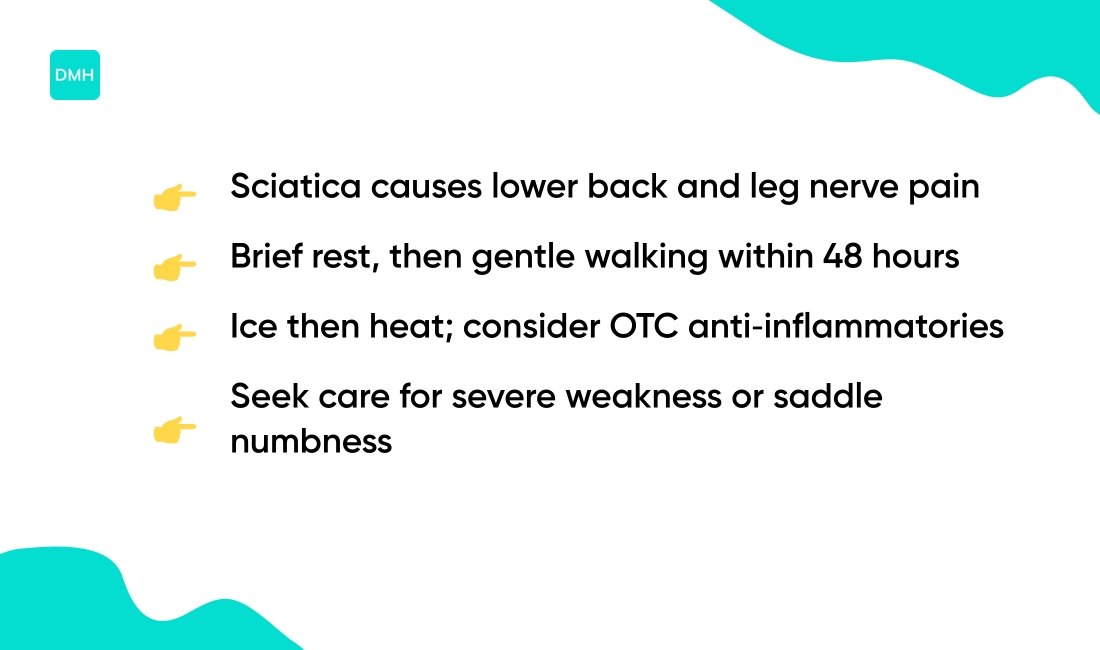
Sciatica is nerve pain from the sciatic nerve. Symptoms often include lower back and leg pain, numbness, or weakness.
Activity modification can reduce strain. Rest briefly, then resume gentle walking and light movement within 48 hours. (Prolonged bed rest may actually slow recovery!)
Heat and ice may help. Apply ice 15–20 minutes every two hours for the first 48–72 hours to reduce inflammation. Switch to heat packs for 15–20 minutes to relax tight muscles afterward.
Sciatica home remedies include over‑the‑counter anti‑inflammatories such as ibuprofen or naproxen, which may offer temporary sciatica pain relief. Avoid high doses and check labels.
Seek medical evaluation for severe leg weakness, numbness in the groin or saddle area, new bowel or bladder changes, fever, or symptoms that worsen or persist beyond 6–8 weeks. These signs may indicate nerve root compression from a herniated disc or spinal stenosis and often need professional care.
Not medical advice, content for educational purposes only. Consult a qualified healthcare professional for advice specific to individual situations.
Which exercises help with sciatica
Therapeutic exercises may reduce sciatic nerve pain by strengthening core muscles and improving flexibility. Key movements include pelvic tilts, bird dog, glute bridges, knee-to-chest, hamstring stretches, and piriformis stretches.
Exercises that target the deep core can lower load on the lumbar spine and build core muscle strength. Begin with 8–12 repetitions and 1–2 sets per exercise.
Increase volume slowly by one set per week or by adding 5–10 seconds to holds. Maintain a neutral spine and engage abdominal muscles during each rep.
Sharp or worsening leg pain may signal nerve root compression and needs assessment. Posture work may support recovery; see improve your posture for related guidance.
Not medical advice, content for educational purposes. Consult a qualified healthcare professional for personalized medical guidance.
What are the best stretches for sciatica
Targeted stretches can reduce pressure on the sciatic nerve and ease sciatic nerve pain. They may improve lower back mobility and decrease lower back and leg pain.
- Piriformis stretch: Lie on your back. Cross the affected ankle over the opposite knee. Pull the knee toward the chest slowly. Hold 20–30 seconds. Repeat 3 times per side, twice daily. This helps piriformis syndrome sciatica by easing muscle tension.
- Hamstring stretch: Sit with one leg extended. Slide your hands toward the toes without bouncing. Hold 20–30 seconds. Repeat 3 times. A clear hamstring stretch technique can lower nerve root compression in lumbar radiculopathy.
- Knee-to-chest: Lie on your back and draw one or both knees to the chest. Hold 20–30 seconds. Repeat 3 times. Gentle lumbar rotation may improve flexibility and sciatica pain relief.
Stop if numbness, increased weakness, or sharp pain appears. For informational purposes only. Always consult a qualified healthcare professional for medical advice specific to your situation.
Acupuncture for sciatica pain relief
Acupuncture may reduce sciatic nerve pain and lower back and leg pain. According to available research, a pooled analysis of 11 randomized trials involving 868 patients found significant reductions in leg pain (SMD -1.08) and overall symptom scores (SMD -2.49) compared with sham procedures and standard care.
Effect size varied by study and follow-up time. Some trials showed moderate pain score drops at short term assessments, while evidence for long term benefit remains limited and may vary from person to person.
Clinical measures favored acupuncture for leg pain relief and for overall symptoms in many trials. The data supports acupuncture as an option among noninvasive sciatica treatments, while acknowledging uncertainty about who benefits most.
Not medical advice. Always consult a qualified healthcare professional for medical advice specific to your situation.
Physical therapy and chiropractic care
Physical therapy and chiropractic care are commonly used conservative treatments for sciatica. Physical therapy focuses on exercises, manual therapy, and education to improve function and reduce pain.
Some studies suggest chiropractic care shows about 72% effectiveness for sciatica management. Manual adjustments and spinal manipulation may be associated with symptom relief in some individuals.
Both approaches prioritize conservative care before considering surgical options. Treatment plans can vary from person to person based on severity and underlying causes.
Not medical advice, content for educational purposes. Consult a qualified healthcare professional for guidance specific to your situation.
When is surgery considered for sciatica
Surgery may be discussed after 6–8 weeks of failed conservative care or when severe compression causes progressive weakness. Microdiscectomy offers short-term relief that may be superior to physical activity alone, with high patient satisfaction and low recurrence rates.
Well, about 80-90% of people avoid surgery overall. Surgery is often considered cost-effective long-term due to fewer recurrences and improved function.
Decisions depend on symptom severity, imaging findings, and individual preferences. Have you tried all conservative options before considering surgery?
Emerging trends include endoscopic spine surgery (92% patient satisfaction), basivertebral nerve ablation (77.4% pain reduction at 12 months), and regenerative therapies such as intradiscal stem-cell therapy. The sciatica market is projected to grow from USD 15.56 billion in 2025 to USD 26.19 billion in coming years, driven by these innovations.
Not medical advice, content for educational purposes only. Always consult a qualified healthcare professional for medical advice specific to your situation.
When should I see a doctor for sciatica
Certain signs may indicate urgent problems that require prompt medical evaluation. Sciatica (sciatic nerve pain) often improves with conservative measures, but red flag symptoms suggest more serious nerve involvement.
- Severe weakness in the leg or foot that limits walking or causes foot drop. Such weakness may indicate significant nerve root compression or lumbar radiculopathy.
- Bladder or bowel dysfunction or new numbness around the groin (saddle anesthesia). These signs may be associated with cauda equina syndrome and often require immediate assessment.
- Progressive symptoms such as increasing numbness or worsening motor loss over days to weeks. Progressive neurological decline may warrant imaging and specialist review.
- Unrelenting pain that fails to improve with rest, over-the-counter medications, or basic sciatica home remedies. Severe, persistent pain can impair daily function and sleep.
- Symptoms that do not improve after about 6 to 8 weeks of conservative sciatica treatment. Lack of recovery over this interval may prompt referral for diagnostic tests or interventional options.
- Systemic signs such as fever, unexplained weight loss, or a recent serious infection or cancer history. These features may indicate infection or malignancy affecting the spine.
Not medical advice, content for informational purposes only. Always consult a qualified healthcare professional for medical advice specific to your situation.
Is my sciatica chronic or acute
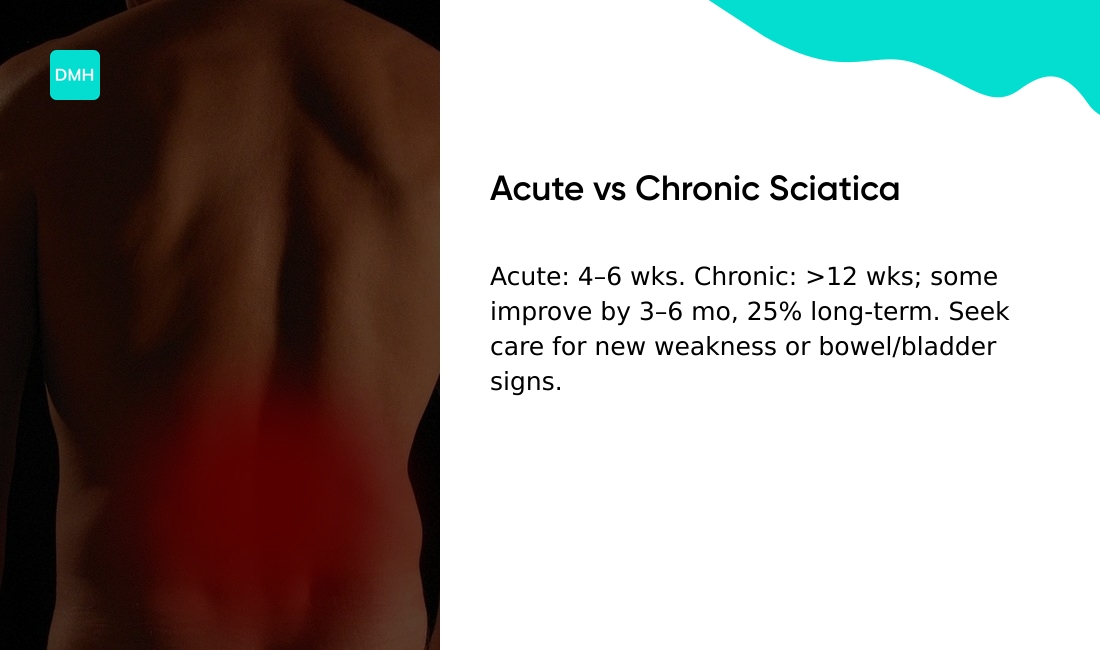
Acute sciatica describes sudden episodes that often improve on their own. Symptoms commonly ease within 4–6 weeks with conservative care and time, and about 50% of cases resolve within 6 weeks.
Chronic sciatica means symptoms persist beyond 12 weeks. Chronic forms account for a 54.05% market share of ongoing sciatica presentations. Many people report gradual improvement over 3–6 months, though 25% face long-term symptoms like persistent pain or weakness.
Key clues that suggest chronic versus acute status include symptom duration, fluctuation of pain intensity, and response to conservative measures. Nerve root compression, disc pathology, and degenerative changes can influence recovery timelines and may make recovery slower.
Objective tests such as imaging or nerve studies can clarify underlying causes but don’t always predict how fast healing will occur. Healing of damaged nerves can vary—see observed nerve healing timelines for context: how long damaged nerves take to heal.
People who have worsening weakness, new bladder or bowel symptoms, or rapidly increasing pain should seek evaluation promptly. Not a medical advice, content for educational purposes, consult a professional.
Read also: How To Heal A Torn Meniscus Naturally
What is the best sleeping position for sciatica
Sciatica refers to pain that follows the sciatic nerve from the lower back into the leg. Nighttime posture can influence nerve root compression and sciatica pain.
Many people find relief using a side-lying with pillow position. A firm pillow placed between the knees keeps the hips level, which may reduce torsion in the lower spine and ease nerve tension.
- Pillow between knees: Keeps lumbar alignment. A pillow about 8–10 cm (3–4 inches) often works for most body types.
- Supine with knees elevated: A small pillow under the knees flattens the lumbar curve and may decrease pressure on nerve roots.
- Fetal position: Slight hip flexion can open neural foramina and reduce lumbar radiculopathy symptoms for some individuals.
Firm mattresses that avoid excessive sagging support spinal alignment. Medium-firm surfaces commonly score better in sleep studies for back pain.
Pillow height for the head should keep the neck neutral to prevent compensatory spinal strain. Simple nightly routines may help—gentle sciatica stretches before bed can reduce muscle tightness around the piriformis muscle.
Avoid prolonged pressure on the painful side during sleep. Not medical advice, for educational purposes only. Consult a qualified healthcare professional for medical advice specific to your situation.
You’ll also like: How To Prevent Osteoporosis At Any Age
How do I ease pregnancy sciatica
Pregnancy sciatica causes sciatic nerve pain along the back and leg. The pain often presents as lower back pain with leg symptoms.
Symptoms often start around mid to late pregnancy, commonly between 20 and 30 weeks. Increased pelvic load and hormonal ligament loosening may be associated with nerve irritation.
- Gentle movement: Short walks and light activity may reduce stiffness and aid pregnancy sciatica relief.
- Modified exercises: Pelvic tilts on hands and knees, cat-cow with a small range, supported bridges with hip support, seated piriformis stretches with bent knees, and hamstring stretches done with a soft knee bend may reduce nerve tension.
- Sleep positioning: Side-lying with a pillow between the knees improves spinal alignment. A wedge under the hip when lying supine for short periods may reduce vena cava pressure.
- Support devices: Pelvic support belts or prenatal massage from trained therapists may lower strain.
- Pain relief: Low heat packs or short ice sessions can provide temporary pain relief.
If you notice severe weakness, bladder changes, or progressive symptoms, prompt medical review may be needed. Evidence varies and management can differ from person to person.
Not medical advice, for educational purposes only. Always consult a qualified healthcare professional for guidance specific to your situation.
Read also: How Long Does a Pulled Muscle Take to Heal
Educational notice: This content is provided for informational and educational purposes only and is not intended as medical advice. Always consult a qualified healthcare professional for medical concerns.