That sinking feeling when a lab report lists an unexpected number and you’re not sure if it’s serious?
An ESR blood test measures how quickly red blood cells settle and is a common—but nonspecific—marker for inflammation.
Many people don’t know what “high” or “low” ESR really means, or what could be causing a change.
This guide explains what ESR measures, normal ranges by age and gender, common causes of abnormal results, and how the test is done.
You’ll learn how to interpret ESR values (including when levels over 100 mm/hr need urgent attention), how ESR compares with CRP, and what to expect at the lab.
By the end you’ll be better prepared to discuss your sed rate test results with a clinician and know which follow-up steps make sense.
What is the ESR blood test
Erythrocyte sedimentation rate refers to a simple laboratory measure of how quickly red blood cells settle in a vertical tube of anticoagulated blood over one hour. The test uses the Westergren method in many labs.
Laboratories report the result in millimeters per hour (mm/hr). A larger number means faster settling.
The sed rate test serves as a nonspecific inflammatory marker. Faster settling often reflects increased blood proteins that promote red cell clumping. Inflammation changes proteins such as fibrinogen in your blood, and those proteins make red blood cells stick together and fall faster.
Clinicians use the test to detect or monitor inflammation. The result doesn’t identify a specific cause. So what does that mean for you? Doctors often pair ESR with clinical examination and other tests such as C-reactive protein (CRP).
Normal values vary by age, sex, and laboratory technique. Some individuals with active inflammation can show markedly higher values, while other people with significant disease may show only mild elevation.
Interpretation relies on context. Observation of symptoms, imaging, and targeted blood work guide follow-up testing.
Always consult a qualified healthcare professional for medical advice specific to your situation. Not a medical advice, content for educational purposes, consult a professional.
What does the ESR test measure
The erythrocyte sedimentation rate measures how far red blood cells fall in a vertical tube over one hour. Results appear as millimeters per hour (mm/hr).
Inflammation changes blood proteins. Fibrinogen and some globulins rise during inflammation. Those proteins make red cells stick together in stacks called rouleaux.
Rouleaux form faster and larger clumps. Clumped cells settle more quickly. That produces a higher number on the sed rate test.
A higher value often signals an inflammatory process. Common causes include infections, autoimmune conditions, and some cancers. Extremely high numbers, for example over 100 mm/hr, may be associated with serious illness and usually prompt urgent evaluation.
The test doesn’t identify the exact cause. Clinicians use it with symptoms, other labs, and imaging to guide diagnosis. Serial ESR measurements can track change over time and monitor response to treatment in some conditions.
Limitations include slow response to change and influence from age, anemia, and pregnancy. Low values can reflect conditions that increase blood thickness, such as polycythemia.
Some studies suggest ESR correlates with disease activity in specific disorders, though results vary by condition and study design. According to available research, the test remains most useful when interpreted alongside clinical findings.
Always consult a qualified healthcare professional for medical advice specific to your situation. Not a medical advice, content for educational purposes, consult a professional.
Normal ESR range by age and gender
ESR normal range for men
Erythrocyte sedimentation rate (ESR) measures how fast red blood cells settle in one hour. Labs report the result in millimeters per hour (mm/hr).
ESR normal range for males under 50 years is typically 0–15 mm/hr. Males aged 50 and older commonly have 0–20 mm/hr.
Johns Hopkins uses a narrower male reference of 0–12 mm/hr. Values above these ranges may be associated with inflammation, infection, or malignancy.
Lab method, anemia, recent illness, and medications can affect the sed rate test. Clinicians often interpret ESR alongside CRP and clinical findings. Levels over 100 mm/hr are often seen with severe illness and usually prompt urgent evaluation.
Always consult a qualified healthcare professional for medical advice specific to your situation. Not a medical advice, content for educational purposes, consult a professional.
ESR normal range for women
ESR normal range usually measures 0–20 mm/hr for women under 50. Women over 50 often show 0–30 mm/hr.
The ESR blood test tracks how fast red blood cells settle. Lab methods and local reference ranges can shift results by a few mm/hr.
If you’re pregnant, ESR often increases across trimesters and may exceed nonpregnant ranges. Hormonal fluctuations and hormone therapy can raise values modestly. (That’s perfectly normal during pregnancy, by the way.)
Elevated rates above 30 mm/hr may signal inflammation, infection, or other conditions but require clinical context and additional tests like CRP.
Always consult a qualified healthcare professional for medical advice specific to your situation. Not a medical advice, content for educational purposes, consult a professional.
ESR normal range for children
The ESR blood test measures how fast red blood cells settle in an hour. It reports the erythrocyte sedimentation rate (ESR).
Newborns usually show 0–2 mm/hr on common methods. Pre-puberty children often fall between 3–13 mm/hr.
Children tend to have lower values than adults. This pattern may reflect lower levels of fibrinogen and other acute-phase proteins and fewer chronic inflammatory conditions.
Higher hematocrit and differences in red cell size in infants can slow settling. Minor infections can still raise rates, so single values need clinical context.
Clinicians interpret results with symptoms, other tests such as CRP, and age-specific ranges. Reference limits can vary by laboratory and method. ESR normal range depends on age and lab. Use trends over time, not one result alone.
The sedimentation rate test results may be associated with infection or inflammation, but are nonspecific.
Always consult a qualified healthcare professional for medical advice specific to your situation. Not a medical advice, content for educational purposes, consult a professional.
What causes high ESR levels
Autoimmune and inflammatory diseases
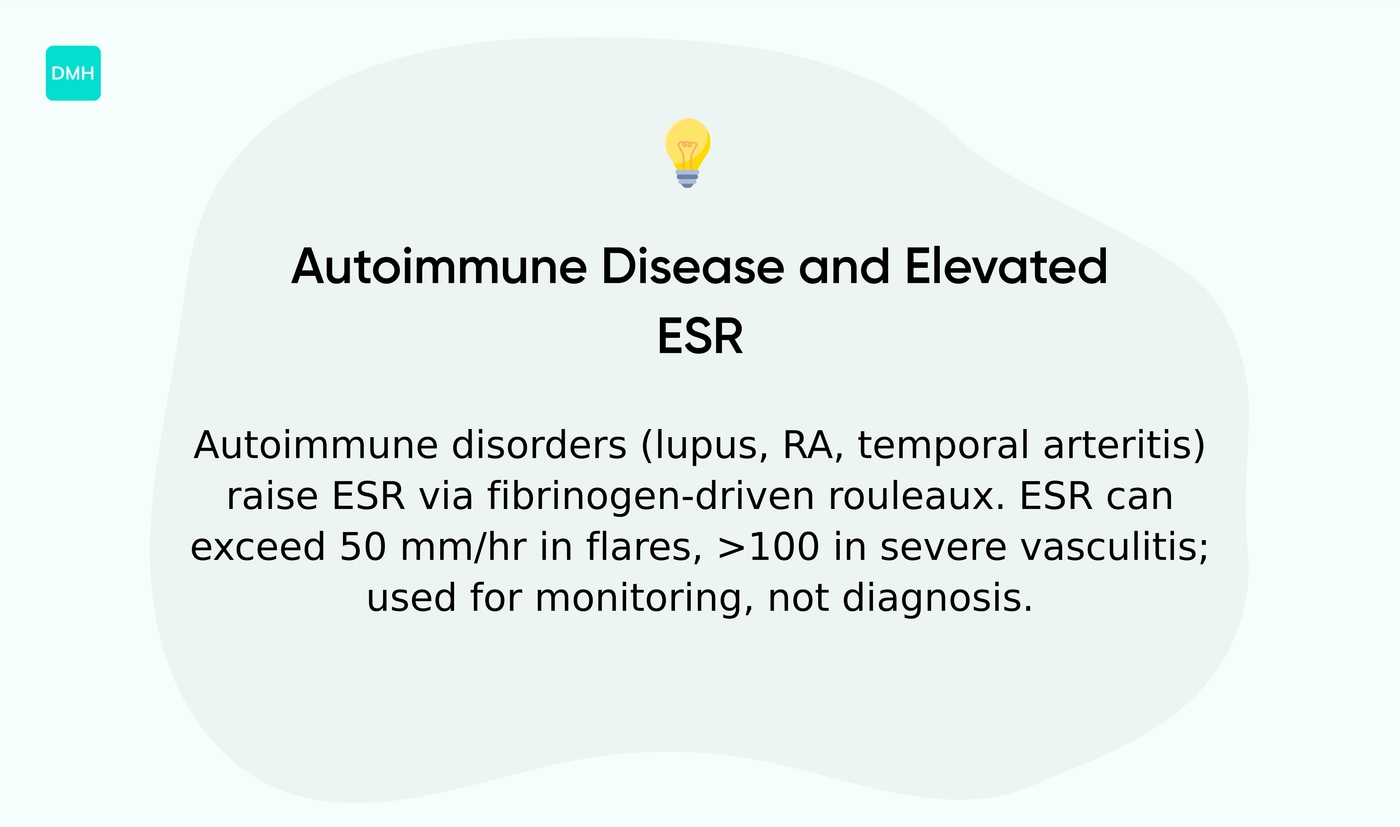
Autoimmune conditions include lupus, rheumatoid arthritis, and temporal arteritis. These diseases may raise the erythrocyte sedimentation rate (ESR).
Chronic inflammation increases liver production of acute-phase proteins such as fibrinogen. Fibrinogen promotes red blood cell clumping and rouleaux formation. That process speeds settling on the sed rate test and raises mm/hr values.
Active autoimmune disease may produce ESR blood test results above the normal range. Levels can exceed 50 mm/hr in moderate flares and top 100 mm/hr in severe vasculitis.
Studies and clinical guidance link collagen vascular diseases with elevated ESR. For instance, someone with active lupus might see values climb during a flare, then drop as treatment takes hold.
The ESR test doesn’t identify a single cause of inflammation. NIH and specialty society guidelines use ESR as a monitoring tool. Well, it gives clinicians a way to track disease activity over time.
Always consult a qualified healthcare professional for medical advice specific to your situation. Not a medical advice, content for educational purposes, consult a professional.
Infections and malignancies
The erythrocyte sedimentation rate (ESR) often rises most in active bacterial infections. Acute infections prompt the liver to release proteins such as fibrinogen.
Those proteins make red blood cells stick together and form rouleaux. A sed rate test can exceed 100 mm/hr in cases with extremely elevated ESR. Infection is commonly reported as the most frequent cause of very high rates.
Cancers like lymphoma and multiple myeloma can also raise the ESR blood test. Multiple myeloma increases monoclonal proteins and serum viscosity, which speed sedimentation. Lymphoma may raise ESR through tumor-related inflammation and cytokine release.
Elevation size can vary by tumor type, stage, and individual factors. The ESR test remains a nonspecific marker and needs other tests for context.
Clinicians commonly use CRP, blood counts, and protein electrophoresis alongside ESR. Elevations may be associated with serious disease, but ESR lacks diagnostic specificity. What does that mean for your next steps? Your doctor will order additional tests to narrow down the cause.
Always consult a qualified healthcare professional for medical advice specific to your situation. Not a medical advice, content for educational purposes, consult a professional.
Chronic conditions affecting ESR
Several chronic conditions can change the ESR blood test result. The erythrocyte sedimentation rate reflects systemic inflammation and protein changes in blood.
Heart disease and chronic kidney disease may be associated with higher ESR. Ongoing inflammation often explains the rise. Type 2 diabetes often shows low-grade inflammation that can raise sedimentation rates.
Anemia lowers red cell mass and can increase ESR by allowing faster settling. Obesity links to inflammatory markers and may produce modest ESR elevation.
Pregnancy commonly increases ESR. Values often rise across trimesters and can reach 30–50 mm/hr in some reports. Menstrual blood loss and iron changes may modestly alter results.
Observational studies report these associations, though magnitude varies by age, sex, and lab method. Interpret results in clinical context and with other tests like CRP. Plus, factors such as alcohol use and aging can nudge the numbers up a bit.
Always consult a qualified healthcare professional for medical advice specific to your situation. Not a medical advice, content for educational purposes, consult a professional.
What causes low ESR levels
Low ESR levels mean red blood cells settle more slowly on the erythrocyte sedimentation rate test. The test reports sedimentation in millimeters per hour.
Here’s what can slow things down:
- Polycythemia raises red blood cell mass and thickens blood. This reduces settling speed.
- Sickle cell disease produces abnormally shaped cells that resist stacking and settling.
- Marked leukocytosis (a high white blood cell count) can separate red cells and lower the rate.
- Heart failure may alter plasma proteins and slow sedimentation.
- Increased blood viscosity from high red blood cell counts or dehydration cuts settling further.
These causes act by changing blood viscosity or by disrupting rouleaux formation. Laboratory reports interpret low ESR against clinical context and other tests, including CBC or inflammatory markers.
Observational reports and clinical lab references describe these mechanisms, though prevalence varies by condition and patient factors. Low ESR values don’t rule out disease and can vary from person to person. Actually, some people naturally run lower numbers without any underlying issue.
Always consult a qualified healthcare professional for medical advice specific to your situation. Not a medical advice, content for educational purposes, consult a professional.
How is the ESR test performed
The Westergren method is the reference technique for the ESR blood test. Lab staff collect a venous blood sample by standard venipuncture.
Technicians draw blood into a tube that contains sodium citrate. The common ratio is four parts blood to one part citrate.
- They gently invert the tube to mix anticoagulant and blood.
- Staff transfer the mixture into a vertically calibrated Westergren tube.
- The tube stands upright at room temperature, usually between 18 and 25°C.
- The sample undergoes a one-hour settling period without disturbance.
- Laboratory personnel read the distance the red blood cells fell, in millimeters.
Technicians report the value as the sedimentation rate in millimeters per hour. The result is commonly measured in mm/hr.
Typical reporting notes the numeric value and a reference range specific to the lab. Clinicians interpret the value with other tests and clinical information. Labs may review a patient’s CBC with differential before final interpretation.
Factors that affect the test include temperature, tube angle, recent exercise, and some medications. Very high rates, such as over 100 mm/hr, often prompt urgent clinical review. (Nobody wants to see a number that high on their report.)
Always consult a qualified healthcare professional for medical advice specific to your situation. Not a medical advice, content for educational purposes, consult a professional.
You’ll also like: When Should You Worry About Abnormal Blood Test Results
ESR test preparation and fasting requirements
ESR fasting requirement: You don’t need to fast for an ESR blood test. The test reports erythrocyte sedimentation rate in millimeters per hour (mm/hr).
ESR test preparation: Stay hydrated and rest before the draw. Wear short sleeves for easy arm access. Bring a list of current medications.
It helps to note recent infections, surgeries, or vaccinations. Medications that may affect results include oral contraceptives, corticosteroids, antibiotics, and biologic anti-inflammatories.
Physiological factors change ESR. Pregnancy and anemia tend to raise rates. High red blood cell counts tend to lower rates. Recent vigorous exercise or dehydration can alter a single result.
Repeat testing may clarify trends if values conflict with clinical signs. What if your number seems off? Your doctor might order a second test to confirm.
| Factor | Effect on ESR |
|---|---|
| Pregnancy | Raises ESR |
| Anemia | Raises ESR |
| Polycythemia | Lowers ESR |
| Dehydration | Can alter result |
| Recent exercise | Can alter result |
ESR test results time: Turnaround varies by lab and urgency. Many outpatient labs post results within 24 hours. Hospital labs can return STAT results within one hour. Some facilities report results in up to 72 hours.
Clinicians may pair ESR with CRP to compare inflammatory signals. Evidence notes that ESR can be affected by noninflammatory factors, so interpretation requires clinical context.
Always consult a qualified healthcare professional for medical advice specific to your situation. Not a medical advice, content for educational purposes, consult a professional.
Read also: What Causes High White Blood Cell Count
ESR vs CRP test for inflammation
The ESR blood test measures how fast red blood cells settle in a tube. Results show millimeters per hour (mm/hr). The test acts as a nonspecific marker of inflammation.
The sedimentation rate test responds slowly. Levels can stay high for days or weeks after inflammation starts or ends. Factors such as age, anemia, and pregnancy may raise ESR independent of inflammation.
The C-reactive protein test measures a liver protein in mg/L. CRP rises within hours of tissue injury or infection and often peaks near 48 hours. CRP falls quickly once inflammation resolves, so clinicians use it to track acute changes.
Doctors order both tests to get a fuller picture. ESR gives context for chronic or long-standing inflammation. CRP helps detect acute or rapidly changing inflammation.
Using both reduces false reassurance from a single test and may narrow diagnostic options. Here’s the thing: each test has strengths, and together they paint a clearer picture.
ESR and CRP remain nonspecific. High values may be associated with infection, autoimmune disease, or malignancy. Low values don’t rule out disease. Interpretation depends on symptoms, exam findings, and other labs.
Always consult a qualified healthcare professional for medical advice specific to your situation. Not a medical advice, content for educational purposes, consult a professional.
Read also: Low White Blood Cell Count: Causes, Symptoms, Leukopenia
How much does an ESR test cost
The price for an ESR blood test can vary by location and facility.
Typical cash prices at national labs range from $10 to $75. Hospital outpatient labs often charge $50 to $200. Urgent care clinics may bill $40 to $150 for a single sed rate test.
Insurance often covers the erythrocyte sedimentation rate when a clinician orders it for a medical reason. Copays, coinsurance, and deductibles affect your out-of-pocket cost. Individuals with high-deductible plans may pay the full lab price until their deductible is met.
Several factors change the final charge:
- Geography: urban areas usually show higher prices than rural areas.
- Facility type: hospital labs cost more than independent labs.
- Test bundling: ordering a CBC with differential and ESR can raise the billed amount.
- Processing speed: rush requests or STAT handling can increase fees.
Estimate your cost before the visit. Call your insurer for coverage details. Ask the lab for a cash price if uninsured. Compare national lab cash prices and hospital estimates to save money. (A little homework can save you a bundle.)
This information may vary by provider and region. According to available resources, large laboratory chains and Medicare fee schedules often report similar ranges, though exact reimbursement differs.
Always consult a qualified healthcare professional for medical advice specific to your situation. Not a medical advice, content for educational purposes, consult a professional.
You might also like: High White Blood Cell Count: Causes, Symptoms and more
Educational notice: This content is provided for informational and educational purposes only and is not intended as medical advice. Always consult a qualified healthcare professional for medical concerns.