High or low creatinine levels can change how the kidneys are assessed and leave many people unsure what their lab results mean.
Many lab reports list a single creatinine number without context, so patients and clinicians may struggle to tell if a value is temporary (from dehydration, exercise, or medications) or suggests kidney disease.
This guide from Daily Medical Health explains what creatinine is, how blood and urine tests differ, common causes of abnormal results, and initial steps to manage levels.
You’ll find clear ranges by age and sex, how eGFR and the BUN-to-creatinine ratio add context, when to seek care, and practical lifestyle and dietary changes that may help.
By reading on you’ll understand your results better and be ready to discuss follow-up with a healthcare provider.
What is creatinine
Creatinine forms when muscle uses energy. It comes from creatine, a compound that supports muscle contraction.
The body makes creatinine at a fairly steady rate. Muscle mass affects how much appears in blood and urine.
This waste product from muscle metabolism leaves the body mainly through the kidneys. Kidneys filter creatinine from blood into urine.
Clinicians measure serum creatinine to assess kidney filtration. A creatinine test gives a quick view of how well kidneys remove waste.
Elevated creatinine levels often indicate reduced filtration. Lower levels can reflect low muscle mass or malnutrition.
Serum creatinine levels feed into equations like eGFR to estimate kidney function. eGFR values below 60 mL/min per 1.73 m² often signal impaired kidney function.
Kidney function assessment relies on creatinine because production stays fairly constant. The test remains common in routine blood panels.
Typical laboratory ranges vary by method and population. Adult men commonly fall between 0.7 and 1.3 mg/dL, while adult women commonly fall between 0.6 and 1.1 mg/dL.
Daily creatinine excretion can range from about 1 to 2 grams in adults, depending on muscle mass. Urine and blood measurements combine to refine kidney function estimates.
Interpretation needs clinical context and follow-up when results change. Not medical advice; content for educational purposes. Consult a qualified healthcare professional for advice specific to your situation. 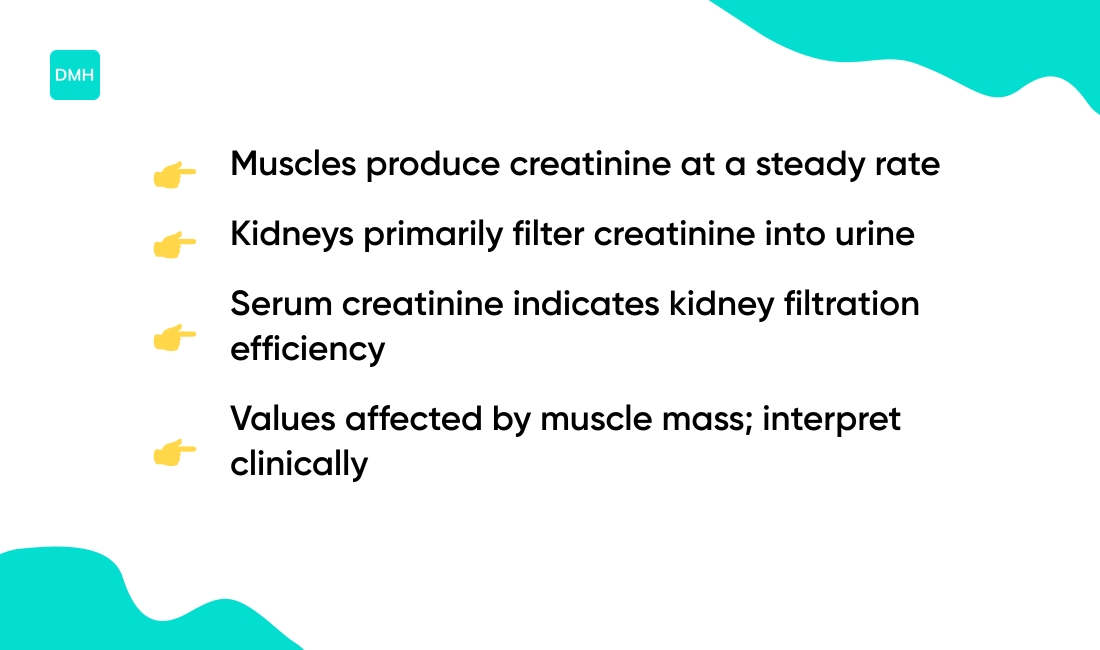
What does a creatinine test measure
Serum creatinine blood test
A serum creatinine blood test measures how much creatinine, a waste product from muscle, is in your bloodstream.
Clinicians use the result to estimate kidney filtration efficiency and to flag potential kidney problems early. Typical adult ranges are 0.7–1.3 mg/dL for men and 0.6–1.1 mg/dL for women. Children have different ranges.
Creatinine rises when glomerular filtration falls, with dehydration, muscle injury, or some medications affecting values. Laboratories use serum creatinine to calculate eGFR. An eGFR ≥90 mL/min is commonly considered normal.
If your result falls outside the lab reference range, discuss it with your clinician. They may repeat testing or review medications.
Learn more about test preparation and interpretation at the UCSF Health creatinine blood test page.
Not medical advice; content for educational purposes only. Always consult a qualified healthcare professional for medical advice specific to your situation.
Urine creatinine test
The urine creatinine test measures creatinine excreted in urine. Creatinine is a waste product from muscle metabolism used to assess kidney function.
Clinicians collect a 24-hour urine or a spot urine sample. A 24-hour collection measures total creatinine excretion over a day, while a spot sample compares urine creatinine to urine albumin to produce an albumin-to-creatinine ratio (UACR).
Results help estimate filtration and detect abnormal creatinine levels. Low urine creatinine can be associated with low muscle mass. High urine creatinine can be associated with concentrated urine from dehydration or increased muscle breakdown.
Urine creatinine often contributes to calculating creatinine clearance and to interpreting eGFR creatinine alongside a serum creatinine blood test. Values can vary from person to person based on age, sex, and muscle mass.
Not medical advice; content for educational purposes. Consult a qualified healthcare professional for advice specific to your situation.
Creatinine clearance test
Creatinine clearance test compares urine and blood creatinine to estimate kidney filtration.
A 24-hour urine collection measures urine creatinine concentration and total urine volume. A blood sample provides serum creatinine for the same time period.
Clearance (mL/min) = (Urine creatinine mg/dL × Urine volume mL/min) / Serum creatinine mg/dLHere’s an example: urine creatinine 120 mg/dL, urine volume 1440 mL/day (≈1 mL/min), serum creatinine 1.0 mg/dL gives a clearance near 120 mL/min.
Calculated clearance may approximate glomerular filtration rate and is used as a kidney function test when eGFR creatinine estimates seem uncertain. Normal adult values often range near 90–120 mL/min, though results can vary by age, sex, and muscle mass.
Not medical advice; content for educational purposes. Consult a qualified healthcare professional for advice specific to your situation.
Normal creatinine levels by age and sex
Normal creatinine levels vary with sex, age, and muscle mass. Adult men commonly range from 0.7 to 1.3 mg/dL, while adult women commonly range from 0.6 to 1.1 mg/dL.
Children have lower serum creatinine than adults. Values scale with growth and muscle development. Infants and toddlers often show values well below adult ranges. School-age children commonly range around 0.3 to 0.7 mg/dL, while adolescents typically approach adult female or male ranges depending on muscle mass.
Older adults may show lower creatinine despite reduced kidney function. Age-related muscle loss means a low serum creatinine can mask reduced filtration. Clinicians often use eGFR calculations that include age and sex to adjust for this effect.
Muscle mass strongly influences creatinine production. Athletes or people with greater muscle bulk can have higher baseline creatinine without kidney damage. Muscle-wasting conditions, malnutrition, or low body mass can produce lower creatinine values.
Laboratory reference ranges can vary by assay and lab. A single creatinine value provides limited information. Trends over time, estimated GFR from creatinine, and urine measures such as albumin-to-creatinine ratio give a fuller picture of kidney health.
|
Age Group |
Typical Range (mg/dL) |
Notes |
|---|---|---|
|
Infants & Toddlers |
0.2–0.4 |
Lower due to small muscle mass |
|
School-age Children |
0.3–0.7 |
Increases with growth |
|
Adolescents |
0.5–1.0 |
Approaches adult ranges |
|
Adult Men |
0.7–1.3 |
Higher muscle mass |
|
Adult Women |
0.6–1.1 |
Lower muscle mass |
|
Older Adults |
Variable |
May be lower; use eGFR |
Not medical advice; content for educational purposes. Always consult a qualified healthcare professional for medical advice specific to your situation.
What causes high creatinine levels
Kidney disease and impaired function
Damage to nephrons causes creatinine to build up in blood. Chronic kidney disease leads to progressive loss of filtration. Serum creatinine rises as glomerular filtration declines.
Acute kidney injury produces fast increases in creatinine because filtration drops quickly. Diabetic nephropathy injures glomeruli and small vessels, increasing waste retention over months to years.
Reduced renal blood flow occurs with heart failure or severe dehydration. That lowers filtration and may raise creatinine.
Lab tests estimate kidney function using creatinine and eGFR creatinine values. An eGFR below 60 mL/min often indicates impaired kidney function. Tracking creatinine trends helps distinguish acute injury from chronic decline and guides further tests like urine albumin and creatinine clearance.
Some conditions may be reversible with prompt care. Others progress despite intervention. Not medical advice; content for educational purposes. Consult a qualified healthcare professional for advice specific to your situation.
Dehydration and temporary elevations
When you don’t drink enough fluid, you develop reduced plasma volume. Kidneys receive less blood. Waste products concentrate and labs record higher serum creatinine.
Low blood volume lowers filtration temporarily. A creatinine test may show an elevated value that reflects concentration, not kidney damage. Some studies suggest mild dehydration can raise creatinine by about 10–30% and reduce eGFR by a similar margin.
Giving fluids restores kidney perfusion and filtration. Creatinine clears faster once blood volume normalizes. Levels often return to baseline within 24–72 hours after rehydration, indicating a temporary elevation.
If creatinine remains high after rehydration, further testing can help distinguish true kidney injury from transient changes. Not medical advice; content for educational purposes. Consult a qualified healthcare professional for advice specific to your situation.
Medications that raise creatinine
Certain drugs can cause elevated creatinine levels by altering kidney blood flow or blocking tubular secretion. Clinicians often track creatinine after starting these agents to monitor renal function.
-
ACE inhibitors and ARBs. These drugs may be associated with rises in serum creatinine up to about 30% after initiation due to reduced glomerular pressure.
-
NSAIDs. Nonsteroidal anti-inflammatory drugs can reduce renal perfusion and raise creatinine, especially with dehydration or concurrent diuretics.
-
Aminoglycoside antibiotics. Gentamicin and tobramycin can cause nephrotoxicity and measurable creatinine increases over days to weeks.
-
Trimethoprim and cimetidine. These agents impair tubular secretion and can raise creatinine without true loss of glomerular filtration.
-
Certain chemotherapy agents. Cisplatin and ifosfamide may cause acute kidney injury and notable creatinine elevation in a subset of patients.
Monitor with a serum creatinine test and track kidney filtration efficiency when starting or combining these drugs. Not medical advice; content for educational purposes. Consult a qualified healthcare professional for advice specific to your situation.
High-protein diets and muscle breakdown
High-protein diets and muscle breakdown can raise creatinine levels. Creatinine forms from muscle creatine as muscles metabolize energy.
Eating large amounts of meat or protein supplements may increase creatinine production. Some studies suggest short-term rises of about 10–30% after intense resistance training or heavy protein intake.
Intense exercise increases muscle metabolism. Rhabdomyolysis causes abrupt muscle cell rupture and can raise creatinine several-fold while releasing myoglobin and enzymes.
Chronic high protein intake may keep baseline creatinine slightly higher for some people with greater muscle turnover. Elevated creatinine on a serum creatinine test can reflect higher production, not only reduced kidney filtration.
Clinicians often compare creatinine with eGFR and urine creatinine measures to separate production from clearance. Not medical advice; content for educational purposes. Consult a qualified healthcare professional for advice specific to your situation.
When to worry about elevated creatinine levels
Elevated creatinine may signal reduced kidney filtration. Medical evaluation is warranted for rapid rises or persistent elevations.
-
Elevated creatinine levels that rise by 0.3 mg/dL within 48 hours or increase by 50% from baseline often indicate acute kidney injury.
-
Decreased urine output such as less than 0.5 mL/kg/hour for six hours may reflect impaired kidney function.
-
Swelling in legs, ankles, or face can reflect fluid retention from lowered filtration.
-
Shortness of breath or sudden weight gain from fluid overload requires prompt assessment.
-
Nausea, persistent vomiting, confusion, or severe fatigue can accompany rapid kidney decline.
-
Severe muscle pain or dark urine may point to muscle breakdown that raises creatinine.
Serum creatinine levels vary by age, sex, and muscle mass. eGFR calculated from creatinine may fall below 60 mL/min/1.73 m² with chronic kidney disease. Those numeric thresholds can vary from person to person.
Medical evaluation is advised when symptoms appear or when a creatinine test shows rapid change. For practical guidance on high creatinine, see the Texas Kidney Institute guide.
Have you noticed any of these symptoms alongside a recent lab result? Not medical advice; content for educational purposes only. Always consult a qualified healthcare professional for medical advice specific to your situation.
What conditions can cause low creatinine
Low creatinine often signals reduced creatinine production rather than improved kidney function. Serum creatinine may fall below 0.6 mg/dL in adults. Labs interpret results using age, sex, and muscle mass.
-
Reduced muscle mass. Older adults, prolonged immobility, or chronic illness can shrink muscle and lower creatinine production.
-
Malnutrition and wasting. Low calorie intake and cachexia reduce muscle turnover and serum creatinine.
-
Severe liver disease. Advanced liver dysfunction can impair creatine synthesis and lead to lower creatinine values.
-
Muscle disorders. Certain myopathies and neuromuscular diseases can lower muscle creatine stores and creatinine output.
-
Low protein intake. Very low protein diets maintained for weeks may reduce creatinine generation.
-
Pregnancy. Expanded plasma volume and increased clearance often dilute serum creatinine.
-
Fluid overload. Large fluid gains can lower measured creatinine by dilution.
Low creatinine can affect estimated GFR (eGFR) calculations. eGFR may overestimate kidney filtration in people with low muscle mass. Some studies suggest measuring cystatin C alongside creatinine improves accuracy in such cases.
Not medical advice; content for educational purposes. Consult a qualified healthcare professional for advice specific to your situation. 
How is eGFR calculated from creatinine
The estimated glomerular filtration rate uses the serum creatinine level, age, sex, and body size to estimate kidney filtration. Clinical labs commonly use the CKD-EPI equation to convert serum creatinine (mg/dL) into eGFR expressed as mL/min/1.73 m².
CKD-EPI applies sex-specific coefficients and adjusts for age. Some laboratories have stopped using a race coefficient because of concerns about accuracy and equity. The formula gives a single numerical estimate that can vary from person to person.
Normal eGFR is ≥90 mL/min/1.73 m². Staging uses standard cutoffs: stage 1 ≥90, stage 2 60–89, stage 3a 45–59, stage 3b 30–44, stage 4 15–29, stage 5 <15. Lower values may be associated with chronic kidney disease and often correlate with higher serum creatinine.
Lab reports pair eGFR with creatinine and urine markers such as the albumin-to-creatinine ratio for a fuller assessment. Not medical advice; content for educational purposes. Consult a qualified healthcare professional for advice specific to your situation.
BUN to creatinine ratio
BUN to creatinine compares blood urea nitrogen and serum creatinine. Clinicians use this ratio to clarify causes of changed creatinine levels.
A ratio between 10:1 and 20:1 is commonly used to describe normal kidney handling of nitrogen waste. Values above 20:1 may be associated with dehydration or reduced kidney blood flow. Values below 10:1 may be associated with low protein intake or impaired urea production in liver disease.
High creatinine with a normal ratio can point to intrinsic kidney damage. High creatinine with an elevated ratio often points to prerenal causes such as fluid loss.
Blood urea nitrogen and kidney function test results work together to guide follow-up testing. Clinicians may order urine studies or measure eGFR creatinine to refine diagnosis.
Not medical advice; content for educational purposes. Consult a qualified healthcare professional for advice specific to your situation.
Albumin to creatinine ratio (UACR)
The urine albumin-to-creatinine ratio (UACR) detects small amounts of protein in urine. It compares albumin to creatinine to adjust for urine concentration.
Values below 30 mg/g are considered normal. Values between 30 and 300 mg/g indicate microalbuminuria, while values above 300 mg/g indicate higher protein leakage and possible kidney damage.
If you have diabetes or high blood pressure, your clinician may order UACR testing regularly. A single spot urine sample or a timed collection measures albumin relative to creatinine and helps track creatinine levels and kidney filtration.
Monitoring UACR helps detect early kidney damage before large eGFR declines. See albumin blood test results for interpretation and next steps.
Not medical advice; content for educational purposes. Consult a qualified healthcare professional for advice specific to your situation.
How to lower creatinine levels naturally
Elevated creatinine often reflects reduced kidney filtration. Small lifestyle changes can lower serum creatinine and may improve eGFR creatinine estimates over time.
-
Reduce protein intake. Some guidelines suggest 0.6–0.8 g/kg/day for people with reduced kidney function. Lowering animal protein, especially red meat, can reduce creatinine production and ease kidney workload.
-
Increase fluid intake. Adequate hydration helps clear creatinine through urine creatinine excretion. Many adults aim for about 1.5–2.5 liters daily, adjusted for health, activity, and climate.
-
Manage underlying conditions. Better blood pressure and blood sugar control often links to lower creatinine and slower decline in creatinine clearance. Weight loss of 5–10% may reduce proteinuria in some people.
-
Avoid nephrotoxic drugs when possible. Certain NSAIDs, some antibiotics, and contrast agents can raise serum creatinine. Discuss medication review with a clinician before stopping or switching medicines.
-
Prefer plant-based protein sources and lower sodium. A balanced diet that limits processed foods can lower kidney stress and support healthier creatinine levels.
Some studies and traditional uses examine herbs for kidney health. For a focused review on ginger and kidneys, see the article on ginger and kidney health.
Monitor creatinine with regular serum creatinine or creatinine blood tests and assess trends alongside eGFR creatinine and BUN creatinine ratio. Not medical advice; content for educational purposes. Consult a qualified healthcare professional for advice specific to your situation.
Diet changes to help reduce creatinine
Small dietary shifts may help lower creatinine levels and support kidney function. Focus on modest protein adjustments rather than extreme restriction.
Limit intake of red and processed meats. High amounts of these proteins can raise serum creatinine and stress filtration. Swap some servings for fish, legumes, or poultry to support a balanced protein intake.
Watch sodium. Diets with high salt content often worsen blood pressure and kidney workload. Lowering salt may link to better creatinine trends. For related guidance on stone risk and sodium, see prevent kidney stones.
Avoid excess supplements that raise creatinine production. Creatine supplements and high-dose amino acids can increase measured creatinine without reflecting worse kidney function. Evaluate supplements with a clinician.
Choose whole foods over processed items. Processed proteins and cured meats add hidden sodium and phosphorus additives that can affect kidney lab values and general health.
Maintain adequate hydration. Dehydration concentrates waste products, including creatinine. Steady fluid intake may help urine creatinine and BUN creatinine ratio readings.
This guidance can vary from person to person. Some studies suggest moderate protein and lower sodium link to improved eGFR creatinine patterns in certain groups.
Not medical advice; content for educational purposes. Consult a qualified healthcare professional for advice specific to your situation.
Educational notice: This content is provided for informational and educational purposes only and is not intended as medical advice. Always consult a qualified healthcare professional for medical concerns.