That sudden wrinkle or stiff knee can make you ask whether something important is changing.
What is collagen, and how does this structural protein actually keep skin firm and joints moving?
Collagen production falls with age and unhealthy habits, so tissues lose strength and recovery slows.
Learning how collagen peptides, supplements, diet (yes, food matters), and nutrients like vitamin C support production gives you practical options.
You’ll learn the main types, evidence for powders and hydrolyzed peptides, natural ways to boost production, and possible side effects.
By the end you’ll be better equipped to choose foods, supplements, or habits that protect skin, joints, and connective tissues.
What is collagen
Collagen is the most abundant protein in the human body, accounting for 25% to 35% of total protein content. It answers the question what is collagen by serving as the primary structural molecule in many tissues.
Collagen protein forms long chains of amino acids. These chains wind together into a triple helix formation. The helix gives tensile strength and stability to fibers.
Fibers assemble into larger bundles called fibrils. Fibrils form the framework of skin, bone, tendon, cartilage, and blood vessels. Collagen acts as the main building block of connective tissues.
Type I collagen makes up about 90% of body collagen. Other types serve specific roles in cartilage, membranes, and blood vessels.
Collagen may be broken into smaller fragments called collagen peptides for supplements or research. Some studies suggest peptides appear in the bloodstream within hours of ingestion and may be associated with tissue turnover.
A peer-reviewed review summarizes collagen biology and provides molecular details and functional context for clinicians and researchers.
Collagen production can vary with age, nutrient status, and cell function. Not medical advice; content for educational purposes — consult a professional.
What does collagen do in the body
Knowing what is collagen clarifies its many roles. Collagen makes up about 30% of total body protein and forms long triple‑helix molecules that assemble into fibrils.
Those fibrils build connective tissues like skin, bone, tendon, and ligament. They provide a scaffold that supports tissue shape and load bearing.
Strength and elasticity come from collagen fiber alignment and crosslinking. This gives skin firmness and bone tensile strength.
Tissue repair processes rely on collagen. Cells use collagen scaffolds to migrate, fill gaps, and rebuild damaged tissue after injury.
Cellular communication pathways may be influenced by collagen. Collagen binds cell receptors such as integrins and can alter cell growth and differentiation.
Different collagen types serve different organs. Type I gives skin and bone strength. Type II supports cartilage and joint cushioning. Type IV forms basement membranes that separate tissues.
Collagen production depends on cells like fibroblasts and nutrients such as vitamin C. Collagen peptides from supplements or collagen powder may raise circulating amino acids within an hour, according to available research.
Effects can vary from person to person and by dose. Not medical advice; content for educational purposes — consult a professional.
Main types of collagen and their functions
Type I collagen
Defining what is collagen, Type I collagen is the most abundant collagen in the body. It makes up about 90% of total collagen and forms long, strong fibrils that give tissues tensile strength.
These fibrils form the scaffold of skin, bone, tendons, and ligaments. Dense bundles of Type I fibers support structural integrity and resist stretching.
Type I collagen may be central to common collagen benefits such as skin firmness and bone strength. Some studies suggest declines in Type I synthesis with age, which can affect tissue function.
Collagen production may depend on vitamin C and specific amino acids. Supplement forms like hydrolyzed collagen or collagen peptides may supply building blocks for the body.
Not medical advice; content for educational purposes — consult a professional.
Type II collagen
Type II collagen is a collagen protein found mainly in cartilage. It helps form a load-bearing network that gives cartilage shape.
Type II makes up about 90% of the collagen in hyaline articular cartilage. Cartilage often contains 70–80% water by weight, so collagen and water work together to absorb shock.
Primary cartilage collagen supports the matrix that cushions joints. This may protect cartilage during movement.
Some studies suggest undenatured Type II collagen might be linked to reduced joint discomfort in some people. Evidence varies and more research is needed.
Type II maintains cartilage flexibility by forming fibrils that resist compression. Cells called chondrocytes produce Type II during tissue maintenance.
Not medical advice; content for educational purposes — consult a professional.
Type III collagen
Type III collagen is a fibrillar collagen found in blood vessels, skin, and internal organs. It may provide flexibility and elasticity to soft tissues.
It often works alongside Type I collagen to give structural support. Some studies suggest Type III levels relate to tissue repair and healing.
Levels can vary with age and health. This type helps explain what is collagen and its role in connective tissues.
Type III can account for 10–20% of collagen in some tissues. Researchers measure Type III when studying vascular health and wound healing.
Some studies suggest shifts in Type III may be associated with scar tissue formation. Not medical advice; content for educational purposes — consult a professional.
Type IV and Type V collagen
Type IV forms basement membranes beneath epithelial and endothelial cells. These thin networks support cell layers and help filter fluids in organs such as kidneys. Type IV assembles as mesh‑like networks rather than long fibrils.
Type V appears on cell surfaces and in hair. It helps control fibril size and surface organization. Type V is less abundant than Type I but remains important for tissue patterning.
Both types perform specialized structural roles instead of bulk tensile support. Some studies suggest genetic changes in these collagens may be associated with tissue fragility or hair differences.
Most collagen supplements and collagen peptides target Types I and II, so research on IV and V in supplements is limited. Not medical advice; content for educational purposes — consult a professional.
How is collagen produced in the body
Collagen production starts in specialized cells. Fibroblasts make most collagen in skin and tendon. Chondrocytes make cartilage collagen. Osteoblasts make bone collagen.
Cells translate collagen genes into long pro-collagen chains. Enzymes add hydroxyl groups to proline and lysine residues. This step requires vitamin C and metal cofactors.
Collagen synthesis process continues as three chains wind into a triple helix. Cells package and secrete the helix as procollagen. Outside the cell, enzymes trim registration peptides.
Trimmed molecules align into tropocollagen units. Tropocollagen self-assembles into fibrils. Enzymes then cross-link fibrils to form strong fibers. This collagen fibril formation gives tissues tensile strength and elasticity.
The vitamin C role is central to stable helix formation. Low vitamin C may lead to weaker fibers. Readers may find practical notes about vitamin C for skin at vitamin C for skin.
Body enzymes break some collagen into peptides. Hydrolyzed collagen and collagen peptides appear in supplements. Some studies suggest these peptides may support skin and joint health, though evidence varies.
Collagen production can vary from person to person with age and nutrition. Not medical advice; content for educational purposes — consult a professional.
What happens to collagen as you age
Collagen acts as a scaffold for skin, bone, cartilage, and connective tissue. Collagen production starts to decline in your mid-20s and may fall about 1% per year.
Fibroblasts slow their output. Collagen strands become less organized. Cross‑linking and sugar‑related changes may stiffen fibers.
Enzymes can fragment them. Fragmented fibers lose strength and no longer form tight networks.
Collagen production drops while repair processes slow down. Skin may lose elasticity and hydration. Fine lines may deepen into permanent creases.
Sagging may appear around jaw and eyelids. Joint cartilage may thin and absorb shock less effectively.
Some studies suggest reduced collagen may be associated with slower tissue repair. Effects can vary from person to person based on genetics, sun exposure, and smoking.
If weight loss changed your skin, learn how to tighten skin after weight loss naturally.
Visible signs may appear gradually over decades. Not medical advice; content for educational purposes — consult a professional.
Collagen benefits for skin and joints
Does collagen improve skin health
Collagen is the primary structural protein of skin. It forms a triple helix and supports dermal strength.
Oral collagen, especially hydrolyzed collagen peptides, may improve skin elasticity. Some studies suggest 2.5–5 g daily can increase elasticity in 8–12 weeks. They may reduce wrinkle depth by about 10–20% in some trials.
Topical collagen rarely penetrates the dermis because molecules are large. Topical products may act as moisturizers and improve skin hydration temporarily.
Hydrolyzed peptides appear in blood within an hour after ingestion. They may supply amino acids and signal fibroblasts to support collagen production and firmness.
People often pair supplements with skin care and targeted methods. The guide to tighten eyelid skin without surgery may be relevant when addressing delicate eyelid skin.
Evidence varies and outcomes can differ among individuals. Some studies suggest benefits from collagen for skin, but research quality and length vary.
Not medical advice; content for educational purposes — consult a professional.
Is collagen good for joints and cartilage
Collagen is the main structural protein that makes up cartilage and connective tissue. It gives cartilage tensile strength and some elasticity.
Some studies suggest oral collagen protein supplements using hydrolyzed collagen or collagen peptides may reduce joint pain and improve function. Reported study doses range from 2.5 g to 15 g per day with benefits often seen after 8 to 24 weeks.
Collagen supplies amino acids such as glycine and proline that support the cartilage matrix. It may stimulate chondrocytes to increase extracellular matrix production according to available research.
Effects can vary from person to person. Product quality, collagen source, and individual biology may influence outcomes. Not medical advice; content for educational purposes — consult a professional.
Other collagen benefits
Collagen may support bone strength. Some studies suggest modest increases in bone mineral density with about 5 g/day of collagen peptides over 12 months. This effect may be more noticeable in postmenopausal individuals.
Collagen can help preserve muscle mass. Trials that combined roughly 15 g/day of collagen peptides with resistance training reported gains in lean mass and strength over 8–12 weeks. Collagen makes up 1–2% of muscle tissue and 6% of skeletal muscle by weight.
Collagen plays a role in vessel structure. Some research links collagen to blood vessel health and reduced arterial stiffness after several weeks of supplementation.
Collagen may affect hair and nails. Small studies and surveys report firmer nails and less breakage after a few months. Evidence for hair strength remains limited and mixed.
Benefits can vary from person to person. Some studies suggest positive effects, but more research is needed to confirm long‑term outcomes. Not medical advice; content for educational purposes — consult a professional.
Understanding collagen supplements
People often ask what is collagen. It’s the body’s main structural protein.
Collagen supplements appear as collagen peptides, hydrolyzed collagen, and collagen powder. Whole collagen forms a large triple-helix. Digestive enzymes can’t absorb it intact.
Manufacturers break collagen into smaller peptides through an enzymatic hydrolysis process. Short peptides dissolve easily and mix well in liquids.
Smaller peptides may reach the bloodstream faster than intact collagen. Some studies suggest peptides appear in blood within an hour of intake.
Bioavailability can vary by source, peptide size, and individual digestion. Marine collagen may have smaller peptides and different amino acids.
Collagen powder often contains hydrolyzed collagen for better absorption and taste. Labels vary, and ingredient lists and peptide types may differ.
Available research shows modest benefits for skin and joint markers at typical study doses. Evidence varies and more studies may be needed.
Some studies use 2.5–15 grams daily, with measurable changes reported after four to twelve weeks. Food sources provide amino acids but not intact collagen peptides.
Not medical advice; content for educational purposes — consult a professional.
What are collagen peptides and hydrolyzed collagen
Collagen peptides are short chains of amino acids formed from collagen. Hydrolyzed collagen describes collagen that has undergone controlled breakdown into those chains.
The hydrolysis process uses enzymes or mild heat and acid to cleave the triple helix. This yields peptides with average molecular weights around 500–5,000 daltons, commonly 2–5 kDa.
Smaller fragments absorb more readily than intact collagen. Some studies suggest hydrolyzed forms reach the small intestine within minutes after ingestion.
Peptides can appear in blood within an hour. Digestive enzymes release di‑ and tri‑peptides that may resist full breakdown. Transport proteins such as PEPT1 can carry these small peptides across the intestinal wall into circulation.
Research has detected hydroxyproline‑containing peptides in plasma at 30–60 minutes after supplementation. Plasma levels may peak near 1–2 hours and decline over several hours, depending on dose and source.
Supplement labels often list hydrolyzed collagen peptides or smaller peptide chains to indicate higher bioavailability. Study doses ranged from about 2.5 g to 15 g per day, with measurable plasma peptides after single doses.
People may compare marine and bovine sources based on peptide size and amino acid profile. Evidence varies and outcomes can differ from person to person. Not medical advice; content for informational purposes — consult a professional.
Marine collagen vs bovine collagen
People often ask what is collagen while choosing supplements. Collagen is a structural protein that supports skin, bone, tendon, and cartilage.
Marine collagen is rich in Type I collagen. Marine sources yield smaller peptides. Some studies suggest marine peptides average 2–3 kDa. These peptides may appear in blood within an hour after ingestion.
Bovine collagen commonly provides Type I and Type III. Bovine hydrolyzed peptides often range 3–6 kDa. They may support skin and connective tissue through a steady supply of amino acids.
Marine collagen peptides may absorb faster and suit people focused on skin and hair. Research using 2.5–5 g daily reported measurable skin elasticity changes over 8–12 weeks in some trials.
Bovine collagen peptides may offer broader support for tendon and ligament structure. Studies often use 5–10 g daily for joint symptom research.
Chicken collagen tends to supply Type II, which is often discussed in relation to cartilage. Porcine collagen resembles bovine in amino acid profile and digestibility.
Fish allergy, dietary restrictions, and sustainability matter when choosing a source. Some people may report mild digestive symptoms with any collagen supplement.
Evidence varies and quality differs across products. Some studies suggest benefits, but results can vary from person to person. Not medical advice; content for educational purposes — consult a professional.
What is the difference between collagen and gelatin
Collagen is the most abundant protein in the human body. It forms long, rope-like fibers that support skin, bone, tendon and cartilage.
Collagen triple helix describes three polypeptide chains wound together. Specific amino acids such as glycine and proline stabilize that shape. Fibers assemble into larger fibrils and confer tensile strength.
Heat or acid can break those bonds. When that structure unfolds, it turns into gelatin. Gelatin is denatured collagen consisting of random coils that dissolve in hot water and gel on cooling. Denaturation often occurs with prolonged boiling of connective tissue.
Uses differ. Collagen protein appears in supplements, wound dressings and tissue scaffolds. Gelatin appears in food gels, capsules, and photographic or pharmaceutical applications.
Collagen peptides are smaller fragments produced by hydrolysis. They may appear in blood faster than whole collagen after ingestion. Gelatin supplies many of the same amino acids but lacks intact fibril structure that cells use for scaffolding.
Some studies suggest gelatin or hydrolyzed collagen might be associated with modest improvements in skin elasticity and joint comfort. Results can vary from person to person and study methods differ. Typical study doses range from about 2.5 g to 15 g per day.
Not medical advice; content for educational purposes — consult a professional.
How to increase collagen naturally
Collagen is the body’s most abundant protein. It forms a triple helix and supports skin, bone, cartilage and connective tissue.
Small changes to your diet and habits may help increase collagen naturally. These steps relate to collagen production and to protecting existing fibers.
|
Strategy |
How It Helps |
Examples |
|---|---|---|
|
Eat collagen-building protein |
Supplies proline and glycine |
Bone broth, chicken, fish with skin, egg whites |
|
Get enough vitamin C |
Supports hydroxylation reactions |
Citrus, bell peppers, strawberries (75–90 mg daily) |
|
Include trace minerals |
Aids cross-linking and repair |
Nuts, shellfish, legumes (copper, zinc) |
|
Protect existing collagen |
Prevents UV and smoke damage |
Use sun protection, avoid tobacco |
|
Prioritize sleep and exercise |
Supports tissue repair |
Adequate sleep, resistance training |
|
Limit excess sugar |
Reduces glycation |
Avoid high glycemic foods |
Plus, you might consider supplements cautiously. Collagen peptides or hydrolyzed collagen may raise circulating amino acids within an hour and some studies suggest 2.5–5 g daily may improve skin measures after 8–12 weeks.
Not medical advice; content for educational purposes — consult a professional.
Which foods are high in collagen
To explain what is collagen, note it’s a structural protein that supports skin, joints, bones, and connective tissue. Diet may supply whole collagen or the amino acids that support collagen production.
-
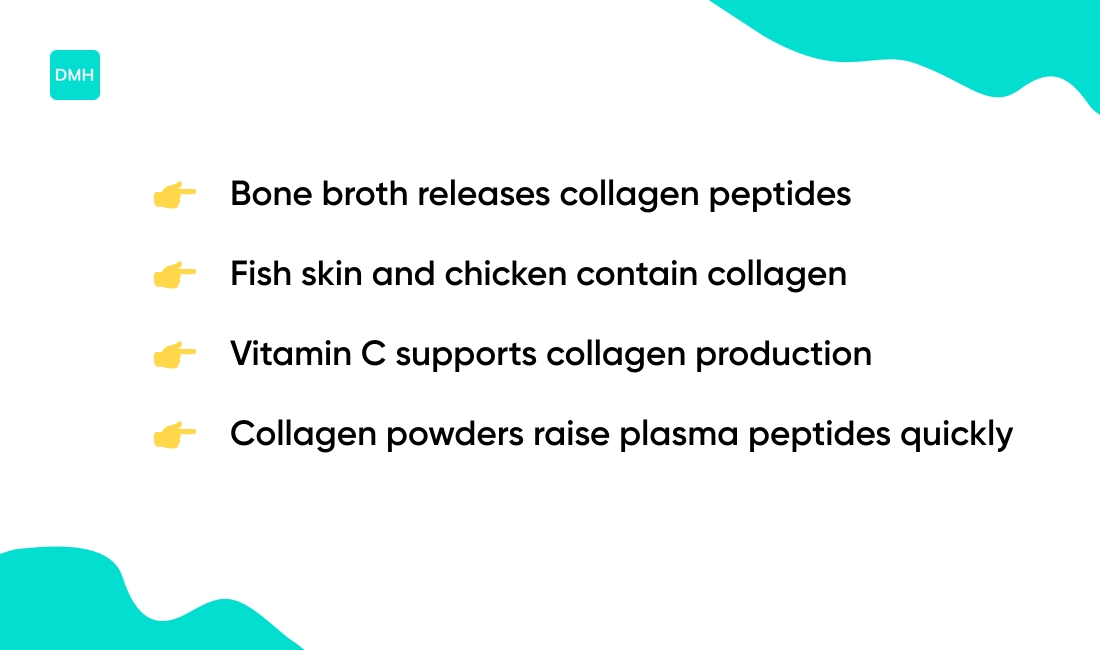
Bone broth: Made by simmering bones and connective tissue. May release collagen peptides and glycine into the liquid.
-
Fish with skin: Fish skin contains Type I collagen. Marine collagen peptides may be more easily absorbed according to some studies.
-
Chicken: Rich in connective tissue and commonly used in studies of collagen for joints.
-
Egg whites: High in proline, an amino acid used in collagen synthesis. Egg whites supply useful building blocks without the fat.
-
Organ meats and shellfish: Provide copper, a trace mineral that may support collagen cross-linking.
-
Vitamin C–rich foods: Citrus, bell peppers, and strawberries may support collagen production by acting as cofactors for collagen-forming enzymes.
-
Protein-rich foods: Lean beef, pork, and dairy supply glycine and other amino acids linked to collagen protein synthesis.
-
Collagen powder and hydrolyzed collagen: Collagen peptides in powder form may raise plasma peptide levels within an hour, based on available research.
Combining collagen-rich foods with vitamin C sources may support collagen production. Evidence varies and can differ between individuals. Not medical advice; content for educational purposes — consult a professional.
Does collagen powder work
Many people ask what is collagen and whether supplements help. Some studies suggest oral collagen peptides can improve skin firmness and reduce joint discomfort.
Clinical trials often use 2.5–10 grams daily. Trials running 8–24 weeks report small to moderate benefits for skin elasticity and wrinkle depth. Joint studies show reduced activity‑related pain over 3 months in some participants.
Hydrolyzed collagen breaks into small peptides. These peptides appear in blood within an hour and may reach skin and cartilage. Harvard Nutrition Source reviews this absorption and the limited long‑term evidence.
Bone data remain limited. A few small studies suggest modest gains in bone mineral density when peptides pair with calcium and vitamin D over a year. Results vary by dose, formulation, and participant age.
Evidence quality varies. Many trials have small samples, short follow‑up, and differing product types. Industry funding appears common. According to available research, effects may be modest and can vary from person to person.
Safety reports list few serious side effects, but allergies to source proteins can occur. People with dietary restrictions may prefer marine or bovine sources. Not medical advice; content for educational purposes — consult a professional.
You might also like: How To Get Rid Of Acne When Nothing Works
How much collagen should you take daily
Daily collagen needs can vary by goal and product. Supplements may provide between 2.5 and 15 grams per day depending on form and intended use.
Some studies suggest skin outcomes with 2.5–5 grams daily. Joint research commonly uses 5–10 grams, with several trials at 10 grams. Bone and muscle studies sometimes test 15 grams. A practical range for many people is 5–10 grams daily.
Several factors may affect dose requirements. Age and body weight can influence needs. Dietary protein intake and overall nutrition may matter. Collagen source and processing can change absorption.
Hydrolyzed collagen supplements may appear in blood faster than whole collagen. Collagen powder doses may differ from capsule counts.
Time to see results can vary from person to person. Some trials report skin changes in 4–12 weeks. Joint symptom changes may appear in 8–24 weeks. Response may depend on baseline health, consistency of use, and co‑nutrients such as vitamin C.
Label clarity helps with dose selection. Look for peptide amount per serving and the collagen type listed. According to available research, evidence varies and more study is needed. People taking medications or with known allergies may want medical advice.
Not medical advice; content for educational purposes — consult a professional.
Read also: Benefits of Chia Seeds For Hair – Dailymedicalhealth
Are there side effects of collagen supplements
Collagen is the most abundant protein in the body. Supplements usually contain hydrolyzed collagen or collagen peptides. Side effects are generally mild and can vary from person to person.
-
Mild digestive symptoms may include nausea, bloating, diarrhea, or constipation.
-
Allergic reactions may occur with marine, bovine, or egg-derived products.
-
Some people report a lingering taste or mild fullness after ingestion.
People with allergies to fish, shellfish, or eggs may be at higher risk of reactions. Some formulations include added ingredients such as vitamin K, glucosamine, or herbal extracts.
Those additives may interact with blood thinners or other medications. If you take blood thinners, a clinician may advise caution before starting supplements.
Studies often use 2.5–15 g daily and report few serious harms, but long-term safety data remain limited. Pregnant and breastfeeding people are underrepresented in research, so safety is uncertain for them.
Always check product labels for source and added ingredients. Not medical advice; content for educational purposes — consult a professional.
You’ll also like: Chia seeds benefits for skin
Educational notice: This content is provided for informational and educational purposes only and is not intended as medical advice. Always consult a qualified healthcare professional for medical concerns.