You might wonder if anxiety is keeping you up at night with breathing problems.
Let’s clear this up right away.
Anxiety doesn’t actually cause sleep apnea, but the two conditions are closely connected in ways that can make both worse.
Can anxiety cause sleep apnea?
No, anxiety does not cause sleep apnea.
Sleep apnea is a physical breathing disorder rooted in your airway or brain signaling, not your mental state.
Upper airway collapse explains obstructive sleep apnea. When throat tissues relax too much during sleep, they block airflow completely for 10 seconds or longer.
Brain signaling failures explain central sleep apnea. Your brain simply stops sending the signal to breathe, leaving you without effort to inhale.
About 25% of adults show signs of obstructive sleep apnea on screening studies. That’s roughly one in four people walking around with undiagnosed breathing pauses at night.
Anxiety is a mental state that can worsen sleep quality and raise arousal. It increases muscle tension and makes breathing feel harder at night, but it doesn’t create airway collapse or stop respiratory signals from your brain.
Many people confuse panic or awake shortness of breath with apnea. (I’ve seen it happen more times than I can count.)
A sleep study can clarify the cause in under one night. Polysomnography measures airflow, oxygen, effort, and brain waves to confirm whether apnea is present.
We recommend testing if you have loud snoring, witnessed pauses, gasping, or persistent daytime sleepiness. Get evaluated by a sleep specialist or your primary care clinician to rule out sleep apnea and get tailored treatment.
Understanding the bidirectional relationship between sleep apnea and anxiety
How does sleep apnea trigger anxiety symptoms?
You feel more anxious because sleep apnea creates repeated physical stress during sleep.
Here’s the chain: airway collapse causes pauses, oxygen falls, sleep fragments, and your body reacts with alarm. Apneas trigger arousals dozens of times each night. Oxygen can dip 4–10 percentage points during events.
Those drops lead to oxygen saturation drops and repeated wake signals. Your brain kicks the sympathetic system into gear, raising heart rate and releasing stress hormones like adrenaline and cortisol.
Raised cortisol and adrenaline make you hyperaware and prone to panic. Nocturnal panic attacks and breathing distress often feel the same because your body reacts to low oxygen and fragmentation in similar ways.
Have you ever woken up gasping with your heart pounding? That’s your sympathetic nervous system responding to an apnea event.
Treating the breathing disorder often eases anxiety and panic at night. Talk to your clinician about sleep testing and targeted treatment if you notice loud snoring, gasping, or worsening anxiety.
Does sleep apnea make anxiety worse?
Sleep apnea often worsens anxiety, and the numbers back it up.
A 2024 CHEST study of over 30,000 adults found 30–60% higher odds of anxiety disorders in people with sleep apnea. Severe cases showed the strongest symptom reinforcement.
Oxygen drops, sleep fragmentation, and repeated awakenings fuel chronic anxiety. These events trigger cortisol spikes and sympathetic arousal that magnify worry and panic throughout the day.
We recommend evaluation when anxiety occurs with loud snoring, witnessed pauses, or daytime sleepiness. Sleep apnea anxiety often forms a loop with stress that feeds on itself.
Treating breathing problems can reduce anxiety and improve sleep quality. Talk to your clinician about sleep testing and strategies to manage CPAP anxiety if device therapy is part of your plan.
Can stress and anxiety worsen sleep apnea symptoms?
Yes, anxiety can worsen sleep apnea symptoms by increasing muscle tension, hyperarousal, and elevated cortisol.
Anxiety tightens throat and jaw muscles. That narrows the airway and raises resistance during sleep, making obstructive events more likely.
Hyperarousal keeps your brain in lighter sleep stages. Light sleep fragments breathing patterns and increases apnea events and snoring intensity.
Chronic stress raises sympathetic drive and cortisol levels. That cuts deep sleep time and makes breathing control more unstable throughout the night.
Stress management matters for many patients. One patient I worked with saw his apnea index rise from 18 to 28 during a high-stress month, then fall back after adding nightly relaxation exercises and CPAP adjustments.
We recommend tracking stress levels, using pre-sleep relaxation techniques, and sharing these patterns with your sleep specialist so you can lower nightly breathing disruptions.
How to tell nocturnal panic attacks from sleep apnea episodes
You need clear signs to tell nocturnal panic attacks from sleep apnea episodes.
|
Feature |
Nocturnal Panic Attack |
Sleep Apnea Episode |
|---|---|---|
|
Timing |
Sudden awakening with intense fear peaking in minutes |
Repeated events dozens of times per hour throughout the night |
|
Breathing pattern |
Rapid, shallow breathing or hyperventilation |
Pauses of 10+ seconds followed by loud gasps |
|
Awareness |
Clear memory of fear and vivid mental images |
Grogginess, poor recall, partner reports pauses |
|
Physical sensations |
Chest tightness, tingling, sweating, sense of doom |
Choking, daytime sleepiness, oxygen dips, elevated heart rate |
Tracking partner observations or using a home sleep monitor helps clarify events. Nocturnal panic attacks and breathing issues from anxiety often lack the snoring and repetitive pauses that define obstructive sleep apnea.
We recommend a sleep study when partners report pauses, loud snoring, or you feel very sleepy by day. If you wake terrified with racing breath, seek an anxiety evaluation instead.
Takeaway: get tested for sleep apnea or evaluated for panic so you get the right treatment. Schedule an appointment with your clinician today.
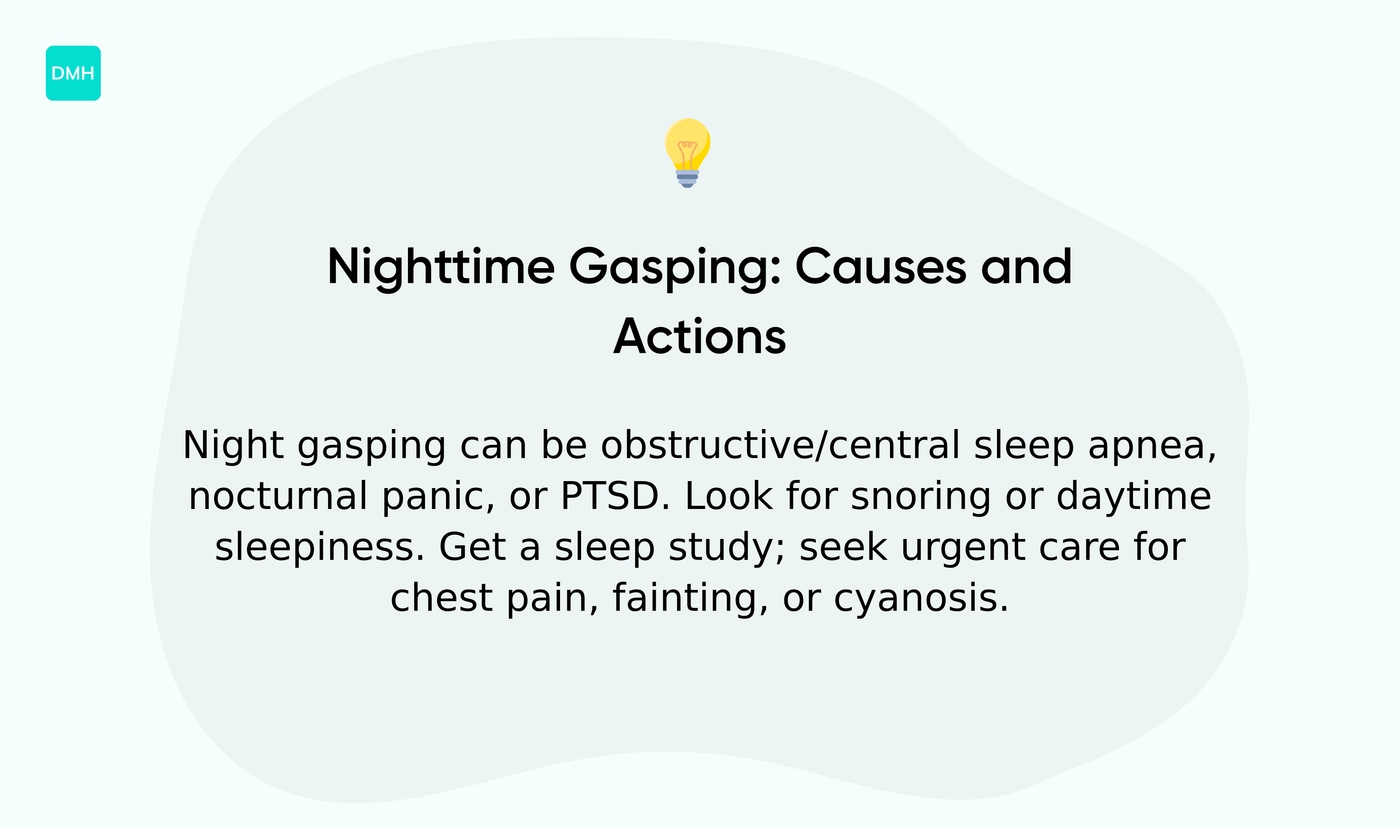
What causes nighttime shortness of breath and gasping?
You wake gasping because your body either stops moving air or panics mid-sleep.
-
Obstructive sleep apnea: throat tissues collapse and block airflow. Oxygen can fall below 90% during events, and loud snoring often precedes gasping.
-
Central sleep apnea: your brain fails to signal breaths. You may wake short of breath without any snoring at all.
-
Nocturnal panic attacks: sudden anxiety activates your fight-or-flight response and causes sharp breathlessness and choking sensations.
-
PTSD-related breathing: nightmares and hyperarousal trigger rapid breathing or gasping during sleep.
Many people blame anxiety for every night gasp. I’ve seen patients assume panic, when tests showed obstructive events happening 40 times per hour.
Your history, partner reports, and daytime sleepiness help sort causes. We recommend overnight testing for repeated gasping or witnessed pauses.
Seek urgent care if you have severe chest pain, fainting, or bluish lips. If breathlessness links with chest discomfort, read about anxiety and chest pain to rule out cardiac causes and anxiety overlaps.
Takeaway: persistent nighttime gasping needs evaluation by a sleep or medical specialist. Book a sleep study or talk to your clinician about urgent testing if symptoms are frequent or severe.
Types of sleep apnea and their connection to anxiety
Obstructive sleep apnea and anxiety rates
Obstructive sleep apnea links to significantly higher anxiety and mental health rates.
A study found a 25.9% OSA risk tied to 52.9% reporting mental health issues, versus 41% without OSA. That’s a meaningful jump.
Obstructive events happen when throat tissues block airflow. Breathing pauses lower oxygen, and sleep fragments after each pause.
Oxygen drops raise cortisol and activate the sympathetic nervous system. That biology fuels anxiety, panic, and daytime worry in a vicious cycle.
These numbers show how a physical problem can drive psychological harm. Treating the airway often eases anxiety symptoms by breaking that cycle.
Listen to examples of loud breathing and gasps at what sleep apnea sounds like to compare symptoms.
We recommend sleep testing when you have loud snoring plus anxiety or daytime sleepiness. Takeaway: get evaluated by a sleep specialist if you suspect OSA and rising anxiety.
Can anxiety cause central sleep apnea?
No, anxiety does not cause central sleep apnea.
Central sleep apnea happens when the brain fails to send steady breathing signals during sleep. Common causes include heart failure, stroke, opioid use, and high-altitude exposure.
Cheyne-Stokes breathing in heart failure causes periodic pauses and severe sleep fragmentation. That’s a neurological issue, not a psychological one.
Anxiety and stress can affect breathing control and raise symptom intensity, but they don’t create the underlying central mechanism. Stress can worsen unstable breathing and amplify daytime fatigue and panic-like sensations, though.
I’ve seen patients whose anxiety magnified perceived breathing problems despite normal sleep studies. Does that sound familiar?
If you wonder “can anxiety cause sleep apnea,” the direct link for central types isn’t supported by evidence. Central sleep apnea represents about 5% of sleep apnea cases.
Ask your clinician for a sleep study referral if you have pauses, gasping, or severe daytime sleepiness. Get evaluated today by a sleep specialist to confirm diagnosis and start appropriate care.
Upper airway resistance syndrome and anxiety
UARS is a milder breathing disorder than classic sleep apnea, but it can still wreak havoc on your sleep.
UARS creates upper airway resistance that increases effort to breathe without full apneas. This extra effort fragments sleep and raises arousal, feeding anxiety-related hyperarousal and restless nights.
UARS often looks like insomnia or panic at night. Patients report tightness, frequent awakenings, and noisy breathing without the obvious pauses of obstructive sleep apnea.
Sleep studies show arousal counts can rise by about 5–20 events per hour with flow limitation. That pattern links to more daytime worry and fatigue, even if your oxygen levels stay normal.
We recommend combined testing for breathing and mood symptoms so you get targeted care. Treating flow limitation and anxiety often improves sleep and daytime symptoms together.
Takeaway: if you wake gasping or wired, see a sleep specialist to check for UARS and related anxiety.
You need objective testing to tell sleep apnea from anxiety-related breathing.
Polysomnography records brain waves, oxygen, airflow, chest motion, and snoring across a full night. It’s the gold standard test and identifies apneas and hypopneas with diagnostic accuracy often above 90%.
Home sleep tests monitor airflow, oxygen, and respiratory effort at home. These catch moderate to severe obstructive sleep apnea with roughly 80% sensitivity, making them a convenient first step.
Sleep questionnaires and mental health screens measure sleep quality and psychological symptoms over weeks. The PSQI gauges sleep quality, while GAD-7 and PHQ-9 quantify anxiety and depression to flag anxiety-related breathing problems at night.
Nocturnal panic and hyperarousal usually show normal oxygen levels and brief rapid breaths on testing. Sleep apnea shows repeated oxygen drops and clear airflow pauses with effort (obstructive) or absent effort (central) based on type.
Pairing a sleep study with a formal anxiety screen speeds accurate diagnosis and avoids unnecessary treatment trials. We recommend ordering polysomnography when a partner reports pauses or when daytime sleepiness appears, and completing a GAD-7 if you report panic or high nighttime arousal.
Takeaway: get both an overnight sleep study and a mental health assessment. Ask your clinician for a PSG and a GAD-7 today.
Treatment approaches for sleep apnea and anxiety
You can break the cycle between sleep apnea and anxiety with targeted combined treatments.
-
CPAP therapy: Regular CPAP use restores airway flow and cuts sleep fragmentation. Trials often report 20–30% drops in anxiety scores with consistent use. Address CPAP anxiety with mask fitting and gradual desensitization.
-
Oral appliances: Custom mandibular devices widen the airway for mild to moderate obstructive sleep apnea and help people who can’t tolerate CPAP.
-
Cognitive behavioral therapy: CBT for anxiety and CBT-I reduces hyperarousal, improves sleep continuity, and raises adherence to breathing therapies.
-
Anxiety medications: Selective serotonin reuptake inhibitors or short-term anxiolytics can ease nocturnal panic, but use clinician oversight because some sedatives can worsen breathing at night.
-
Lifestyle modifications: Weight loss, limiting alcohol, consistent sleep timing, and evening relaxation cut cortisol and sympathetic overdrive that worsen breathing disruptions.
We favor integrated plans that treat breathing and mental health at once. Combining device therapy with CBT and sensible lifestyle changes gives the fastest, most durable symptom relief.
Takeaway: pursue a sleep study plus a mental health evaluation and ask your clinician for a coordinated treatment plan tailored to your symptoms.
You might also like: How to Make Friends With Social Anxiety: 7 Tips
Can treating sleep apnea improve anxiety symptoms?
You can see real anxiety relief when sleep apnea is treated.
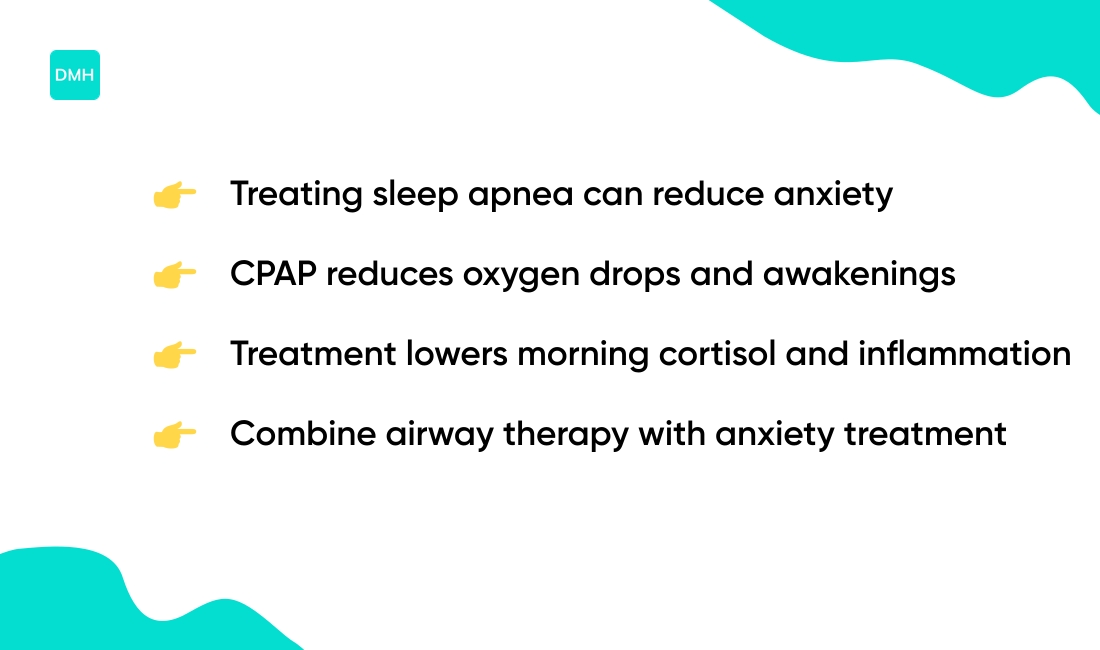
Treating breathing disruptions reduces sleep debt, lowers stress hormones, and calms inflammation. CPAP restores steady breathing and fewer oxygen drops, stopping repeated night awakenings and lowering sympathetic arousal linked to sleep apnea anxiety.
Clinical research reports measurable mental health gains after weeks of therapy. A December 2025 study linked higher apnea burden to poorer mental health, highlighting the benefit of effective treatment. When breathing events fall, labs often show lower morning cortisol and reduced inflammatory markers.
Combining airway treatment with anxiety care speeds recovery. Plus, addressing lifestyle triggers helps too. See the list of foods that worsen sleep apnea and avoid those that raise airway resistance.
We recommend pairing CPAP or an appropriate airway strategy with therapy for anxiety. Tackle both issues together to break the cycle of poor sleep and worsening anxiety.
Takeaway: treating sleep apnea often cuts anxiety by fixing oxygen drops, sleep debt, and stress-system overdrive. Talk with your sleep specialist or mental health provider about an integrated plan.
You might also like: How to Deal with Turbulence Anxiety: Top Tips
You can reduce CPAP anxiety with focused steps that make the device feel manageable.
-
Gradual mask acclimation: Start with 10–15 minutes while awake. Add 5 minutes each night until you tolerate a full session.
-
Adjust humidifier settings: Warm, moist air cuts dryness and airway irritation that can trigger panic. Try low-to-medium heat first.
-
Mindful breathing practice: Practice slow nasal breaths for five minutes before donning the mask. Use a soft-paced 4-4-6 rhythm to calm heart rate.
-
Try different mask styles: Nasal pillows often feel less claustrophobic than full-face models. Ask your supplier for two trial options.
-
Use ramp and pressure relief features: Lower starting pressure reduces initial discomfort and noise-related startle.
-
Consider behavioral support: Short exposure sessions plus CBT techniques reduce device avoidance and nighttime panic symptoms.
We suggest tracking nightly tolerance for two weeks and noting anxiety triggers. Gradual exposure paired with simple breathing exercises gives the fastest relief in my experience.
Takeaway: try the mask, ramp, humidifier, and short exposure plan this week. If anxiety persists, book a visit with your sleep specialist or mental health provider.
Read also: Why Is My Anxiety Worse in the Morning?
When to see a doctor for nighttime breathing problems
You need prompt medical evaluation for certain nighttime breathing signs to protect your health and sleep.
-
Persistent gasping or choking that wakes you repeatedly each week.
-
Partner reports witnessed breathing pauses or very loud, irregular snoring.
-
Waking with headaches, extreme daytime sleepiness, or confusion after sleep.
-
Sudden, intense panic at night with racing heart, sweating, or a feeling of smothering and severe anxiety symptoms.
-
Existing heart disease, stroke, or opioid use combined with breathing problems while asleep.
-
Blue lips, fainting, or breathing that stops for long stretches (apneas over 10 seconds need review).
Research shows people with sleep apnea often have higher odds of anxiety, with studies reporting a 30–60% increase in anxiety rates among those affected. That’s not a small number.
You shouldn’t wait if any red flag appears. Early testing can prevent daytime decline and reduce risk of serious complications.
We recommend you call your primary care or a sleep clinic for urgent assessment when red flags appear. For severe symptoms like prolonged gasping, loss of consciousness, or cyanosis, call emergency services immediately.
Takeaway: get evaluated now if you notice these signs. Schedule an urgent appointment or seek emergency care for life-threatening symptoms.
You’ll also like: How Long Does Ashwagandha Take for Anxiety Relief?