High lymphocytes in a blood test means you have more lymphocytes than normal—these are the white blood cells that help fight infections and disease.
For adults, a count above 3,000 to 4,000 lymphocytes per microliter typically signals lymphocytosis, though thresholds vary slightly between labs.
Most often, elevated levels just mean your body is actively fighting an infection, like a virus or bacterial illness.
That temporary spike? Totally normal and harmless.
However, persistently high counts can sometimes point to more serious conditions—blood cancers like chronic lymphocytic leukemia (CLL), autoimmune disorders, or chronic infections.
(Don’t panic yet, though—most cases really are just reactive!)
What does high lymphocytes mean in a blood test
A high lymphocyte count signals an active immune response and needs clinical context to interpret properly.
Lymphocytosis means lymphocyte numbers exceed your lab’s normal range. Lymphocytes fight viruses, coordinate immunity, and produce antibodies.
Normal lymphocyte percentage sits around 20 to 40 percent of white blood cells. Absolute counts typically range from about 1,000 to 4,800 cells/µL in adults. Elevated values commonly appear after viral infections like mono or flu.
High lymphocytes may reflect a short, reactive rise or a persistent problem. Short spikes follow acute viral illness. Persistent rises point toward autoimmune disease or blood cancers such as CLL and lymphoma.
Many folks fear that high lymphocytes automatically equal cancer. Actually, most cases reflect infection or inflammation, not malignancy.
Persistent lymphocytosis with symptoms like unexplained weight loss or night sweats deserves prompt evaluation. Early testing can genuinely change care plans.
Your lab report should show absolute values and a differential. Look for reactive lymphocytes on a smear and consider flow cytometry if lymphocytosis persists.
Read more about what lymphocytes mean on our detailed guide: lymphocytes in blood test.
We recommend discussing abnormal counts with your clinician and repeating a CBC within a few weeks. Timely follow-up clarifies the cause and guides next steps.
What is the normal lymphocyte range in adults
A healthy adult usually has an absolute lymphocyte count around 1,000–4,800 cells/µL.
Typical lymphocyte percentage sits near 20% to 40% of total white blood cells.
Children show higher normals. Infants can have counts up to about 9,000 cells/µL. Toddlers often range 3,000–9,000 cells/µL. Older children shift toward adult values by school age.
Laboratories report different cutoffs and methods. Check your lab’s reference range on the CBC report or compare results with a trusted guide like CBC with differential values and meanings.
Absolute numbers give cells per microliter. Percentages show the share of total white cells.
A high percent with low neutrophils suggests relative lymphocytosis. An absolute lymphocyte count that’s high is more meaningful for diagnosis than a lone percentage.
Clinicians monitor trends over time. One isolated high value often reflects a recent viral infection or stress.
Persistent lymphocytosis over weeks raises concern for chronic causes like leukemia or lymphoma and needs further testing.
Here’s the thing: any elevated lymphocytes don’t automatically mean serious disease. Many reactive infections cause temporary high lymphocytes. Persistent elevation or very high counts, however, require evaluation and specialty referral.
We recommend you discuss abnormal CBC lymphocytes high results with your provider and repeat testing if counts stay elevated. You can track trends and pursue further testing when needed.
What causes a high lymphocyte count
Viral and bacterial infections
Viral and bacterial infections often cause temporary lymphocytosis.
Lymphocytes surge as your immune system targets pathogens. Mononucleosis and flu commonly raise lymphocyte numbers, producing a reactive picture.
Absolute lymphocyte counts often rise above 4,000 cells/µL during acute viral infection. High lymphocyte count can reflect adaptive immune activity rather than malignancy.
We see reactive lymphocytes as a common, reversible response to infection. Some patients fear leukemias when lymphocytes climb. Most cases show normalization within two to six weeks after symptoms fade.
Order a CBC with differential to track a reactive lymphocytes response and guide follow-up. If counts remain high, get retesting and consider hematology referral.
If viral testing confirms influenza or EBV, treat supportively and monitor counts. Trend monitoring prevents unnecessary invasive tests. Persistent lymphocytosis or abnormal smear requires further testing like flow cytometry or bone marrow biopsy.
Blood cancers and lymphoproliferative disorders
We recommend prompt evaluation for persistent high lymphocytes.
These numbers mean abnormal lymphocyte production or accumulation in CLL or lymphoma. CLL often shows an absolute lymphocytosis above 5,000 cells/µL. Rising counts suggest a clonal process and need specialist review.
You might think elevated lymphocytes only follow infections. Persistent or markedly high counts require hematology assessment.
Flow cytometry separates reactive from clonal cells. Bone marrow biopsy or imaging can confirm a lymphoproliferative disorder.
| Measurement | Normal Range | Concerning Level |
|---|---|---|
| Lymphocyte percentage | 20–40% | Above 50% |
| Absolute count | 1,000–4,800 cells/µL | Above 5,000 cells/µL |
| Duration | Resolves in 2–6 weeks | Persists beyond 8 weeks |
If you have unexplained persistent lymphocytosis, see a hematologist for targeted tests.
Autoimmune conditions and chronic inflammation
Autoimmune diseases often cause sustained high lymphocyte counts by keeping the immune system active.
Autoantibodies and persistent antigen stimulation drive expansion of B and T cells, raising the absolute lymphocyte count. Chronic cytokine signals increase lymphocyte survival and lead to persistent lymphocytosis on CBC results.
Conditions such as lupus and rheumatoid arthritis often show elevated lymphocytes for months and can mimic reactive or malignant patterns.
Well, ongoing inflammation often explains a high lymphocyte count when infection is ruled out. Some say infections cause most high lymphocytes. But autoimmune causes become likely if counts stay high and inflammatory markers such as ESR or CRP remain raised.
If you have persistent high lymphocytes in a blood test, see your clinician for targeted autoimmune testing and possible hematology referral.
Medications and lifestyle factors
We advise reviewing medications and lifestyle when high lymphocytes appear.
Certain drugs and habits can raise or lower counts. Certain prescription drugs include some immune therapies that increase lymphocyte numbers and steroids that lower them.
Physical and emotional stress often shift white blood cell distribution. Short-term stress response can raise circulating lymphocytes for hours or days.
Smoking and recent vaccines can change results. Recent vaccine exposure may cause a temporary lymphocytosis that normalizes in a few weeks.
Most changes are transient. You should tell your clinician about medications, smoking, and recent illnesses. We recommend repeating a CBC in 4–6 weeks to see if elevated lymphocytes persist.
What’s the difference between absolute and relative lymphocytosis
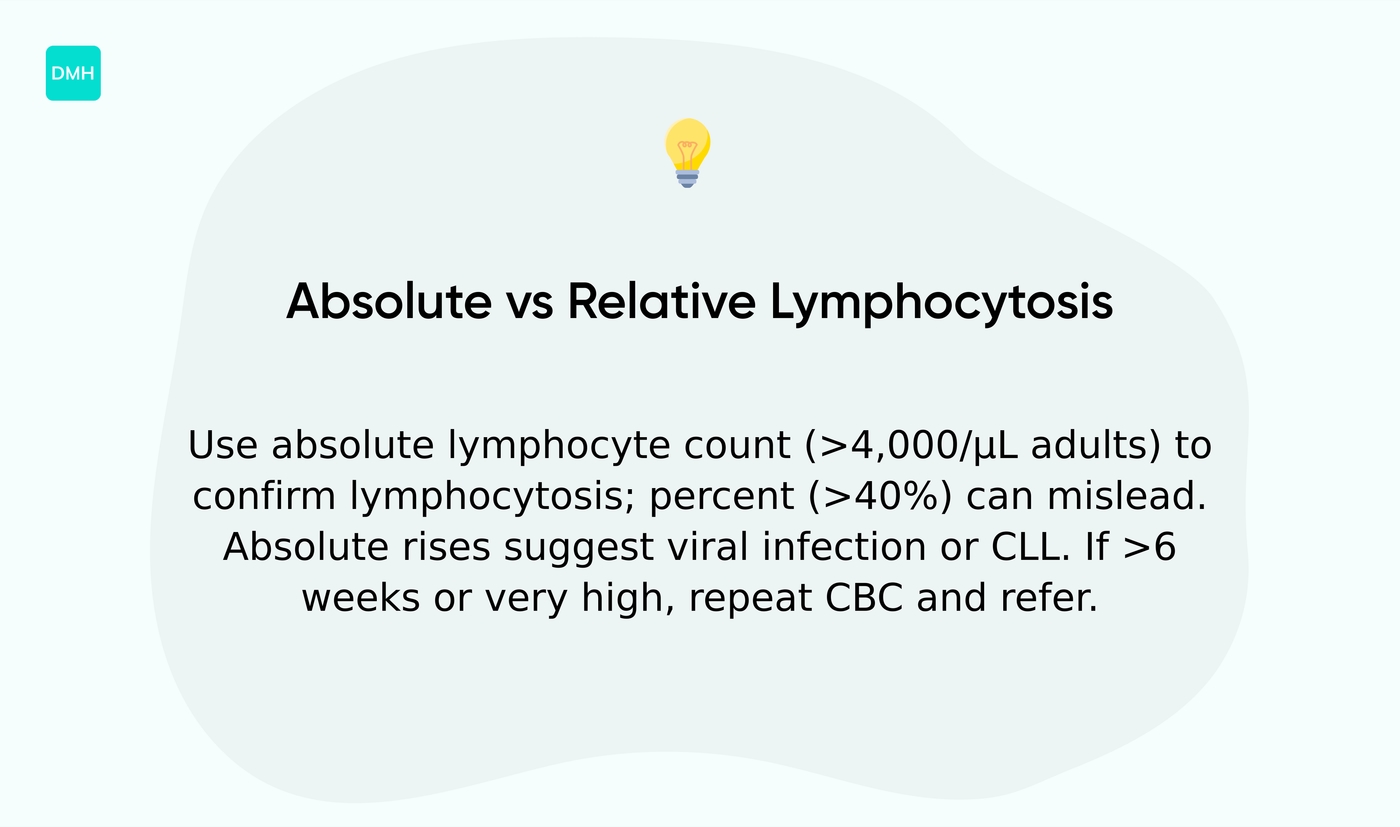
Use the absolute lymphocyte count to tell if lymphocytosis is real.
The absolute lymphocyte count gives a cell number per microliter. Values above 4,000 cells/µL in adults indicate an actual rise in lymphocytes. Labs report this as cells/µL on a CBC with differential.
Relative lymphocytosis describes a higher percentage of lymphocytes among white cells. A value over about 40% can reflect a proportion change. That can occur if neutrophils fall while lymphocytes stay normal.
What does high lymphocytes mean in a blood test? Check both measures. Absolute rise points toward viral infection, chronic lymphocytic leukemia (CLL), or other lymphoproliferative disorders. A high percentage alone often reflects shifts after bacterial infections or treatment effects.
Clinicians should focus on the absolute count first. Percentages can mislead when total white blood cell numbers change. Persistent lymphocytosis for more than six weeks or very high absolute counts should prompt further testing such as flow cytometry.
Read more on lymphocyte interpretation at lymphocyte counts.
We recommend getting a repeat CBC with differential and specialist referral if lymphocytes stay high or if you have symptoms suggestive of malignancy.
When should I worry about high lymphocytes
We recommend urgent evaluation when lymphocyte counts are very high, persist for weeks, or come with worrying symptoms.
An absolute lymphocyte count above 4,000/µL or lymphocytes over 40% of white cells signals high lymphocyte count. Persistent elevation beyond 3–4 weeks deserves specialist review and further testing.
When should you actually worry? Watch for these red flags:
- Rapidly growing or painful lymph nodes
- Unexplained weight loss or drenching night sweats
- High fevers, severe shortness of breath, or fainting
- Easy bruising, unusual bleeding, or new petechiae
- Marked fatigue or left upper-quadrant pain suggesting spleen enlargement
Seek immediate care for any of those warning signs. A single high CBC reading can reflect a recent viral infection. Persistent counts or abnormal cell shapes on a smear point to conditions like CLL or lymphoma.
Typical follow-up includes a repeat CBC in 2–6 weeks, a peripheral smear, and flow cytometry. Bone marrow biopsy and imaging follow if tests suggest a blood cancer.
You should see a hematologist for ongoing lymphocytosis, abnormal smears, or counts that climb above 5,000/µL. Read the Cleveland Clinic overview for more detail.
If you notice red-flag symptoms or persistent elevation, contact your clinician now so you get timely diagnosis and care.
What does high lymphocytes with low neutrophils indicate
High lymphocytes with low neutrophils often signal a viral or immune-driven process. We recommend medical follow-up and a repeat CBC to clarify the cause.
Viral infections raise lymphocytes while lowering neutrophils as the immune system shifts its response. Autoimmune diseases can produce the same pattern through chronic immune activation.
Certain drugs, severe stress, or bone marrow suppression may also invert the white cell ratio.
An absolute lymphocyte count above 4.0 x10⁹/L or a lymphocyte percentage over 40% suggests true lymphocytosis rather than a percent change alone. Check neutrophils in blood test for context.
Some clinicians worry about leukemia or lymphoma when lymphocytes rise and neutrophils fall. Persistent lymphocytosis, especially with abnormal cells on smear, needs hematology review and flow cytometry.
You may expect a quick answer. Most reactive cases normalize in two to six weeks after infection clears. If counts stay abnormal beyond four weeks or symptoms worsen, seek specialist evaluation and further testing.
We advise tracking symptoms and repeating blood tests. You can book an appointment with your clinician to decide on further steps.
Do high lymphocytes mean leukemia or lymphoma
We recommend investigating persistent high lymphocytes rather than assuming cancer.
Most cases reflect infection or inflammation, called reactive lymphocytosis. An absolute lymphocyte count above 4.0 x10⁹/L defines lymphocytosis in adults.
Typical adult absolute lymphocyte range runs 1.0 to 3.0 x10⁹/L. Chronic lymphocytic leukemia often shows sustained counts over 5 x10⁹/L and clonal B cells.
Smudge cells on smear and CD5-positive, CD23-positive immunophenotype point to CLL. Lymphoma may not raise blood lymphocyte levels early. PET or CT scans find lymph node disease in lymphoma.
Diagnosis needs blood smear, flow cytometry, and sometimes bone marrow biopsy. Neutrophils low, lymphocytes high can signal viral infection or marrow disorder.
Mononucleosis often causes lymphocyte percentages above 50 percent temporarily. Children normally have higher lymphocyte counts than adults. Persistent lymphocytosis means high counts for three months or more.
Repeat testing and immunophenotyping avoid misdiagnosis. You may fear any high lymphocytes equal cancer. Most cases are reactive and resolve after infection. CLL median diagnosis age is about 70 years.
Seek hematology evaluation for persistent high lymphocyte count or symptoms. Timely testing prevents unnecessary worry. Ask about immunophenotyping.
We recommend repeat CBC in six weeks and hematology referral for persistent lymphocytosis.
What tests are done for persistent lymphocytosis
We recommend a targeted diagnostic workup for persistent lymphocytosis.
Flow cytometry results identify clonal lymphocyte populations. This test tells if lymphocytes are reactive or malignant. It clarifies an absolute lymphocyte count high finding quickly.
Bone marrow biopsy evaluates marrow involvement when blood tests suggest leukemia or marrow disease. If you have persistent high lymphocytes, consult our high white blood cell count resource for context and next steps.
Imaging scans such as CT or PET look for enlarged nodes or organomegaly. They help stage suspected lymphoma or detect hidden infection sites.
Specialized blood tests include immunophenotyping, PCR for clonality, viral serologies, and autoimmune panels. These tests narrow causes from viral infection to CLL or other lymphoproliferative disorders.
- Repeat CBC with differential to confirm persistent elevation
- Peripheral blood smear to examine cell morphology
- Flow cytometry to detect clonal populations
- Viral serologies (EBV, CMV, HIV) to rule out infection
- Autoimmune panels if inflammation markers are elevated
- Bone marrow biopsy if flow cytometry suggests malignancy
- Imaging (CT, PET) to assess lymph nodes and organs
Early flow cytometry speeds diagnosis and avoids needless procedures. My experience shows targeted testing reduces repeat visits and anxiety.
You may worry about invasive tests. Targeted testing limits the scope and focuses care.
We advise you to discuss flow cytometry and specific blood panels with your clinician. Ask for follow-up CBCs and a hematology referral if lymphocytosis persists beyond several weeks.
You might also like: Granulocytes: immature cells, normal range and absolute count
How are reactive lymphocytes different from malignant ones
Reactive lymphocytes reflect a normal immune response; malignant lymphocytes indicate a cancerous clone that usually needs specialist evaluation.
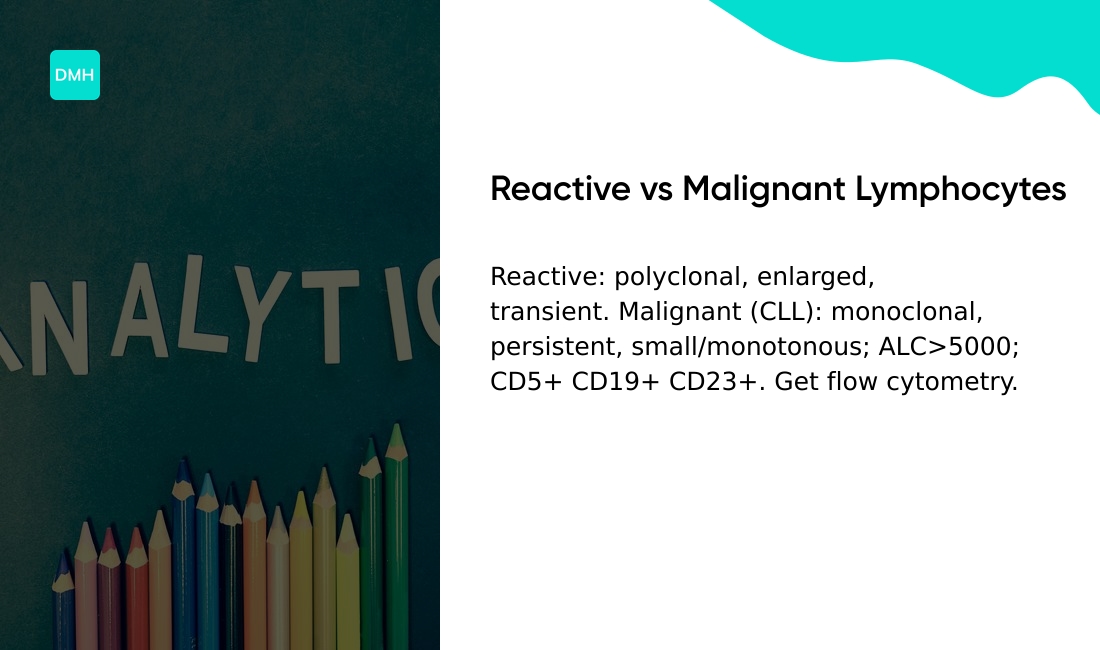
Reactive cells enlarge with abundant pale cytoplasm and open chromatin. They appear on a peripheral smear as irregular but varied cells.
Malignant lymphocytes often look small or monotonous, with dense chromatin and frequent smudge cells. In chronic lymphocytic leukemia (CLL) the absolute lymphocyte count often exceeds 5,000/µL.
Functionally, reactive lymphocytosis is polyclonal and transient. It helps clear infections and then resolves. Malignant lymphocytosis is monoclonal and persistent. The clone expands and loses normal immune roles.
Laboratory distinction uses simple and specific tests. A CBC and smear flag abnormalities. Flow cytometry shows surface markers and clonality.
CLL classically shows CD5+, CD19+, CD23+ cells. Immunoglobulin gene rearrangement PCR and cytogenetics confirm a malignant clone when needed. Bone marrow biopsy measures marrow involvement.
We advise referral if lymphocytosis persists beyond three months or the absolute lymphocyte count stays high. Ordering flow cytometry early cuts unnecessary anxiety and speeds diagnosis. If you notice persistent elevated lymphocytes, ask your clinician about immunophenotyping and hematology follow-up.
You might also like: Monocytes: low, high, absolute count and normal range, causes
How long do lymphocytes stay elevated after illness
Lymphocyte counts usually return to baseline within 2 to 6 weeks after most infections.
Mild viral infections commonly normalize in 2–4 weeks. More intense infections like mononucleosis can keep counts high for 8–12 weeks. I’ve seen lymphocyte counts remain elevated for three months after mono in some patients.
Post-infectious reactive lymphocytes reflect immune activity and often fall as symptoms clear. A repeat CBC with differential at 4–6 weeks shows improvement in most cases. If the absolute lymphocyte count stays high beyond 8 weeks, consider further evaluation.
A sustained rise suggests either ongoing immune stimulation or a chronic problem such as autoimmune disease or a lymphoproliferative disorder. Patterns including very high counts, abnormal smear morphology, or a steadily rising trend raise concern for persistent lymphocytosis or high lymphocytes leukemia like CLL.
You may worry that prolonged elevation equals cancer. Many cases are reactive and resolve. A focused workup clarifies the cause quickly.
We recommend a repeat CBC at 4–6 weeks if you had a recent infection, sooner if you have fever, weight loss, night sweats, or swollen nodes. Seek hematology referral for counts high beyond 8–12 weeks, abnormal blood smear, or flow cytometry findings.
Read also: Eosinophils: low, relative high, absolute count, normal range
Should I see a hematologist for repeated high lymphocytes
See a hematologist if your lymphocytes stay high on repeat tests or you develop worrying symptoms.
Primary care can monitor mild lymphocytosis after a viral illness with a repeat CBC in 4 to 6 weeks. Refer sooner for a high lymphocyte count above about 5,000/µL, low neutrophils with high lymphocytes, or an abnormal peripheral smear.
We recommend referral when lymphocytosis persists beyond six weeks or when counts climb over 5 x10⁹/L.
Expect targeted testing from a hematologist: flow cytometry to check for clonal cells, peripheral smear review, specific blood panels, and sometimes bone marrow biopsy or CT scans.
Early specialist input can speed diagnosis of conditions like CLL or lymphoma and ease uncertainty about reactive lymphocytes. You may worry that referral is premature. I believe timely evaluation avoids delayed treatment for serious disorders.
If repeat tests worry you or you want guidance on a dangerous white blood cell count, ask your primary doctor for a hematology referral. You should bring prior CBCs and any symptom notes to the appointment.
Read also: What Is Basophils In Blood Test
Educational notice: This content is provided for informational and educational purposes only and is not intended as medical advice. Always consult a qualified healthcare professional for medical concerns.