MCHC measures the average hemoglobin concentration inside your red blood cells.
The value shows how much hemoglobin fits into a given red cell volume.
Doctors order it to check red blood cell color and oxygen-carrying potential.
MCHC blood test appears on a standard complete blood count. Low MCHC suggests pale, under-filled cells. High MCHC points to dense or abnormal cells.
We view MCHC as a quick, useful marker for anemia screening. The test ties directly to hemoglobin and hematocrit values. Labs calculate MCHC using those two numbers. Your clinician uses the result to guide iron tests or further red cell studies.
You can read more about what a CBC covers at CBC with differential values and meanings. If you feel fatigued or notice pale skin, ask your provider to review your MCHC within the CBC panel.
So what does your MCHC number actually tell you about your health? MCHC gives a concise view of hemoglobin density inside red cells. Bring your CBC results to your appointment and ask about MCHC if you have anemia symptoms.
What are red blood cell indices and where does MCHC fit
MCHC measures the average hemoglobin concentration inside each red blood cell. It helps classify anemia and evaluate oxygen capacity.
Complete blood count reports list several key values. Labs report MCV, MCH, MCHC, and RDW as core red blood cell indices.
Here’s what each one does:
- MCV shows average cell size
- MCH reports average hemoglobin mass per cell
- MCHC gives hemoglobin mass relative to cell volume
- RDW indicates size variation across cells
Reading these together clarifies causes of abnormal results. Low MCHC with low MCV often points to iron deficiency and hypochromia. Normal MCV with high RDW and low MCHC can suggest mixed deficiencies or recent blood loss.
High MCHC suggests red cell shape or membrane issues. We recommend checking MCHC alongside MCV and RDW for a quick, useful snapshot of red cell health.
Pairing MCHC with MCV gives the clearest diagnostic hint. Use values, clinical signs, and basic iron studies to guide next steps. If you need a deeper dive, review a CBC with differential and the RDW guide linked above.
How labs calculate MCHC
MCHC measures average hemoglobin concentration inside red cells. Labs use two common formulas. (Pick the one your lab reports.)
| Method | Formula | Example Calculation |
|---|---|---|
| Hemoglobin & Hematocrit | MCHC (g/dL) = Hgb (g/dL) ÷ Hct (%) × 100 | 15 ÷ 45 × 100 = 33.3 g/dL |
| MCH & MCV | MCHC (g/dL) = MCH (pg) ÷ MCV (fL) × 100 | 30 ÷ 90 × 100 = 33.3 g/dL |
Showing both methods stops confusion. Check units before you calculate. Hemoglobin needs g/dL. Hematocrit must be percent. MCH uses picograms. MCV uses femtoliters.
Compare your result to reported MCHC levels on your lab sheet. If numbers look off or units differ, ask your clinician for clarification.
MCHC normal range and what results mean
Normal MCHC levels range from 32 to 36 grams per deciliter (g/dL). Labs may vary slightly, but most use this standard window.
What happens when your MCHC falls outside that range? Values below 32 g/dL signal low hemoglobin concentration. Values above 36 g/dL suggest concentrated or abnormal red cells.
What causes low MCHC
Low MCHC levels indicate reduced hemoglobin concentration inside red blood cells and point to hypochromia.
Common causes include iron deficiency anemia, chronic disease, thalassemia trait, ongoing blood loss, and genetic or acquired problems that impair hemoglobin synthesis. Hypochromia means red cells look paler under the microscope because they contain less hemoglobin.
If you see low MCHC alongside a low red blood cell count, review possible sources of bleeding and iron studies. Visit our page on low red blood cell count for related findings and tests.
We recommend targeted iron tests and a reticulocyte count to narrow the cause. Early identification speeds treatment and improves outcomes.
If you have fatigue, pallor, or shortness of breath, ask your clinician for CBC with indices and iron studies. Act on abnormal results promptly.
What symptoms are associated with low MCHC
Low MCHC means lower hemoglobin concentration inside red blood cells. Reduced hemoglobin lowers oxygen delivery to tissues and creates noticeable signs.
Common symptoms include:
- Fatigue — persistent tiredness and low energy
- Weakness — muscle or general lack of strength
- Pale skin — visible pallor of face or palms
- Shortness of breath — breathlessness during light activity
- Dizziness or lightheadedness
Values below 32 g/dL suggest hypochromia and often point to iron deficiency anemia or chronic blood loss. We recommend checking a CBC and ferritin when you notice these signs.
Early testing speeds diagnosis and improves treatment. If symptoms persist, see your clinician for targeted tests and treatment.
What is considered critically low MCHC
MCHC under 28 g/dL is often treated as critically low when symptoms or other lab deficits appear. Normal MCHC sits at 32–36 g/dL. Values below 32 g/dL indicate hypochromia.
MCHC below 28 g/dL raises concern for severe hemoglobin problems. Here’s when you should act fast:
- Severe anemia indicators: hemoglobin ≤7 g/dL or hematocrit ≤25%
- Seek immediate care: chest pain, fainting, rapid heartbeat, low blood pressure, or severe shortness of breath
- Lab signs that increase urgency: falling reticulocyte count, very low iron studies, or rapid hemoglobin drop
Any very low MCHC with symptoms needs prompt evaluation. I’ve seen rapid improvement after timely transfusion or iron therapy in similar cases.
We recommend urgent clinician contact for unstable vitals, same-day CBC repeat, iron studies, and hospital assessment when symptoms or low hemoglobin occur.
What causes high MCHC
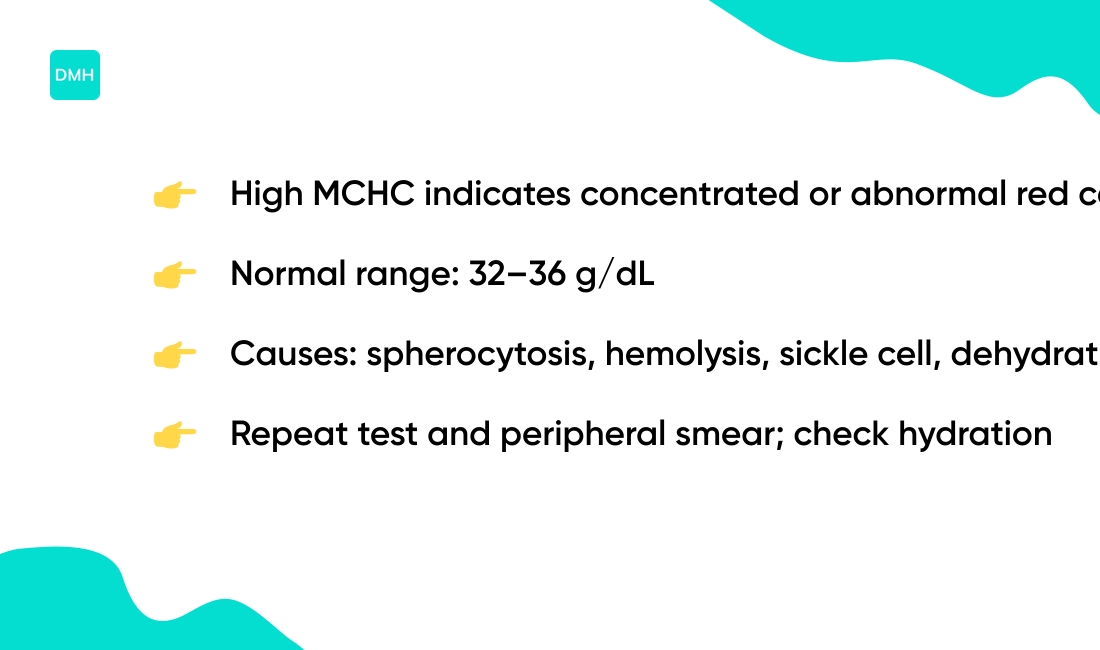
High MCHC points to concentrated or abnormally shaped red cells. Normal MCHC range runs 32–36 g/dL. Values above that show elevated MCHC levels and need evaluation.
Potential causes include:
- Red blood cells with altered shape, as in hereditary spherocytosis
- Autoimmune hemolysis
- Sickle cell disease
- Liver disease
- Hypothyroidism
- Vitamin B12 deficiency
- Lymphoma
- Dehydration
- Laboratory artifact or instrument error
We advise repeat testing and a peripheral smear to confirm results. Checking hydration first prevents false positives. If results remain high, check for underlying causes like hemolysis, thyroid disease, or B12 deficiency.
Follow up with your clinician and bring the CBC report. You can learn more about related causes, including high red blood cell count, before your visit.
Is low MCHC a sign of anemia
Low MCHC often signals hypochromic anemia. It shows reduced hemoglobin concentration inside red blood cells.
Low MCHC commonly appears with iron deficiency anemia and thalassemia trait. Chronic blood loss and some chronic illnesses can lower MCHC. Normal range sits around 32–36 g/dL.
MCHC helps classify anemia as hypochromic versus normochromic. Pair MCHC with MCV and RDW for clearer classification. A low MCHC plus low MCV strongly points toward iron deficiency or thalassemia trait.
But here’s the thing: MCHC alone lacks full reliability for detecting iron deficiency. Ferritin and transferrin saturation offer direct iron status data. Reticulocyte count and peripheral smear add useful context.
Should you rely on MCHC as your only anemia test? MCHC works best as a screening clue, not a final diagnosis. We recommend ordering iron studies when MCHC is low and symptoms or other CBC abnormalities exist.
If your report lists a low MCHC, ask for ferritin and iron studies. Discuss findings with your clinician to plan treatment. Read more about the MCHC blood test for patient-friendly details.
MCH vs MCHC: what’s the difference
MCH vs MCHC measure related but different red blood cell properties.
MCH means mean corpuscular hemoglobin and reports average hemoglobin per cell in picograms. It doesn’t account for cell volume.
MCHC means mean corpuscular hemoglobin concentration. Clinicians calculate it by dividing hemoglobin by hematocrit to show a hemoglobin concentration measure.
Example: hemoglobin 15 g/dL and hematocrit 45% gives MCHC 33.3 g/dL.
MCH helps when you want the average hemoglobin per red cell and a simple MCH blood test value. MCHC highlights hypochromia and helps flag conditions like hereditary spherocytosis, dehydration, or lab artifacts.
Low MCHC often appears with iron deficiency and shows reduced hemoglobin per cell volume. High MCHC can reflect spherocytes or measurement errors and may need further testing.
We recommend reviewing MCH, MCHC, MCV, and RDW together for a clear picture. MCHC often gives a clearer clinical signal for low hemoglobin concentration.
If your results seem off, ask your clinician to compare indices and order iron studies or a peripheral smear.
MCV and MCHC together tell you about red cell size and color. They help classify anemia quickly and point to the next tests you need.
Mean corpuscular volume (MCV) reports average cell volume in femtoliters. Normal range sits near 80–100 fL. Low MCV indicates microcytic anemia. High MCV indicates macrocytic anemia.
MCHC reports average hemoglobin concentration levels inside each cell in g/dL. Normal range is about 32–36 g/dL. Low MCHC gives hypochromia. High MCHC suggests spherocytic changes or lab artifact.
Here’s how different combinations guide diagnosis:
- Low MCV + low MCHC: classic microcytic, hypochromic anemia. Think iron deficiency or thalassemia trait. Order iron studies and a peripheral smear.
- Low MCV + normal MCHC: consider thalassemia or mixed deficiencies. Check hemoglobin electrophoresis.
- Normal MCV + low MCHC: mild hypochromia from chronic disease or early iron loss. Correlate with clinical signs.
- High MCV + normal/low MCHC: suggests macrocytic anemia from B12/folate issues despite color changes.
Reading MCV and MCHC side by side speeds diagnosis and avoids guesswork. We recommend pairing these indices with RDW, iron studies, and a peripheral smear.
If you see abnormal pairs, ask your clinician for targeted labs.
How to increase MCHC levels
You raise MCHC by correcting deficiencies, treating underlying disease, and improving red cell quality. Fixing iron deficiency produces the fastest measurable change in MCHC.
Here’s your action plan:
- Iron supplementation: Oral ferrous sulfate 325 mg delivers 65 mg elemental iron. Aim for about 100–200 mg elemental iron per day under medical guidance.
- Dietary changes: Eat heme iron sources like lean beef and liver. Add vitamin C to enhance iron absorption.
- Vitamin B12 and folate: Give 400–800 mcg folic acid daily and treat B12 deficiency with 1,000 mcg oral or intramuscular doses as directed.
- Address bleeding and chronic disease: Stop occult blood loss and treat inflammation that blocks iron use.
- Lifestyle: Limit heavy alcohol, optimize sleep, and avoid NSAID overuse to reduce bleeding risk.
Monitor response with repeat CBCs every 8–12 weeks. Aim for MCHC within the 32–36 g/dL range while tracking hemoglobin and hematocrit.
If levels stay low despite therapy, consider specialist referral and tests for thalassemia or hemoglobinopathies. See practical steps to raise hematocrit for related guidance.
Talk with your clinician about targeted testing and a tailored iron and B12 plan to normalize MCHC.
Read also: What Causes High White Blood Cell Count
How is high MCHC treated
We prioritize treating the underlying cause of elevated MCHC levels. MCHC above 36 g/dL often signals hemolysis, hereditary spherocytosis, liver disease, or dehydration.
If dehydration causes high MCHC, rehydrate with oral fluids or isotonic IV saline, commonly 1–2 liters. Repeat the MCHC blood test after 24–48 hours to confirm normalization.
Autoimmune hemolysis requires hematology evaluation. Treatments include corticosteroids, IVIG, or targeted immunosuppression to stop ongoing red cell destruction.
Hereditary red cell disorders need specific management. Folate supplements reduce marrow stress. Splenectomy may reduce hemolysis for severe hereditary spherocytosis.
Monitor treatment effectiveness with a focused panel:
- CBC and MCHC values
- Reticulocyte count
- Bilirubin, LDH, and haptoglobin
- Peripheral smear review
Check CBC every 2–4 weeks until values stabilize. After stability, schedule checks every 3–6 months to track long-term trends.
Quick reassessment and targeted therapy keep complications low and restore normal hemoglobin concentration faster. If you want guidance on managing related markers, see our guide to lower hematocrit.
You’ll also like: Is It Serious To Be Referred To A Hematologist
How is MCHC blood test performed
MCHC blood test is a quick, routine venous blood draw that labs use within a CBC to measure average hemoglobin concentration in red blood cells.
The technician ties a tourniquet, cleans your skin, and inserts a needle into a vein. Blood fills one or more tubes. The draw takes about 30 seconds to two minutes.
The lab runs the sample on an automated analyzer. Machines measure hemoglobin and hematocrit, then calculate MCHC. Example: hemoglobin 14 g/dL and hematocrit 42% gives MCHC = (14/42)×100 = 33.3 g/dL.
No special preparation is required. You don’t need to fast. Expect minimal discomfort and a brief pinch. (Mild bruising or lightheadedness can happen in some people.)
Result times vary by facility. Many clinics report CBC and MCHC within a few hours. Some reference labs take 24 to 48 hours. If your provider wants follow-up testing, they may check the MCHC in CBC against reticulocyte counts and other indices.
A simple blood draw feels routine, but you should tell staff about bleeding issues or medications that thin your blood. We recommend you ask your provider what the MCHC result means for your symptoms and next steps.
Understanding this number helps you and your clinician make clearer decisions about anemia and treatment. Check a related test for bone marrow response by viewing the reticulocyte count: reticulocyte count.
You’ll also like: What Type Of Cancer Causes Low Hemoglobin
Educational notice: This content is provided for informational and educational purposes only and is not intended as medical advice. Always consult a qualified healthcare professional for medical concerns.