An unexpected lab result can instantly shift your day from routine to worrisome.
Thrombocytosis—a higher than normal platelet count—raises questions about clotting risk and possible underlying conditions.
High platelets may be a temporary reaction to infection, iron deficiency, or surgery, or they may signal a myeloproliferative disorder that needs ongoing care.
This article outlines how thrombocytosis is diagnosed, the differences between reactive and essential forms, and treatment options from observation and aspirin to cytoreductive drugs.
You’ll learn common symptoms, key tests (like CBC with differential and JAK2 mutation screening), potential complications, and when referral to a hematologist is appropriate.
By the end you’ll feel better equipped to discuss results and treatment choices with your care team.
What is thrombocytosis
Elevated platelet count is what thrombocytosis means. Platelets are small blood cells that help clots form and stop bleeding.
Normal platelet count ranges from 150,000 to 450,000 platelets per microliter of blood, according to the NIH. Counts above 450,000 per microliter qualify as thrombocytosis.
Laboratory methods and individual factors can cause small differences in reported values. Dangerously high counts often refer to values above 1,000,000 platelets per microliter. Levels in that range may be associated with increased risk of blood clots or abnormal bleeding.
Causes of high platelet count include infections, inflammation, iron deficiency, surgery, cancer, and bone marrow disorders. Some cases resolve after the triggering condition improves.
Primary bone marrow disorders such as essential thrombocythemia involve persistent overproduction of platelets and may need long-term monitoring. For specifics on thresholds that prompt urgent care, see what level of platelets is dangerous for more detail and numeric guidelines.
Some studies suggest links between very high platelet counts and clot risk, but risk varies by cause and individual health. Not medical advice. Content for educational purposes; consult a qualified healthcare professional for advice specific to your situation.
Types of thrombocytosis
Reactive thrombocytosis
Reactive thrombocytosis describes a high platelet count driven by another condition. Platelet counts often exceed 450,000/µL. Rarely they surpass 1,000,000/µL.
Common causes include infection, inflammation, iron deficiency, cancer, and postsplenectomy. This form is also called secondary thrombocytosis and usually follows surgery or acute illness.
Reactive cases typically lack JAK2 mutations seen in essential thrombocythemia. Counts often peak within days to weeks and fall as the trigger is managed.
Monitoring uses a complete blood count, iron studies, and tests to identify inflammatory or infectious causes. Thrombosis risk is often lower than with essential thrombocythemia, though clotting or bleeding symptoms warrant evaluation.
For informational purposes only. Always consult a qualified healthcare professional for medical advice specific to your situation.
Essential thrombocythemia
Essential thrombocythemia is a chronic blood cancer that causes too many platelets. Bone marrow cells overproduce platelets, creating sustained elevation.
The condition is a type of myeloproliferative neoplasm affecting platelets. A JAK2 V617F mutation may be found in about 50–60% of cases. CALR mutations occur in roughly 20–30%, and MPL mutations are less common.
Platelet counts can exceed 1,000,000 per µL in some people, increasing clot and bleeding risks. These risks are linked to high platelet counts and variable platelet function.
Treatment focuses on lowering counts and reducing clot risk. Low-dose aspirin and cytoreductive drugs such as hydroxyurea are common choices for higher-risk patients. Long-term follow-up by a hematologist helps track progression and guide care.
Not medical advice. For informational purposes only. If you’re concerned about symptoms, consult a qualified healthcare professional for personalized evaluation.
Key differences between reactive and essential thrombocytosis
Reactive thrombocytosis refers to a temporary high platelet count due to another condition. Common triggers include infection, inflammation, iron deficiency, cancer, or postsplenectomy.
Platelet counts often fall once the trigger resolves. Essential thrombocythemia is a primary bone marrow disorder. The marrow makes too many platelets because of clonal mutations. Counts remain high without targeted long-term care.
Genetics help tell them apart. The JAK2 mutation appears in about 50–60% of essential thrombocythemia cases. CALR mutations occur in roughly 20–30%, and MPL mutations are less common. Reactive thrombocytosis lacks these driver mutations.
| Feature | Reactive Thrombocytosis | Essential Thrombocythemia |
|---|---|---|
| Cause | Secondary to infection, inflammation, iron deficiency, surgery | Primary bone marrow disorder with clonal mutations |
| Duration | Temporary, resolves with treatment of underlying cause | Persistent, requires long-term management |
| Genetic markers | Negative for JAK2, CALR, MPL mutations | JAK2 (50–60%), CALR (20–30%), MPL (less common) |
| Thrombosis risk | Lower risk unless other risk factors present | Higher risk, varies by age and history |
| Treatment approach | Address underlying trigger | Antiplatelet drugs, cytoreductive agents based on risk |
Thrombosis risk differs. Essential thrombocythemia carries a higher clot risk that can vary by age and history. Reactive thrombocytosis rarely causes clots unless other risk factors exist.
Treatment for reactive cases targets the underlying cause. Treatment for essential thrombocythemia may include antiplatelet drugs or cytoreductive agents such as hydroxyurea, based on risk assessment. For informational purposes only. Always consult a qualified healthcare professional for medical advice specific to your situation.
Causes of high platelet count
Thrombocytosis means an elevated platelet count. Normal platelet count ranges from 150,000 to 450,000 platelets per microliter according to NIH.
Counts above 450,000/µL qualify as high and risks rise as numbers climb above 1,000,000/µL. What drives your platelets up? Well, several factors can be at play:
- Reactive thrombocytosis: A temporary rise after infection. Inflammatory diseases such as rheumatoid arthritis and inflammatory bowel disease can cause elevated platelets.
- Iron deficiency thrombocytosis: Low iron can raise platelet levels. Treating iron deficiency often reduces counts.
- Essential thrombocythemia: A myeloproliferative neoplasm where bone marrow makes too many platelets. Many cases link to JAK2, CALR, or MPL mutations.
- Cancer: Solid tumors and hematologic cancers may drive a reactive platelet rise.
- Surgery and trauma: Major operations and significant blood loss can trigger a compensatory increase.
- Postsplenectomy changes: Removing the spleen commonly leads to sustained higher platelet levels.
- Medications: Some drugs, such as corticosteroids, can raise platelet counts in some people.
- Bone marrow disorders: Other marrow diseases besides essential thrombocythemia can produce elevated platelets.
Distinguishing secondary causes from a primary marrow disorder matters for management. Clinicians may order repeat complete blood counts, inflammatory markers, iron studies, JAK2 testing, or bone marrow biopsy to identify the cause.
For informational purposes only. Always consult a qualified healthcare professional for medical advice specific to your situation.
Thrombocytosis symptoms
Thrombocytosis means an elevated platelet count in the blood. Normal platelet counts range from 150,000 to 450,000 platelets per microliter.
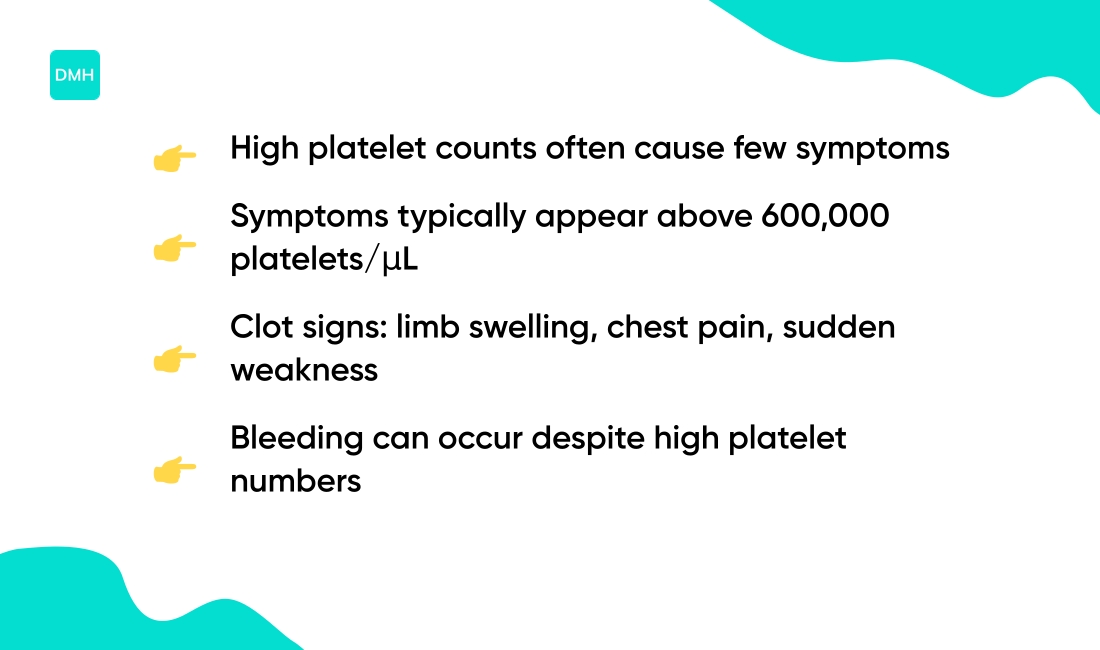
Symptoms often appear as counts rise above about 600,000 per microliter and can become more noticeable over 1,000,000 per microliter, according to NIH sources. Actually, many people don’t notice anything until levels get quite high.
- Elevated platelets warning: Headaches and lightheadedness may occur. Some people report episodes of dizziness or fainting.
- Blood clot symptoms: Sudden limb swelling, pain, warmth, or redness can signal a deep vein clot. Shortness of breath, chest pain, sudden severe headache, slurred speech, or weakness may indicate a clot in the lung or brain and require urgent evaluation.
- Bleeding complication signs: Nosebleeds, gum bleeding, heavy menstrual bleeding, or easy bruising can happen despite high platelet numbers. Platelets may not function normally even when counts are high.
- Vision changes and transient numbness can appear with microvascular symptoms. Fatigue and generalized weakness may be present and deeply affect daily life.
Reactive thrombocytosis often causes milder, temporary symptoms linked to infection or inflammation. Essential thrombocythemia may cause persistent symptoms and a higher clot risk due to bone marrow cell changes such as JAK2 mutations.
For informational purposes only. Always consult a qualified healthcare professional for medical advice specific to your situation.
How thrombocytosis is diagnosed
Diagnosis begins with a blood test. Clinicians order a complete blood count with differential to confirm a high platelet count.
Normal platelet count range is about 150,000–450,000/µL. Counts above this range suggest thrombocytosis. But here’s the thing—one high reading isn’t always enough.
Lab review includes a blood smear examination. Microscopy checks platelet size and shape. The smear helps distinguish reactive thrombocytosis from a myeloproliferative disorder.
Genetic testing follows when primary causes are suspected. Tests look for the JAK2 mutation, CALR, and MPL changes. Some studies suggest the JAK2 mutation appears in roughly half of essential thrombocythemia cases.
Bone marrow evaluation supports diagnosis of a marrow disorder. A bone marrow biopsy shows platelet-producing megakaryocytes and marrow fibrosis. Pathology helps classify essential thrombocythemia or other myeloproliferative neoplasms.
Workup for reactive causes identifies underlying drivers. Tests may include iron studies, ferritin, CRP or ESR, infection screens, liver function, and cancer screening when indicated. Recent surgery or splenectomy history can explain a transient rise.
Clinicians combine lab results, genetic tests, and clinical history to decide on monitoring or referral to a hematologist. Thrombosis risk assessment often guides urgency of follow-up. Not medical advice. For informational purposes only. Always consult a qualified healthcare professional for medical advice specific to your situation.
Complications and risks of elevated platelets
Thrombocytosis means a high platelet count. Platelets help blood clot. Too many platelets can cause problems.
Thrombosis risk rises with elevated platelets. Platelets can form clots in arteries or veins. Some cohort studies report a 1–3% annual risk of thrombosis in patients with essential thrombocythemia.
Older age and a prior clot raise that risk. JAK2 mutation status also correlates with higher clot rates, according to hematology studies. Does your mutation status matter? Research suggests it does.
Bleeding complications can occur despite high platelets. Very high counts may cause acquired von Willebrand syndrome. That condition impairs clotting and can lead to mucosal bleeding. Some research links platelet counts above 1,000 x10^9/L with measurable bleeding risk.
Pregnancy complications include miscarriage, placental problems, and preeclampsia. Pregnancy registries and small studies show varied rates, often influenced by underlying cause and management. Close monitoring by obstetric and hematology teams is often advised for people with thrombocytosis in pregnancy.
Progression risks exist for essential thrombocythemia. Long-term studies report development of myelofibrosis in roughly 5–15% over many years. Transformation to acute leukemia remains uncommon, usually under 5% in published series.
Monitoring helps guide care. Lab trends, mutation testing, and symptom review inform risk assessment. Not medical advice. For informational purposes only. Always consult a qualified healthcare professional for medical advice specific to your situation.
Thrombocytosis treatment options
Aspirin therapy for high platelets
Low-dose aspirin therapy may lower platelet stickiness. It can reduce blood clot risk in some people with thrombocytosis.
Thrombocytosis means a high platelet count. Values above 450,000 per microliter often define the condition. Guidelines target essential thrombocythemia for aspirin consideration. Age over 60, prior thrombosis, or JAK2 mutation raise risk.
Reactive thrombocytosis often resolves when the underlying cause improves. Aspirin for high platelets rarely applies when elevation is transient.
Monitoring uses regular complete blood counts to follow platelet trends. Clinicians may repeat CBC every few months during stable therapy. Watch for bleeding signs, new bruises, or black stools. Counts above 1,000,000/µL may associate with platelet dysfunction and bleeding.
Evidence comes mainly from observational studies with varied sizes. Hematology guidelines, including the American Society of Hematology, inform decisions. For informational purposes only. If you’re concerned, consider speaking with a qualified healthcare professional for individualized advice.
Medications to lower platelet count
Hydroxyurea for ET remains the long-standing therapy for essential thrombocythemia. It commonly lowers platelet counts and is associated with reduced clot risk in many patients.
Clinicians monitor blood counts for low white cells or anemia. Decades of use provide a substantial safety profile from observational studies.
Anagrelide alternative option offers targeted platelet reduction when hydroxyurea isn’t suitable. It can lower platelet counts within weeks. Side effects may include headache, palpitations, or fluid retention, and clinicians weigh benefits against tolerability.
Ropeginterferon for high-risk shows promise in recent trials. A 2026 global study reported by Wake Forest found that ropeginterferon alfa-2b demonstrated better control of essential thrombocythemia, improved blood counts, fewer symptoms, and fewer serious complications compared to anagrelide in high-risk patients who can’t tolerate hydroxyurea.
The FDA has accepted an application to expand approval for this drug, with a review expected to be completed by August 30, 2026. Some studies suggest sustained platelet control and potential disease modification in certain high-risk patients.
Not medical advice. For informational purposes only. Always consult a qualified healthcare professional for medical advice specific to your situation.
Plateletpheresis procedure
Plateletpheresis is an emergency apheresis used to rapidly lower platelet levels in thrombocytosis. It removes platelets from blood and returns the remaining components to the body.
This procedure is considered when patients have a high platelet count often above 1,000 x109/L (about 1,000,000/µL) and show severe symptoms or signs of thrombosis or bleeding caused by dangerously high counts.
Blood passes through a centrifuge or separator. The machine can rapidly remove excess platelets into a collection bag. Sessions usually last one to three hours. Central venous access may be needed for large-volume sessions.
Plateletpheresis can lower counts within hours and reduce acute thrombosis risk in patients with extreme elevation, including reactive thrombocytosis or essential thrombocythemia. Risks include bleeding, citrate reaction, and line complications. For informational purposes only. If you’re concerned about symptoms, consult a qualified healthcare professional for advice specific to your situation.
Treating underlying causes of reactive thrombocytosis
Reactive thrombocytosis, a form of secondary thrombocytosis, follows iron deficiency, infection, inflammation, surgery, or trauma. Normal platelet count ranges from 150,000 to 450,000 per µL.
Counts above 450,000 per µL indicate elevated platelets. Iron deficiency can raise counts to 500,000–700,000 per µL in some people.
Reactive thrombocytosis causes focus on finding and addressing the trigger:
- Iron replacement for iron deficiency may reduce platelet production over weeks.
- Managing inflammatory disease with appropriate medical care can lower platelet counts.
- Treating infections often leads to rapid normalization of platelet levels.
- Addressing post-surgical or trauma-related elevations through monitoring and supportive care.
Managing inflammatory conditions requires collaboration with clinicians. Collaboration helps target the underlying condition and monitor blood counts.
Monitor platelet recovery after surgery or trauma. Repeat complete blood counts every few weeks until counts return to range. Persistent high platelets beyond three months may prompt hematology referral. Testing for JAK2 mutations can help exclude primary causes.
For informational purposes only. Always consult a qualified healthcare professional for medical advice specific to your situation.
You might also like: Leukocytosis: definition, causes, symptoms and treatments
Special populations with thrombocytosis
Thrombocytosis in pregnancy: Platelet counts normally range 150,000–450,000/µL. Counts above 450,000/µL define thrombocytosis.
Pregnant individuals with elevated platelets may need more frequent CBC checks. Some studies suggest higher platelets may be associated with increased clot risk and pregnancy complications. Persistent counts above 1,000,000/µL often prompt specialist input.
Monitoring plans vary by risk factors and fetal status. Professional guidance from sources such as NIH and obstetric societies informs care.
Pediatric thrombocytosis: Reactive thrombocytosis is common after infections or iron deficiency. Platelet counts in children can exceed 1,000,000/µL and still normalize within weeks.
True myeloproliferative causes, including JAK2 mutation, are uncommon in childhood. Clinicians usually focus on identifying triggers and watching trends. Neonatal platelet patterns differ from older children and require age-appropriate interpretation.
Postsplenectomy thrombocytosis: Platelet rise typically peaks 1–3 weeks after spleen removal. Counts can surpass 1,000,000/µL in some patients. Most platelet elevations decline over months, sometimes up to a year.
Early monitoring often occurs weekly. Follow-up may shift to monthly while clinicians watch for thrombosis signs. Evidence derives from surgical series and observational studies.
Reference the hematology appointment guide for visit expectations and test planning. For informational purposes only. Always consult a qualified healthcare professional for medical advice specific to your situation.
You’ll also like: What Causes High White Blood Cell Count
When to see a hematologist for high platelets
Referral to a hematologist helps clarify causes of elevated platelet counts and guides care for complex cases. Normal platelet count ranges from 150,000 to 450,000 per microliter.
Platelet levels above 450,000 per microliter define thrombocytosis. Counts above 1,000,000 per microliter may need urgent evaluation. When should you pick up the phone? Consider these scenarios:
- Persistent platelet elevation on repeat complete blood counts over weeks to months.
- Suspected essential thrombocythemia with very high counts, spleen enlargement, or positive JAK2/MPL/CALR testing.
- Unusual blood test patterns such as rising platelet trends, concurrent anemia, or high white blood cell counts.
- Symptoms that suggest clotting or bleeding, including leg swelling, sudden chest pain, focal neurologic signs, or easy bruising.
- Need for specialized diagnostic testing like JAK2 mutation analysis or bone marrow biopsy.
- Planning long-term treatment or rapid platelet reduction using cytoreductive drugs or plateletpheresis.
- Questions about why a referral matters. Read more about being referred to a hematologist for context.
Hematology evaluation often includes a blood smear, molecular testing, and a treatment discussion based on individual risk. Plus, they can help you navigate the complexities of long-term monitoring and care.
Not medical advice. For informational purposes only. Consult a qualified healthcare professional for advice specific to your situation.
You might also like: High White Blood Cell Count: Causes, Symptoms and more
Educational notice: This content is provided for informational and educational purposes only and is not intended as medical advice. Always consult a qualified healthcare professional for medical concerns.