A tooth infection is a bacterial invasion that destroys tooth tissue and can spread to gums and bone.
It often creates a pocket of pus that causes sharp pain and swelling.
Common causes include tooth decay, gum disease, and dental trauma.
Cavities let bacteria reach the tooth pulp, while gum disease lets bacteria enter the tissue around the root.
A cracked tooth lets microbes pass through enamel.
What is a tooth infection and what causes it
Well, let’s break down what you’re dealing with. Tooth infection causes include untreated cavities, advanced gum disease, and fractured teeth. Typical bacteria are anaerobic streptococci and gram-negative rods that thrive without oxygen.
Signs you shouldn’t ignore? Severe tooth pain, visible swelling, fever, bad taste or drainage, and swollen lymph nodes. Pain may worsen when chewing or lying down. (Honestly, nighttime tooth pain is the worst!) Pus drainage can reduce pain temporarily but signals ongoing infection.
We advise prompt dental care for any abscess. Quick treatment cuts the risk of spread to the jaw and bloodstream. You can use home measures for short relief, but they don’t remove the infected tissue.
If you suspect an abscess, see your dentist within 24 to 48 hours or seek urgent care for rapid swelling or breathing trouble. Early drainage or root treatment prevents larger problems and limits the need for strong antibiotics.
Do natural antibiotics work for tooth infections
Natural antibiotics ease symptoms but can’t cure the root cause of a tooth infection.
Lab studies show compounds like allicin, eugenol, carvacrol and curcumin kill many oral bacteria in controlled tests. Those results suggest natural antibiotic options can lower bacterial counts and reduce pain for hours.
Here’s the thing: clinical limits matter. An abscess sits inside bone or deep tissue. Topical remedies rarely reach that pocket. Dental procedures such as drainage or a root canal remove the infection source. Prescribed antibiotics target spread and lower systemic risk.
Garlic ranks highest among herbs for antibacterial power. Salt water rinses, clove oil and manuka honey offer short-term comfort. Use them as a stopgap while you arrange dental care.
For a rounded summary of strongest choices, check out Hello Family Dental’s guide. Always use safe dilutions and avoid swallowing concentrated oils.
We recommend urgent dental evaluation for swelling, fever, spreading redness or trouble breathing. If you have severe pain or systemic signs, seek emergency care right away. For mild pain, follow a dentist-approved plan and treat remedies as temporary tooth infection relief.
Top natural antibiotics for tooth infection
Garlic – the strongest natural antibiotic
Garlic is the strongest natural antibiotic for many tooth infections. What’s the secret behind its power?
Its active molecule, the allicin compound, kills oral bacteria and reduces biofilms. Lab studies show low MICs for common oral strains, often under 100 µg/mL. This makes garlic one of the most effective natural antibiotics for tooth infection.
To use garlic for tooth infection, follow this simple method. Peel 1 clove and crush fresh garlic into a paste. Let the paste sit 10 minutes to activate allicin.
Apply to the gum or tooth with a cotton swab for up to 10 minutes. You can gently chew for effectiveness one clove for 1 minute. (Yes, the taste is strong, but it works!)
We recommend garlic for short-term relief. Crushed garlic eases pain quickly but it doesn’t cure abscesses. See a dentist for draining, antibiotics, or root canal if swelling or fever appear.
Clove oil for toothache and infection
Eugenol in clove oil kills bacteria, numbs pain, and reduces inflammation. Simple dilution makes the oil effective and safer for oral use.
Here’s how to apply it properly:
- Wash hands and prepare a cotton swab.
- Mix 1 drop clove oil with 1 tsp (5 ml) carrier oil such as olive or coconut.
- Soak the swab and press it against the sore tooth or gum for up to 10 minutes.
- Repeat every 2–3 hours while you arrange dental care.
Don’t swallow. Stop if you feel burning or severe irritation. Seek urgent dental care for fever or spreading swelling.
Check out our guide on how to stop tooth pain fast for additional pain-control options.
Turmeric for tooth infection relief
Turmeric reduces bacterial load and eases gum inflammation around an infected tooth. Curcumin has antimicrobial action and acts as a natural anti-inflammatory agent.
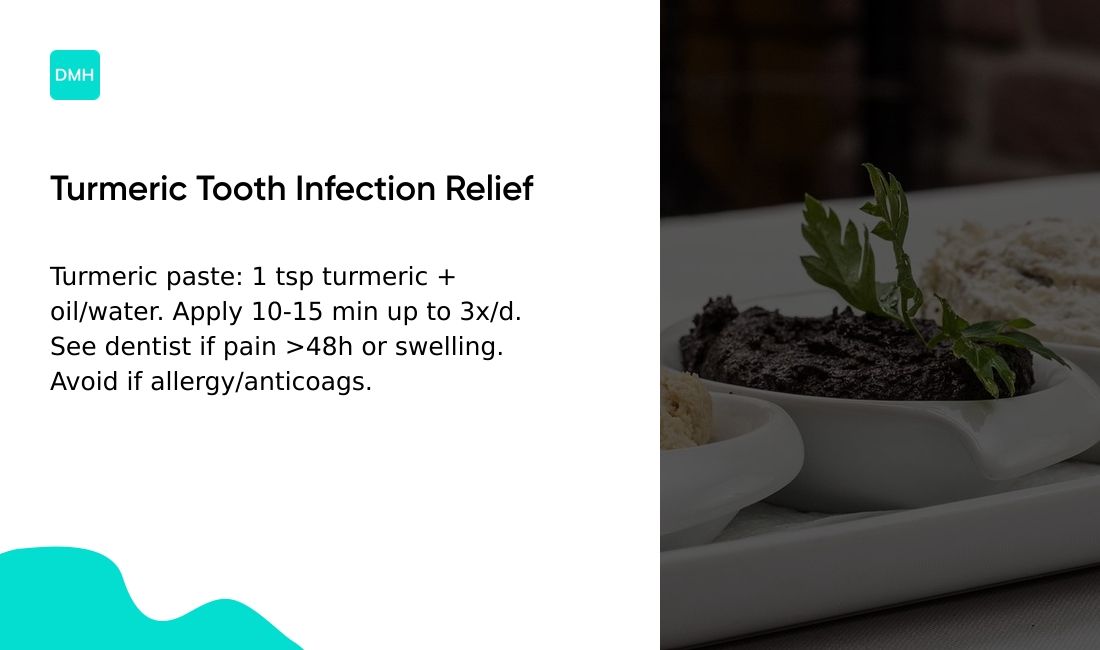
Make a paste by mixing 1 tsp turmeric with a few drops of water or 1 tsp coconut oil. Apply the paste directly to the infected tooth or gums for 10 to 15 minutes. Rinse gently with warm water.
Repeat up to 3 times a day. We recommend turmeric paste for temporary relief. Use it only until you can see a dentist.
Evidence includes lab studies on curcumin and patient reports. Avoid use if you have an allergy or take blood thinners. See a dentist if pain lasts beyond 48 hours or swelling spreads.
Oregano oil antibacterial properties
Oregano oil can reduce oral bacteria when used safely. Carvacrol and thymol break bacterial cell membranes, disrupt metabolism and curb fungal growth.
Lab tests show strong activity against common oral strains. You can use oregano oil as one of several natural antibiotics for tooth infection symptoms.
Proper dilution ratios: mix 1 drop oregano oil into 1 teaspoon (5 mL) olive or coconut oil for about a 1% dilution. Apply with a cotton swab to the gum or aching tooth. Don’t swallow. Repeat up to 2 times per day for 48–72 hours.
Oregano oil offers short-term relief for mild infections. Stop use and see your dentist if pain, swelling, or fever appear.
Tea tree oil for gum infections
Tea tree oil can reduce bacteria and ease gum infection when used correctly. The oil contains terpinen-4-ol, a compound with proven antimicrobial and anti-inflammatory action.
Mix 1–2 drops in 8 oz (240 ml) of water for a mouthwash. Swish 30 seconds and spit. Never apply undiluted oil to gums. Do a patch test on skin first to check for allergy.
Avoid swallowing. Keep away from children and pets. Stop use if you notice burning or swelling.
Clinical trials report lower plaque and less gingival inflammation with regular, diluted use. We recommend tea tree oil as an adjunct to professional care, not a replacement.
It helps mild cases when paired with good brushing and flossing. For tips to improve gum health, read our guide.
Additional home remedies for tooth abscess
Salt water rinse for tooth infection
Salt water rinses clean infected areas and ease symptoms, but they’re not antibiotics. If you search for the strongest natural antibiotic for tooth infection, salt ranks lower than garlic and clove oil.
We recommend this rinse as a first aid step while you arrange dental care. It reduces swelling and soothes pain fast.
A salt water rinse works by osmosis and gentle washing. It softens pus and draws out infection from gum pockets. It lowers bacterial load and calms inflamed tissue.
Mix 1/2 to 1 teaspoon salt in 8 oz (240 ml) warm water. Swish gently for 30 seconds. Spit. Repeat 3 times daily and after meals.
See how long salt water heals gums for typical timelines. Don’t rely on this as your only treatment. See a dentist for fever, spreading swelling, or worsening pain.
Manuka honey for dental abscesses
Manuka honey fights bacteria with methylglyoxal (MGO), low pH, and high sugar osmolarity. MGO levels run about 100–800 mg/kg and UMF 10+ or MGO 100+ shows reliable antibacterial action against oral pathogens.
It soothes inflammation and helps tissue repair in oral wounds. Use it as one of the natural antibiotics for tooth infection for short-term relief while you arrange dental care.
We recommend a UMF 10+ jar for mouth use. Apply 1/2 tsp with a sterile cotton swab to the abscess site. Leave 10–20 minutes and then spit. Do this twice daily for up to 3 days while you wait for professional care.
Manuka is more effective than regular honey because of measurable MGO. If you have fever, spreading swelling, or severe pain, see a dentist immediately. Manuka helps, but it’s not a full substitute for dental treatment.
Hydrogen peroxide rinse
We recommend a 1.5% hydrogen peroxide mouth rinse for short-term bacterial control and symptom relief.
Mix one part 3% hydrogen peroxide with one part water to reach 1.5%. For sensitive tissue mix one part 3% with two parts water for about 1%. Rinse for 30 seconds and spit. Use twice daily while you arrange dental care.
Proper dilution ratios matter. Hydrogen peroxide kills bacteria by oxidation on contact and lowers bacterial load. It can aid tooth infection home remedies as a temporary measure but it doesn’t replace antibiotics or dental procedures.
Safety and limits: Don’t swallow the rinse. Stop at any burning, lasting irritation, or white patches. Avoid prolonged daily use to prevent mucosal damage.
Rinse 30 seconds, 2 times per day, for no more than 7 days without dental follow-up. Hydrogen peroxide serves as an antiseptic, not a cure. It helps as a stopgap while you get professional care.
How to treat a tooth infection naturally at home
You can use natural remedies to reduce pain and slow bacterial growth while you wait for dental care. Follow a clear, safe protocol using antiseptics, topical pain relief, and supportive rinses.
| Remedy | Method | Frequency |
|---|---|---|
| Salt water rinse | Mix 1/2 tsp salt in 8 oz warm water, swish 30 seconds | Every 3 hours |
| Garlic | Crush one fresh clove, apply to sore tooth 10–15 minutes | Twice daily |
| Clove oil | Mix 1 drop with 1/2 tsp carrier oil, dab on gum | Up to 3 times daily |
| Turmeric paste | Mix 1/2 tsp turmeric with coconut oil, apply 5–10 minutes | Twice daily |
| Oregano oil | Dilute 1 drop in 1 tsp carrier oil for spot use | Once or twice daily |
| Tea tree mouthwash | Add 3 drops to 8 oz water, swish 30 seconds | Once daily |
| Manuka honey | Apply small amount to abscessed area after rinsing | Once or twice daily |
| Hydrogen peroxide | Mix 1 part 3% H₂O₂ with 3 parts water, swish 30 seconds | Once daily for 2–3 days |
If pain wakes you at night, read our guide on how to sleep with toothache for practical tips.
Which remedy works fastest for you? Garlic ranks highest for short-term antibacterial action. Plus, it’s probably already in your kitchen!
We recommend seeing a dentist within 48 hours for swelling, fever, spreading pain, or any sign of systemic infection. If symptoms worsen, seek emergency care immediately.
When should I see a dentist instead of using natural remedies
Seek professional care for warning signs of a spreading dental infection right away. Actually, some symptoms need immediate attention:
- Severe swelling of the face or neck that grows fast
- Fever above 101°F or chills with tooth pain
- Difficulty swallowing or speaking
- Spreading infection that moves beyond the tooth or gum
- Breathing trouble, uncontrolled pain, or persistent pus drainage
These signs can mean the infection entered soft tissue, jaw bone, or the bloodstream. Spread can lead to sepsis, airway compromise, or osteomyelitis that needs hospital care and IV antibiotics. (Not something you want to mess around with!)
Knowing what is the strongest natural antibiotic for tooth infection helps you ease symptoms. Natural antibiotics like garlic, clove oil, or manuka honey can reduce bacteria briefly. But they can’t remove pus, drain an abscess, or fix a dead nerve.
A dentist must drain, perform a root canal, or extract the tooth to stop spread. Learn typical timing for how long a root canal takes.
If you see any warning sign, call your dentist or go to the emergency room now. While you wait, rinse with warm salt water, avoid placing substances deep in the socket, and use OTC pain relief per label. Get professional care to prevent serious complications.