Mean platelet volume measures the average platelet size in femtoliters (fL).
Labs list it as part of a complete blood count.
We explain how MPV relates to platelet function and production.
MPV blood test captures size differences that imply platelet age. Larger platelets tend to be younger and more active, while smaller platelets tend to be older or underproduced.
MPV units use fL. Common lab references sit near 7.5–11.5 fL, though some labs report 7–12 fL for adults. A 2011 study of 326 healthy adults found 95% had MPV between 7.2–11.7 fL, with a mean of 8.9 fL.
High MPV values above 11.5–12 fL suggest increased platelet production or destruction. Low MPV values below about 7.5 fL suggest impaired marrow production. Always pair MPV with platelet count and platelet distribution width (PDW) for proper interpretation.
I’d say that MPV gives quick, practical clues about platelet health. Use it alongside symptoms and other CBC indices to guide next steps.
The MPV normal range helps screen for thrombocytopenia and thrombocytosis risks, inflammation, and marrow disorders. Review abnormal results with your clinician. Learn more about CBC values at CBC with differential values and meanings.
MPV normal range and reference values
We present standard numbers you can use when reviewing MPV results.
MPV normal range in many labs spans 7.2–12 fL. Common lab references list 7.5–11.5 fL or 7–12 fL for adults. That 2011 study reported a 95% range of 7.2–11.7 fL with no major age or sex differences.
Mean platelet volume varies by age, sex, ethnicity, and the hematology analyzer used. Children often show slightly higher MPV. Older adults may show lower values. Different lab equipment shifts readings by about 0.2–0.8 fL on average.
Here’s the thing: interpret MPV with the platelet count and platelet distribution width (PDW). Low platelets plus low MPV points toward reduced production. High MPV with low platelets suggests increased destruction or rapid production.
MPV units fL appear on your CBC report next to platelet count. For patient-friendly detail, see the Cleveland Clinic MPV blood test page.
Treating MPV as a lone value leads to misinterpretation. Use trends, the full CBC, and clinical context to decide next steps.
| MPV Category | Range (fL) | Clinical Implication |
|---|---|---|
| Low MPV | Below 7.5 | Impaired marrow production |
| Normal MPV | 7.2–12 | Typical platelet size and function |
| High MPV | Above 11.5–12 | Increased production or destruction |
The MPV reference range helps flag abnormalities, but your lab report and clinician provide final interpretation.
What does a high MPV indicate?
Common causes of high MPV levels
Mean platelet volume reflects average platelet size on your CBC. Labs report MPV in fL; values above 11.5–12 fL suggest high MPV.
- Immune thrombocytopenia (ITP) drives marrow to release young, large platelets. Studies show MPV around 10–12 fL in ITP.
- Bleeding events prompt rapid platelet production and raise MPV on the MPV blood test.
- Inflammation increases platelet turnover and lifts MPV levels.
- Diabetes and cardiovascular risk link to higher MPV and worse outcomes. For example, small rises of 0.5–1 fL have correlated with higher heart attack and stroke risk in cohort studies.
- Platelet destruction from immune or mechanical causes forces release of larger platelets.
We watch MPV in CBC alongside platelet count and PDW. Cross-check for low counts on the page about dangerous platelet levels.
Pairing MPV results with platelet count gives the clearest clinical picture for follow-up and testing.
Symptoms of high MPV
We see people flagged after an MPV blood test and feel the need to clarify common signs. Clear, simple guidance reduces anxiety and helps you act.
- Frequent clots in legs or lungs, causing pain or sudden breath shortness.
- Bleeding tendencies such as easy bruising, gum bleeding, or nosebleeds.
- Headaches and fatigue that persist without other clear causes.
- Chest pain or unexplained weakness during activity.
- Recurrent minor infections or slow recovery after injury.
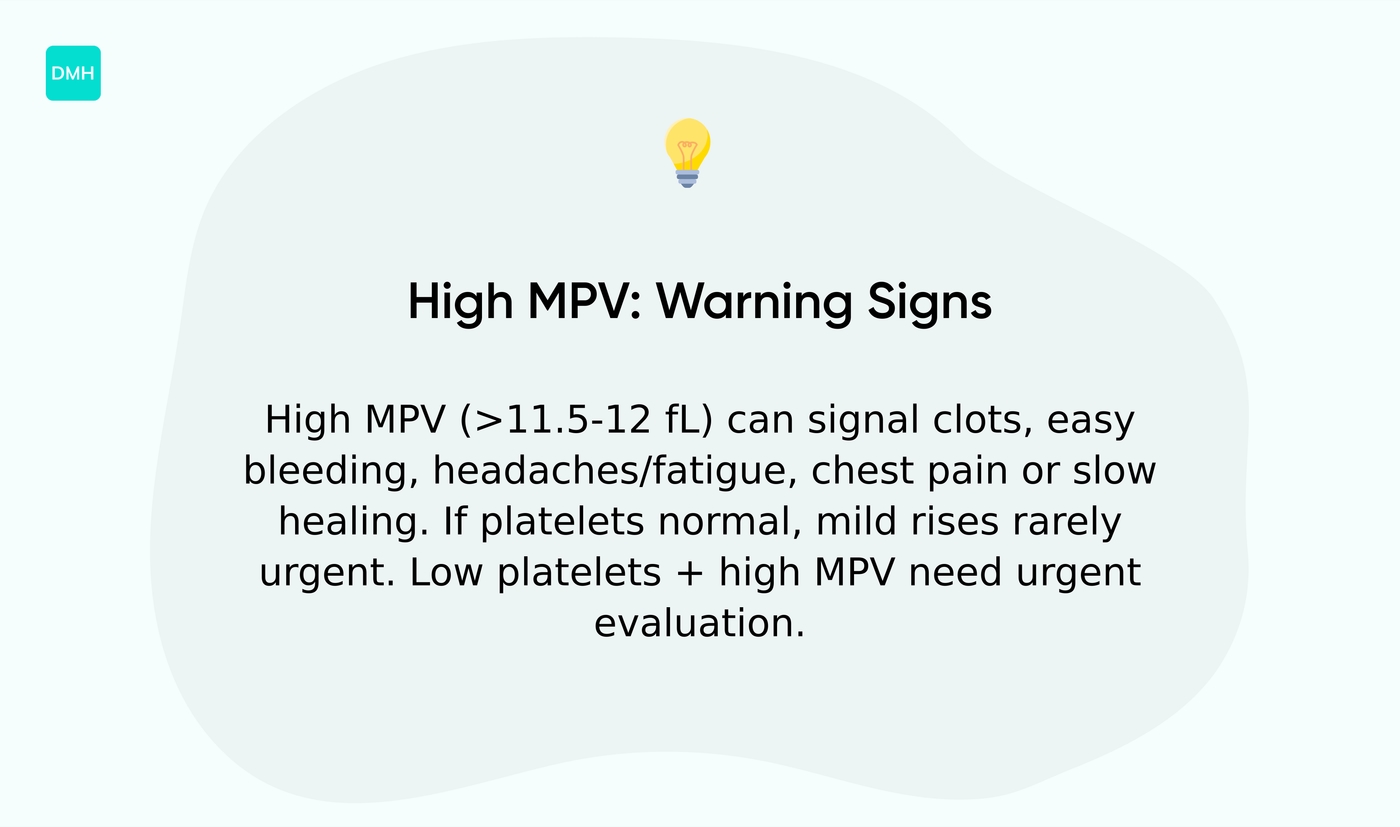
MPV above 11.5–12 fL is often called high. Mild MPV elevations without symptoms rarely require urgent action when platelet count is normal.
A low platelet count with high MPV suggests increased platelet destruction and needs prompt evaluation. Track MPV trends and share results with your clinician for proper interpretation.
Why is my MPV high but platelet count normal?
We show that a high mean platelet volume with a normal count reflects platelets trading number for size.
MPV measures average platelet size in fL. Labs report an MPV clinical significance around 7.2–12 fL. A value above 11.5 fL often reads as high MPV.
An inverse relationship exists between MPV and platelet count. The body keeps total platelet mass fairly stable, so larger platelets can appear while overall count stays in range.
Common reasons include inflammation that speeds production and an early bone marrow response after loss. Young platelets are bigger and more active. You may see normal platelets on an MPV blood test despite a high MPV.
Actually, the trend matters more than one isolated result. Check PDW and past CBCs.
Repeat testing in one to two weeks and talk to a hematologist if you have bleeding or clotting symptoms. Platelet count normal readings paired with high MPV need context, not panic.
What does a low MPV indicate?
Common causes of low MPV levels
Low mean platelet volume signals smaller platelets. Your MPV on a CBC helps assess platelet production and turnover.
- Bone marrow suppression from toxins, infections, or marrow disorders reduces platelet size and count.
- Aplastic anemia destroys marrow precursors and yields low MPV with low platelets.
- Chemotherapy effects blunt megakaryocyte output and lower MPV.
- Inflammatory bowel disease links to reduced MPV in some studies.
- Hypoproliferative thrombocytopenia shows MPV near 9 fL in research and often pairs with low platelets.
We advise repeating the MPV blood test if values fall below the MPV normal range.
An MPV around 9 fL with low platelets warrants marrow evaluation. If your clinician refers you, read about being referred to a hematologist.
Low MPV and platelet count relationship
We treat the MPV value as a diagnostic hint rather than a stand-alone answer.
Mean platelet volume below about 7.5 fL combined with a platelet count under 150,000/µL strengthens suspicion for bone marrow hypoproduction. Small platelets plus low numbers point toward aplastic anemia, marrow infiltration, or chemotherapy effect. Lab noise alone rarely produces both findings.
For clinical evaluation, you should confirm the CBC and rule out pre-analytical error. Order a peripheral smear, check platelet distribution width and immature platelet fraction. Review medications, recent infections, B12 and folate, liver tests, and viral serologies.
If cytopenia persists after repeat testing, arrange a bone marrow biopsy to define marrow cellularity and cause. In my opinion, a timely peripheral smear and IPF test reduce unnecessary biopsies.
Your MPV blood test matters most when interpreted with platelet count, PDW, and clinical context.
You might also like: How To Lower Hematocrit – Dailymedicalhealth
Symptoms of low MPV
We explain mean platelet volume and the common signs linked to low MPV.
Low MPV reflects smaller platelet size and often lower platelet production in the bone marrow. You may feel persistent fatigue and weakness. Easy bruising appears without clear injury.
You may spot tiny red dots on the skin called petechiae. Heavy or prolonged bleeding from cuts or menstrual flow signals increased bleeding risk. Nosebleeds and gum bleeding matter too.
Have you noticed any unexplained bruising or excess bleeding lately? Track low MPV symptoms such as fatigue, unexplained bruising, and excess bleeding. Your clinician will review MPV results with platelet count and platelet distribution width for accurate MPV interpretation.
Early follow-up after a low MPV blood test helps identify causes like marrow suppression or thrombocytopenia. Seek urgent care for severe bleeding or sudden fainting. Timely medical evaluation necessary improves diagnosis and guides treatment.
You’ll also like: How to Raise Hematocrit: Natural techniques & Measurements
How to interpret MPV results on a CBC
We break MPV reading into clear, actionable checks so you can understand your report fast.
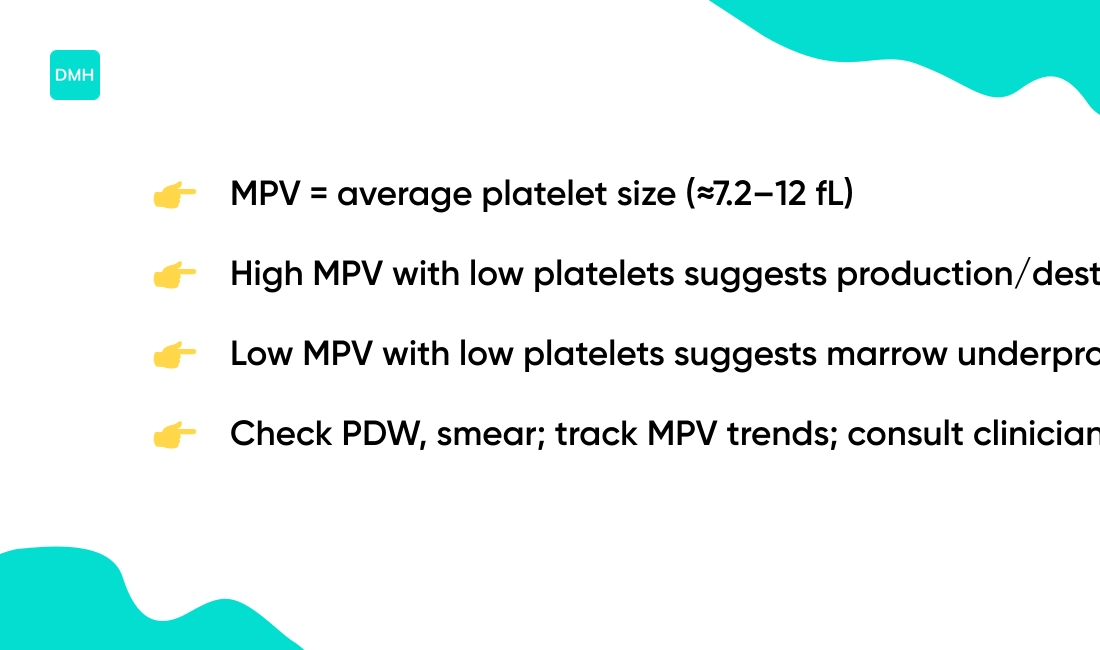
Mean platelet volume is the average platelet size measured in fL on your CBC. Labs list an MPV reference range near MPV normal range of 7.2–12 fL. Use the lab value printed on your report for accurate comparison.
- Check units and reference. MPV units fL must match the lab note.
- Compare MPV with platelet count. High MPV with low platelets suggests increased production or peripheral destruction. Low MPV with low platelets suggests low marrow production.
- Review platelet distribution width and a peripheral smear for size variation or giant platelets. These findings add context to MPV results.
If MPV reads above 11.5–12 fL, expect larger, younger platelets. If MPV reads below 7.5 fL, expect smaller, older platelets.
Combine MPV with symptoms such as bleeding or clotting and with other CBC values for a full picture. Pairing MPV, platelet count, and PDW gives the clearest interpretation.
Bring abnormal MPV results to your clinician and track MPV trends on repeat CBCs. That simple habit reveals patterns faster than a single test.
You might also like: Low Red Blood Cell Count: Causes, Symptoms And Treatment
Mean platelet volume measures average platelet size in fL. Larger platelets often signal higher platelet activity and increased clotting potential.
High MPV links to cardiovascular disease and inflammation. Small rises of 0.5–1 fL have correlated with higher heart attack and stroke risk in cohort studies. Plus, diabetes often shows elevated MPV alongside other metabolic markers.
Low MPV suggests reduced platelet production from bone marrow problems or chemotherapy. Combine MPV with platelet count to clarify risk for thrombocytopenia or thrombocytosis.
Platelet distribution width adds context. A high PDW plus high MPV strengthens the signal for active platelet turnover seen in immune thrombocytopenia and some infections.
Pregnancy often shifts MPV upward slightly. Infections drive MPV changes rapidly—bacterial sepsis can raise MPV while viral illnesses may lower it.
Can a single MPV reading really tell the whole story? Use MPV as a clinical risk indicator more than a single diagnostic tool. MPV works best as a clue you follow with other tests, not as a final answer.
Interpret MPV alongside CBC values, clinical exam, and inflammatory markers like CRP. A normal MPV (7.2–12 fL) with abnormal symptoms still needs evaluation.
MPV clinical significance depends on trend and context. Track MPV over time to spot meaningful changes and guide referrals to hematology when patterns suggest marrow disease or thrombotic risk.
Read also: Reticulocytes: Functions, Low, high, Normal Ranges, Diagnoses